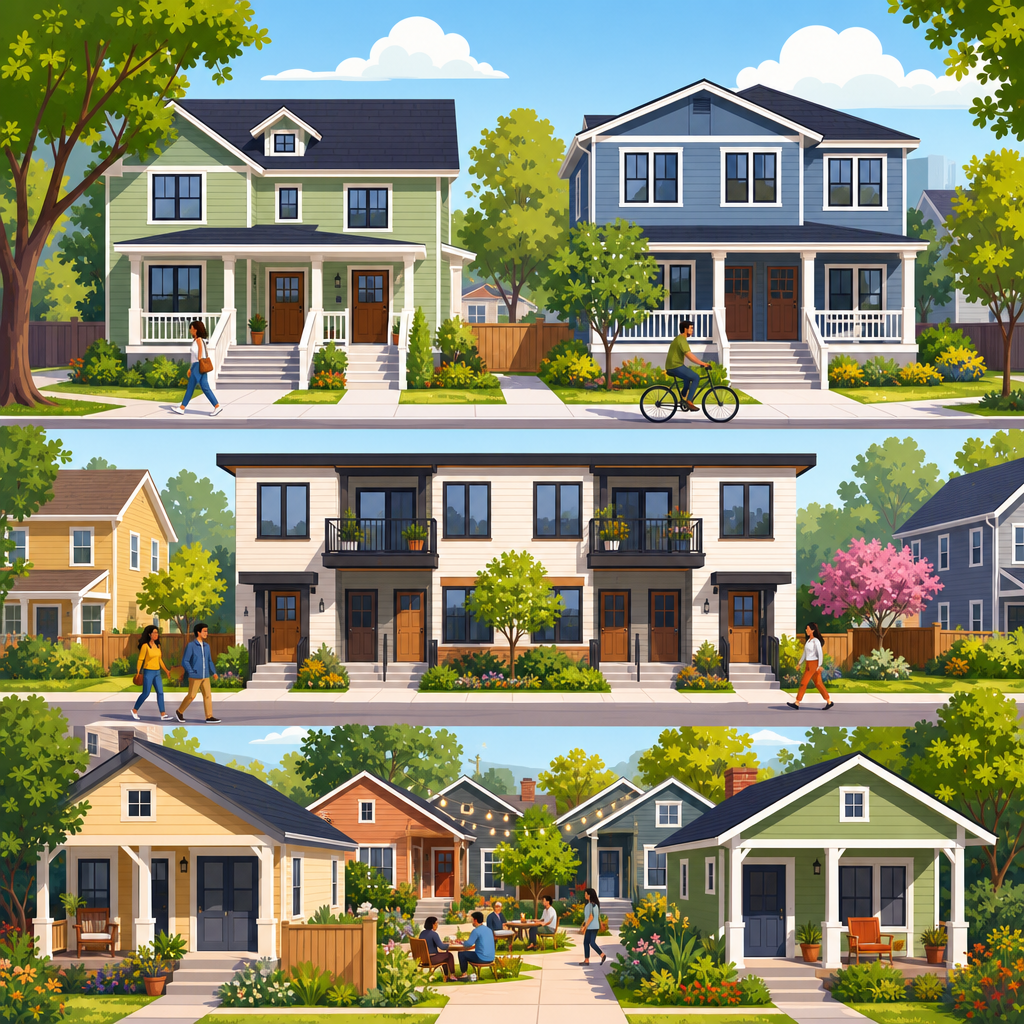
The architecture of missing middle housing sits between detached single-family homes and large apartment blocks, providing compact, walkable, neighborhood-scaled dwellings such as duplexes, fourplexes, and cottage courts. The term describes housing types that were common in North American towns before postwar zoning separated residential uses by lot size, parking supply, and density. In practice, missing middle housing means multiple homes on a small footprint, designed to feel compatible with nearby houses through careful massing, entries, porches, rooflines, and landscape edges.
This category matters because cities across the United States and Canada face simultaneous shortages of attainable housing, rising infrastructure costs, and growing pressure to reduce vehicle dependence and carbon emissions. In projects I have reviewed with planners, architects, and small infill developers, these building types repeatedly emerge as the most workable middle ground. They can add homes on serviced land without the cost profile of podium apartments, and they can support local retail, transit ridership, and school enrollment without overwhelming neighborhood scale.
Key terms are worth defining clearly. A duplex contains two homes in one building or on one lot, often side by side or stacked. A fourplex contains four homes, usually arranged around a shared stair or as paired units. A cottage court is a cluster of small detached or semi-detached homes oriented around a common garden, path, or courtyard. These are not luxury abstractions. They are practical forms with a long architectural history in places like Portland, Pasadena, Montreal, and older streetcar suburbs across the continent.
The architectural question is not simply how many units fit on a parcel. It is how to create density that feels livable, durable, and contextually appropriate. Good missing middle housing balances private space with shared space, daylight with compact footprints, and efficient construction with dignified street presence. Done well, it broadens housing choice for young households, downsizing seniors, and moderate-income renters or owners who want a neighborhood lifestyle without the cost or maintenance burden of a detached house. That is why duplexes, fourplexes, and cottage courts have become central to sustainable urban development policy and design.
Why Missing Middle Housing Works in Urban Neighborhoods
Missing middle housing works because it aligns physical form with everyday urban economics. A detached house on a large lot uses expensive land inefficiently, while a mid-rise apartment often requires elevators, double-loaded corridors, structured parking, and more complex fire and acoustic assemblies. Duplexes and fourplexes usually avoid those thresholds. They can be built with light wood framing, compact circulation, and simpler foundations, which lowers per-unit construction cost compared with larger multifamily buildings. Cottage courts distribute small homes around shared open space, increasing unit count while preserving a domestic scale.
From a planning perspective, these forms also fit established neighborhoods better than either suburban sprawl or abrupt high-rise redevelopment. Their heights commonly range from one to three stories, matching typical house districts. Their lot patterns can work on standard urban parcels, especially corner lots, deep lots, and former single-house sites near transit corridors. Because they increase households per acre without requiring major road expansion, they make better use of existing pipes, sidewalks, parks, and schools. That efficiency matters to municipal budgets as much as to housing supply.
There is also a social advantage. A fourplex over two and a half stories can house singles, couples, roommates, and small families in the same block where only one household might otherwise live. A cottage court can provide accessible single-level units for older residents who want to stay in their community. More residents within walking distance of neighborhood businesses can stabilize corner stores, cafés, and bus service. In real projects, I have seen the strongest public support when drawings show familiar materials, visible front doors, stoops, and landscaped setbacks rather than blank parking pads or oversized curb cuts.
Duplex Architecture: Compact Density With Familiar Form
The duplex is the simplest missing middle building type, but its architecture demands discipline. Side-by-side duplexes typically present as one volume with mirrored entries, allowing each unit to have windows on three sides and direct ground access. Stacked duplexes place one home above another, often with a shared vestibule or an exterior stair. The choice depends on lot width, accessibility goals, and the surrounding pattern of houses. Side-by-side plans usually work best on wider lots; stacked plans can preserve the appearance of a large house on narrower parcels.
Effective duplex design starts with massing. If the building reads as a single oversized box, neighbors often object. Breaking the volume with gabled forms, recessed entries, bay windows, porches, and varied cladding reduces apparent scale. Architects also pay close attention to privacy. Windows should avoid direct sightlines into adjacent yards, and outdoor space should be deliberately placed, not left over. Small rear patios, fenced side gardens, and usable front porches outperform token strips of lawn because they support actual daily use.
Inside, duplexes need efficient layouts. Repeating wet walls lowers plumbing cost. Open living areas can make compact footprints feel generous, but bedrooms still need acoustic separation. In attached side-by-side units, party wall assemblies should exceed minimum code where possible because sound transmission is a common complaint. The International Residential Code and local amendments often govern smaller duplex forms, though fire separation, egress, and energy code compliance vary by jurisdiction. When a duplex includes one ground-floor accessible unit, it can serve multigenerational households or aging residents without changing neighborhood character.
Fourplex Design: Small Multifamily Buildings With Big Impact
The fourplex is arguably the most powerful missing middle type because it creates meaningful density on lots that once held one house while remaining architecturally compatible with low-rise streets. A well-designed fourplex can resemble a large house, a mansion apartment, or a paired building composition. The best examples use one clear organizing idea: two units down and two up, stacked flats around a central stair; four corner units with cross-ventilation; or two duplex-style volumes linked by a shared entry element. Clarity in plan translates into efficiency in structure, code compliance, and construction sequencing.
Fourplex architecture turns on circulation and light. Internal corridors waste valuable area, so compact stairs and direct entries are preferred. Corner windows, shallow floor plates, and dual-aspect units improve daylight and natural ventilation, which is especially important in smaller apartments. The challenge is balancing private entries with facade coherence. Too many doors can create visual clutter; too few can make the building feel institutional. Architects often solve this through paired stoops, shared porches, or one central entry with high-quality detailing that signals each household has an identifiable front door.
Because fourplexes house more residents, parking, trash storage, bike storage, and mail delivery must be integrated early. Rear-lane access is ideal, but many neighborhoods lack alleys. In those cases, limiting curb cuts and prioritizing secure bicycle parking can preserve the streetscape. The economics are compelling. A fourplex can spread land cost across four households, often making each home more attainable than a detached house in the same area. That is why local reforms in cities such as Minneapolis, Portland, and Edmonton have focused on legalizing small multifamily forms on formerly single-dwelling lots.
Cottage Courts: Shared Open Space as the Organizing Principle
Cottage courts are distinct because landscape is not leftover space; it is the primary architectural element. Instead of one large building, a cottage court arranges several small homes around a common green, pedestrian path, or courtyard. This form has deep roots in early twentieth-century bungalow courts in California and small worker housing clusters elsewhere. Contemporary versions usually include homes between roughly 400 and 1,200 square feet, though local codes differ. The result is higher density than detached houses, but with front doors facing shared outdoor space rather than parking.
The success of a cottage court depends on proportional relationships. The common court must be large enough to function as an amenity, yet small enough to maintain spatial intimacy. Building placement should create “eyes on the court,” with windows and porches overlooking shared space for passive supervision and community interaction. Parking, if required, is best pushed to the perimeter or rear so cars do not dominate the social core. Path widths, lighting, seating, stormwater planting, and storage all matter because residents use these spaces daily, not occasionally.
Cottage courts are particularly effective for infill on deeper lots, corner parcels, and consolidated sites where a standard apartment block would feel out of scale. They can also support aging in place by including single-story units with no internal stairs. In my experience reviewing site plans, the most common mistake is underdesigning the shared landscape. A courtyard without shade, drainage strategy, or seating quickly becomes decorative rather than functional. When the open space is treated as outdoor living room, however, the court becomes the project’s social and environmental engine.
Key Architectural Decisions, Codes, and Performance Goals
Designing missing middle housing requires careful coordination between architecture, planning rules, and building performance. Lot coverage, floor area ratio, setbacks, height limits, and parking minimums can determine whether a project pencils out before drawings are advanced. Form-based codes often support these housing types better than conventional Euclidean zoning because they regulate envelope and frontage rather than only use categories. Architects also need early code analysis on occupancy classification, fire-resistance ratings, stair geometry, egress windows, accessibility obligations, and energy compliance. Small projects can fail financially when these issues appear late.
Sustainability is not automatic just because the buildings are smaller. The strongest projects pair compact form with high-performance envelopes, low embodied carbon materials where feasible, all-electric systems, and stormwater-conscious site design. Heat pumps, heat pump water heaters, continuous insulation, blower-door testing, and good solar orientation can materially reduce operating costs. Shared walls in duplexes and fourplexes cut heat loss compared with detached houses. Cottage courts can integrate rain gardens, permeable paving, and shade trees to lower runoff and heat island effect while improving resident comfort.
| Housing type | Typical height | Best-fit lot conditions | Primary design advantage | Main architectural challenge |
|---|---|---|---|---|
| Duplex | 1 to 2.5 stories | Narrow to medium urban lots | Simple construction and familiar street presence | Privacy, acoustics, and balanced facade composition |
| Fourplex | 2 to 3 stories | Standard city lots near transit or services | Strong land efficiency without mid-rise complexity | Circulation, daylight, and service integration |
| Cottage court | 1 to 2 stories | Deep lots, corner lots, assembled parcels | High amenity through shared open space | Making the courtyard functional and parking unobtrusive |
Material selection should reinforce longevity. Fiber-cement siding, brick, durable roofing, and high-quality windows can reduce life-cycle costs, but budget must be allocated strategically. Overbuilding decorative features while cutting waterproofing or acoustic assemblies is a false economy. Universal design features such as no-step entries, wider doors, blocking for future grab bars, and adaptable bathrooms can extend the usefulness of units over time. For developers and municipalities alike, the best metric is not just units delivered, but housing that remains serviceable, efficient, and loved for decades.
Development, Policy, and Neighborhood Acceptance
Architecture alone cannot deliver missing middle housing if policy and financing remain misaligned. Many jurisdictions still carry minimum lot sizes, setback rules, parking requirements, and owner-occupancy conditions that effectively ban duplexes, fourplexes, or cottage courts even when the use is nominally allowed. Reform efforts that work typically pair legalization with clear design standards, permit streamlining, and preapproved plan sets. Pattern books can help small builders and homeowners understand what a code-compliant project looks like, reducing uncertainty and opposition during entitlement.
Financing is another bottleneck. Large lenders often understand either single-family homes or bigger apartment deals, not small infill multifamily. That leaves local banks, credit unions, mission lenders, or private capital to fill the gap. Construction cost volatility, utility upgrade fees, and carrying costs can erase feasibility on otherwise sensible sites. Public incentives such as fee waivers, low-interest predevelopment loans, tax abatements, or reduced parking requirements can materially affect whether these projects move forward. The policy lesson is simple: legalization is necessary, but not sufficient.
Neighborhood acceptance improves when people can see the architecture as an evolution of familiar forms, not a rupture. Good engagement uses measured drawings, shadow studies, and precedents from beloved local streets. Residents usually ask direct questions: Will parking spill over? Will trees be removed? Will privacy be lost? Will the building look like an apartment block? The most credible answers come from specifics: retained mature trees, limited curb cuts, window placement strategies, and setbacks shaped around neighboring yards. If cities want more homes in established neighborhoods, the design review conversation has to stay grounded in form, function, and shared benefit.
Missing middle housing offers a practical architectural path toward more inclusive, resilient, and climate-conscious neighborhoods. Duplexes provide a gentle increase in density with familiar form and straightforward construction. Fourplexes deliver stronger land efficiency and meaningful housing supply while remaining compatible with low-rise streets. Cottage courts add homes through shared landscape, creating community-oriented living environments that many conventional subdivisions and apartment blocks fail to match. Across all three types, the core principle is the same: compact housing can feel generous when massing, entries, daylight, privacy, and outdoor space are designed with care.
For sustainable urban development, the benefit is cumulative. These buildings use serviced land more efficiently, support walkability and transit, and expand housing choice for households at different life stages. They also diversify neighborhood fabric, making room for renters, first-time buyers, older adults, and multigenerational families in places that might otherwise become economically exclusive. The architectural details matter because public trust depends on lived outcomes, not abstract unit counts. Durable materials, code-aware planning, strong acoustic performance, and well-designed common spaces are what turn policy goals into successful homes.
If you are shaping housing policy, designing infill projects, or evaluating redevelopment in established neighborhoods, start with these forms. Study local precedents, audit code barriers, and compare lots where a duplex, fourplex, or cottage court could succeed today. Missing middle housing is not a niche idea. It is one of the clearest ways to add homes gracefully, strengthen neighborhoods, and build a more sustainable urban future.
Frequently Asked Questions
What is missing middle housing, and why is it important in architectural design?
Missing middle housing refers to a range of small-scale, multi-unit residential building types that fall between detached single-family homes and large apartment buildings. Common examples include duplexes, triplexes, fourplexes, cottage courts, bungalow courts, townhomes, and small courtyard apartments. Architecturally, these buildings are significant because they deliver more homes within a neighborhood-scaled form, allowing increased density without the visual or spatial impact of mid-rise or high-rise development. In many historic North American neighborhoods, these housing types were once a normal part of the urban fabric, offering practical, compact living arrangements close to schools, shops, transit, and jobs.
From a design perspective, missing middle housing is important because it emphasizes compatibility, walkability, and efficient land use. Rather than relying on very large lots or large apartment blocks, it organizes multiple dwellings on a relatively modest footprint through thoughtful massing, shared outdoor space, smaller unit sizes, and carefully scaled entries. The architecture often uses familiar residential forms such as pitched roofs, porches, stoops, divided facades, and landscaped setbacks to help denser housing feel comfortable within existing neighborhoods. This makes missing middle housing a powerful architectural strategy for addressing housing shortages, supporting local businesses, reducing car dependence, and creating communities that are both livable and economically resilient.
How do duplexes, fourplexes, and cottage courts differ architecturally?
Although they all belong to the missing middle category, duplexes, fourplexes, and cottage courts each solve housing needs in a distinct architectural way. A duplex typically places two homes within one building or on one lot, either side by side or stacked one above the other. Its architecture often resembles a larger house, especially when the facade is symmetrical or the entrances are subtly integrated. Because of this, duplexes can blend easily into neighborhoods dominated by detached homes while still doubling the number of households on the site.
A fourplex increases that intensity by fitting four separate dwellings into one building or a closely organized structure. Architecturally, a fourplex requires more attention to circulation, privacy, window placement, and facade composition so the building does not appear bulky or institutional. Well-designed fourplexes often break up massing with porches, bay projections, roof articulation, and individual entry cues. This helps preserve a residential character while creating efficient, compact housing that works especially well on corner lots, transit corridors, and small infill sites.
Cottage courts differ from both by organizing several small detached or semi-detached homes around a shared open space, such as a central garden or courtyard. The defining architectural feature is not a single building mass but a site plan that promotes community and human-scaled outdoor living. Each cottage may be modest in size, but the collective arrangement creates a strong sense of place and shared identity. Cottage courts often prioritize pedestrian paths, front porches, and common green space over driveways and parking dominance, making them especially effective for creating intimate, walkable residential environments.
How can missing middle housing fit into existing neighborhoods without feeling out of scale?
One of the central ideas behind missing middle housing is that density can be added through design rather than through dramatically larger buildings. Architectural compatibility usually begins with scale and proportion. Designers often use heights similar to nearby houses, break larger programs into smaller visible volumes, and rely on rooflines, setbacks, and facade rhythms that reflect the surrounding neighborhood. A duplex or fourplex may contain multiple units, but if its massing is carefully composed, it can still read as a house-sized building rather than a mini apartment block.
Details also matter. Separate front doors, porches, stoops, windows that align with neighboring buildings, and durable residential materials such as wood siding, brick, or fiber cement can make these homes feel familiar and welcoming. Landscape design plays a major role as well, especially in softening edges, defining private and shared outdoor space, and reinforcing a pedestrian-friendly streetscape. In many successful projects, parking is minimized, placed to the rear, or visually screened so that the architecture and public realm remain the focus. When these elements are handled thoughtfully, missing middle housing can enhance a neighborhood’s character rather than disrupt it, adding more residents while preserving the sense of scale that people value.
What are the main design benefits of missing middle housing for residents?
For residents, the architectural benefits of missing middle housing go well beyond simply having more housing options. These building types often provide a balance between privacy and community that is difficult to achieve in either detached houses or large apartment complexes. A duplex or fourplex may offer a private entrance, more natural light from multiple sides, and a stronger connection to the street than a typical apartment corridor building. Cottage courts, meanwhile, create opportunities for informal social interaction through shared gardens, pathways, and open spaces that encourage neighbors to know one another.
Missing middle housing can also support a wider range of household needs. Smaller units may be suitable for first-time buyers, renters, older adults looking to downsize, or multigenerational families who want proximity without sharing a single home. Architecturally, these homes often emphasize efficient layouts, usable outdoor areas, and access to neighborhood amenities within walking distance. Because the buildings are compact and land is shared more efficiently, they can sometimes offer a more attainable price point than detached homes in the same area. In this way, the design of missing middle housing contributes not only to neighborhood form, but also to everyday comfort, social connection, and long-term housing choice.
Why did missing middle housing become less common, and why is it returning now?
Missing middle housing became less common largely because of postwar land use policies and development patterns that separated housing by type, lot size, and density. In many cities and towns, zoning rules began favoring detached single-family homes on larger lots while placing strict limits on multi-unit buildings in residential neighborhoods. Minimum parking requirements, setback rules, density caps, and approval processes made it difficult or financially impractical to build small-scale multi-unit housing, even when these forms had historically existed in the same communities. As a result, the housing market increasingly produced either single-family homes or larger apartment developments, leaving a gap in between.
Its return is being driven by both necessity and design opportunity. Communities are facing rising housing costs, limited land supply, climate concerns, and growing interest in walkable neighborhoods with a broader range of housing choices. Architects, planners, and local governments are revisiting duplexes, fourplexes, and cottage courts because they offer a practical way to add homes incrementally without requiring major changes in neighborhood character. Advances in infill design, updated zoning reforms, and renewed appreciation for traditional neighborhood patterns have all helped make these housing types more viable again. Today, missing middle housing is returning not as a new invention, but as a rediscovery of time-tested architectural forms that can support more inclusive, adaptable, and sustainable communities.