Tactical urbanism that leads to permanent public realm improvements is the disciplined practice of using low-cost, quick-build street and space interventions to test ideas before cities commit to capital construction. In transportation and placemaking work, I have seen temporary curb extensions, painted plazas, flex-post bike lanes, parklets, and weekend street closures reveal how people actually move, linger, and spend money. Tactical urbanism matters because conventional capital projects often take years of design, procurement, and political negotiation, while communities need safer crossings, cooler public spaces, and more accessible streets now. The public realm includes streets, sidewalks, squares, parks, transit stops, and the edges where private buildings meet shared civic space. Permanent improvement means the temporary pilot does not remain a novelty; it generates evidence, public support, operational learning, and design refinements that justify durable materials, updated regulations, and recurring maintenance funding.
The most successful tactical urbanism projects are not random acts of paint. They are structured demonstrations tied to measurable outcomes such as lower vehicle speeds, shorter crossing distances, higher pedestrian volumes, stronger retail performance, improved bus reliability, or better perceived safety after dark. Good projects define the problem first: a dangerous slip lane near a school, an oversized intersection that wastes public land, a downtown block dominated by through traffic, or a commercial street with no room for outdoor seating. They also identify the implementation pathway from pilot to permanence. That usually includes agency sponsorship, traffic control approval, accessibility review, liability coverage, baseline data, and a budget line for evaluation. When cities skip those steps, temporary installations often fail politically even when the idea is sound. When they prepare carefully, temporary action becomes a practical decision tool that helps sustainable urban development move faster and with less risk.
What Tactical Urbanism Includes and Why It Works
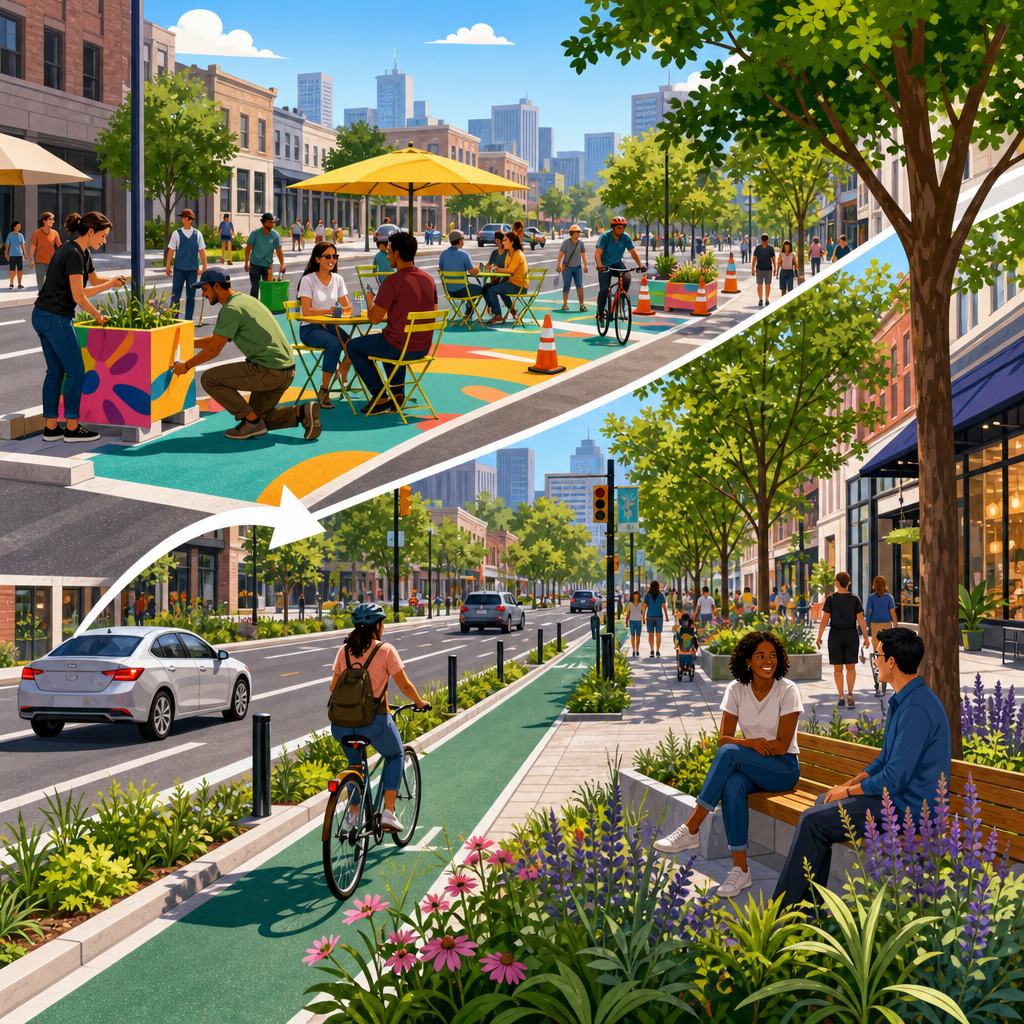
Tactical urbanism includes interventions that are temporary in material but strategic in intent. Common examples are paint-and-post curb extensions, pop-up protected bike lanes, modular bus boarding islands, daylighting corners with planters, converting parking spaces into parklets, testing school streets, and creating interim public plazas with movable seating. The reason these projects work is simple: they reduce the gap between concept and lived experience. A rendering can suggest that a plaza will feel welcoming; a weekend pilot shows whether people sit there, whether delivery access still functions, and whether emergency vehicles can turn. In my experience, skeptical stakeholders often change their position only after they can walk through the space and observe the results themselves.
Temporary pilots also improve design quality. Engineers can observe turning paths, queuing patterns, and drainage behavior. Operations staff can test sweeping routes, trash collection access, and snow clearance implications. Accessibility advocates can identify issues with detectable warnings, route continuity, seating placement, and crossing alignment. Business owners can comment on loading, visibility, and customer circulation. This feedback is far more useful when gathered in a real installation than in a public meeting centered on abstract plans. As a result, permanent public realm improvements emerging from tactical urbanism are often better calibrated to actual use, not just standards on paper.
There is also a fiscal advantage. Permanent reconstruction with concrete, granite, utility relocation, and signal work is expensive. A city can use a modest pilot budget to test whether a plaza should be 4,000 or 6,000 square feet, whether a protected lane should sit at curb level or parking-protected, or whether a bus stop performs better farside or nearside of an intersection. This sequencing reduces the chance of building the wrong thing permanently. It also creates a stronger capital case because decision-makers can point to measured outcomes rather than promises. That shift from speculative benefit to observed benefit is often what unlocks funding.
Designing Pilots That Can Become Permanent
Not every temporary intervention deserves permanence. The ones that do share several traits. First, they solve a clearly documented problem using a testable hypothesis. For example, if a corridor has high turning speeds and frequent pedestrian conflicts, a pilot curb extension should aim to tighten geometry and shorten crossings. Second, the project uses materials appropriate for a safe trial: epoxy paint, modular curbs, bollards, planters, temporary ramps, barriers, and movable furniture selected to stay legible in weather and at night. Third, the layout is grounded in accepted guidance such as the NACTO Urban Street Design Guide, MUTCD requirements for traffic control devices, ADA accessibility obligations, and local fire and sanitation clearances.
Fourth, the pilot has an evaluation plan before installation. This should include baseline and post-installation counts, speed studies, conflict observations, merchant feedback, transit travel times where relevant, and user surveys in multiple languages. Fifth, the city establishes criteria for scaling up, modifying, or removing the project. This prevents tactical urbanism from becoming endless provisionalism. Residents deserve clarity: if pedestrian injuries drop, footfall rises, and operations remain manageable, the city will pursue capital design. If accessibility or loading problems emerge, the design will be revised. If the concept fails, it will be removed and lessons documented. That transparency builds trust and reduces the perception that pilots are a way to bypass accountability.
One practical rule I use is to design the pilot as the first phase of the permanent project, not as separate theater. If the long-term concept is a raised crossing, the temporary version should still establish the future crossing location, desire lines, curb radii, and waiting areas. If the long-term goal is a plaza, the pilot should already test edge conditions, programming, furniture placement, and service access. This continuity makes the transition from temporary materials to capital construction smoother and preserves the public understanding of what is being tested.
From Quick Build to Capital Project: The Conversion Path
The conversion path from tactical urbanism to permanent public realm improvements usually follows a repeatable sequence. First comes problem identification using crash data, heat mapping, curb-use analysis, travel behavior, and community input. Second is pilot design and permitting. Third is installation and active management, often with on-site adjustments in the first days. Fourth is evaluation against predefined metrics. Fifth is formal adoption into agency plans, capital programs, zoning updates, or streetscape standards. Sixth is detailed design, procurement, and construction with durable materials. Cities that institutionalize this sequence deliver better outcomes than cities treating every pilot as a one-off event.
| Stage | Main Actions | Evidence Collected | Decision Output |
|---|---|---|---|
| Diagnosis | Crash review, speed data, curb inventory, interviews | Baseline safety and use patterns | Target problem statement |
| Pilot Design | Layout, approvals, accessibility checks, materials selection | Feasibility and risk review | Install-ready quick-build plan |
| Pilot Operation | Install, monitor, adjust geometry, manage maintenance | Observed behavior, complaints, operations issues | Refined concept |
| Evaluation | Counts, surveys, speed studies, business feedback | Before-and-after performance | Go, revise, or remove decision |
| Permanent Delivery | Capital design, funding, procurement, construction | Cost estimates and final technical drawings | Durable public realm improvement |
New York City’s pedestrian plazas illustrate this pathway well. Early plaza conversions used temporary materials, paint, and movable furniture to reclaim excess roadway. Times Square’s initial pilot in 2009 allowed the city to observe traffic redistribution, pedestrian dwell time, and business response before permanent reconstruction. Measured findings showed pedestrian injuries fell and travel times on some avenues improved due to simpler traffic patterns. The permanent build-out followed because the pilot created operational proof and public familiarity. Similar logic has shaped projects in San Francisco, Paris, Barcelona, Bogotá, and many smaller cities where quick-build treatments prepared the ground for lasting change.
What often gets overlooked is the administrative work required after a successful pilot. Permanent conversion may require council approval, updated curb regulations, revised maintenance agreements, utility coordination, and capital budgeting across several fiscal years. Strong project teams prepare for that early. They identify who will own the asset, who will maintain planters or drainage inlets, how snow removal will occur, and whether adjacent businesses or a business improvement district will program the space. Permanent public realm improvements fail less often when governance is designed as carefully as geometry.
Measuring Success: Safety, Access, Climate, and Economic Performance
The strongest case for making tactical urbanism permanent comes from rigorous measurement. Safety metrics are the first priority: vehicle speeds, turning behavior, yielding rates, crossing distances, and crash patterns. On commercial streets, I also watch pedestrian counts, cyclist volumes, dwell time, vacancy rates, and merchant sentiment. For transit streets, bus travel time and stop accessibility matter. For public squares and plazas, seating occupancy, gender balance of users, shade use, and evening activity reveal whether the space works for more than one group. A pilot should produce a clear answer to the question, “What improved, for whom, and by how much?”
Climate and public health outcomes increasingly matter as well. Temporary tree beds, seating under shade structures, reflective surface treatments, and reduced traffic exposure can improve thermal comfort and air quality at street level. While small pilots alone will not solve urban heat or emissions, they can show where street space should be reallocated to walking, cycling, and transit in a permanent redesign. During summer evaluations, I have seen shaded seating areas remain occupied while nearby unshaded asphalt stays empty, which is obvious once observed but powerful when documented. That kind of direct evidence helps justify capital investment in canopy, permeable surfaces, and stormwater elements.
Economic concerns deserve a balanced reading. Some merchants fear losing curbside parking, yet many pilots show increased foot traffic and longer dwell times when sidewalks widen or plazas add seating. The outcome depends on context. A destination retail street with heavy footfall may benefit quickly, while an auto-oriented strip may need loading adjustments and better wayfinding before gains appear. The right approach is not to promise universal uplift. It is to measure transaction patterns where possible, document occupancy and turnover in nearby parking, and compare retail performance with broader district trends. Credible evidence persuades better than slogans.
Common Failure Points and How Cities Avoid Them
Most failed tactical urbanism projects fail for ordinary reasons, not because the concept of temporary testing is flawed. One common problem is weak maintenance. Faded paint, damaged delineators, dead plants, or overflowing trash signal neglect and rapidly erode public confidence. Another problem is poor accessibility. If temporary ramps are too steep, walking routes are cluttered, or wayfinding is unclear for blind and low-vision users, the project may create new barriers. A third issue is ambiguous traffic operations. Drivers need legible geometry, visible edge lines, and consistent signal phasing; otherwise confusion overwhelms the intended benefit.
Political framing also matters. When agencies present a pilot as already decided, opponents treat it as procedural overreach. When they present it as a reversible test with clear metrics, debate becomes more practical. I have also seen projects stumble because cities under-engage freight carriers, schools, emergency services, or sanitation crews. These groups experience the street differently from occasional visitors, and their operational insights can make or break a permanent design. Early coordination does not mean giving every stakeholder veto power. It means surfacing constraints while there is still time to adapt the pilot.
Finally, cities must resist the temptation to leave successful pilots temporary for too long. Quick-build materials are useful, but they are not an end state. If a project demonstrably improves safety and public use, agencies should advance durable paving, drainage, lighting, trees, and seating. Permanence communicates that the city values the space and the people using it. It also lowers long-term maintenance costs compared with repeatedly patching temporary materials. Tactical urbanism succeeds when it shortens the path to quality, not when it normalizes makeshift public infrastructure.
Tactical urbanism works best when cities treat temporary change as a serious public delivery method rather than a weekend experiment. The core lesson is straightforward: start with a documented problem, test a focused solution in the real world, measure what changes, and convert successful pilots into durable public realm improvements with funding, standards, and maintenance in place. That process reduces risk, improves design quality, and builds public confidence because residents can experience the proposal before construction becomes irreversible. It also aligns with sustainable urban development by reallocating street space toward walking, cycling, transit, shade, safety, and social life without waiting years for every answer.
For practitioners, the benefit is practical clarity. A painted curb extension can reveal whether concrete is warranted. A temporary plaza can show how much seating, loading access, and programming a block truly needs. A school street pilot can prove that calmer traffic and cleaner air are achievable with manageable operations. The permanent projects that follow are usually stronger because they are informed by observation, not assumption. If you are planning improvements in any downtown, neighborhood main street, or transit corridor, build the pilot around measurable outcomes and a clear conversion path. Then use the evidence to deliver public spaces that last.
Frequently Asked Questions
What is tactical urbanism, and how does it lead to permanent public realm improvements?
Tactical urbanism is the practice of using low-cost, fast-to-install interventions to test changes in streets, sidewalks, plazas, and other shared public spaces before committing to expensive permanent construction. Instead of debating a concept in the abstract for years, cities, business districts, nonprofits, and community groups can put a real version of the idea on the ground and observe how it performs. Common examples include temporary curb extensions, painted plazas, protected bike lanes created with flex-posts, parklets, interim pedestrian zones, pop-up transit boarding areas, and weekend street closures.
What makes tactical urbanism so valuable is that it turns planning into a live experiment. It allows practitioners to study how people actually move, gather, cross streets, access storefronts, ride bikes, wait for transit, and use public space under real conditions. That evidence can then shape a permanent capital project with greater confidence. A temporary curb extension, for example, can demonstrate that shortening crossing distances improves pedestrian comfort and visibility without creating unacceptable traffic impacts. A painted plaza can reveal whether underused asphalt can become a successful civic space. A pilot bike lane can show whether more people will cycle once they feel protected from moving vehicles.
The path from temporary to permanent usually depends on documentation and performance. If the pilot improves safety, supports local businesses, increases foot traffic, reduces conflicts, or creates a stronger sense of place, decision-makers have a stronger case for investing in permanent materials such as concrete, stone, lighting, trees, drainage upgrades, and custom furnishings. In that sense, tactical urbanism is not a substitute for permanent design. It is a disciplined way to reduce uncertainty, build public support, refine design details, and make permanent public realm improvements more effective.
Why do cities use temporary street and public space interventions instead of going straight to permanent construction?
Cities use temporary interventions because permanent public realm projects are expensive, time-consuming, and often difficult to adjust once built. Traditional capital projects can require years of planning, engineering, environmental review, budgeting, procurement, and construction. During that time, assumptions about how a place works may go untested. Tactical urbanism offers a practical middle step: test the idea first, learn from real-world use, and then invest in a permanent solution that is better informed.
This approach is especially useful when there is uncertainty about traffic operations, curb management, emergency access, transit operations, delivery activity, parking demand, or public acceptance. A quick-build pilot can answer questions that models and public meetings alone cannot fully resolve. For instance, a temporary protected bike lane can help determine whether lane widths are workable, whether turning movements need adjustment, and whether ridership increases when the facility feels safer. A weekend plaza can show whether a street segment has the potential to function as a civic destination rather than just a vehicle corridor.
Temporary projects also lower political and financial risk. If a pilot performs poorly, it can be modified or removed much more easily than a fully built project. If it performs well, the city gains credible evidence to justify permanent investment. That evidence often helps win support from elected officials, transportation agencies, adjacent property owners, and community stakeholders. In many cases, tactical urbanism accelerates progress because it reframes the conversation from “Should we ever try this?” to “Now that we have seen it work, how should we build it permanently?”
What kinds of tactical urbanism projects are most likely to become permanent public realm upgrades?
The tactical urbanism projects most likely to become permanent are the ones that solve a clear public problem, are easy for people to understand, and produce measurable benefits. Safety-focused interventions tend to be strong candidates, especially temporary curb extensions, daylighting treatments near intersections, refuge islands, school street pilots, quick-build bike lanes, and pedestrianized segments in areas with heavy foot traffic. These projects often generate visible and immediate improvements in comfort, crossing behavior, and conflict reduction, which makes the case for permanence easier to communicate.
Projects that unlock underused public space also have strong potential. Painted plazas, parklets, open streets, pop-up seating areas, and converted slip lanes often reveal that asphalt can do more for a neighborhood than simply storing or moving cars. When people begin using these spaces to sit, meet, dine, play, or attend events, the public value becomes tangible. Business owners may notice stronger foot traffic and longer dwell times. Residents may begin to see the space as part of neighborhood identity. Those shifts in behavior and perception are often what propel a temporary intervention into a permanent redesign.
That said, permanence is rarely determined by popularity alone. The most durable projects usually combine community support with solid operations, maintainability, and design feasibility. A successful pilot should demonstrate that access needs are workable, maintenance responsibilities are understood, and the concept can be translated into durable materials and code-compliant geometry. In practice, the strongest candidates are not just visually appealing temporary installations. They are pilots that prove a long-term public realm function and provide a roadmap for capital implementation.
How do planners and designers measure whether a tactical urbanism project is successful enough to justify permanent investment?
Successful tactical urbanism projects are evaluated using both quantitative data and qualitative observation. On the quantitative side, practitioners often look at pedestrian volumes, bicycle counts, vehicle speeds, turning movements, transit travel times, crash patterns, near-miss observations, retail sales indicators, occupancy of public seating, and duration of stay. These metrics help answer whether the intervention improved safety, access, economic activity, and public space performance. For example, if a temporary plaza attracts consistent use across different times of day, or if a quick-build bike lane increases ridership while reducing conflicts, that is meaningful evidence for a permanent upgrade.
Qualitative evaluation is just as important. Observing how people behave in the space can reveal whether the design is intuitive and comfortable. Do pedestrians naturally gather there? Do families use it? Do older adults feel comfortable crossing? Are delivery drivers able to adapt? Do businesses engage with the new public space? Are there recurring confusion points that need redesign? Community feedback, stakeholder interviews, intercept surveys, and staff observations all help interpret what the numbers alone may miss. A technically functional pilot can still fail if it feels unsafe, poorly maintained, or disconnected from local needs.
The strongest evaluation processes compare before-and-after conditions and set clear goals in advance. Rather than simply asking whether people liked the project, cities should define what success looks like: reduced crossing distances, slower turning speeds, more public seating use, improved ADA access, stronger retail activity, or better transit boarding conditions. When those goals are tied to documented outcomes, the transition to permanent construction becomes much easier to justify. Good pilots do not just create buzz. They generate actionable evidence that sharpens design decisions and supports long-term public investment.
What are the biggest challenges in turning tactical urbanism into a permanent public realm project?
The biggest challenge is moving from temporary enthusiasm to institutional follow-through. Many tactical projects succeed as demonstrations but stall before permanent construction because the next steps require funding, agency coordination, engineering development, approvals, and maintenance planning. A painted curb extension can go in quickly, but a permanent curb extension may need utility review, drainage redesign, accessible curb ramps, signal adjustments, and capital budgeting. That transition demands a different level of process and commitment than the pilot itself.
Another common challenge is stakeholder alignment. Temporary projects often expose competing priorities around parking, loading, emergency access, sanitation, transit operations, and street management. Even when the public responds positively, agencies and adjacent users may still disagree on how the permanent design should work. The pilot phase can help surface these issues early, but it does not automatically resolve them. Strong implementation depends on documenting tradeoffs clearly, refining the design based on observed conditions, and showing how the permanent project will address operational concerns without losing the public benefits demonstrated by the pilot.
Maintenance and design quality also matter. Temporary materials can tolerate a rougher aesthetic because they are understood to be interim. Permanent public realm improvements need to perform over time, fit the surrounding context, and withstand weather, wear, and ongoing use. That means selecting durable materials, planning for upkeep, and ensuring that the final project is not just safer or more efficient, but genuinely comfortable and attractive. The most successful transitions happen when cities treat tactical urbanism as a serious design and evidence-gathering process rather than a one-off activation. When the pilot is documented well, tied to clear public goals, and backed by a path to capital delivery, temporary action can become a lasting improvement to the public realm.