Sustainable parcel-scale design gives small developers and homeowners a practical way to cut operating costs, improve resilience, and create healthier places on a single lot. At this scale, “parcel” means one legally defined property, whether it holds a detached house, a duplex, a small apartment building, or a mixed-use infill project. “Sustainable design” means shaping that property to reduce energy use, manage stormwater, support biodiversity, limit material waste, and improve comfort over decades rather than only minimizing upfront cost. I have worked with infill sites where one grading decision changed drainage outcomes for years, and with homeowners whose utility bills dropped because orientation, shading, and air sealing were addressed before finishes were chosen. That is why parcel-scale decisions matter: they are small enough to control directly and significant enough to affect monthly expenses, maintenance burden, regulatory approval, and neighborhood performance. For readers exploring sustainable urban development, this article serves as the hub for the parcel-level strategies that connect planning goals to construction reality. It explains what to prioritize first, how systems interact, and where tradeoffs usually appear.
Why is this topic important now? Local codes are tightening around stormwater retention, energy performance, tree preservation, electrification, and wildfire or flood risk. Insurance premiums are rising in hazard-prone areas. Water rates are increasing in many cities, and extreme heat is stressing buildings that were never designed for today’s temperatures. At the same time, small developers and owner-builders face thin margins, expensive debt, and limited time. Sustainable parcel-scale design is the discipline of making each square meter of land work harder without overcomplicating the project. Good parcel planning can lower peak runoff, reduce cooling loads, preserve mature trees, improve daylight, and make future additions easier. Poor planning locks in avoidable problems, such as west-facing glass without shading, low points that collect water near foundations, oversized paving that intensifies heat, or mechanical systems fighting a weak building envelope. The strongest projects treat the parcel as an integrated system of sun, wind, soil, water, structures, and occupants.
Start with site analysis and climate-responsive layout
The first step in sustainable parcel-scale design is a disciplined site analysis. Before selecting cladding or solar panels, map sun angles, prevailing winds, existing vegetation, utility connections, topography, setbacks, neighboring building heights, and drainage paths. On many small lots, orientation and massing drive long-term performance more than any premium product later added. In hot climates, reducing east and west solar exposure and creating shaded outdoor areas can noticeably lower cooling demand. In cool climates, south-facing glazing with proper overhangs can improve winter gains while limiting summer overheating. On constrained urban parcels, even a narrow side yard can become a ventilation corridor if openings are aligned thoughtfully. I have seen compact multifamily projects gain meaningful comfort simply by relocating stair cores and shifting window placement to allow cross-ventilation.
Layout also determines whether a site remains permeable, usable, and adaptable. A driveway that consumes half the front yard usually increases runoff and surface temperature while reducing planting space. A building placed too low on the site can require constant pumping or complicated drains. Preserving healthy mature trees often provides more cooling value than replacing them with small new plantings after construction. Root protection zones, soil compaction limits, and equipment access routes should be established early, not during excavation. If the parcel has poor soil infiltration, that does not eliminate sustainable strategies; it simply changes the design response toward lined bioretention, detention storage, or controlled discharge. The key is to let site conditions guide the layout instead of forcing a generic plan onto every property.
Design the envelope before the equipment
Small developers often jump quickly to high-efficiency equipment, but the durable savings usually come from the building envelope first. A well-designed envelope controls heat flow, air leakage, and moisture movement. That means continuous insulation where practical, careful air barrier detailing, high-performance windows matched to orientation, and assemblies that can dry safely. Standards from the International Energy Conservation Code, Passive House principles, and ASHRAE guidance all reinforce the same lesson: mechanical systems perform better when loads are reduced at the source. For a homeowner, this may mean prioritizing attic air sealing, roof insulation, window shading, and duct sealing before replacing a furnace with a larger, more expensive unit. For a small infill project, it may mean simplifying the building form to reduce thermal bridges and envelope complexity.
Moisture control deserves special attention because many sustainability failures are really durability failures. Tighter buildings without a coherent ventilation strategy can trap humidity. Reservoir claddings, poorly flashed openings, and inward vapor drives can create hidden damage that erases any efficiency gain. In mixed-humid climates, I usually advise clients to treat water management layers, drainage gaps, and flashing details as non-negotiable line items. Better insulation does not excuse weak rain control. Likewise, better windows do not fix uncontrolled air leakage around penetrations. The most cost-effective envelope is rarely the one with the highest marketed R-value; it is the one that is buildable, inspected, and likely to perform as designed for thirty years.
Manage stormwater as a design asset
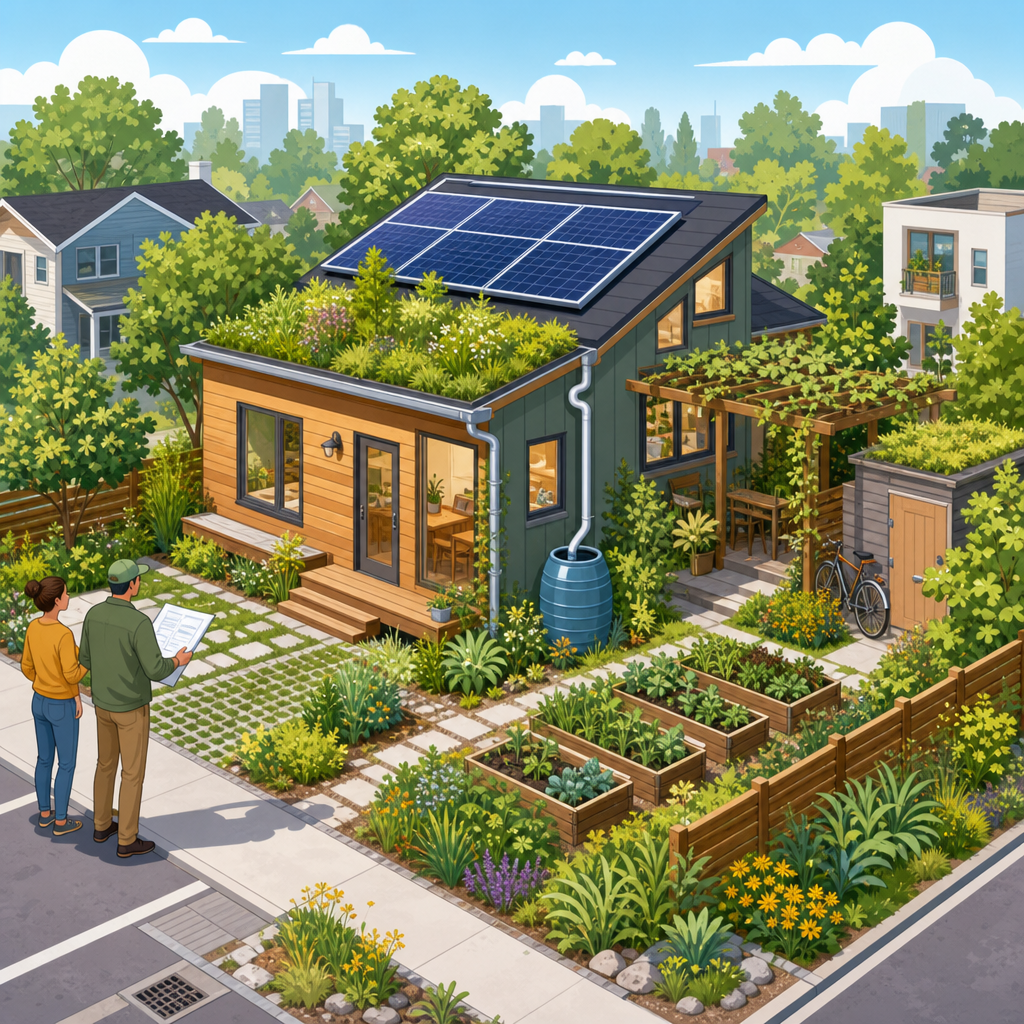
Stormwater management is one of the clearest parcel-scale opportunities because it can be addressed on almost any lot. The goal is simple: slow, spread, infiltrate, store, and reuse water where feasible. Conventional development moves rain off site as quickly as possible through hard surfaces and pipes. Sustainable parcel-scale design does the opposite by reducing impervious cover, directing runoff into planted areas, and providing temporary storage. On a single-family lot, this may include rain gardens, permeable paving, downspout disconnection, cisterns, and contouring that keeps water away from the foundation while allowing infiltration elsewhere. On a small multifamily site, it may involve underground detention, bioswales, blue-green roofs, or modular tank systems if land is limited.
Municipal requirements vary, but many cities now regulate the first flush of runoff because it carries sediment, metals, nutrients, and hydrocarbons. Capturing the first inch of rainfall on site can materially reduce downstream impacts. Design must still respect soil type, groundwater depth, slope stability, and maintenance reality. Permeable pavers clogged with sediment will underperform. A rain garden placed where roof runoff ponds against a basement wall is a mistake, not a green feature. The best systems are simple enough for the owner to inspect and maintain: cleanouts that are accessible, overflow routes that are obvious, and plant palettes that tolerate wet and dry cycles. When stormwater infrastructure is visible and integrated into the landscape, owners understand it and care for it better.
| Parcel strategy | Primary benefit | Best use case | Main caution |
|---|---|---|---|
| Rain garden | Infiltrates and filters roof or pavement runoff | Yards with moderate space and suitable setbacks | Needs overflow planning and soil compatibility |
| Permeable paving | Reduces runoff from driveways and paths | Low-speed surfaces on sites with manageable sediment loads | Requires base design and periodic vacuum maintenance |
| Cistern or rain barrel | Stores water for irrigation or controlled release | Parcels with limited infiltration or high water costs | Overflow, mosquito control, and freeze protection matter |
| Tree preservation | Improves shade, cooling, interception, and habitat | Sites with mature healthy canopy | Construction compaction can kill roots quietly |
Use landscape, soil, and shade to improve microclimate
Landscape design is not decoration after the building is complete; it is part of site performance. Trees, understory planting, soil depth, mulch, and surface reflectance all influence thermal comfort, runoff, and biodiversity. On urban parcels, shade can lower surface temperatures dramatically, especially over dark paving and west-facing walls. Deciduous trees can reduce summer solar gain while permitting winter sun where desirable. Native and climate-adapted species generally require less irrigation once established and support local pollinators more reliably than ornamental monocultures. However, “native” should not be used as a simplistic label; plant selection must match soil volume, root behavior, maintenance capacity, fire risk, and visibility needs near entries and sidewalks.
Healthy soil is often overlooked because it is hidden after construction. Compacted subgrade limits infiltration, root growth, and soil biology. On redevelopment sites, imported topsoil spread thinly over compacted fill will not perform like living soil. A better approach is to protect existing soil where possible, loosen compacted zones, add stable organic matter, and specify realistic planting volumes. Green infrastructure depends on soil function, not just plant appearance. For homeowners, replacing unnecessary lawn area with layered planting and drip irrigation can reduce water use and mowing while improving habitat. For small developers, planting design can also support leasing and resale because shaded, usable outdoor space is a marketable amenity, especially where indoor space is compact.
Electrify strategically and right-size systems
Electrification is becoming central to parcel-scale sustainability, but it works best when paired with load reduction. After improving the envelope, select efficient electric systems sized to actual demand. Heat pumps now serve many climates effectively for space conditioning and water heating, especially when paired with modern controls and well-designed distribution. Induction cooking improves indoor air quality compared with unvented gas combustion. Electric dryers, heat pump water heaters, and panel upgrades should be planned together so service capacity, circuit routing, and future loads are coordinated. In my experience, many retrofit budgets get strained because electrification is approached appliance by appliance instead of through a whole-property electrical plan.
Solar photovoltaic systems can be valuable, but they are not automatically the first dollar to spend. If the roof is poorly oriented, shaded by adjacent buildings, or nearing replacement age, envelope work and demand reduction may produce better returns initially. Battery storage adds resilience and peak management benefits but remains cost-sensitive in many markets. For some parcels, it is wiser to make the building solar-ready with conduit, roof load allowance, inverter space, and clear electrical labeling, then install panels later. EV charging readiness is another smart parcel decision because trenching during construction is cheaper than retrofitting. The principle is straightforward: build a flexible electrical backbone so the property can decarbonize over time without expensive rework.
Choose materials for durability, carbon, and maintenance
Material selection at the parcel scale should balance embodied carbon, lifespan, repairability, moisture tolerance, and local availability. This is where sustainable design becomes nuanced. A low-carbon material that fails early is not sustainable. A durable material shipped long distances may still be justified if it prevents repeated replacement. For small projects, the practical method is to focus on the biggest categories first: concrete, framing, insulation, cladding, roofing, and interior finishes. Supplementary cementitious materials in concrete can reduce embodied carbon. Advanced framing can save lumber when engineering and sequencing are handled carefully. Cellulose, mineral wool, and wood fiber may offer lower-carbon insulation pathways depending on region and assembly. Reclaimed materials can add value, but only if lead times, dimensions, and code compliance are managed realistically.
Maintenance should be evaluated during design, not after occupancy. Fiber cement, brick, standing-seam metal, and well-detailed wood all have valid roles, but they carry different inspection cycles, repainting schedules, and repair expectations. In wet climates, back-ventilated rainscreens often justify their added complexity because they improve drying and service life. Roofing color and reflectance can matter in hot regions, while hail resistance may dominate in others. Interior materials also affect health and operations. Low-VOC finishes, formaldehyde-free products, and durable floor surfaces improve indoor conditions and reduce replacement frequency. The right question is not “What is the greenest product?” but “What assembly best fits this climate, budget, skill level, and maintenance plan?”
Budget, approvals, and phased implementation
For small developers and homeowners, the success of sustainable parcel-scale design depends on execution under real constraints. Budgeting should distinguish between first cost, operating cost, replacement cycle, and risk avoidance. A French drain, better flashing package, or larger roof overhang may not look impressive in listing photos, yet each can prevent expensive failures. Similarly, preserving a mature tree or reducing hardscape can cut costs while improving performance. I advise clients to create three tiers: must-do measures tied to code compliance and durability; high-return upgrades such as air sealing, shading, and heat pump sizing; and future-ready measures like EV conduit or solar rough-in. This keeps the project moving even when bids come in high.
Approvals can shape design as much as sustainability goals do. Zoning, lot coverage limits, tree ordinances, stormwater thresholds, historic review, fire access, and utility rules all affect parcel choices. Early coordination with civil, structural, and mechanical professionals prevents late redesign. Commissioning and verification matter as well. A blower door test, balancing report, irrigation audit, and drainage walk-through after the first major rain can reveal issues before they become chronic. The central lesson is that sustainable parcel-scale design is not a premium add-on. It is disciplined decision-making at the lot level. Start with climate and site, invest in the envelope, manage water visibly, use landscape as infrastructure, electrify strategically, and select materials for long service. If you are planning a new build, renovation, or small infill project, use this framework to set priorities early and make every parcel perform better for decades.
Frequently Asked Questions
What does sustainable parcel-scale design mean for a small developer or homeowner?
Sustainable parcel-scale design means planning and improving one legally defined property so it performs better environmentally, economically, and functionally over time. For a homeowner, that could mean rethinking a single-family lot to reduce energy bills, capture rainwater, add shade, improve indoor comfort, and create healthier outdoor spaces. For a small developer, it may involve designing a duplex, small apartment building, accessory dwelling unit, or mixed-use infill project so the site works as an integrated system rather than a building dropped onto a lot. At this scale, decisions about orientation, paving, planting, drainage, roof design, insulation, windows, and materials all affect long-term cost and resilience.
The main value of parcel-scale sustainability is that it turns broad environmental goals into practical, site-specific actions. Instead of focusing only on large district infrastructure or abstract green standards, it asks what one property can do to use less energy, manage stormwater on site, reduce heat gain, support biodiversity, and improve occupant health. Even modest strategies such as preserving mature trees, reducing unnecessary hardscape, selecting durable materials, sealing the building envelope, and using climate-appropriate landscaping can produce meaningful benefits. For small developers and homeowners, this approach is especially useful because it aligns sustainability with real-world priorities: budget control, lower operating costs, durability, market appeal, and a more comfortable place to live or own.
What are the most important sustainable design strategies to prioritize on a single lot?
The best strategies usually start with the fundamentals: siting, building envelope performance, water management, and landscape design. If the building can be oriented to take advantage of daylight while limiting unwanted summer heat, that is often one of the highest-value early decisions. A strong envelope, including proper insulation, air sealing, quality windows, and careful detailing around roofs and walls, is equally important because it reduces heating and cooling demand for the life of the property. On many parcels, these measures deliver better long-term returns than expensive technologies added later to compensate for avoidable inefficiencies.
Water should be a close second priority. Sustainable parcel-scale design treats rain as a resource and a risk to manage intelligently. That can include grading the site to move water away from structures, reducing impervious surfaces, using permeable paving where appropriate, installing rain gardens or bioswales, adding cisterns or rain barrels, and preserving healthy soils that absorb runoff. These strategies help reduce flooding, erosion, and strain on municipal systems while protecting foundations and landscaping. In areas with drought concerns, efficient irrigation, native or adapted plantings, and soil improvement can significantly reduce water use without sacrificing appearance.
Landscape and outdoor design also deserve serious attention. Trees, layered planting, and habitat-supportive species can cool the site, improve air quality, support pollinators, and make the property more attractive and livable. Shade over paving, outdoor gathering areas, and south- or west-facing walls can meaningfully improve thermal comfort. For small developers, well-designed site features often increase tenant satisfaction and property value. For homeowners, they improve daily experience. If budget is limited, prioritize decisions that are hardest to change later: orientation, drainage, building form, roof readiness for solar, and major planting or hardscape layout. Mechanical systems and finishes can be upgraded more easily over time than poor site planning.
How can sustainable parcel-scale design reduce operating costs and increase resilience?
Sustainable parcel-scale design reduces operating costs by lowering ongoing demand for energy, water, maintenance, and repairs. A well-insulated, airtight building with efficient windows and shading needs less heating and cooling. Efficient fixtures and drought-tolerant landscaping reduce water bills. Durable materials with longer service lives help avoid frequent replacement and repair costs. Smart drainage design prevents expensive damage to foundations, paving, and exterior finishes. Over time, these savings can be substantial, especially as utility prices rise and weather extremes become more common. For small developers, lower operating costs can improve net operating income and make units more attractive to buyers or tenants. For homeowners, they directly reduce monthly expenses and improve affordability.
Resilience is the other major benefit, and it matters just as much as efficiency. At the parcel scale, resilience means the property can better handle heat waves, heavy rain, drought, smoke events, power outages, and shifting climate conditions. Passive survivability is a useful concept here: even if power or mechanical systems fail, a well-designed building stays safer and more comfortable for longer. Features such as exterior shading, natural ventilation, high-performance insulation, reflective or vegetated roof strategies where appropriate, backup-ready electrical layouts, water-conscious planting, and on-site stormwater controls all contribute to that resilience. Good site grading and drainage also reduce vulnerability to intense rainfall and localized flooding.
Importantly, resilience does not always require expensive add-ons. Often it comes from integrated design choices made early. For example, preserving shade trees can reduce heat stress and cooling loads at the same time. Limiting impervious area can reduce runoff while lowering site temperatures. A simple roof form oriented for future solar can provide flexibility even if panels are not installed immediately. In this way, sustainable parcel-scale design helps owners create properties that cost less to run, adapt better to disruptions, and remain functional and valuable for longer.
Is sustainable parcel-scale design only worth it for new construction, or can existing properties benefit too?
Existing properties can absolutely benefit, and in many cases retrofit projects offer some of the most practical opportunities for parcel-scale sustainability. A homeowner with an older house can improve performance through air sealing, insulation upgrades, better windows where needed, electrification, low-water landscaping, reduced lawn area, permeable walkways, and better drainage management. A small developer renovating an infill property can upgrade roofs, wall assemblies, HVAC systems, lighting, plumbing fixtures, and site surfaces while also reworking outdoor space to handle stormwater and improve usability. These changes can often be phased over time, making them more manageable financially.
Retrofit work is especially valuable because many existing lots already suffer from predictable issues: excessive paving, poor drainage, heat buildup, high energy use, weak envelope performance, and landscapes that require too much irrigation or maintenance. Parcel-scale sustainable design helps identify where the property is underperforming and where improvements will have the greatest effect. A site audit or integrated design review can reveal opportunities such as disconnecting downspouts into planted infiltration areas, replacing failing hardscape with permeable materials, adding shade trees in key locations, or redesigning parking and access areas more efficiently. Even small interventions can improve comfort, reduce runoff, and lower utility demand.
For older buildings, it is often wise to focus first on health, safety, and durability. That means addressing moisture problems, bulk water intrusion, poor ventilation, and envelope leaks before adding higher-end sustainability features. Once the building is dry, durable, and energy-conscious, other improvements become more effective. In short, sustainable parcel-scale design is not limited to ground-up development. It is equally relevant to existing homes, small multifamily properties, and adaptive reuse projects, especially when owners want practical upgrades that improve performance without requiring a complete rebuild.
How should small developers and homeowners balance sustainability goals with budget constraints?
The most effective approach is to think in terms of life-cycle value rather than just initial cost. Some sustainable strategies cost little or nothing if they are incorporated early, while others may have a higher upfront price but lower long-term ownership costs. The key is to prioritize measures that affect the property for decades and are expensive to fix later. Site drainage, orientation, structural readiness, roof design, envelope quality, window placement, shading, and foundational landscape decisions should typically come before aesthetic upgrades or technologies that can be added in future phases. This approach protects the budget while preserving long-term performance.
It also helps to group investments into tiers. First, fund the essentials: moisture management, insulation, air sealing, efficient equipment, durable materials, and sensible stormwater planning. Second, add high-impact site and landscape measures such as native planting, reduced impervious cover, shade trees, and permeable surfaces where they fit the site conditions. Third, consider future-ready features such as conduit for electric vehicle charging, solar-ready roof planning, battery-ready electrical design, or space allocation for rainwater storage. These steps allow owners and developers to build a strong sustainability framework now without overextending financially.
Another smart budgeting strategy is to evaluate interactions between systems. A better building envelope may allow for smaller HVAC equipment. More shade and less hardscape may reduce cooling demand and irrigation needs. Compact, efficient site planning can lower excavation, paving, and maintenance costs. In many projects, integrated thinking reveals that sustainability is not an added expense so much as a better way to allocate money. Finally, owners should look at local incentives, utility rebates, stormwater fee reductions, and jurisdiction-specific requirements that may reward efficient equipment, water management, electrification, or green infrastructure. When approached strategically, sustainable parcel-scale design becomes less about paying extra for “green” features and more about making disciplined decisions that deliver lower costs, better comfort, stronger resilience, and a healthier property over the long run.