Passive cooling strategies for multifamily housing in hotter cities are no longer a niche design concern; they are becoming a baseline requirement for livable, resilient urban housing. Passive cooling means reducing indoor heat gain and improving heat removal primarily through building form, orientation, shading, ventilation, thermal mass, and envelope design rather than relying only on mechanical air conditioning. In multifamily housing, the term covers apartment buildings, mixed-income developments, public housing, student residences, and senior living properties where many households share walls, roofs, corridors, and services. As cities warm because of climate change and local heat island effects, these strategies matter for three reasons: resident health, energy affordability, and grid resilience. I have seen projects where a well-shaded facade and operable windows lowered peak indoor temperatures enough to keep common areas usable during outages, while similar nearby buildings became unsafe within hours. For owners and housing agencies, passive cooling reduces operating costs and helps meet stricter energy codes. For residents, especially renters with limited control over equipment upgrades, it can mean fewer dangerous heat exposure hours, lower utility bills, and quieter, healthier homes.
Why multifamily buildings overheat in hotter cities
Multifamily housing in dense urban areas often traps heat because the same characteristics that improve land efficiency can worsen summertime comfort. Dark roofs absorb solar radiation. West-facing walls take intense afternoon sun. Poorly insulated top-floor units receive heat from both roof and facade. Corridor layouts can block cross ventilation. Window air conditioners leak air and create pressure imbalances. Sealed facades in older retrofits may cut infiltration without adding adequate shading or night flushing, so indoor heat accumulates. In many hotter cities, outdoor temperatures now stay elevated overnight, reducing the natural recovery period buildings once relied on. The urban heat island effect compounds this problem: asphalt, concrete, and low tree cover keep surrounding air several degrees warmer than rural areas, particularly after sunset. Residents who work daytime shifts may return to apartments that have stored heat all day, and vulnerable populations such as older adults, infants, and people with cardiovascular illness face the highest risk. Understanding these drivers is the foundation of effective passive cooling, because the best solutions respond to climate, orientation, occupancy, and building type rather than applying generic measures.
Site planning, orientation, and urban form
The earliest and often cheapest passive cooling decisions happen at the site scale. Building orientation affects solar exposure more than many developers realize. In hot climates, elongating the building along the east-west axis can reduce the area of east and west facades, which are hardest to shade because low-angle sun penetrates deeply. Courtyard buildings can perform well when proportions allow air movement and avoid creating stagnant heat pockets. Tower spacing matters too: tightly packed blocks may increase mutual shading, which helps during the day, but they can also obstruct breezes. On several planning reviews I have worked through, computational fluid dynamics studies clarified that a small shift in tower placement improved wind access at lower floors and in open corridors without hurting density targets.
Ground surfaces also influence heat around the building. High-albedo paving, shaded walkways, trees with broad canopies, and permeable landscapes reduce mean radiant temperature in outdoor spaces that residents use daily. This is not just a comfort upgrade. Cooler courtyards and entry zones reduce heat entering through open doors and adjacent walls. Parking should be minimized or shaded, because large exposed lots radiate heat toward lower apartments. Service yards, transformers, and exhaust points should be located to avoid adding unwanted heat near operable windows. At the neighborhood scale, planners should connect multifamily projects to cooler pedestrian routes, transit stops with shade, and public open space. Passive cooling works best when the building is treated as part of an urban microclimate rather than an isolated object.
Solar control through shading and facade design
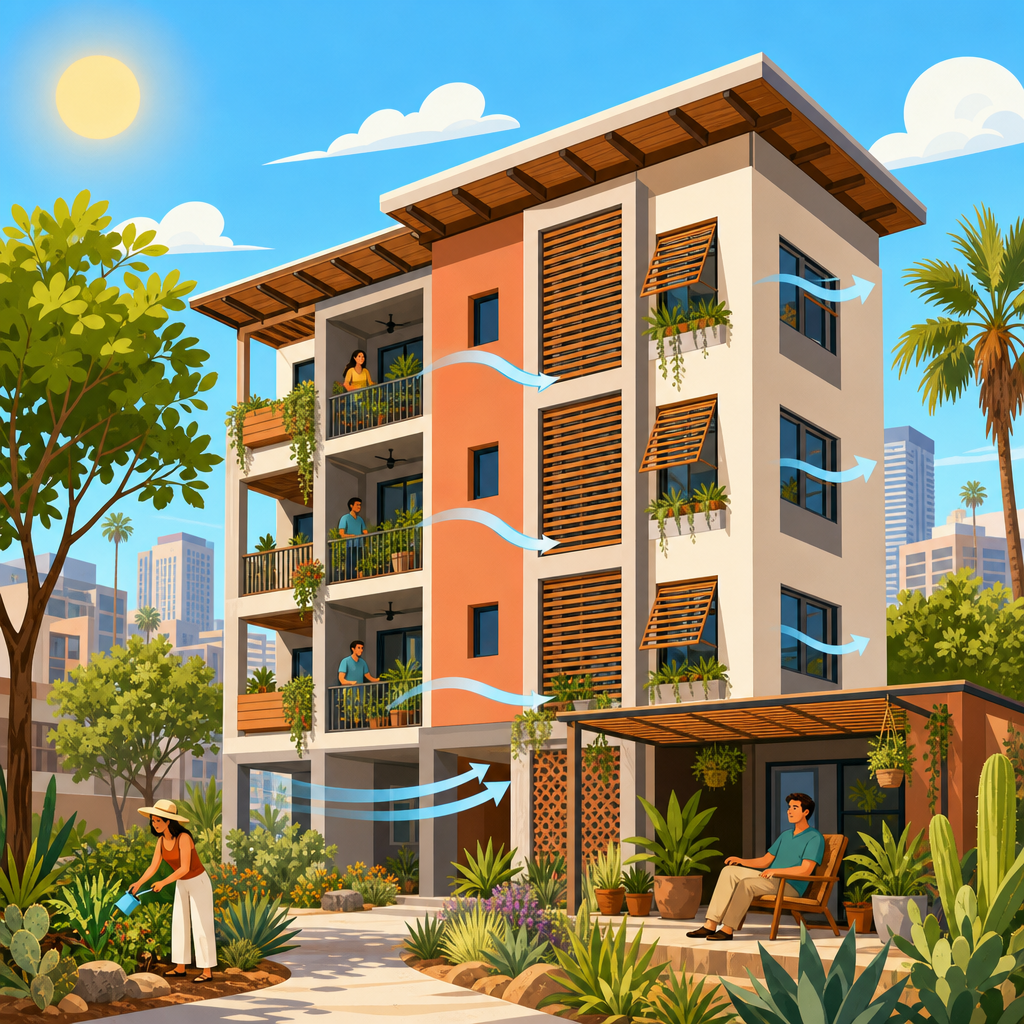
Shading is the most reliable passive cooling measure because stopping solar gain before it reaches glass is far more effective than removing heat after it enters the apartment. Exterior shading devices outperform interior blinds, which still allow solar radiation indoors before blocking glare. Horizontal overhangs work best on south-facing facades in many northern hemisphere climates because the high summer sun can be blocked while lower winter sun still enters. Vertical fins, perforated screens, balconies, and recessed windows are more effective on east and west exposures where sun angles are lower. In multifamily housing, balconies can serve as social amenity and thermal strategy simultaneously when their depth is properly modeled. I have seen facade studies where extending balcony slabs by even 18 to 24 inches significantly reduced summer cooling loads in units below and behind them.
Window-to-wall ratio should be disciplined, not maximized for marketing renderings. Large unshaded glass areas increase radiant discomfort and peak cooling demand, especially in west-facing living rooms. Spectrally selective glazing helps by reducing solar heat gain coefficient while preserving visible light, but glass specification alone cannot solve a poor facade concept. Light-colored exterior finishes reduce heat absorption, and ventilated rainscreens can limit heat transfer by allowing a buffer cavity to dissipate solar load. Operable exterior shutters, common in many traditional hot-climate buildings, deserve renewed attention in modern housing because they give residents direct control over heat and glare. The main principle is straightforward: if a facade receives intense sun, design it to reject that sun physically, not merely to endure it.
Natural ventilation, mixed-mode operation, and apartment layout
Natural ventilation can be highly effective in multifamily housing, but only when layout, openings, and controls support actual airflow. Cross ventilation is the gold standard because air enters from one side and exits another, sweeping heat and pollutants from the apartment. Single-aspect units, common in urban infill projects, are harder to ventilate effectively, particularly when they face noisy streets or polluted corridors that residents hesitate to open onto. Dual-aspect units, corner units, and through-units perform better because they create pressure differences. Even in constrained buildings, design moves such as offset openings, transom vents, ventilated corridors, and operable stair or atrium exhaust can improve air movement.
Mixed-mode buildings combine passive ventilation with mechanical systems, allowing residents and operators to switch strategies based on weather and outdoor air quality. This approach is especially useful in hotter cities where shoulder seasons may be comfortable naturally, while extreme heat periods still require cooling equipment. The challenge is control logic. Windows should not open into negatively pressurized corridors that pull in contaminants, and ventilation openings must consider humidity, wildfire smoke, and urban noise. Ceiling fans are one of the most cost-effective complements to passive cooling because increased air speed expands the temperature range occupants find comfortable. Good apartment planning supports this. Bedrooms need secure nighttime ventilation. Kitchens should not trap heat. Internal partitions should allow airflow transfer without sacrificing privacy. Passive ventilation is not accidental; it is a designed pathway for air, tested against real climate conditions and resident behavior.
Thermal mass, insulation, and roof performance
Thermal mass is often misunderstood. Heavy materials such as concrete or masonry do not automatically make a building cooler. They help when daily temperatures swing enough for the structure to absorb heat during the day and release it at night, especially if night flushing removes stored heat. In many hotter cities, nighttime temperatures are rising, so mass must be paired with ventilation and shading to remain beneficial. In multifamily buildings with exposed concrete slabs, this can still work well when windows or controlled vents allow cooler nighttime air to pass over interior surfaces. Without that release cycle, thermal mass can become a heat battery that keeps apartments warm after sunset.
Insulation remains essential, even in hot climates, because it slows conductive heat flow through roofs and walls. Roofs deserve particular attention since top-floor overheating is among the most common resident complaints. Cool roofs with high solar reflectance and thermal emittance can lower roof surface temperatures substantially compared with dark membranes. Green roofs can also moderate roof heat gain and improve stormwater performance, though they add structural, irrigation, and maintenance considerations. Airtightness matters because uncontrolled leakage brings hot air indoors and can undermine ventilation strategy. The balance is to tighten the envelope while preserving deliberate, controllable pathways for fresh air. The table below summarizes common envelope measures and their primary cooling benefit.
| Strategy | Primary effect | Best application | Main limitation |
|---|---|---|---|
| Cool roof membrane | Reduces solar heat absorption at roof | Low- and mid-rise buildings with exposed roof area | Performance can decline if surface gets dirty |
| Exterior shading | Blocks solar gain before it reaches glass | Facades with high sun exposure, especially east and west | Needs climate-specific geometry and maintenance |
| Added wall and roof insulation | Slows conductive heat transfer | Retrofits and top-floor overheating problems | Does not address solar gain through unshaded windows |
| Thermal mass with night flushing | Dampens daytime temperature swings | Climates with cooler nights | Less effective where nights remain hot |
| Airtight envelope with planned ventilation | Reduces unwanted hot air infiltration | Buildings upgrading enclosure and systems together | Requires careful moisture and indoor air management |
Resident-focused retrofit strategies for existing housing stock
Most multifamily residents in hotter cities live in existing buildings, not new construction, so retrofit strategy is where passive cooling has the biggest practical impact. The first step is diagnosis. Infrared imaging, blower door testing, solar exposure mapping, and resident interviews reveal where heat enters and where comfort breaks down. In occupied buildings, the best early wins are often exterior shading films or screens where appropriate, reflective roof coatings, attic or roof insulation, air sealing around window AC sleeves, and replacement of dark interior blinds with more effective reflective shades. If facade replacement is not feasible, targeted interventions on the hottest orientations can still deliver measurable improvement. I have worked on properties where simply shading west-facing stair towers and corridor glazing reduced evening temperatures enough to cut complaints dramatically.
Resident behavior and controls matter as much as hardware. Clear guidance on when to close blinds, when to ventilate at night, and how to use fans with open windows can improve outcomes, but only if the building gives residents viable options. Security screens allow safer nighttime ventilation. Window restrictors can protect children while preserving airflow. Common spaces such as lobbies, laundry rooms, and community rooms should also be part of the strategy because they often become informal refuge areas during heat events. For affordable housing providers, passive measures are especially valuable because they lower energy burden without shifting complexity to tenants. Successful retrofits are phased, climate-specific, and tested after installation. Post-occupancy monitoring using simple temperature and humidity sensors is one of the most underused tools in housing rehab.
Codes, metrics, and design process for long-term resilience
Passive cooling should be embedded in the design and approval process, not treated as an optional sustainability feature. Leading teams evaluate overheating risk early using hourly simulation tools such as EnergyPlus, IES VE, Ladybug Tools, or DesignBuilder, then verify assumptions with enclosure review and airflow analysis. Useful metrics include peak operative temperature, hours above comfort thresholds, nighttime bedroom temperature, and survivability during power outages. Several green building frameworks and local codes now address resilience more directly, while ASHRAE Standard 55 remains central for thermal comfort assessment under occupied conditions. In Europe, the adaptive comfort model has pushed designers to think more carefully about operable windows and occupant control, and similar thinking is increasingly relevant in North American housing as heat extremes intensify.
Developers and housing agencies should ask simple but decisive questions. Which units are most exposed to afternoon sun? Can residents ventilate safely and quietly at night? What happens indoors during a three-day outage? Are top-floor apartments materially hotter than lower floors? Will facade maintenance preserve shading performance over time? Answering these questions creates better buildings and stronger compliance narratives for financing, planning, and community review. Passive cooling is not anti-technology; it reduces the size, runtime, and failure consequences of mechanical systems. For multifamily housing in hotter cities, that is the real advantage. Buildings that block sun, move air, moderate heat, and support resident control remain safer and more affordable under both everyday summer conditions and extreme heat emergencies. Project teams should make passive cooling a standard design brief from the first site sketch through post-occupancy evaluation, then carry those lessons into every future housing development.
Hotter cities are reshaping what good multifamily housing looks like, and passive cooling strategies are central to that shift. The core ideas are consistent across climates and building types: reduce solar gain, improve shading, support natural ventilation, design the envelope carefully, use thermal mass only where it can release heat effectively, and prioritize roofs, top floors, and west-facing units. At the same time, no single tactic is enough on its own. The strongest projects combine site planning, facade design, apartment layout, resident controls, and measured retrofit priorities into one coordinated approach. That integrated method protects health, lowers energy costs, reduces strain on electrical grids, and makes buildings more resilient during outages and heat waves.
For owners, designers, housing authorities, and city officials, the main benefit is durable performance. Passive cooling reduces dependence on expensive mechanical fixes and improves comfort in ways residents feel immediately. It also creates a clear roadmap for this broader sustainable urban development subtopic, linking building-scale design to neighborhood heat mitigation, public health, and long-term housing affordability. If you are planning a new project or upgrading an existing property, start with an overheating assessment, identify the highest-risk units, and prioritize the passive measures that address the local climate first.
Frequently Asked Questions
What does passive cooling mean in multifamily housing, and why is it becoming essential in hotter cities?
Passive cooling in multifamily housing refers to design strategies that limit heat gain and help buildings shed heat without depending primarily on air conditioning. In practice, that includes building orientation, exterior shading, window placement, cross-ventilation, better roof and wall assemblies, thermal mass, lighter-colored exterior surfaces, and layouts that reduce direct solar exposure in units and shared spaces. In apartment buildings and other higher-density residential projects, passive cooling is not just about comfort during summer afternoons. It is increasingly tied to public health, energy affordability, grid resilience, and long-term building performance.
In hotter cities, residents are facing longer heat seasons, more frequent heat waves, and warmer nights that make indoor spaces harder to cool. That creates serious challenges for multifamily properties, especially for low-income households, seniors, children, and tenants with medical vulnerabilities. If a building overheats quickly, residents become more dependent on mechanical cooling, which raises utility costs and increases exposure during power outages or peak-demand events. Passive cooling helps reduce those risks by making the building itself more heat-resistant and more livable under stress.
For multifamily developers, owners, architects, and housing agencies, passive cooling is becoming essential because it supports multiple goals at once. It can reduce energy use, improve resident satisfaction, lower peak cooling loads, support decarbonization targets, and make buildings more resilient in extreme heat. Importantly, it also helps address comfort inequities that often show up in poorly oriented, under-shaded, or under-ventilated apartments. In short, passive cooling is shifting from a nice design feature to a baseline strategy for durable, healthy urban housing.
Which passive cooling strategies are most effective for apartment buildings in dense urban environments?
The most effective passive cooling strategies for multifamily buildings in dense cities usually start with solar control and envelope performance. Exterior shading is one of the strongest tools available because it stops heat before it enters the building. That can include overhangs, recessed windows, vertical fins, operable shutters, balcony design, screens, and landscape shading where site conditions allow. In hotter climates, west-facing facades often need particular attention because low-angle afternoon sun can drive major overheating in units.
Window design also matters significantly. High-performance glazing, lower solar heat gain coefficients where appropriate, well-insulated frames, and carefully tuned window-to-wall ratios can reduce unwanted heat gain while still preserving daylight and views. Orientation and massing are equally important. Buildings can be shaped to minimize harsh solar exposure, create self-shading facades, and improve airflow through courtyards, breezeways, and unit layouts. In dense urban contexts where neighboring buildings limit wind or shade access, these massing decisions become even more consequential.
Natural ventilation strategies can be highly effective when climate and air quality conditions support them. Cross-ventilation, dual-aspect units, operable windows placed to encourage air movement, corridor ventilation strategies, and stack-effect ventilation through atria or stair towers can all help remove heat. However, these must be carefully designed with resident control, acoustics, pollution, and security in mind. In many hotter cities, night flushing can also work well, allowing cooler nighttime air to remove heat stored during the day.
Roof design is another major opportunity. Cool roofs, ventilated roof assemblies, roof insulation, green roofs in some cases, and shaded rooftop amenity areas can all reduce heat gain at the top of the building, where upper-floor units are often most vulnerable. Thermal mass can help moderate indoor temperature swings when paired with nighttime ventilation, although its effectiveness depends on local day-night temperature patterns. The best results usually come from combining strategies rather than relying on a single measure. In dense multifamily projects, layered design decisions almost always outperform isolated upgrades.
How can passive cooling improve resident comfort and resilience without replacing air conditioning entirely?
Passive cooling is not an all-or-nothing alternative to air conditioning. In most hotter cities, the goal is not to eliminate mechanical cooling altogether, but to reduce how hard it has to work and to keep indoor conditions safer and more stable when systems are strained or unavailable. A well-designed multifamily building can stay cooler for longer, recover more quickly at night, and avoid extreme indoor temperature spikes. That improves day-to-day comfort and creates an important safety buffer during heat emergencies.
For residents, the benefits are practical and immediate. Apartments with better shading, less direct solar gain, and stronger ventilation tend to feel more comfortable even before air conditioning turns on. Indoor temperatures fluctuate less, hot spots near windows are reduced, and nighttime sleeping conditions can improve. This is especially important in buildings where some residents may limit AC use because of energy costs. Passive cooling lowers the baseline heat burden, which can help reduce utility expenses and improve livability across income levels.
From a resilience standpoint, passive cooling is valuable because it continues to function during partial equipment failure, maintenance disruptions, or power outages. Buildings with better envelopes and heat-rejecting design features do not become dangerous as quickly as poorly designed ones. Common areas can also be planned as passive refuge zones with strong shading, ventilation, and lower solar exposure. That kind of heat resilience is increasingly important as cities prepare for more intense weather events and more stress on electric systems.
In other words, passive cooling and mechanical cooling should work together. Passive strategies reduce loads, improve comfort, extend equipment life, and support safer indoor conditions. Mechanical systems then provide targeted cooling when needed rather than carrying the entire burden alone. That combined approach is often the most realistic, cost-effective, and resident-centered path for multifamily housing in hotter urban climates.
What design challenges make passive cooling harder in multifamily housing, and how can teams address them?
Passive cooling in multifamily buildings can be challenging because these projects must balance many competing demands at once. Developers and design teams often face tight urban sites, zoning limits, noise exposure, privacy concerns, air pollution, budget constraints, code requirements, and the pressure to maximize unit count or rentable area. All of those factors can limit options for orientation, window placement, courtyard depth, facade articulation, and operable ventilation. Unlike a detached house, a multifamily building has to perform well across many units with different exposures, floor levels, and occupancy patterns.
One common challenge is uneven thermal performance across the building. Corner units, top-floor apartments, and west-facing units often overheat more than others. Another issue is that strategies that improve airflow, such as operable windows and cross-ventilation, may conflict with exterior noise, security concerns, or poor outdoor air quality. In dense neighborhoods, adjacent buildings can also block breezes and create urban heat island effects that reduce the cooling potential of nighttime ventilation. At the same time, poorly coordinated facade design can accidentally increase solar gain through oversized glazing or insufficient shading.
Teams can address these problems by integrating passive cooling early in the design process instead of treating it as a late-stage sustainability add-on. Climate analysis, solar studies, and energy modeling should inform massing, facade design, and unit planning from the start. It is also important to study overheating risk by unit type and orientation, not just average building performance. That helps identify where stronger shading, better glazing, different layouts, or more robust ventilation measures are needed.
Operational and social considerations matter too. Residents need cooling strategies they can actually use, understand, and trust. Windows should be operable in intuitive ways, shading devices should be durable and maintainable, and building management should support clear guidance for hot weather operation. When passive cooling is approached as a whole-building and resident-experience issue rather than just a technical checklist, it becomes much more effective and far easier to sustain over time.
How should developers and housing providers prioritize passive cooling in new construction and retrofits?
For new construction, the best approach is to build passive cooling into the core architecture from the beginning. That means starting with climate-responsive orientation, massing, facade design, and unit layout before moving to equipment selection. Developers should prioritize measures that permanently reduce heat gain, such as exterior shading, high-performance envelopes, roof reflectivity, appropriate glazing, and ventilation-friendly plans. These choices tend to deliver long-term value because they are embedded in the building and continue working throughout its life cycle.
In retrofit projects, priorities often depend on what can be changed cost-effectively without major structural intervention. Exterior shading upgrades, roof improvements, air sealing, insulation enhancements, better windows, solar-control films in some cases, and common-area ventilation strategies can all make meaningful differences. If full facade replacement is not feasible, targeted measures for the most heat-exposed units may be the smartest first step. Upper floors and west-facing apartments often deserve early attention because they frequently experience the greatest overheating.
Developers and housing providers should also think beyond first cost. Passive cooling investments can reduce future HVAC sizing, cut peak energy demand, lower utility burdens for residents, and decrease overheating complaints. In affordable and mixed-income housing, that has direct implications for equity and long-term operating stability. It is also wise to evaluate passive cooling as part of broader resilience planning, especially in cities where heat emergencies, power disruptions, and climate adaptation requirements are becoming more common.
Ultimately, prioritization should be based on climate data, building type, resident needs, and measurable overheating risk. The strongest projects use a layered strategy: reduce solar gain