
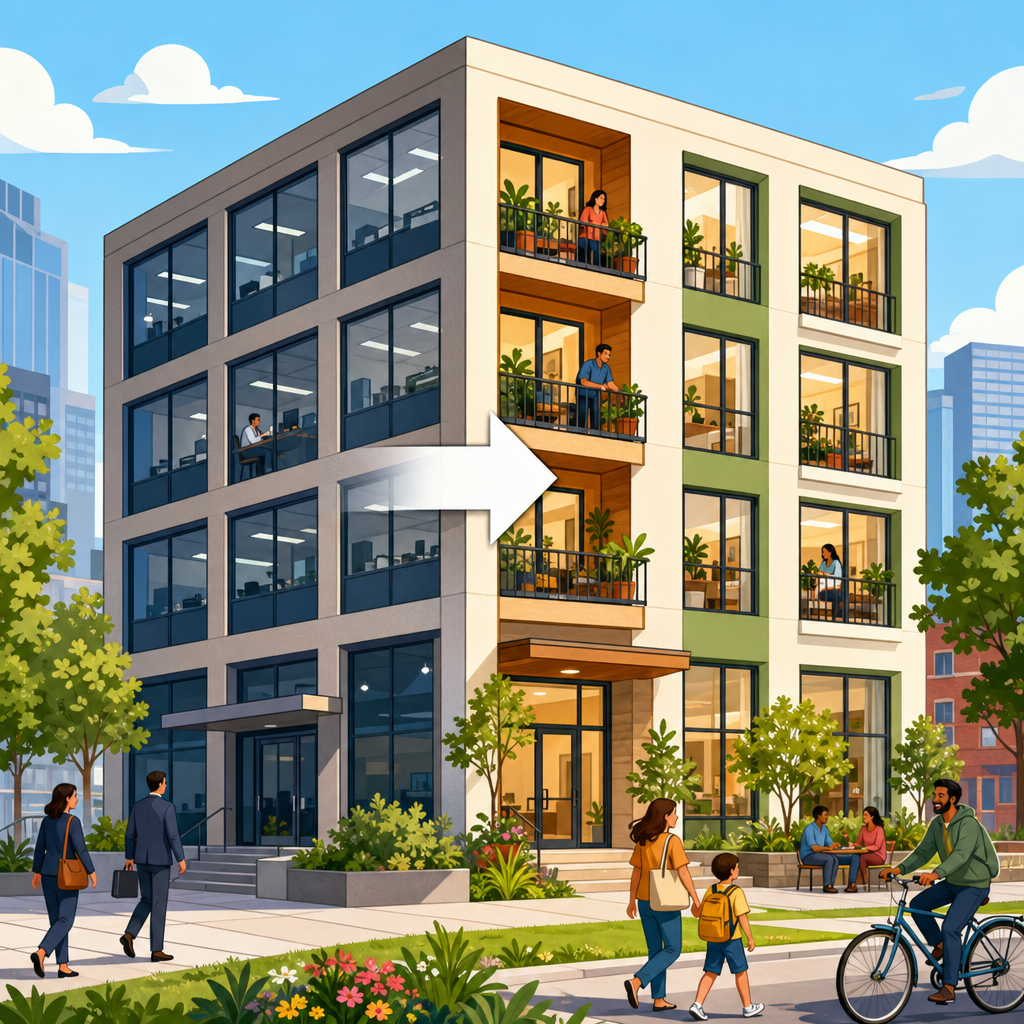
Office-to-residential conversions are becoming a practical strategy for creating affordable housing, but not every empty office building can become safe, efficient, and livable homes. A viable conversion depends on far more than vacancy rates or a good downtown address. It requires the right physical structure, workable floor plates, code compliance pathways, utility capacity, financing alignment, and a local market where affordable units can operate sustainably.
In this context, office-to-residential conversion means adapting an existing commercial office property into apartments or mixed-income housing. Affordable housing generally refers to homes that cost no more than 30 percent of household income, often supported through public subsidies, tax credits, inclusionary programs, or mission-driven ownership. Viability means the project can be built, permitted, financed, leased, and operated without creating long-term functional or financial problems. I have worked on adaptive reuse evaluations where the early excitement around a vacant tower faded quickly once we tested plumbing stacks, window lines, and egress. That is why disciplined screening matters.
The topic matters because many cities face two pressures at once: rising housing costs and underused office inventory. Remote and hybrid work have weakened demand for older office space, especially commodity Class B and C buildings built before modern workplace expectations. At the same time, municipalities need affordable homes near jobs, transit, schools, and services. Conversions can preserve embodied carbon, shorten delivery timelines compared with ground-up construction, and reactivate struggling business districts. Yet the wrong building can absorb large subsidies and still produce poor units. The central question is simple: what makes a building viable for affordable housing conversion?
The answer starts with hard constraints. Residential buildings need daylight, ventilation, privacy, acoustic separation, fire safety, accessible design, and repeated wet areas for kitchens and bathrooms. Office buildings were designed for different uses: deeper floor plates, centralized restrooms, large mechanical zones, and occupancy patterns tied to daytime work rather than round-the-clock living. The best candidates usually combine modest depth from window to core, robust structure, multiple elevators, convertible mechanical systems, and zoning that allows housing. Buildings that miss several of these fundamentals often become expensive exercises in compromise rather than durable affordable housing assets.
Physical characteristics that determine whether conversion is possible
The first screen is the building itself. Floor plate depth is usually decisive. Residents need access to natural light and operable or code-compliant window conditions for habitable rooms. In many markets, a depth of roughly 40 to 60 feet from window line to corridor works well, while very deep office plates can leave large interior areas unusable unless they become corridors, storage, amenity space, or borrowed-light rooms that may not satisfy code. Buildings with narrow footprints, courtyard opportunities, or multiple exterior exposures perform better because they support efficient unit planning with less wasted space.
Window spacing and façade design matter just as much. Offices can tolerate large spans between windows or sealed curtain wall systems with high solar gain. Apartments cannot. Bedrooms and living rooms require regular access to daylight, and affordable projects need layouts that maximize countable rentable area. If the façade can accept punched openings, Juliette balconies, or selective recladding, design flexibility improves. Structural systems also affect viability. Concrete flat-plate and regular column grids are usually easier to adapt than heavily braced frames or buildings with intrusive transfer structures. Floor-to-floor height matters too, especially when new plumbing, ventilation, and fire protection must fit above ceilings.
Vertical circulation is another make-or-break issue. Residential occupancy changes elevator demand patterns, package delivery loads, security needs, and stair requirements. A building with adequate stairs located to support new unit layouts has a major advantage. So does one with a core that does not consume the entire center of the plan. I have seen projects fail because the core left awkward slivers around the perimeter, creating too many studios and not enough family-sized apartments. For affordable housing, unit mix matters operationally and politically; a building that only yields micro-units may not meet funding goals or community needs.
Below-grade and ground-floor conditions also affect success. Affordable housing usually benefits from secure bike storage, trash rooms, resident services, and community space. Office buildings with oversized lobbies, loading docks, and basement service areas can absorb these uses efficiently. Others cannot. Parking is highly local: some cities waive minimums near transit, while others still demand substantial spaces, which can kill the economics. Seismic condition, envelope performance, and hazardous materials are equally important. Older buildings may contain asbestos, lead paint, or outdated glazing systems that trigger major remediation costs before any apartment work begins.
Code, zoning, and life-safety issues that shape feasibility
A promising shell means little if the code path is unworkable. Conversions sit at the intersection of zoning ordinances, building codes, fire codes, accessibility rules, and sometimes historic preservation requirements. The first zoning question is use: is residential allowed by right, through conditional approval, or only after rezoning? The second is density. Some office buildings sit on parcels with floor area that already exceeds current residential envelopes, creating a nonconforming condition that can complicate additions, setbacks, and open-space rules. Local planners can sometimes solve this through overlays or adaptive reuse ordinances, but developers should never assume flexibility before receiving written confirmation.
Building code compliance is more technical. A change of occupancy typically triggers review under the International Existing Building Code or comparable local provisions. The compliance method chosen can significantly alter scope and cost. Fire-resistance ratings, compartmentation, smoke control, alarm systems, sprinkler coverage, and means of egress all require careful analysis. Residential corridors may need different separation than office corridors. Unit entry doors, stair pressurization, and refuge requirements can add cost quickly. Accessibility is equally consequential. Fair Housing Act design standards, Americans with Disabilities Act obligations in common areas, and local accessibility mandates influence bathroom layouts, turning radii, elevator upgrades, and route continuity from sidewalk to unit.
Acoustics and habitability standards deserve special attention because they are often underestimated. People can tolerate a noisy office HVAC system during working hours; they will not tolerate it at night in an apartment. Sound transmission class and impact insulation class targets, party wall construction, window acoustic performance, and vibration isolation for mechanical equipment all affect resident experience. Many jurisdictions also require minimum unit sizes, openable windows, or outdoor space access. Historic buildings may receive some flexibility, but tradeoffs remain. Any affordable project that relies on waivers without solving basic livability risks higher turnover, management strain, and future capital needs.
| Factor | Usually favorable | Usually difficult |
|---|---|---|
| Floor plate depth | 40 to 60 feet from window to corridor | Very deep interiors with little daylight |
| Structure | Regular concrete or steel grid | Transfer beams, irregular bracing, low ceilings |
| Windows | Frequent openings, adaptable façade | Wide spacing, sealed curtain wall, high solar load |
| Code path | Adaptive reuse ordinance or clear occupancy change route | Extensive nonconforming conditions and unclear approvals |
| Systems | Capacity for new plumbing and ventilation runs | Limited shafts, undersized service, obsolete equipment |
| Affordable housing fit | Supports varied unit mix and resident services | Only yields awkward micro-units with little common space |
Mechanical, electrical, plumbing, and envelope realities
Most conversion budgets rise or fall on building systems. Office plumbing is sparse and centralized; apartments need kitchens and bathrooms distributed across every floor. That means more vertical stacks, more horizontal branch lines, and enough floor depth or ceiling space to route waste and vent piping without awkward soffits everywhere. Existing slab penetrations, beam locations, and post-tensioned concrete can limit where new wet walls go. Electrical service must also be rethought. Residential metering, in-unit panels, all-electric cooking, heat pump water heating, and growing demand for cooling can exceed the capacity originally designed for office loads configured differently.
HVAC strategy is another major decision. Many older offices use central air systems designed for daytime occupancy and fixed zoning. Housing needs individual control, quieter operation, better humidity management, and year-round comfort. Variable refrigerant flow systems, packaged terminal heat pumps, water-source heat pumps, and four-pipe fan coil conversions are common options, but each interacts differently with envelope performance and utility costs. In affordable housing, long-term operating expense matters as much as first cost. A cheap retrofit that produces high utility bills undermines affordability for residents and owners. Energy modeling should test not just compliance, but actual performance under local weather and occupancy patterns.
The façade can be one of the largest hidden risks. Office curtain walls from the 1960s through 1990s often have poor thermal breaks, failing seals, and limited operability. Residential use exposes these weaknesses immediately because occupants notice drafts, condensation, and overheating. Some projects can retain the façade with selective upgrades such as interior storm panels, spandrel insulation improvements, and shading. Others need partial recladding or full replacement, which can erase the cost advantage over new construction. Envelope commissioning, infrared scanning, and mockups are worth the expense. If the skin cannot support comfortable apartments, the conversion will struggle no matter how attractive the pro forma looks.
Financial feasibility, policy support, and delivery strategy
A viable building is not automatically a viable affordable housing deal. Acquisition basis, construction cost, financing structure, and operating revenue must line up. In many cities, office values have fallen, but not always enough to compensate for heavy retrofit costs. Developers should compare total development cost per net rentable square foot against both new construction and alternative reuse scenarios such as hotel, student housing, or life sciences. Affordable housing often relies on layered capital including Low-Income Housing Tax Credits, tax-exempt bonds, HOME funds, Community Development Block Grants, local trust funds, energy incentives, and property tax abatements. The more complex the capital stack, the more important schedule certainty becomes.
Public policy can dramatically improve conversion viability. Some cities have adopted tax incentives, fee waivers, expedited permitting, relaxed parking requirements, and downtown residential overlays specifically to encourage adaptive reuse. Calgary, New York, Washington, DC, and Los Angeles have all explored or implemented policies aimed at converting underused offices, though local outcomes vary. Historic tax credits can be valuable when a building has qualifying status, but they come with standards that may constrain window replacement, layout changes, or rooftop additions. The best projects align the physical building, the regulatory path, and the subsidy program from the start rather than forcing one to fit the other late in design.
Delivery strategy also matters. Early due diligence should include measured drawings, destructive investigation, code consulting, utility coordination, and market testing of unit mix. Guaranteed maximum price contracting can help manage risk, but only after enough unknowns are resolved to avoid change-order escalation. Phased occupancy is rare and difficult in full office conversions because systems, egress, and life-safety upgrades are usually building-wide. Owners should also model operating realities after lease-up: resident services staffing, security, maintenance access, turnover, replacement reserves, and compliance reporting if subsidy programs are involved. Affordable housing succeeds over decades, so a building is viable only if it can be managed well after ribbon-cutting.
How cities and owners should evaluate candidates
The most effective way to evaluate office-to-residential conversions is through a repeatable screening framework. Start with five questions. First, can the building physically produce good apartments with daylight, reasonable unit depth, and a practical mix of studios, one-bedrooms, and family units? Second, is there a clear code and zoning pathway? Third, can systems be upgraded without gutting the building to the point that reuse loses its advantage? Fourth, does the financial stack support long-term affordability? Fifth, does the location work for residents, not just for office workers? That means access to groceries, schools, transit, parks, healthcare, and everyday services.
Location deserves emphasis because affordable housing cannot succeed on building geometry alone. Some downtown office districts still lack the retail mix, public realm, and school access that households need. Others are ideal, especially where transit, libraries, clinics, and job centers are already in place. Owners should study neighborhood demand by household type, not just broad occupancy projections. A building near a medical district may be well suited for workforce housing. One near a commuter rail hub may support mixed-income units for service workers and small families. Matching the building to the resident profile improves design decisions, financing strategy, and long-term stability.
Office-to-residential conversions can add affordable housing faster than ground-up development when the building is genuinely viable. The best candidates have shallow enough floor plates, adaptable façades, workable cores, upgradeable systems, a clear legal path, and a financing plan tied to durable operations. The weakest candidates are deep, overcomplicated, underpowered buildings in locations that were built only for nine-to-five use. Cities and owners should resist treating every empty office as a housing opportunity. Careful screening protects public subsidy, resident quality of life, and project outcomes.
If you are assessing a vacant office asset, begin with a multidisciplinary feasibility study before committing to design. The right building can become high-quality affordable housing. The wrong one will consume time, capital, and political support that should go elsewhere.
Frequently Asked Questions
What physical characteristics make an office building a strong candidate for residential conversion?
A strong office-to-residential conversion usually starts with the building’s basic geometry and structure. One of the most important factors is floor plate depth. Residential units need access to natural light and ventilation, so very deep office floors can be difficult to adapt without carving out courtyards, atriums, or light wells, which adds cost and reduces rentable area. Buildings with narrower floor plates, operable window potential, and good perimeter access tend to convert more efficiently. Ceiling height also matters. Adequate floor-to-floor heights are needed to fit residential mechanical, plumbing, and fire protection systems while still creating comfortable living spaces.
Structural layout is another major consideration. Column spacing, core placement, and load capacity can either support efficient apartment layouts or make them awkward and expensive. A building with repetitive structural bays and a centrally located core often allows more practical unit planning than one with irregular geometry or large interior zones with no daylight. Window spacing and facade design are equally important because residential use demands a different relationship to light, privacy, and operability than office use. If the facade can be modified without excessive cost or historic restrictions, the project becomes more viable.
Developers also look closely at the building envelope, roof condition, elevator systems, and overall state of deferred maintenance. An empty office building may appear available, but if it needs major facade stabilization, full window replacement, hazardous material abatement, or extensive structural repair, the economics can change quickly. In affordable housing, where budgets are especially sensitive, buildings that already offer a solid shell, manageable floor depths, and adaptable infrastructure are typically the best candidates.
Why do building codes and life safety requirements play such a big role in office-to-residential conversions?
Code compliance is one of the biggest reasons a vacant office tower does not automatically become housing. Offices and residential buildings are governed by different occupancy classifications, and that change triggers new requirements for egress, fire separation, accessibility, plumbing fixture counts, ventilation, acoustics, and sometimes seismic or energy upgrades. Residential units must provide safe sleeping areas, compliant exits, fire-rated assemblies, and acceptable levels of light and air. A building that worked perfectly well as office space may still require substantial redesign to meet housing standards.
Life safety is especially critical. Apartment residents occupy a building differently than office workers. People are there overnight, they cook in their units, and many residents may include children, seniors, or people with disabilities. That means stair capacity, travel distances, sprinkler systems, alarm systems, smoke control, and compartmentalization must all be evaluated carefully. In some cases, the existing stair configuration or corridor arrangement becomes a major obstacle. In others, local codes or adaptive reuse provisions may offer alternative compliance paths that make conversion feasible without requiring full new-construction standards across every component.
Accessibility can also reshape the design and budget. Residential projects must provide accessible units, common areas, routes, and entrances consistent with applicable federal, state, and local requirements. In affordable housing, additional compliance obligations may apply depending on funding sources. Successful projects usually involve code consultants, architects, and local officials early in the process so developers can understand whether the building has a realistic path to approval. A conversion is viable not just when the building can be redesigned in theory, but when it can reach compliance in a financially workable way.
How important are utilities, plumbing, and mechanical systems in determining whether a building can become affordable housing?
They are absolutely central. Office buildings and apartment buildings use water, power, heating, cooling, and ventilation in very different ways. Offices typically have centralized systems designed for daytime occupancy and relatively limited plumbing distribution. Residential buildings require kitchens, bathrooms, laundry access, domestic hot water, individual metering strategies in some cases, and systems that support round-the-clock occupancy. That means the viability of a conversion often depends on whether the building can accept extensive new plumbing stacks, bathroom groups, duct routes, and electrical distribution without excessive demolition or loss of usable space.
Plumbing is often one of the biggest technical hurdles. Apartments need many more wet areas than office floors do, and those wet areas must connect efficiently to sanitary lines and venting systems. If the structural system makes coring difficult, or if the floor-to-floor heights are too tight to accommodate new piping, costs can escalate quickly. Mechanical systems raise similar concerns. Residential comfort expectations differ from commercial expectations, and units usually need better acoustic separation, independent temperature control, and fresh air strategies that work room by room rather than across a large open floor plate.
Utility capacity also affects project feasibility. The building may need upgraded electrical service, new transformers, expanded domestic water service, or improved gas infrastructure depending on the design. Energy code requirements can trigger envelope upgrades, new insulation strategies, and replacement of outdated systems. For affordable housing, operating costs matter just as much as construction costs, so developers often prioritize buildings where efficient systems can be installed and maintained without pushing rents beyond affordability targets. In short, a viable conversion is not only one that can physically fit apartments, but one that can support residential infrastructure reliably and economically over the long term.
What financial and market factors determine whether an office-to-residential conversion can actually deliver affordable housing?
Even if a building is physically convertible, the project still has to make financial sense. Affordable housing conversions depend on a complex capital stack that may include tax credits, public subsidies, tax abatements, grants, low-interest loans, and conventional debt. The acquisition cost of the office building is a major variable. If the property was purchased at a value that still reflects pre-downturn office expectations, the numbers may not work. Viable projects often begin with a basis low enough to absorb the substantial cost of redesign, code upgrades, new systems, and tenant improvements.
Construction economics are equally important. Office conversions can be deceptively expensive because they involve both demolition and reconstruction inside an existing shell. Unexpected conditions, hazardous materials, facade repairs, and structural modifications can create budget pressure. Affordable housing projects are especially sensitive because rents are restricted, so developers cannot simply raise lease rates to cover overruns. That is why strong feasibility analysis includes not just hard construction costs, but also soft costs, financing costs, contingency planning, and long-term operating assumptions.
Market conditions matter too. A city may need affordable housing in general, but the specific location still has to support successful residential occupancy. Residents need access to transit, grocery stores, schools, healthcare, and neighborhood services. Local demand must align with the unit mix being proposed, whether that is studios, family-sized apartments, or supportive housing. Policy support can make a decisive difference as well. Jurisdictions that streamline approvals, offer adaptive reuse incentives, or coordinate funding programs tend to produce more viable conversions. In practice, the best affordable housing conversions happen where building suitability, public policy, financing tools, and real residential demand all line up.
Can every vacant downtown office building be converted into housing, or are some simply not viable?
No, not every vacant office building is a good housing candidate, and recognizing that early is essential. Some buildings are too deep, too structurally constrained, too obsolete, or too costly to retrofit. Others may have facade systems that are difficult to modify, cores that limit unit planning, or floor heights that cannot accommodate modern residential systems. In some cases, the code pathway is so complex that the amount of intervention required effectively erases any reuse advantage. A building may also be located in a district where residential demand is weak or where surrounding services do not support stable housing outcomes.
There are also cases where a conversion is technically possible but not practical for affordable housing. The project might work as luxury apartments because higher rents can absorb the extra cost, but it may not pencil out at affordable rent levels. That distinction is critical. Affordable housing viability is not just about whether units can be built; it is about whether they can be created, financed, operated, and maintained sustainably while meeting income-restricted targets. If the building requires extraordinary intervention, the subsidy needed may be disproportionate compared with other housing development options.
The most successful approach is disciplined screening. Developers, architects, engineers, housing agencies, and code experts typically evaluate candidate buildings through a combination of due diligence, test fits, infrastructure review, and financial modeling. That process helps separate buildings that are merely empty from those that are genuinely adaptable. Office-to-residential conversion can be a powerful affordable housing strategy, but it works best when the building has the right bones, the regulations offer a workable path, and the economics support long-term affordability rather than a one-time redevelopment opportunity.


