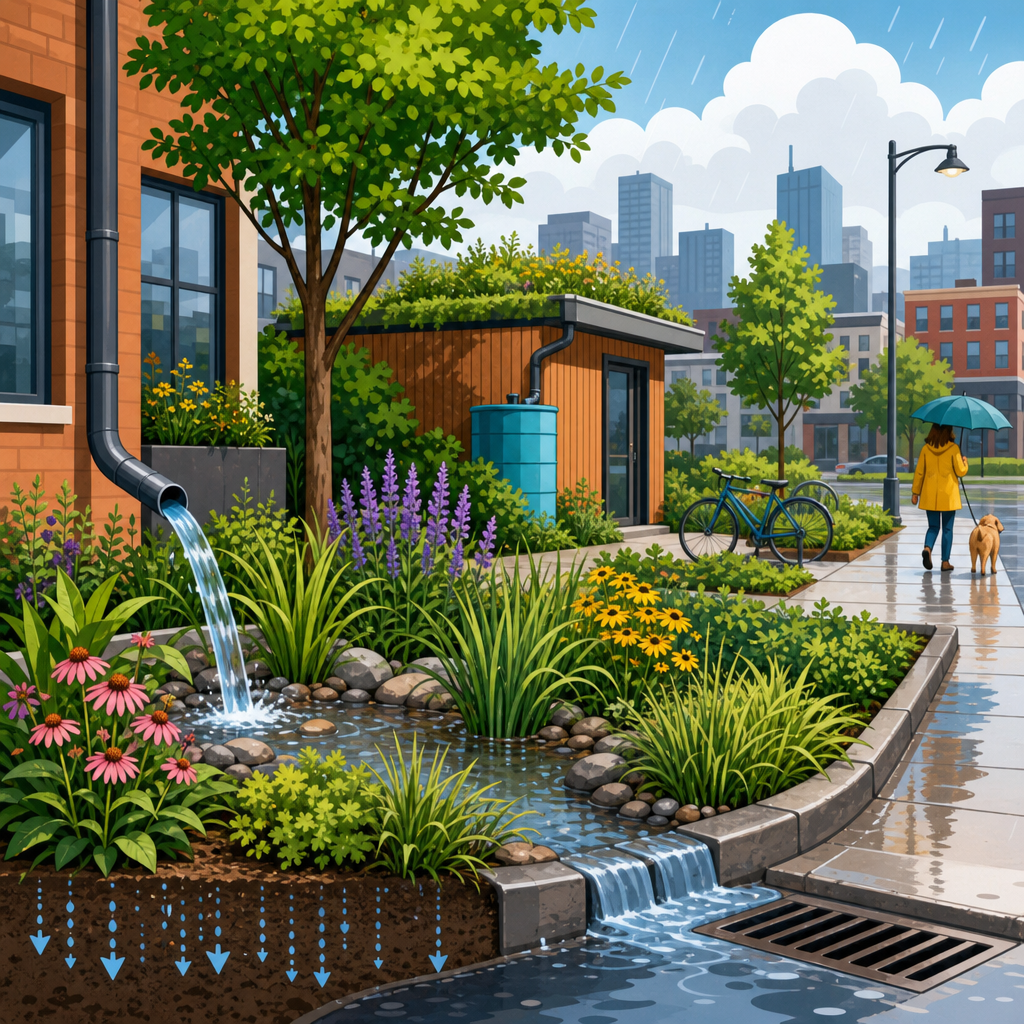
Nature-based solutions for stormwater on small urban sites are practical design strategies that slow, capture, filter, and reuse rainfall by working with soil, plants, and natural water cycles instead of relying only on pipes and hard drainage infrastructure. On compact lots, courtyards, alleys, townhouse developments, schools, and retrofit commercial parcels, these methods can reduce flooding, improve water quality, lower heat, and add usable landscape value at the same time. I have seen small sites outperform larger conventional systems when the design team treats every square meter as hydrologic infrastructure, from roofs and downspouts to planting beds and pavement joints. That matters because urban stormwater is not just excess water; it carries sediment, nutrients, heavy metals, hydrocarbons, trash, and heat into local waterways, stressing drainage networks and degrading public spaces during increasingly intense rain events.
In this context, small urban sites usually means parcels where land is constrained, utilities are crowded, setbacks are tight, and owners need each intervention to serve multiple purposes. Nature-based solutions include bioretention cells, rain gardens, bioswales, permeable pavements, tree trenches, green roofs, cisterns paired with planting, infiltration planters, and soil restoration. The common principle is source control: keep rainfall close to where it lands, let vegetation and engineered soil do treatment work, and release water gradually only after peak runoff has been reduced. For developers, municipalities, schools, and property managers, the value is straightforward. These systems can help meet regulatory runoff targets, reduce downstream infrastructure burden, support biodiversity, and often create more attractive sites than purely gray systems. The challenge is not whether they work. The challenge is selecting combinations that fit tiny footprints, difficult soils, maintenance realities, and local code requirements without compromising performance.
What nature-based stormwater management means on constrained urban parcels
On a small urban parcel, the most effective stormwater strategy starts with a water balance, not a product list. Designers first estimate how much runoff a site produces during a chosen design storm, then map where water falls, how fast it moves, and where it can safely be detained, infiltrated, evapotranspired, or reused. In practice, that means separating surfaces into categories such as roofs, pedestrian paving, parking stalls, service areas, and planting zones, then assigning each one a role in the stormwater system. A downspout may discharge to a planter box. A driveway may become permeable. A sidewalk edge may become a curb cut feeding a bioretention strip. A flat roof may support a green roof or blue-roof storage layer. The site becomes a linked network of small controls rather than one oversized basin that rarely fits.
The distinction between infiltration, detention, retention, and reuse is important. Infiltration sends water into underlying soil where conditions allow. Detention stores water temporarily and releases it slowly. Retention keeps water on site permanently through infiltration, evapotranspiration, or harvesting. Reuse captures runoff, usually from roofs, for irrigation or nonpotable demand. Small sites often need all four. For example, I worked on a compact infill housing site where native soils infiltrated poorly because of subgrade compaction and clay lenses. Full infiltration was impossible, but a combination of a 100-millimeter green roof, underdrained bioretention, and a slim cistern connected to drip irrigation still cut peak discharge substantially and met local water quality requirements. That mixed approach is typical in built-up neighborhoods where ideal conditions are rare.
Core systems that deliver the most value on small sites
Bioretention is usually the most versatile tool because it can fit into corners, parking lot edges, entry landscapes, and internal courtyards. A properly designed bioretention cell includes pretreatment, ponding depth, engineered media, mulch, resilient planting, and either infiltration into native soil or an underdrain if infiltration rates are too low. Its job is to remove suspended solids, capture dissolved pollutants through adsorption and biological uptake, and flatten runoff peaks. Rain gardens are similar but are often smaller and less engineered. On urban retrofit sites, I prefer bioretention details because they perform more predictably and are easier to align with stormwater manuals.
Permeable pavement is another strong option where surface area is available but planting space is not. Permeable interlocking concrete pavers, porous asphalt, and pervious concrete all allow water to pass into a stone reservoir below. The real determinant of success is not the top surface alone; it is the full section, including choker course, open-graded aggregate storage, edge restraints, and overflow design. In dense pedestrian areas, permeable pavers are often easier to maintain and repair than porous concrete. In parking bays or low-volume access lanes, the subsurface storage can provide meaningful detention even where native soils are restrictive.
Tree trenches and structural soil systems are especially valuable on streetscapes and narrow development frontages. Urban trees intercept rainfall in the canopy, but the larger benefit comes from giving roots enough uncompacted soil to absorb and store water. A connected tree trench can receive street runoff through curb inlets, provide treatment through soil filtration, and support healthy canopy growth that reduces summer surface temperatures. Green roofs are ideal when ground area is scarce. Extensive systems with sedum mats reduce runoff volume from frequent storms, while deeper intensive roofs can support diverse plantings and larger storage layers but add structural cost. Cisterns and rainwater harvesting tanks make sense when roof runoff is clean and there is a regular demand for irrigation, toilet flushing, or cooling water. Without a dependable use, storage can sit full before the next storm, so demand matching is essential.
How to choose the right solution for your site
The best nature-based solution for stormwater depends on five filters: site hydrology, soil and groundwater conditions, available footprint, utility conflicts, and maintenance capacity. Start with drainage area. If most runoff comes from roofs, harvesting, green roofs, and infiltration planters are often efficient. If the site is dominated by paving, permeable pavement and linear bioretention usually make more sense. Then test infiltration. Field methods such as double-ring infiltrometer testing or falling-head tests are better than relying on soil maps alone. I have seen mapped sandy soils fail because of construction compaction and buried debris, while sites expected to perform poorly improved dramatically after deep soil decompaction and amendment.
Groundwater separation and contamination history also affect feasibility. Infiltration should be approached cautiously where seasonal high groundwater is shallow, where bedrock is near the surface, or where historic industrial use raises the risk of mobilizing pollutants. Utility mapping matters just as much. Small sites often have shallow gas lines, electric conduits, telecom ducts, and building services exactly where a planter or trench seems ideal. Early potholing and utility coordination save redesign time. Finally, choose systems the owner can actually maintain. A beautifully planted bioretention bed will fail if inlets clog and dead plants are not replaced. A permeable pavement installation will lose infiltration capacity if it is routinely sanded or vacuum sweeping is never scheduled.
| System | Best small-site use | Main strength | Key limitation |
|---|---|---|---|
| Bioretention | Courtyards, parking edges, setbacks | Water quality treatment plus detention | Needs careful inlet and overflow design |
| Permeable pavement | Walkways, parking bays, alleys | Uses existing hardscape footprint for storage | Requires vacuum maintenance |
| Tree trench | Street frontage, linear spaces | Combines canopy, cooling, and runoff capture | Conflicts with utilities are common |
| Green roof | Buildings with limited ground area | Reduces roof runoff and heat gain | Structural capacity can be limiting |
| Cistern | Sites with irrigation or nonpotable reuse | Turns runoff into a resource | Needs reliable drawdown between storms |
Design principles that separate durable projects from decorative ones
Successful systems are sized from local rainfall data and regulatory performance targets, not generic percentages copied from another climate. Many jurisdictions require treatment of the first flush, a water quality storm, or a specified retention depth such as the first 25 millimeters of runoff. Others require peak flow control for larger return periods. The design must reflect local standards, whether from municipal stormwater manuals, state environmental agencies, or recognized frameworks such as the U.S. EPA guidance, CIRIA SuDS Manual, or local low-impact development criteria. On small sites, overflow routing is critical. Every system must have a safe bypass path for extreme rain, especially where basement entries, loading docks, and neighboring properties are nearby.
Soil specification is another make-or-break issue. Bioretention media must balance infiltration with moisture retention and nutrient management. Too much fines content and the cell clogs. Too sandy and plants struggle while pollutant removal drops. Pretreatment is equally important. Forebays, sump catch basins, stone diaphragms, and screened inlets keep sediment from blinding the media surface. Planting should prioritize species that tolerate both inundation and dry periods. In my experience, projects fail when ornamental preference overrides hydraulic reality. The best palettes are tough, layered, and locally adapted, with dense roots that hold soil and recover after storms.
Construction sequencing deserves more attention than it usually gets. If a bioretention area is excavated early and left open during mass grading, it becomes a sediment trap before it ever functions as designed. Protect infiltration surfaces from compaction, keep sediment controls upstream, and verify elevations before final handover. Commissioning should include outlet checks, ponding verification, and maintenance training for operations staff. Nature-based systems are infrastructure. Treat them with the same rigor as any mechanical or civil asset.
Performance benefits beyond runoff reduction
The strongest case for nature-based stormwater management on small urban sites is that it solves several urban problems at once. Water quality improvement is the most immediate. Bioretention and soil-based systems commonly reduce total suspended solids and can also lower metals, hydrocarbons, and nutrients when designed correctly. Urban heat mitigation is another major benefit. Trees, planted swales, and green roofs cool surfaces through shading and evapotranspiration, which matters in districts dominated by asphalt and masonry. I have measured dramatic differences in surface comfort between a paved courtyard with no canopy and a similar courtyard using tree trenches and planted infiltration beds. The hydrologic function was important, but occupants noticed the temperature and usability first.
There are social and economic gains as well. Small sites often sit in highly visible locations where a stormwater feature also serves as landscape identity. A schoolyard rain garden can become an outdoor teaching space. A multifamily courtyard bioretention bed can improve amenity value. Retail or office properties may see reduced irrigation demand when harvested rainwater is integrated sensibly. In some cities, developers also gain fee reductions, faster permitting, or bonus points within sustainability rating systems such as LEED, SITES, and Envision. These benefits should not be treated as incidental. On constrained parcels, multifunctionality is usually what makes the business case work.
Common mistakes, maintenance realities, and retrofit opportunities
The most common mistake is assuming a small site is too small to matter. In aggregate, thousands of tiny parcels create a significant share of urban runoff, and distributed controls often improve resilience better than one distant detention basin. Another frequent error is oversizing storage while undersizing inlets and pretreatment. If water cannot enter the system efficiently, the theoretical storage volume is irrelevant. Poor overflow design, planting that cannot tolerate periodic flooding, and inaccessible maintenance points are close behind. On permeable pavement projects, sealing the surface with sediment during adjacent construction is a classic and avoidable failure mode.
Maintenance is not optional, but it is manageable when planned correctly. Inspections should focus on inlets, sediment accumulation, standing water duration, plant health, erosion, and underdrain function where present. Permeable pavements generally need regenerative air or vacuum sweeping. Bioretention needs mulch renewal, weeding, pruning, and occasional media rehabilitation. Cisterns require filter cleaning, pump checks, and winterization where freezing occurs. Owners should receive a clear schedule, not a generic note on a drawing. I recommend assigning tasks by season and linking them to ordinary landscape contracts wherever possible, because systems maintained by nobody inevitably become systems maintained too late.
Retrofits offer some of the best opportunities. Disconnecting roof leaders into planters, replacing a few parking stalls with curb-cut bioretention, converting a standard paver courtyard to permeable paving during resurfacing, or adding modular green roof trays to an existing annex can all produce measurable improvement without full site reconstruction. For practitioners in sustainable urban development, that is the central lesson: small urban stormwater projects succeed when they are integrated early, designed to local conditions, built carefully, and maintained as working infrastructure. If you are planning a compact site, start with a runoff map, identify every surface that can store or treat water, and build a layered nature-based strategy that turns stormwater from a liability into an asset.
Frequently Asked Questions
What are nature-based solutions for stormwater on small urban sites?
Nature-based solutions for stormwater are site design approaches that manage rainfall by mimicking the way water moves through healthy landscapes. Instead of sending runoff directly into pipes, inlets, and storm sewers as quickly as possible, these strategies aim to slow water down, spread it out, soak it into the ground where feasible, filter pollutants through soil and plant roots, and in some cases store or reuse it. On small urban sites, that can include rain gardens, bioretention planters, permeable paving, tree pits, bioswales, green roofs, infiltration trenches, cisterns, and carefully shaped grading that keeps water on-site longer without creating nuisance ponding.
What makes these solutions especially valuable on compact properties is that they often perform more than one job at the same time. A courtyard planter can capture roof runoff, improve drainage, cool the space, and create an amenity. A permeable parking area can reduce puddling while also supporting tree growth and improving appearance. A narrow retrofit strip along a sidewalk or alley can intercept runoff that would otherwise overwhelm a conventional drain. In dense neighborhoods where land is limited and underground utility conflicts are common, the best stormwater approach is often not one large feature, but a coordinated set of smaller interventions distributed across the site.
These systems are not just aesthetic landscaping. When properly sized and detailed, they are functional infrastructure. They can reduce peak runoff rates, improve water quality by removing sediment and nutrients, decrease localized flood risk, and lessen pressure on combined or aging sewer systems. For owners and designers working with constrained urban parcels, nature-based stormwater design is often the most practical way to make a site more resilient without giving up all usable space to hard-engineered drainage components.
Can nature-based stormwater strategies really work on very small or highly paved urban properties?
Yes, they can, and in many cases they are particularly well suited to those conditions. Small urban sites usually generate runoff quickly because they have a high percentage of roofs, paving, compacted soils, and hard edges. That means even a modest rain event can create nuisance flooding, splash, erosion, or overwhelmed drains. Nature-based measures work by breaking that fast runoff pattern into smaller, manageable steps. A downspout can be disconnected into a planter. A paved walk can drain to a linear bioretention strip. A parking bay can be rebuilt with permeable pavement over a stone reservoir. A small underground or above-ground cistern can capture roof water for irrigation. None of these elements needs to be large on its own to produce measurable benefits.
The key is matching the solution to site constraints. If infiltration is limited because soils are tight, groundwater is shallow, or building setbacks are strict, the design can emphasize detention, filtration, and controlled release rather than full infiltration. If the site has no room for a broad rain garden, a series of contained planters or tree trenches may be more realistic. If pedestrian use is heavy, runoff can be directed to features with reinforced edges and durable planting. Compact sites often benefit most from distributed design, where several small interventions are located close to runoff sources instead of trying to send everything to one corner of the property.
Success also depends on realistic expectations. On a tiny parcel, nature-based stormwater systems may not eliminate all runoff from every storm, but they can substantially reduce the volume and speed of water leaving the site, especially during the frequent smaller storms that account for much of annual runoff pollution and drainage stress. Even when complete on-site management is not possible, partial capture and treatment can still improve performance, reduce maintenance problems, and make a property more comfortable and resilient. In other words, small sites do not have to be perfect to gain real value from these strategies.
Which nature-based stormwater features are usually the best fit for compact lots, schools, alleys, and retrofit commercial parcels?
The best choice depends on drainage patterns, available area, soil conditions, utilities, and how the site is used every day, but a few features consistently stand out for small urban applications. Bioretention planters and rain gardens are among the most versatile because they can be integrated into edges, corners, courtyards, and setbacks. They are designed to accept runoff, temporarily store water, and filter it through engineered soil and plant roots. On sites where open soil exposure needs to be limited, raised or contained planters can offer many of the same water quality and detention benefits while fitting cleanly into urban architecture.
Permeable paving is another strong option where space is too valuable to dedicate solely to planting. It allows rainfall to pass through the surface into a stone storage layer below, reducing surface runoff while maintaining usable circulation or parking space. This can be effective in alleys, parking stalls, plazas, and low-speed access drives, provided the base is designed correctly and sediment loading is managed. Urban tree systems, including suspended pavements and stormwater tree trenches, are also highly effective because they combine canopy benefits with subsurface stormwater storage and root-zone treatment. For schools and campuses, these systems can help cool hardscapes while visibly demonstrating environmental stewardship.
Green roofs, cisterns, and narrow bioswales also deserve consideration. Green roofs are especially useful when ground-level space is scarce, as they reduce and delay runoff from rooftops while improving thermal performance. Cisterns can be paired with irrigation demand to turn runoff into a resource, especially for landscapes or school gardens. Bioswales and linear vegetated channels work well along property edges, drive aisles, or pedestrian corridors where water can be guided through a planted system. In retrofit commercial settings, the most successful designs often combine several of these elements: for example, routing roof runoff to a cistern, overflow to a planter, and pavement runoff to permeable parking zones. That layered approach improves reliability and helps the site perform under a wider range of storms.
What are the biggest design and maintenance considerations before installing nature-based stormwater systems?
The first major consideration is understanding the site itself. Good stormwater design starts with clear information about where runoff comes from, how much impervious area is connected, where water currently ponds, what the existing grades do, and whether soils are capable of infiltration. It is also important to identify underground utilities, building foundations, easements, overflow routes, and any regulatory requirements for water quality or detention. On compact sites, inches matter. A system that looks simple on paper can fail if an overflow is too high, a planter is too close to a basement wall, or runoff bypasses the intended collection point.
Planting and soil design are equally important. These are infrastructure systems, not decorative beds, so they need the right engineered media, underdrain configuration where required, mulch treatment, and plant palette. Plants should be selected for alternating wet and dry conditions, urban heat, salt exposure if applicable, and realistic maintenance levels. A feature that depends on delicate species or irrigation-intensive planting may struggle on a school, alley, or commercial parcel with limited upkeep. The strongest designs use robust plant communities and straightforward details that maintenance crews can understand and service without specialized equipment.
Maintenance should be planned from the beginning, not treated as an afterthought. Nature-based systems typically require routine inspection, sediment and trash removal, occasional mulch renewal, pruning, plant replacement, and checks to ensure inlets, outlets, and overflow structures remain clear. Permeable pavements need vacuum sweeping on an appropriate schedule to preserve infiltration. Cisterns require inspection of screens, pumps, and controls. None of this is unusually burdensome compared with conventional drainage maintenance, but it is different, and owners need to know what they are agreeing to. The most durable projects are the ones designed with maintenance access, simple pretreatment, and clear responsibilities built in from day one.
What benefits do nature-based stormwater solutions provide beyond simple drainage control?
One of their greatest strengths is that they solve more than one problem at the same time. In addition to reducing runoff volume and peak flow, these systems improve water quality by filtering sediment, metals, oils, and nutrients before they reach storm drains or nearby waterways. That matters on urban sites where runoff often carries pollutants from roofs, parking areas, sidewalks, and loading zones. By slowing and treating water close to where it falls, nature-based systems support healthier downstream creeks, rivers, and municipal drainage networks.
They also improve the day-to-day experience of a site. Trees, planted swales, and green infrastructure features can reduce urban heat, add shade, soften hardscapes, and create more attractive and usable outdoor areas. On schools, they can become teaching tools for ecology, climate resilience, and the water cycle. On townhouse developments or compact multifamily sites, they can increase landscape value while making courtyards and paths feel cooler and more inviting. On retrofit commercial parcels, they can upgrade the visual quality of the property and support sustainability goals without requiring a complete redevelopment.
There is also a resilience and cost perspective. By reducing pressure on conventional drainage systems, nature-based approaches can help limit nuisance flooding, backups, and wear on aging infrastructure. In some cases, they can reduce the need for large underground pipes or storage structures, especially when used in combination across a site. Over time, that multifunctional performance can make a small urban property more adaptable, more comfortable, and more valuable. For owners, designers, and municipalities alike, the appeal is not just that these systems handle