Designing dog parks that do not create neighbor conflict starts with a simple reality: a dog park is not just a fenced play area, but a piece of civic infrastructure that affects noise, traffic, maintenance budgets, stormwater, public safety, and daily quality of life for people who may never use it. In planning meetings, I have seen support for a new park collapse when residents felt blindsided by barking, parking overflow, or poor siting near bedroom windows. The most successful dog parks are designed backward from those predictable friction points. They balance canine exercise needs with compatible land use, clear operating rules, durable materials, and ongoing management.
Neighbor conflict around dog parks usually comes from a few recurring causes: excessive noise, dogs off leash outside the enclosure, inadequate waste control, headlights and door slamming at dawn or late night, congestion on residential streets, and fears about safety or declining property values. Good design can reduce each one. The key terms matter. Siting means choosing the right location relative to homes, roads, drainage, and other park uses. Buffering means creating distance and screening with landforms, fencing, walls, or vegetation. Capacity means matching the size of the dog park to the number of users so crowding does not push problems into nearby areas. Operations means hours, enforcement, maintenance, and communication after the ribbon cutting.
This matters because dog ownership is high, urban open space is limited, and municipalities increasingly need places where dogs can exercise legally rather than in schoolyards, sports fields, or conservation areas. Well-designed dog parks can reduce conflict across an entire park system by concentrating off-leash activity in a managed space. Poorly designed parks do the opposite: they export impacts to neighbors and undermine trust in future public projects. A durable, low-conflict dog park therefore requires the same discipline planners apply to streets, playgrounds, and stormwater facilities. It must be located carefully, engineered properly, and managed consistently.
Start with site selection, not amenities
The most important decision is where the dog park goes. If the site is wrong, adding benches, turf, or agility features will not solve the core problem. A low-conflict site is separated from the nearest homes by meaningful distance, topography, existing active uses, or infrastructure that already generates ambient sound. In practice, that often means placing a dog park near arterial roads, athletic complexes, maintenance yards, parking fields, or commercial edges rather than tucked beside back fences in a quiet neighborhood. Distance is the cheapest noise control measure, and it works better than decorative landscaping alone.
Good site selection also considers access patterns. If users must drive through a narrow local street lined with homes, neighbors will experience every arrival and departure. A better site connects directly to collector roads, existing public parking, sidewalks, and if possible transit. I have found that the parking lot layout matters almost as much as the enclosure itself. Lights should point inward, doors should not face nearby homes, and circulation should prevent queues from forming on residential streets. When planners map conflict complaints after opening, parking and circulation issues often rank as high as barking.
Drainage and soil conditions belong in site selection from day one. Dog parks generate intense wear, concentrated urine, and repeated hose-down or rain events in a compact area. Sites with poor infiltration, steep erosion risk, or known flooding create mud, odors, runoff, and expensive repairs. Municipal standards used for athletic fields and stormwater design should guide grading, subbase preparation, and outfall protection. If the park will be near a creek, wetland, or lake, add setbacks and water quality controls early. Neighbors react strongly when a dog facility appears to threaten local environmental quality.
Use buffers that actually reduce noise and visibility
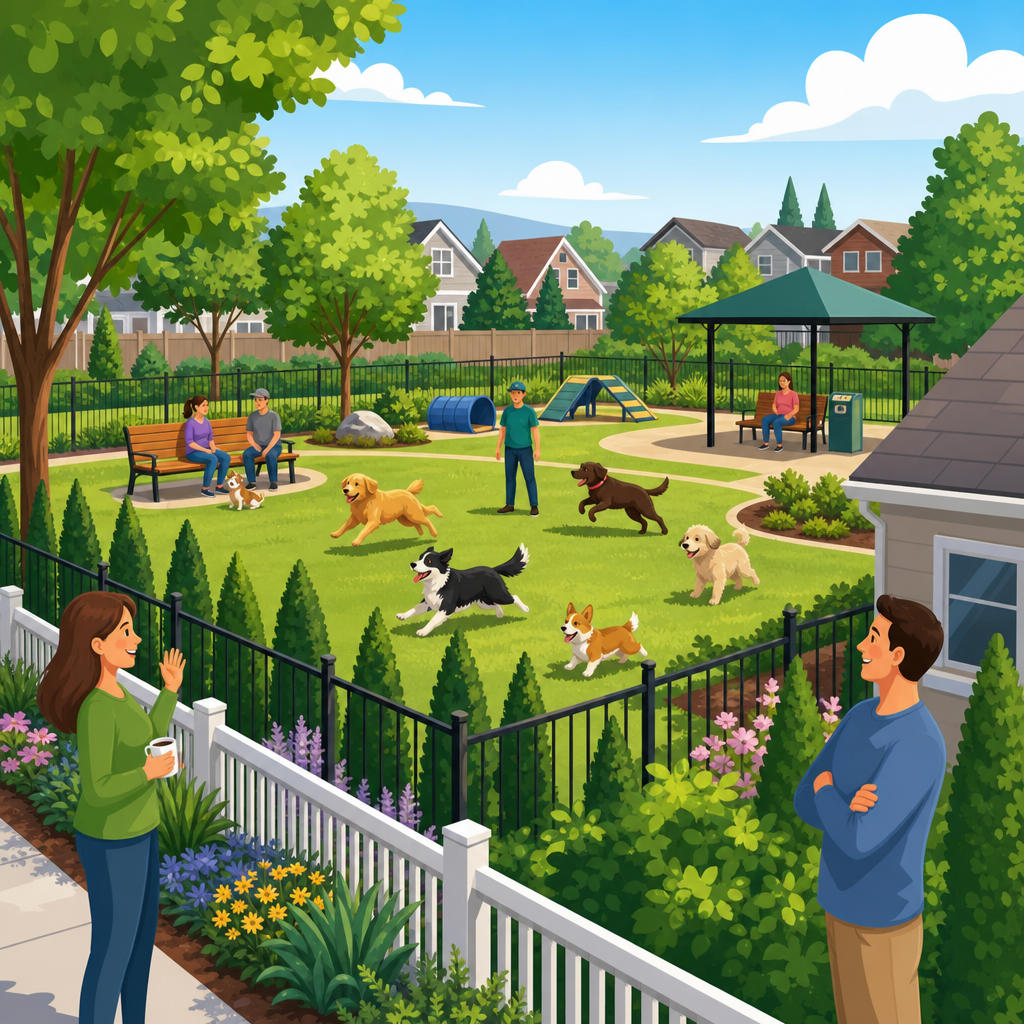
Many communities underestimate how much barking carries, especially in the early morning when ambient noise is low. The answer is not to promise silence, because that is unrealistic. The answer is layered buffering. Effective buffers combine setback distance with topographic separation, solid fencing where appropriate, and planting that screens views even if it provides limited acoustic benefit. A berm with dense evergreen planting can interrupt sightlines and reduce the feeling of constant activity. When dogs and people cannot easily see adjacent backyards, arousal and reactive barking often decrease.
Fence choice matters. Standard chain-link is durable and affordable, but it transmits views, movement, and some noise. In locations near homes, combining black vinyl-coated chain-link inside the park with a second solid or semi-solid perimeter element outside can reduce visual intrusion. Double-gate vestibules are essential because they cut escapes, improve safety, and reduce the chance that users cluster in entry areas while dogs bark at passersby. Orient entrances away from the closest residences and toward parking or internal paths. Small layout decisions change the sound profile more than many people expect.
Lighting needs restraint. If a park is close enough to homes that lighting spill is a concern, that is already a warning sign about the site. Still, where lighting is necessary for winter afternoons or safety near entries, use full cutoff fixtures, low mounting heights, dimming controls, and strict shutoff times. Continuous evening use is one of the fastest ways to create neighbor opposition. A dog park does not need stadium illumination. Most successful facilities set operating hours that align with broader park hours and communicate clearly that after-hours use is prohibited and enforced.
Design for capacity, durability, and sanitation
A crowded dog park creates conflict inside and outside the fence. Inside, overcrowding increases dog stress, fights, and nonstop barking. Outside, users spill into adjacent lawns and paths while waiting or exercising dogs elsewhere. Capacity planning should consider not only acreage but also the number of simultaneous users the site can support without surface failure. As a rule, bigger is better, but design quality matters too. Separate spaces for large and small dogs reduce incidents and improve user confidence. Multiple activity zones and looping paths disperse dogs instead of concentrating them at the gate.
Surface design is often the difference between a loved facility and a complaint magnet. Natural turf can work in lower-use parks with rotational closures, irrigation, resilient grass mixes, and active maintenance. In high-use urban parks, decomposed granite, engineered wood fiber in limited zones, or specialized synthetic turf systems with drainage layers may perform better. Each option has tradeoffs. Turf looks natural but fails under overuse. Aggregate drains well but can migrate and track. Synthetic systems are expensive and require strict sanitation protocols. There is no perfect surface, only a best fit for climate, budget, and usage intensity.
Waste management must be visible, easy, and redundant. Place bag dispensers at every entry and at internal decision points, not just one box by the gate. Trash receptacles should be lidded, animal-resistant where needed, and emptied often enough to avoid overflow on warm weekends. Water access should support both dogs and maintenance crews, with freeze-protected fixtures in cold climates. Hose bibs, quick couplers, and washdown zones make sanitation realistic rather than aspirational. If maintenance staff cannot clean the facility efficiently, neighbors will notice odors long before managers do.
| Design issue | Low-conflict solution | Why it works |
|---|---|---|
| Barking near homes | Set back the park, use berms, orient gates away from residences | Distance and broken sightlines reduce arousal and sound transmission |
| Parking overflow | Provide dedicated parking on collector roads with clear circulation | Prevents spillover onto local streets and reduces door-slamming near houses |
| Mud and odor | Install drainage layers, durable surfacing, and washdown access | Improves sanitation and prevents standing water and urine concentration |
| Dog escapes | Use double-gate entries and secure perimeter fencing | Improves safety and lowers fear among nearby walkers and residents |
| After-hours disturbance | Limit hours, add signage, lighting controls, and enforcement | Reduces nighttime noise, headlights, and unauthorized gatherings |
Create rules that are enforceable, not decorative
Signage alone does not manage behavior, but unclear rules guarantee conflict. Dog park rules should be short, specific, and enforceable under existing municipal code. Typical essentials include license and vaccination requirements, limits on the number of dogs per handler, minimum age for handlers, a prohibition on food and glass, immediate waste pickup, and mandatory leash use outside the enclosure. If local law already addresses dangerous dogs, nuisance barking, and hours of operation, the dog park signs should reference those rules consistently. Conflicting messages between parks staff and animal control erode credibility fast.
Operations planning should define who responds when problems occur. Is it parks maintenance, animal control, code enforcement, or police for after-hours trespass? Residents need one clear reporting path. In communities that manage this well, complaint logs are reviewed alongside maintenance records and parking observations so patterns become visible. If most complaints occur before 7 a.m., change opening times or increase patrols. If a gate area becomes a noise hotspot, redesign the approach rather than just posting more warnings. The strongest parks departments treat complaints as operational data, not as public relations issues.
Community stewardship helps, but it should not replace professional management. Volunteer groups can support fundraising, outreach, and cleanup days, yet responsibility for enforcement, repairs, and sanitation belongs to the municipality or site operator. I have seen cities rely too heavily on informal peer pressure, only to discover that a small number of repeat offenders can dominate the space. Good governance means documenting incidents, maintaining inspection schedules, and budgeting for fence repairs, surface replenishment, and fixture replacement. A dog park without a realistic operating budget will eventually externalize costs onto neighbors.
Engage neighbors early and keep measuring performance
Public engagement works best before a site is selected, not after drawings are complete. Nearby residents should be asked specific questions: what times of day are most sensitive, where does parking already overflow, which walking routes children use, and what environmental concerns exist on the site? That level of detail produces better plans than broad surveys asking whether people like dog parks in principle. People usually oppose impacts, not the concept itself. When they can see that buffers, drainage, and hours are being shaped around local conditions, trust rises.
Pilot strategies can reduce risk. Temporary fencing, limited hours, and a six-month evaluation period allow cities to test assumptions before permanent construction. During the pilot, collect data on noise complaints, parking occupancy, waste volumes, maintenance hours, and incident reports. Smartphone-based counters, camera systems that respect privacy laws, and routine site audits can provide a factual picture of use patterns. Measured performance is especially useful when critics claim the park is unmanageable or advocates claim every complaint is exaggerated. Data does not remove disagreement, but it makes decision-making defensible.
Long-term success depends on adaptation. Tree growth changes sightlines, neighborhoods densify, and park usage often rises after opening as word spreads. Reviewing conditions annually is prudent. Re-stripe parking if conflict emerges. Add acoustic fencing at a persistent hotspot. Convert a worn turf area to a more durable surface. Shift hours seasonally if dark winter evenings create headlights into homes. Good dog park design is not one static blueprint. It is a system of siting, physical design, operations, and feedback that keeps neighborhood impacts below the threshold that turns irritation into organized opposition.
The central lesson is straightforward: dog parks do not create neighbor conflict because dogs are unwelcome in cities; conflict happens when planners treat them as simple amenities instead of specialized public facilities. The lowest-conflict parks are carefully sited away from the most sensitive residential edges, connected to appropriate roads and parking, buffered to reduce noise and visibility, engineered for drainage and heavy wear, and operated with rules that can actually be enforced. Every one of those choices is more effective than trying to solve a bad location with cosmetic improvements after complaints begin.
For municipalities, designers, and neighborhood groups, the practical benefit of this approach is durability. A well-planned dog park protects nearby quality of life while giving owners a legal, attractive place to exercise dogs off leash. That reduces pressure on school grounds, sports fields, trails, and habitat areas elsewhere in the community. Start with site analysis, map likely conflict points, budget for maintenance from the beginning, and evaluate performance after opening. If you are planning a new facility, use these principles as your checklist before finalizing the site and design.
Frequently Asked Questions
What is the most important principle when designing a dog park that will not create conflict with neighbors?
The most important principle is to treat the dog park as civic infrastructure, not just a recreational amenity. That means the design process should begin by asking how the park will affect nearby residents, streets, drainage systems, maintenance staff, and public safety operations, rather than focusing only on what dog owners want inside the fence. Neighbor conflict usually starts when a park is planned too narrowly. A site may seem convenient on paper, but if it places barking dogs near bedroom windows, funnels car traffic onto a quiet residential street, or creates muddy runoff into adjacent yards, the project will quickly generate opposition.
Successful dog parks are typically the result of balanced planning. They are placed with enough separation from homes to reduce repetitive noise, designed with parking that matches actual demand, and built with durable surfaces and drainage systems that prevent odor, mud, and maintenance failures. They also include circulation patterns, fencing, lighting, signage, and rules that support safe behavior and predictable use. Just as important, the public process matters. When neighbors feel heard early, they are more likely to support solutions such as landscape buffers, restricted hours, or alternative access routes. In practical terms, the best principle is simple: design the park around compatibility with its surroundings, not just capacity for dogs.
How far should a dog park be from homes to reduce barking and privacy concerns?
There is no single universal setback that solves every problem, because sound behavior depends on topography, building orientation, fencing, vegetation, park size, and how many dogs use the site at one time. However, as a planning and design strategy, more distance is almost always better when homes are nearby, especially where park activity would align with sensitive spaces such as bedrooms, patios, and small backyards. Repetitive barking can be more frustrating to neighbors than occasional peak noise because it interrupts routines early in the morning, in the evening, and on weekends when people expect quiet enjoyment of their property.
Instead of relying on distance alone, good design combines setback with buffering. This often includes placing the active dog run away from residential edges, using parking lots, open lawns, or maintenance zones as separation areas, and installing earth berms, dense planting, solid or partially sound-moderating fencing, and strategic gate locations. Designers should also pay attention to line of sight. Dogs frequently bark more when they can directly see passing pedestrians, other dogs, or activity in adjacent yards. Redirecting sightlines through planting or fence treatments can reduce visual triggers. Park hours are another major tool. Limiting very early and late use can meaningfully reduce complaints. In short, the right answer is not just “how far,” but “how well buffered, how well oriented, and how well managed.”
What design features help control noise, traffic, and parking overflow around a dog park?
Noise, traffic, and parking are the three issues that most often turn a well-intentioned dog park into a neighborhood flashpoint, so they should be addressed as core design criteria from the beginning. For noise control, the most effective measures include proper siting, separation from homes, use of vegetated buffers and berms, orientation of the main play areas away from residential property lines, and materials that reduce visual stimulation. Double-gated entries and clear circulation inside the park also help because they reduce chaos near the entrance, where barking often intensifies when dogs arrive and leave.
For traffic, the goal is to prevent the park from pushing vehicle activity onto streets that were never meant to absorb frequent turnover. A good plan looks at how users will approach the site, whether surrounding intersections can safely handle added trips, and whether pedestrians and cyclists can enter without crossing dangerous drive aisles. If the dog park is expected to draw users from a wide area, it should not depend on informal curb parking in front of homes. Dedicated parking sized to realistic peak use is essential, and overflow should be studied honestly rather than assumed away.
Parking design should also reduce conflict on site. Marked spaces, ADA access, one-way circulation where appropriate, and a layout that prevents vehicle backups at entry points all matter. Time patterns should be considered too, since dog parks often experience sharp peaks in the early morning, after work, and on weekends. In some locations, reservation systems are unnecessary, but managed hours, signs directing users to designated parking, and enforcement against illegal parking can make a major difference. If a site cannot safely accommodate expected arrivals without spilling into nearby residential areas, it is usually a sign that the park is in the wrong location or needs to be redesigned before construction.
How can stormwater, mud, odor, and maintenance problems contribute to neighbor complaints, and how should they be addressed?
These issues are often underestimated because they develop gradually, but they can be just as damaging as noise. A dog park with poor drainage can turn into a muddy, unsanitary area that tracks dirt onto sidewalks, carries waste-contaminated runoff into storm drains, and creates persistent odor in warm weather. Once that happens, nearby residents may see the facility not as a community asset, but as a source of nuisance and neglect. In many communities, complaints rise not because the original idea was bad, but because the site was built without enough thought for long-term operations.
The design response starts with grading and drainage. The park should shed water in a controlled way, avoid low spots where waste and water collect, and use surfaces suited to heavy dog traffic. Depending on climate and maintenance capacity, that may mean reinforced turf systems, decomposed granite, engineered wood fiber in limited areas, or other durable materials paired with rest periods for turf recovery. Waste stations need to be numerous, obvious, and easy to service. Trash receptacles should be placed conveniently but not in a way that creates odor concentration near neighboring homes or park entries.
Maintenance planning is equally important. A dog park that cannot be cleaned, repaired, and resurfaced on a realistic schedule will eventually generate conflict no matter how good the concept was. Water access, hose bibs, storage, lighting for staff visibility, and gate widths for maintenance equipment should all be considered during design. Rotational use areas can reduce wear, and posted rules can support cleaner conditions, but those only work when backed by regular staff attention. In practice, one of the strongest ways to protect neighborhood support is to demonstrate that the city or operator has both the budget and the operational plan to keep the site clean, dry, and functional over time.
How do community engagement and operating rules help prevent dog park disputes before they start?
Community engagement and operating rules are often the difference between a park that is tolerated and a park that is genuinely supported. Even an excellent physical design can run into resistance if neighbors feel the project was imposed on them without notice. Early outreach allows planners to identify concerns before they harden into opposition. Residents may point out issues that are easy to miss in a site analysis, such as where headlights shine into homes, where informal parking already causes stress, or where evening sound carries farther than expected. Bringing those observations into the design process builds trust and usually leads to better outcomes.
Operating rules matter because they set expectations and make the park feel managed rather than chaotic. Typical best practices include posted hours, leash requirements outside the enclosure, vaccination and behavior standards, limits on food or certain equipment, rules for waste pickup, and procedures for reporting hazards or aggressive incidents. Clear rules help users understand that the facility is a shared public space with responsibilities, not an anything-goes enclosure. Enforcement matters too. If rules exist only on a sign and are never supported by staff presence or follow-up, neighbors will quickly lose confidence.
Many successful dog parks also benefit from a stewardship model. Friends groups, volunteer ambassadors, or formal partnerships can support education, report maintenance needs early, and create a culture of respectful use. This does not replace municipal responsibility, but it does strengthen accountability. Most importantly, engagement should continue after opening. Monitoring complaints, observing traffic patterns, reviewing maintenance conditions, and adjusting hours or operations when needed show that management is responsive. That responsiveness is one of the strongest tools available for preventing long-term neighbor conflict.