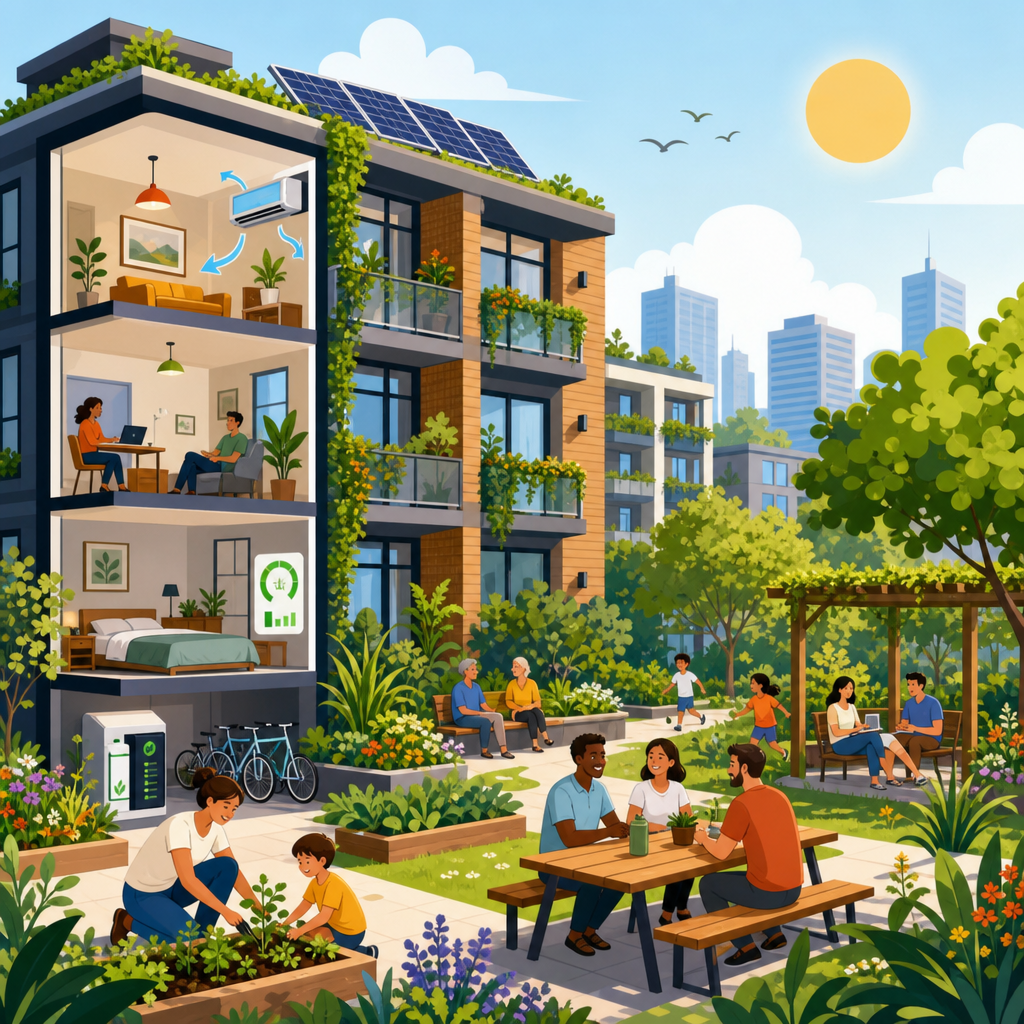
Shared outdoor space changes residential building performance by influencing energy use, thermal comfort, stormwater control, resident health, maintenance demands, and long-term asset value. In practice, courtyards, roof terraces, communal gardens, play streets, shaded setbacks, and semi-public entry zones are not decorative leftovers between buildings; they are operating components of the building system. When I have reviewed multifamily schemes after occupancy, the projects with well-designed common exterior space consistently performed better in resident satisfaction, summer heat management, and day-to-day building stewardship than similar projects that treated open area as residual circulation. Residential building performance, in this context, means more than energy benchmarks. It includes environmental metrics such as solar gain, air movement, runoff reduction, and biodiversity support, but also social and financial outcomes: fewer complaints, stronger retention, reduced vandalism, safer access, and better use of shared amenities. Shared outdoor space matters because housing is increasingly expected to do several jobs at once. It must provide comfort during heat waves, manage heavier rainfall, support aging residents and families, and remain economically viable under tighter operating budgets. Designers, developers, and housing operators who understand how common exterior areas affect building performance make better decisions about massing, materials, drainage, planting, and management from the start.
The term shared outdoor space covers any exterior area used by multiple residents rather than one household alone. That includes central courtyards in apartment blocks, common balconies, green roofs with access, podium gardens above parking, community allotments, perimeter walking loops, and widened entrance landscapes that function as social thresholds. These spaces shape building behavior through measurable mechanisms. Trees and trellises lower surface temperatures and reduce cooling demand. Permeable soils and rain gardens slow runoff and reduce drainage loads. Exterior gathering areas distribute occupancy and improve indoor air quality by giving residents alternatives to crowded interior lounges. Carefully arranged setbacks improve daylight while preserving privacy. Good layouts also support passive surveillance, a principle long validated in housing management, by increasing visibility and routine use. Poorly designed shared space can do the opposite. Large unshaded hardscape courts become heat sinks. Oversized lawns consume irrigation and provide little habitat. Under-programmed corners attract dumping and antisocial behavior. The central question is not whether shared outdoor space is good in theory, but how it is planned, detailed, and managed so it improves residential building performance across climate, health, and operational outcomes.
Microclimate, Energy, and Thermal Comfort
Shared outdoor space affects building performance first through microclimate. The arrangement of vegetation, paving, water, walls, and shade structures changes how heat, wind, and sunlight interact with the building envelope. In dense residential projects, this can materially alter indoor conditions. Deciduous trees on western exposures reduce late-afternoon solar gain during summer while allowing winter sunlight after leaf drop. Pergolas, deep canopies, and planted courtyards can lower adjacent wall and glazing temperatures, reducing cooling loads and improving comfort in perimeter apartments. The effect is especially important in cities facing stronger urban heat island conditions, where hard surfaces store heat and re-radiate it at night. The U.S. Environmental Protection Agency and similar agencies internationally have repeatedly noted that shade trees and high-albedo materials can reduce surface and ambient temperatures at the site level.
Courtyard geometry matters. A narrow, deep court may provide shade but limit breezes and daylight if proportions are wrong. A broader courtyard with mixed canopy layers, light-colored paving, and shaded seating often performs better because it balances solar access, ventilation, and usability. I have seen apartment schemes in warm climates where replacing dark pavers with lighter, lower-heat materials and adding tree trenches cut peak courtyard surface temperatures dramatically, making the space usable in the afternoon and lowering heat stress on lower-floor units. Wind also needs calibration. In cooler climates, buildings and planting can be arranged to buffer prevailing winter winds at entrances and play areas. In hot-humid climates, preserving airflow through raised canopies and porous fencing may be more valuable than enclosing the space heavily. Good shared outdoor space is therefore not generic landscaping. It is site-specific environmental engineering expressed through landscape and massing choices.
Stormwater Management, Water Efficiency, and Resilience
Shared outdoor spaces are often the most practical location for water-sensitive design in residential developments. Instead of sending rain immediately into pipes, common exterior areas can retain, infiltrate, filter, and slowly release stormwater. Bioswales along access routes, rain gardens in courtyards, permeable paving in gathering areas, and cistern-fed irrigation systems all improve site performance. These strategies matter because many cities are seeing more intense rainfall events, and conventional drainage infrastructure is frequently overloaded. When a housing project manages water on site, it reduces flood risk, sewer surcharge, erosion, and maintenance stress. It can also improve water quality by trapping sediments and pollutants before discharge.
There are tradeoffs, and they are manageable with proper detailing. Permeable paving fails when subgrades clog and maintenance is ignored. Planter drains must be accessible. Soil depth must match the planting strategy and expected retention volumes. In multifamily housing, irrigation systems for communal gardens should be zoned and metered, because overwatering is one of the most common reasons landscapes underperform financially. The strongest projects treat shared outdoor space as blue-green infrastructure with maintenance plans, not as an aesthetic layer added at the end. In one mid-rise housing development I evaluated, a podium garden originally designed with shallow ornamental planters suffered repeated die-off and ponding. After retrofit with deeper soil profiles, overflow controls, and drought-tolerant planting, the same space began retaining rainfall effectively while cutting replacement planting costs. Resilience improved because the outdoor space was redesigned to perform hydrologically, not merely look planted.
Health, Social Use, and Building Operations
Shared outdoor space also changes performance by altering how residents live in and around the building. Access to usable common exterior areas is associated with more physical activity, lower perceived stress, stronger social ties, and better mental restoration, especially in higher-density housing where private outdoor space is limited. The mechanism is straightforward: people are more likely to spend time outside when spaces feel safe, comfortable, visible, and relevant to daily life. A bench under shade near the entrance supports older residents. A loop path supports walking. A play edge visible from seating areas helps caregivers supervise children. A productive garden creates routine use and resident stewardship. These patterns matter operationally because active, watched spaces tend to experience fewer nuisance issues than abandoned ones.
Management teams notice the difference quickly. Buildings with successful shared outdoor areas often see fewer complaints about crowded lobbies and less pressure on interior amenity rooms. Leasing teams use these spaces as evidence of quality, but the real performance gain comes after move-in: residents stay longer when the building supports everyday routines beyond the apartment door. Social design should not be confused with overscheduling every corner. Some residents want quiet retreat, not programmed events. Strong schemes provide a gradient from public to semi-private to calm, with clear sightlines and durable furniture. Accessibility is non-negotiable. Routes should comply with recognized accessibility standards, seating should include backs and arms, and thresholds should avoid unnecessary level changes. When outdoor common space works for children, older adults, and people with limited mobility, the building serves a broader resident base and reduces exclusion-driven turnover.
| Shared outdoor space type | Primary performance benefit | Design requirement | Common failure point |
|---|---|---|---|
| Central courtyard | Improves daylight balance, social use, and passive cooling | Shade, airflow, durable seating, visible access | Too much hardscape creating heat buildup |
| Roof terrace | Adds amenity value and can reduce roof heat gain | Wind control, planting depth, waterproofing protection | High maintenance and poor summer usability |
| Rain garden | Manages runoff and improves water quality | Correct soil media, overflow routing, maintenance access | Clogging, standing water, neglected planting |
| Community garden | Supports health, stewardship, and social cohesion | Sunlight, tool storage, water access, management rules | Conflict over plots and seasonal neglect |
| Shaded entry landscape | Improves first impression, comfort, and passive surveillance | Lighting, shade, clear wayfinding, seating | Decorative design with no functional use |
Economic Value, Maintenance, and Asset Performance
Developers sometimes view shared outdoor space as a cost center because it consumes land area and requires ongoing care. That is too narrow. The better question is whether the space increases total asset performance over time. In many markets, the answer is yes when design and management are aligned. Attractive, functional common outdoor areas support leasing velocity, perceived quality, and resident retention. They can justify stronger positioning in competitive multifamily segments, especially where unit sizes are compact. For affordable and social housing providers, the value may show up less in rent premium and more in lower turnover, better resident satisfaction scores, and reduced wear on interior communal areas. Exterior spaces can also protect the building physically by limiting splashback near façades, managing roof exposure, and reducing heat stress on membranes and finishes.
Maintenance discipline determines whether these gains persist. The most successful projects specify robust materials and simple planting palettes suited to local conditions. That means avoiding fragile furniture, undersized tree pits, and high-water lawns that cannot be maintained under real budgets. It also means writing maintenance responsibilities into operating plans from the outset. Who cleans drains in planter beds? Who replaces dead shrubs? Who manages resident use of grills or garden plots? These are performance questions, not housekeeping details. I have seen expensive shared terraces become liabilities because the operations team inherited complex irrigation, slippery decking, and no replacement budget. By contrast, straightforward designs using native or climate-adapted planting, unit pavers with accessible bases, and modular seating have held up well for years. Asset value rises when outdoor space is designed for lifecycle cost, not opening-day photography.
Planning Principles for High-Performing Shared Outdoor Space
The best shared outdoor spaces start with a few disciplined planning principles. First, place the space where residents will naturally pass through or overlook it. Visibility drives use and safety. Second, match the space type to the building and resident profile. Family housing benefits from supervised play edges and stroller-friendly paths, while senior housing often benefits more from sheltered seating, smooth walking circuits, and low-glare lighting. Third, design for climate before aesthetics. Shade, drainage, wind moderation, and water access should be solved early, alongside massing and structure. Fourth, create a hierarchy of use. A successful site usually combines active zones, social zones, and quiet zones rather than forcing one space to do everything. Fifth, coordinate landscape, architecture, and property management from the beginning. Outdoor space fails most often when each discipline assumes another will resolve drainage, lighting, storage, or rules of use.
Measurement should continue after completion. Post-occupancy review can track whether the shared outdoor space is actually changing residential building performance. Useful indicators include summer surface temperatures, stormwater retention, frequency of use, resident satisfaction, complaint patterns, irrigation consumption, and maintenance callouts. Even simple observations reveal a lot: where people sit, when they avoid the space, whether children can play safely, whether planting survives seasonal stress. These findings should feed future design decisions across a housing portfolio. Shared outdoor space is not a luxury layer added after architecture is finished. It is part of the building’s environmental, social, and financial operating system. When it is planned with the same rigor given to structure, envelope, and mechanical systems, it improves resilience, comfort, and value in ways residents notice every day.
Shared outdoor space changes residential building performance because it affects the fundamentals of how a building handles climate, water, people, and cost. Well-designed common exterior areas reduce heat stress, support passive comfort, retain stormwater, and expand the practical living area of higher-density housing. They also strengthen resident wellbeing and day-to-day operations by creating visible, useful places that invite routine use rather than neglect. The opposite is also true: poorly planned outdoor space can increase maintenance burdens, worsen heat buildup, and create underused areas that weaken the building experience. That is why successful projects treat courtyards, terraces, gardens, and entry landscapes as core infrastructure.
For teams working within sustainable urban development, the main benefit is clear. Shared outdoor space helps one residential project deliver several outcomes at once: environmental performance, resident health, social resilience, and stronger asset durability. The key is to design these spaces around climate, access, management, and actual patterns of use, then measure results after occupancy. If you are planning a new housing project or improving an existing one, audit the shared outdoor areas first. Look at shade, drainage, seating, visibility, planting, and maintenance responsibilities. Small design changes in those shared spaces often produce outsized improvements across the whole building.
Frequently Asked Questions
1. How does shared outdoor space improve residential building performance beyond aesthetics?
Shared outdoor space improves residential building performance because it directly affects how the building manages heat, water, air movement, occupancy patterns, and resident behavior. In strong multifamily projects, courtyards, roof terraces, communal gardens, shaded setbacks, and semi-public entry zones function as part of the building’s operating system rather than as leftover open areas. For example, a well-proportioned courtyard can increase daylight access, support cross-ventilation, and reduce localized heat buildup around residential units. Shaded outdoor areas can lower solar gain on adjacent façades, which can reduce cooling loads during warm periods. Landscaped surfaces and permeable paving can absorb and slow stormwater runoff, taking pressure off drainage infrastructure and lowering flood risk around foundations and access routes.
There is also a human performance dimension. When residents have access to attractive, usable shared exterior areas, they are more likely to spend time outside their units, move through the building more frequently, and use common circulation spaces in healthier, more social ways. That can change how internal amenity areas, corridors, and even mechanical systems are used over time. Buildings with high-quality shared outdoor space often experience better resident satisfaction, stronger retention, and more consistent care of communal areas, all of which support operational stability. In other words, outdoor common space influences both physical building performance and occupancy performance, and the best results come when these spaces are designed intentionally from the start.
2. What is the relationship between shared outdoor space and energy use in residential buildings?
The relationship is significant because shared outdoor space can moderate the microclimate around a building and influence how much heating, cooling, and artificial lighting the building needs. Trees, pergolas, planted buffers, and strategic shading elements can reduce heat gain on walls, windows, and paved surfaces. This helps lower surrounding air temperatures and can reduce the cooling demand in units that face exposed courtyards, terraces, or streets. In cooler seasons, site layout and wind buffering can also improve comfort near entrances and circulation areas, reducing drafts and heat loss in frequently used transition zones.
Shared outdoor spaces also affect energy use indirectly through daylight and ventilation. When buildings are arranged around a courtyard or open communal zone with proper orientation and spacing, more units may receive balanced daylight and access to operable windows with useful airflow. That can reduce dependence on electric lighting during the day and lower demand for mechanical cooling when outdoor conditions are favorable. Semi-public entry zones and covered exterior circulation can further reduce the burden on conditioned interior space by creating thermal transition areas. The key point is that energy performance is not determined by insulation and equipment alone. The exterior common space around and within the building can meaningfully improve or undermine the efficiency of the whole residential system.
3. How do courtyards, communal gardens, and roof terraces affect resident comfort and health?
These spaces can have a major effect on both physical comfort and overall well-being. From a thermal comfort perspective, shared outdoor areas can provide shade, breeze, seating options, and seasonal flexibility that make the building feel more livable throughout the year. Residents benefit when there are different microclimates available, such as sunny seating in cooler months, shaded gathering spots in summer, and planted areas that reduce glare and reflected heat. This variety matters because comfort is highly dependent on time of day, age, activity level, and exposure. A building that offers usable outdoor environments gives residents more control over how and where they spend time, which is an important aspect of comfort that is often overlooked in purely technical performance discussions.
Health benefits are just as important. Access to shared outdoor space supports routine movement, informal social contact, and restorative time outside, all of which are linked to better mental and physical health outcomes. Families benefit from visible play areas, older residents often benefit from walkable and shaded seating zones, and all residents gain from having places to step outside without leaving the property. Communal gardens can encourage light activity, resident interaction, and stewardship, while roof terraces can create valuable open-air amenity in dense urban settings where ground-level space is limited. After occupancy, projects with well-designed and well-managed shared outdoor areas often show stronger community use patterns and fewer complaints about isolation, inactivity, or lack of amenity. That makes these spaces important not only for lifestyle but for measurable residential performance over time.
4. Can shared outdoor space help with stormwater management and site resilience?
Yes, and this is one of the most practical performance benefits. Shared outdoor space can be designed to capture, slow, filter, and reuse stormwater rather than simply pushing it into overburdened drainage systems. Communal gardens, bioswales, rain gardens, planted setbacks, tree pits, and permeable paving all contribute to better water management at the residential site scale. Instead of treating exterior common space as hardscape only, resilient projects use grading, soil depth, planting design, and water-tolerant landscape strategies to reduce runoff velocity and improve infiltration. That lowers ponding risks, protects walkways and entrances, and can reduce wear on below-grade waterproofing and drainage infrastructure.
Site resilience also improves when outdoor spaces are designed for multiple functions. A courtyard can be both a social amenity and a stormwater detention area during peak rainfall events if the surface design and planting strategy support that purpose. Roof terraces can include planting systems that reduce runoff and moderate roof temperatures at the same time. Shaded setbacks and planted edges can help stabilize soil, reduce erosion, and improve the durability of the site during extreme weather. From an operations perspective, this matters because unmanaged water is one of the most expensive and persistent threats to residential building performance. Shared outdoor space, when properly detailed and maintained, can become a first line of defense against water-related damage while also delivering environmental and social value.
5. What design and maintenance factors determine whether shared outdoor space adds long-term value?
Long-term value depends on whether the space is usable, durable, climate-responsive, and realistically maintainable. The most successful shared outdoor spaces are not oversized gestures with no clear purpose. They are designed around actual resident needs, circulation patterns, and management capacity. That means providing appropriate seating, shade, lighting, drainage, visibility, and access while making sure the space feels safe and easy to use. A beautiful terrace that overheats, a courtyard with poor drainage, or a garden that requires specialized upkeep the property team cannot support will underperform quickly. By contrast, spaces that are comfortable, legible, and easy to care for tend to stay active and attractive, which reinforces resident satisfaction and protects the property’s reputation.
Material choice and management strategy are equally important. Exterior finishes should tolerate weather exposure, wear, and regular cleaning. Planting should match local climate conditions, irrigation capacity, and maintenance staffing. Designers and owners should think carefully about storage, furniture durability, irrigation access, seasonal use, security, and who is responsible for upkeep. When those basics are resolved well, shared outdoor space can support leasing performance, resident retention, and long-term asset value because it becomes a visible sign of quality and livability. In post-occupancy reviews, the residential schemes that perform best are usually the ones where shared outdoor space was treated as an essential operational component of the property, not as decorative surplus between buildings.