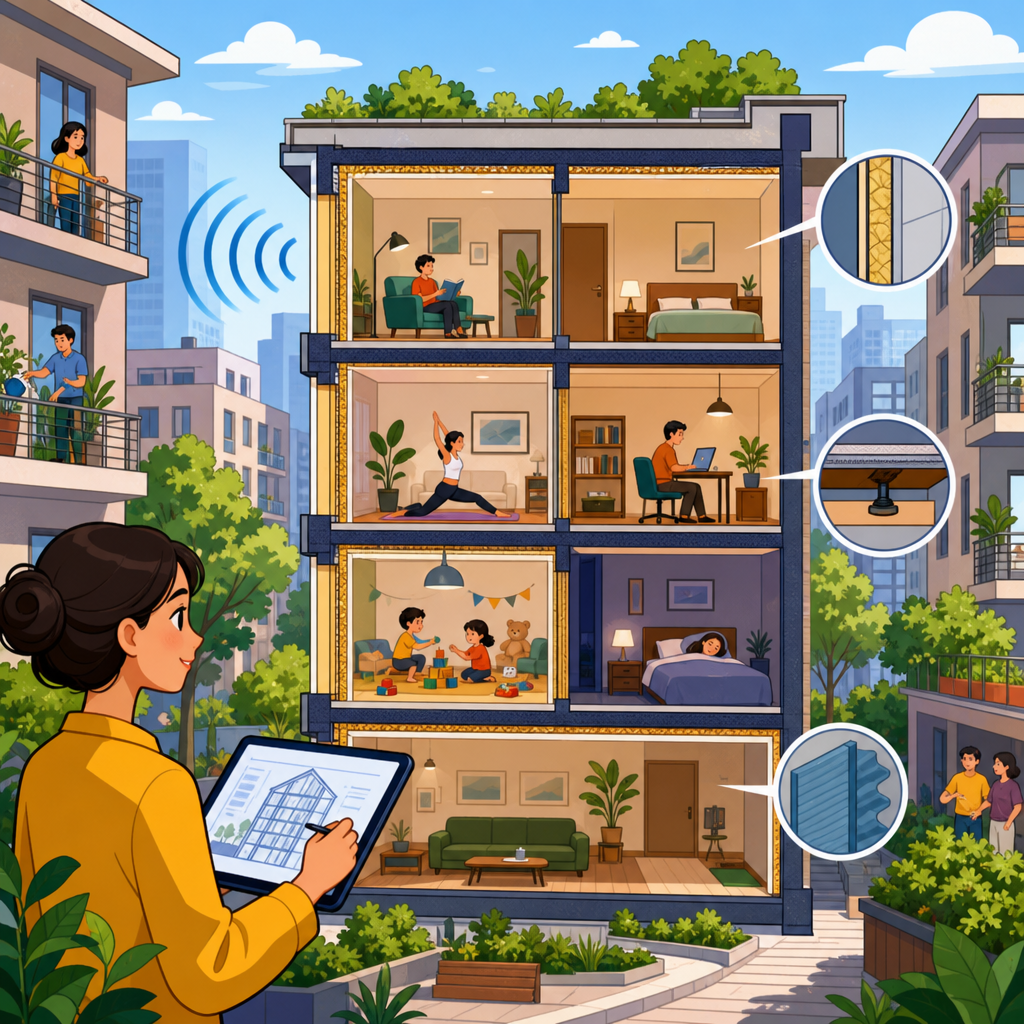
Acoustic design for high-density housing determines whether apartments feel restorative or relentlessly stressful, and the difference is usually locked in long before residents move in. In practical terms, acoustic design is the planned control of airborne noise, impact noise, vibration, reverberation, and sound transmission paths through walls, floors, facades, corridors, services, and shared structure. High-density housing includes apartment buildings, mixed-use residential towers, student accommodation, build-to-rent schemes, and compact urban infill projects where many households share boundaries. Reducing noise complaints early matters because post-occupancy fixes are expensive, disruptive, and often partial, while early-stage decisions on massing, structure, wall build-ups, facade specification, and building services can prevent problems at their source. In projects I have worked on, the noisiest disputes rarely came from extreme events; they came from ordinary living sounds made more noticeable by weak detailing, poor flanking control, or unrealistic assumptions about how people occupy homes. Good acoustic design supports wellbeing, privacy, sleep quality, resident retention, and long-term asset value. It also aligns with sustainable urban development by making denser living acceptable, durable, and socially resilient rather than merely efficient on paper.
Why noise complaints happen in dense housing
Noise complaints in apartments usually fall into four categories: neighbors heard through walls or floors, footfall and furniture movement from above, noise entering from outside, and building services noise from lifts, plumbing, fans, heat pumps, or waste systems. The key point is that residents judge their homes by audibility and disturbance, not by drawing details. A party wall can pass a laboratory rating and still generate complaints if flanking paths bypass it through slab edges, facade interfaces, continuous ceiling voids, or rigid service penetrations. Likewise, a premium facade can underperform if trickle vents, poorly sealed openings, or lightweight spandrel panels become weak points. Complaints also cluster around predictability. People tolerate urban sound better when bedrooms are protected at night, internal background noise is low, and sudden tonal or intermittent sounds are controlled.
Dense housing amplifies risk because more homes mean more adjacency conditions and more combinations of noise source and receiver. A stacked bathroom over a bedroom, a gym below flats, a refuse chute near a study area, or a rooftop plant enclosure above penthouses each create specific transmission challenges. Mixed-use schemes are especially sensitive. I have seen retail delivery bays trigger residential complaints despite compliant facade glazing because vibration entered the structure through loading equipment and re-radiated inside bedrooms. That is why complaint reduction starts with zoning and building layout, not just product selection. Separate noisy and quiet uses wherever possible, stack similar room types, place circulation and storage buffers between homes, and protect bedrooms from both street noise and internal service risers. These moves cost little at concept stage and can save substantial remediation later.
Design decisions that matter before planning and schematic design freeze
The earliest design phases set the acoustic ceiling for the whole project. Site analysis should identify dominant external sources such as arterial roads, rail corridors, nightlife streets, schools, plant yards, or intermittent construction zones. For each facade, estimate daytime and night-time exposure, then assign room uses accordingly. Bedrooms should go to the quietest elevation whenever the plan allows. Where that is impossible, use winter gardens, inset balconies, acoustic screens, or double-skin strategies with careful ventilation planning. Single-aspect dwellings facing persistent night noise are inherently harder to make comfortable than dual-aspect layouts, and that planning reality should be acknowledged early rather than hidden in later specifications.
Structural choice matters just as much. Heavier floor slabs generally improve airborne sound insulation, but impact performance depends heavily on floor finishes, resilient layers, and edge isolation. Cross-laminated timber can perform well when designed properly, yet it demands disciplined attention to junctions, vibration control, and low-frequency behavior. Concrete frames offer mass, but rigidly connected facade brackets, service supports, and lightweight partitions can still create transmission bridges. I routinely advise teams to map likely flanking routes at concept stage: slab-to-facade, corridor-to-unit walls, riser walls, balcony connections, and door undercuts to common areas. Once these are visible, coordination improves because every consultant can see where a seemingly minor penetration or support detail could undermine privacy.
| Early decision | Acoustic effect | Typical consequence if ignored |
|---|---|---|
| Stack bedrooms over bedrooms | Reduces mismatch between noisy and quiet activities | Sleep disturbance from bathrooms, kitchens, or living rooms above |
| Buffer homes from lifts and plant with corridors or storage | Lowers structure-borne and airborne exposure | Recurring complaints about humming, starts, and braking events |
| Assess each facade by day and night noise | Targets glazing, ventilation, and room placement correctly | Over-specified quiet facades and under-protected bedrooms |
| Coordinate risers and drainage routes early | Controls plumbing noise and avoids boxed-in surprises | Flush noise, water hammer, and costly late rerouting |
| Plan flanking control at junctions | Preserves wall and floor performance in the real building | Field results much worse than laboratory expectations |
Walls, floors, facades, and flanking transmission
Residents experience sound transmission as a system, not as isolated elements. For party walls, the practical target is robust airborne insulation with airtight construction, discontinuity where needed, and disciplined sealing around all penetrations. Double-stud or staggered-stud walls with insulation and separated linings can outperform thinner single-frame assemblies, but workmanship is decisive. Even small gaps at perimeter seals, socket back-boxes, or poorly packed deflection heads can materially reduce performance. For floors, the common mistake is to focus on slab thickness while underestimating impact noise. Hard floor finishes without resilient underlay are a complaint generator. A floating floor, resilient ceiling hangers, and edge strips at screeds or finishes are often the difference between acceptable and unacceptable living conditions.
Facades require a balanced view of glazing, frame performance, air leakage, and ventilation. Standard double glazing may be adequate on a quiet street yet fail near rail or high-speed traffic, especially where low-frequency content is strong. Glass thickness asymmetry, larger cavity depths, laminated panes, and acoustically rated vents can all improve performance, but they must be matched to measured or modeled spectra. Open windows are the defining challenge. If overheating strategy relies on openable windows on a noisy facade, the acoustic benefit of high-performance glazing disappears at the moment residents need ventilation. That is why acoustic design cannot be separated from thermal and ventilation design. Mechanical ventilation with heat recovery, attenuated supply paths, or quiet courtyard ventilation routes often become enabling measures rather than optional upgrades.
Flanking transmission is where many projects lose control. Sound can travel around a separating element through connected structure, suspended ceilings, raised floors, facade cavities, service voids, or continuous lightweight partitions. Standards and pre-completion testing help, but they do not replace junction design. I treat slab edges, partition heads, service cupboards, and facade interfaces as high-risk details requiring mock-ups or peer review. On one urban residential tower, a compliant party wall was bypassed by a continuous corridor ceiling plenum that linked several apartments; sealing and compartmenting that void solved more complaints than adding mass to the wall would have. The lesson is consistent: details at interfaces decide whether the specification survives construction.
Building services, amenities, and mixed-use conflicts
Mechanical, electrical, and plumbing systems are among the most underestimated sources of dissatisfaction. Residents notice tonal fan noise, intermittent pump starts, lift machinery, pipe flow, valve chatter, and drainage stack noise because these sounds are repetitive and hard to ignore at night. The solution starts with equipment selection, but it does not end there. Low-noise fans, variable speed drives, and hydraulically stable pipework help, yet structure-borne transmission through supports, bases, and connected services can still dominate. Equipment should be mounted on suitable isolators, connected with flexible connectors where appropriate, and kept away from noise-sensitive rooms. Plant rooms above bedrooms remain a bad idea even when calculations look comfortable, because maintenance drift and future replacement can erode margins.
Drainage deserves special attention in apartment design. Vertical stacks beside bedrooms or living rooms routinely create complaints if pipes are rigidly fixed, lightly boxed in, or combined with hard finishes that re-radiate sound. Proprietary acoustic pipe systems, resilient brackets, increased enclosure mass, and thoughtful routing are proven measures. Water supply systems also need pressure management to avoid hiss and hammer. For lifts, machine-room-less systems can save space but require careful structural and acoustic coordination around rails, motors, and landing doors. Refuse chutes, parcel rooms, access control devices, and garage doors are smaller sources individually, yet in aggregate they shape residents’ impression of building quality.
Amenities and mixed-use components can add value while creating conflict if acoustics are treated late. Gyms transmit impact and vibration into adjacent homes unless heavy free-weight zones are isolated on sprung floors and separated from sensitive occupancies. Roof terraces can become social hotspots over penthouse bedrooms. Restaurants and bars need control of music breakout, kitchen extract noise, and delivery activity. Even coworking lounges generate complaints when movable furniture and hard finishes amplify evening use. The disciplined approach is to write acoustic criteria for each use at briefing stage, allocate enough construction depth for isolation, and define management rules alongside physical design. Good operations cannot rescue a weak assembly, but weak operations can certainly defeat a good one.
Verification, procurement, and preventing failures on site
Acoustic intent often fails between design documentation and handover. To avoid that gap, set measurable performance targets for airborne insulation, impact insulation, facade sound reduction, internal ambient noise, reverberation in common areas, and maximum services noise in habitable rooms. Use recognized references appropriate to the jurisdiction, such as national building regulations, housing design guides, and environmental noise standards, then translate them into project-specific criteria. Tender packages should identify critical junctions, sealant requirements, back-box treatments, service penetration rules, and any tested assembly that must be replicated exactly. When contractors are left to value-engineer without acoustic guardrails, resilient layers disappear, cavity barriers become bridges, and lightweight substitutions undermine privacy.
Field verification is essential because laboratory ratings represent ideal conditions. Pre-construction mock-ups can de-risk unusual assemblies, especially timber structures, modular housing, mixed-use podium interfaces, and facades facing dominant transport noise. During construction, hold inspections before closures: verify insulation continuity, perimeter sealing, isolation strips, pipe brackets, floating floor edges, and independent framing. Commissioning should include not only mandated sound tests but also services noise measurements under realistic operating modes. I have found that night-mode testing of fans, pumps, and heat pumps reveals issues hidden during daytime commissioning, when background activity masks audibility. Occupancy readiness should also include practical checks such as door closer noise, latch impact, and corridor reverberation, because these influence resident perception from day one.
Procurement strategy matters. Design-and-build contracts can work well if acoustic requirements are explicit and reviewed at every substitution request. Modular and off-site systems can deliver excellent repeatability, but only when module-to-module junctions, facade interfaces, and services connections are tested and controlled. Post-occupancy evaluation closes the loop. Track complaint types, locations, and timing, then compare them with predictions and test data. Over time, this creates a reliable pattern library for future projects. Teams that learn systematically from callout logs usually stop repeating the same mistakes, particularly around drainage stacks, plant adjacency, hard flooring, and facade ventilation tradeoffs.
High-density housing succeeds when residents can sleep, work, talk, and recover without feeling constantly invaded by sound. That outcome is not luck, and it is not delivered by a single high-performance wall or a thicker glazing unit. It comes from early acoustic design that connects site planning, apartment layout, structure, envelope, services, amenity planning, procurement, and verification into one coordinated strategy. The central lesson is straightforward: the cheapest and most effective moment to reduce noise complaints is before layouts, risers, structural grids, and facade concepts are locked. Once people move in, every correction becomes slower, costlier, and more visible.
For sustainable urban development, this matters beyond compliance. Cities need more homes in less space, but density only remains socially durable when homes provide privacy and predictable quiet. Projects that control airborne sound, impact transmission, facade exposure, and services noise earn better resident trust, fewer disputes, and stronger long-term performance. Start with zoning and stacking, design out flanking paths, coordinate ventilation with facade acoustics, protect homes from plant and mixed-use conflict, and verify the work before handover. If you are planning or refurbishing housing, make acoustic review an early design gate, not a late technical check. That single decision prevents many of the complaints that are otherwise designed in from the beginning.
Frequently Asked Questions
Why is acoustic design so important in high-density housing projects?
Acoustic design is critical in high-density housing because noise problems are rarely minor once a building is occupied. In apartments, mixed-use residential towers, student accommodation, and other closely shared living environments, residents are exposed to many different sound sources at the same time: voices through walls, footsteps from above, plumbing noise in risers, lift and plant vibration, traffic through facades, reverberant corridors, and sound leakage around doors and service penetrations. When these issues are not addressed early, they can undermine sleep, concentration, privacy, comfort, and overall resident satisfaction. That is why buildings that look impressive on paper can still perform poorly in real life if sound control has not been considered as a core part of the design strategy.
The most important point is that acoustic performance is largely determined before construction starts. Early design decisions about structural systems, apartment layouts, wall and floor assemblies, facade performance, mechanical services routing, and junction detailing have a lasting effect on how the building sounds. If those decisions are made without acoustic input, later fixes can be expensive, disruptive, and only partially effective. A noisy building often leads to complaints, disputes between residents, increased management burden, reputational damage for developers, and pressure on owners corporations or operators. By contrast, a well-designed acoustic environment helps apartments feel calm, private, and restorative, which is exactly what residents expect from their homes.
Good acoustic design also goes beyond simply “meeting code.” Minimum compliance may not be enough in projects with busy urban settings, mixed-use podiums, rooftop plant, or sensitive occupancies stacked closely together. A robust acoustic strategy considers both technical requirements and lived experience. It anticipates likely noise paths, accounts for future use patterns, and integrates sound control with architecture, structure, building services, and construction methodology. In practice, that early coordination is one of the most reliable ways to reduce future noise complaints and improve the long-term performance of high-density housing.
What types of noise should designers focus on reducing in apartment buildings?
Designers need to think about several different categories of noise because each behaves differently and requires different control measures. The first is airborne noise, which includes speech, music, televisions, barking dogs, and other sounds transmitted through the air and then through walls, floors, ceilings, doors, windows, and facade elements. If airborne sound insulation between dwellings is weak, residents will hear conversations, entertainment systems, and daily activity from neighboring apartments, which quickly creates a sense of lost privacy.
The second major category is impact noise. This is generated when something physically strikes a structure, such as footsteps, moving furniture, dropped items, exercise activity, or children running across a floor. Impact noise is especially common in multi-storey housing because it travels through floor slabs and connected structural elements. Unlike airborne noise, impact noise often feels intrusive because it can be repetitive, low-frequency, and difficult to mask. Hard floor finishes, poor underlay selection, and direct structural connections can make this problem much worse.
Designers also need to manage vibration and structure-borne noise from building services and equipment. Lifts, pumps, fans, condensers, hydraulic systems, waste pipes, water hammer, and rooftop mechanical plant can all transfer energy into the building structure. When that happens, residents may hear humming, droning, rattling, or intermittent banging even when the source is physically distant. These issues are often traced back to poorly isolated equipment, rigid service connections, or inadequate separation between plant rooms and habitable spaces.
Another important issue is reverberation in common areas such as corridors, lobbies, stairwells, and shared amenity rooms. In highly reflective spaces, sounds bounce around for longer, making voices, footsteps, and door slams seem louder and more chaotic. While reverberation is sometimes overlooked in residential projects, it strongly influences the acoustic character of circulation spaces and can increase the amount of noise entering apartments from common areas.
Finally, facade noise cannot be ignored, especially in urban or mixed-use developments. Traffic, rail, aircraft, entertainment precincts, loading docks, outdoor plant, and street-level retail activity can all affect resident comfort. Facade performance depends on glazing, framing, seals, vents, wall construction, balcony configuration, and how the building is actually used. If windows must stay open for ventilation, for example, the acoustic design must reconcile fresh air requirements with external noise exposure. Effective apartment acoustics comes from addressing all of these noise types together, not treating them as isolated issues.
At what stage should acoustic design be introduced to reduce future noise complaints?
Acoustic design should be introduced at the earliest concept and planning stages, not after documentation is complete and certainly not after complaints begin. The reason is simple: the biggest drivers of acoustic performance are established very early. Site orientation, massing, facade exposure, apartment stacking, room zoning, structural grid choices, plant locations, and service riser placement all influence how sound will travel through the building. Once these fundamentals are fixed, the project team has far fewer options to improve performance without cost increases, redesign, or compromised outcomes.
Early involvement allows acoustic objectives to shape the design in practical ways. Bedrooms can be placed away from noisy roads, lifts, refuse rooms, or entertainment uses. Wet areas and kitchens can be arranged to buffer quieter rooms. Plant and service spaces can be separated from habitable areas. Structural systems can be selected with realistic expectations about airborne and impact isolation. Facades can be developed in response to the actual external noise environment instead of relying on generic assumptions. Even small early decisions, such as where to place access corridors or whether to use continuous balcony slabs, can have meaningful acoustic consequences later.
Introducing acoustic design early also improves coordination between consultants and contractors. Many of the worst residential noise problems occur at interfaces: slab edges, facade junctions, service penetrations, ceiling voids, lightweight partitions, door thresholds, and flanking paths around supposedly high-performing assemblies. These are not just product selection issues; they are detailing and coordination issues. By bringing acoustics into concept design, schematic design, and detailed documentation, the team can identify risks before they are built in. That makes it much easier to specify realistic construction details, quality assurance procedures, and performance targets.
Just as importantly, early acoustic input helps align the project with market expectations. A premium apartment building in a dense urban setting may require stronger performance targets than the bare minimum, while student accommodation may need especially careful control of corridor, communal, and service noise. Establishing the acoustic brief early creates a clearer path for design decisions, procurement, construction review, and testing. In short, if the goal is to reduce noise complaints, acoustic design should begin before the building takes shape, not after problems become expensive to fix.
What are the most common causes of noise complaints in high-density residential buildings?
Most noise complaints in high-density housing come from a combination of predictable design and construction shortcomings rather than unusual resident behavior. One of the most common causes is inadequate separation between apartments, especially where walls or floors do not provide enough airborne or impact insulation. Residents may hear speech, televisions, chairs dragging, cupboard doors, and footsteps because the assemblies themselves are underperforming or because flanking paths allow sound to bypass the main barrier. A wall can have a good laboratory rating, for example, but still fail in practice if sound travels around it through the slab, ceiling void, facade edge, or service penetrations.
Service noise is another major source of complaints. Plumbing risers, waste stacks, water supply lines, booster pumps, exhaust fans, lift equipment, and rooftop plant often generate recurring disturbance, particularly at night when background noise levels are lower. These complaints are frequently linked to poor isolation, rigid connections, insufficient enclosure treatment, or locating noisy services too close to bedrooms and living areas. In mixed-use projects, commercial tenancy noise, loading docks, car park doors, and back-of-house operations can also affect residential amenity if the interfaces are not carefully controlled from the outset.
Floor finishes are a particularly common trigger for disputes between neighbors. Hard surface finishes such as tile, stone, or engineered timber can significantly increase perceived impact noise if they are installed without proper acoustic underlay or if the slab-and-ceiling system was not designed for that finish in the first place. In many buildings, complaints begin after settlement when occupants change flooring without understanding the acoustic consequences. This is why it is important for acoustic strategy, strata rules, and fitout controls to work together.
Complaints also arise from common areas and entry points. Apartment entrance doors with poor seals, lightweight corridor walls, reverberant hallways, and frequent door slamming can allow noise from circulation spaces to intrude into dwellings. Similarly, external noise can become a major issue where facades are under-specified for the site conditions or where natural ventilation strategies do not account for urban noise exposure. The pattern across all these examples is consistent: most complaints trace back to issues that were foreseeable during design, documentation, or construction review. That is exactly why early acoustic planning and careful execution are so valuable.
How can developers and design teams reduce noise complaints before residents move in?
The most effective approach is to treat acoustics as a project-wide performance objective rather than a last-minute compliance item. That starts with a clear acoustic brief that reflects the building type, site context, occupancy profile, and market positioning. From there