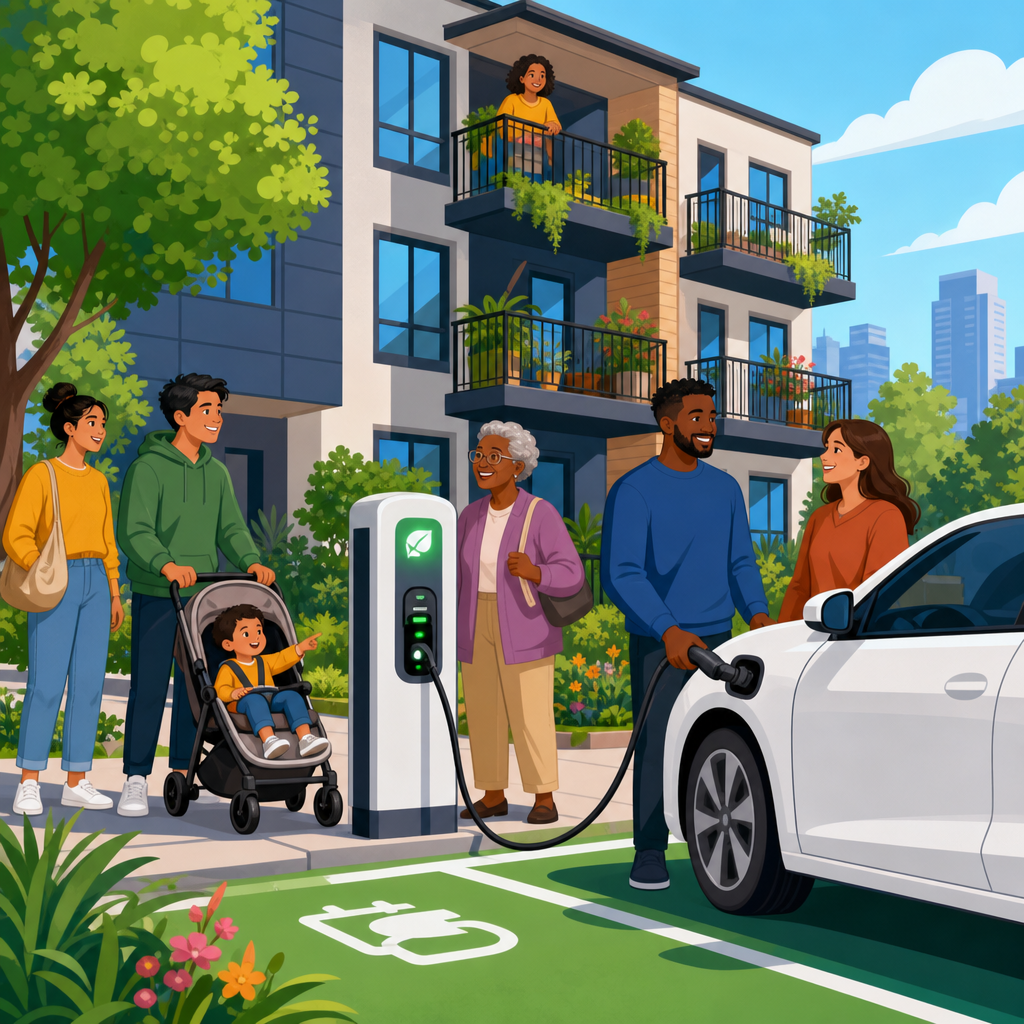
Equity in EV charging access for apartment residents is becoming one of the defining challenges in sustainable urban development because the people most likely to be left out of the electric vehicle transition are often those who live in multifamily housing. EV charging access means the practical ability to charge a vehicle reliably, safely, and affordably where people live. Apartment residents include tenants in garden-style complexes, workforce housing, mixed-use buildings, public housing, condominiums, and subsidized developments. When charging is unavailable at home, drivers depend on public stations, workplace charging, or fast charging hubs, which usually cost more and require more time. That gap affects transportation costs, vehicle ownership decisions, and the fairness of climate policy.
I have worked on urban mobility and building electrification planning, and the pattern is consistent across cities: homeowners with garages adopt EVs earlier because the charging solution is simple, while renters face legal, technical, and financial barriers even when they are equally interested. This matters because apartments house a large share of urban residents. In many major U.S. cities, renters make up the majority of occupied households, and multifamily properties account for much of the housing stock near jobs and transit. If apartment residents cannot charge easily, EV adoption skews toward higher-income households and detached suburban neighborhoods, weakening emissions goals and excluding the people who could benefit most from lower fueling and maintenance costs.
Equity in EV charging access is not only about installing more plugs. It involves who pays, who controls parking, how electricity is metered, whether accessible spaces are available, whether chargers are dependable, and whether building rules allow residents to request installation. It also includes race, disability, age, language access, and neighborhood investment patterns. A charger that exists but is always blocked, priced too high, or reserved for luxury tenants does not create equitable access. The core question is simple: can apartment residents use EV charging under conditions comparable to those enjoyed by single-family homeowners? Cities, utilities, developers, and property owners increasingly recognize that the answer depends on policy design as much as hardware deployment.
For a hub article, the goal is to map the issue clearly. Apartment EV charging sits at the intersection of land use, energy infrastructure, housing policy, parking management, and consumer behavior. Decisions made during building design are very different from retrofit decisions in older properties. A deed-restricted affordable housing project faces different financing constraints than a market-rate tower. A tenant with an assigned space has different options than a resident parking on the street. Understanding these distinctions is essential because no single charging model works everywhere. The most effective strategies combine baseline building readiness, fair cost allocation, strong tenant protections, and public investment targeted to locations where the market is least likely to deliver access on its own.
Why apartment residents face a different charging problem
Most EV charging happens at home, but the home charging model was built around private garages and driveways. Apartment properties complicate that model. Parking may be shared, unassigned, stacked, valet-operated, or off-site. Electrical rooms may be far from parking areas, making trenching and conduit expensive. Panels may have limited spare capacity, especially in older buildings. Ownership can also be fragmented. In condominiums, the resident owns the unit but not necessarily the electrical infrastructure serving the garage. In rental buildings, the landlord controls improvements while the tenant receives the transportation benefit. This split incentive is one of the biggest barriers I see in practice: the party paying for the charger is often not the party saving money on fuel.
There are also operational issues that do not affect detached homes. Multifamily managers must think about load management, billing, maintenance contracts, insurance, signage, and enforcement. If one resident gets a dedicated Level 2 charger, others may demand equal treatment. If too many chargers are installed without smart controls, peak demand charges can raise operating costs. If access rules are unclear, chargers may sit unused by residents who feel they are not entitled to use them. These details matter because apartment charging is a service system, not just an equipment purchase. Good programs define how residents request access, how fees are set, how usage is tracked, and how future demand is accommodated as EV ownership increases.
Street parking adds another layer. Many apartment residents do not park in a private lot at all. They rely on curbside spaces, neighborhood lots, or informal arrangements. For them, building-based charging may be impossible without major redevelopment. Cities therefore need a wider toolkit that includes curbside charging, utility pole charging where allowed, shared neighborhood charging hubs, and fast charging near daily destinations. Equity requires planning for residents who cannot bring electricity to a reserved space. It is not enough to say that public charging exists somewhere in the city. Access must be close enough, safe enough, and priced reasonably enough to function as a true substitute for private home charging.
What equitable access looks like in practice
Equitable EV charging access for apartment residents has five practical features. First, availability: enough ports or managed charging capacity exist to meet actual demand. Second, affordability: pricing does not erase the savings of driving electric. Third, reliability: stations work, payment systems are clear, and repairs happen quickly. Fourth, usability: chargers are accessible to people with disabilities, understandable in multiple languages, and supported by fair reservation or sharing rules. Fifth, geographic fairness: lower-income and historically underserved neighborhoods receive investment early, not after wealthier districts are already fully served. When these conditions are present, charging supports adoption. When one is missing, utilization and trust drop sharply.
Standards and design guidance help translate these principles into projects. Level 2 charging, typically using 208- or 240-volt service, is the workhorse for apartments because vehicles are parked for hours overnight. Networked chargers can allocate power dynamically so multiple vehicles share available electrical capacity. Open Charge Point Protocol support can reduce vendor lock-in. ADA-informed design affects aisle width, reach range, and path of travel, although accessible EV charging remains a developing area with uneven local enforcement. Property managers also need transparent pricing models. Residents accept fees more readily when they understand whether they are paying for electricity only, session time, parking rights, or cost recovery for capital upgrades.
| Access factor | Common apartment barrier | Equitable solution |
|---|---|---|
| Availability | Too few chargers for growing demand | Install conduit for expansion and use load management |
| Affordability | High session fees or markup above utility cost | Adopt transparent pricing and public incentives |
| Reliability | Broken ports remain offline for weeks | Require service-level maintenance contracts |
| Usability | Confusing apps, blocked spaces, inaccessible layout | Clear signage, accessible design, multilingual instructions |
| Geographic fairness | Investment concentrated in affluent districts | Target incentives to underserved neighborhoods |
In real projects, equitable access usually means mixing private and shared charging. A portion of residents may receive dedicated chargers in assigned spaces, while others rely on shared stations with reservation systems or overnight rotation. The right balance depends on parking patterns and expected adoption. I have seen oversubscription avoided by using managed charging platforms that throttle output across many ports while still delivering enough energy by morning. This is often more cost-effective than upgrading the entire electrical service immediately. Equity improves when a building plans for future users instead of forcing the first few adopters to consume the entire available capacity.
Policy, financing, and the role of cities and utilities
Public policy determines whether apartment charging remains a niche amenity or becomes standard urban infrastructure. The strongest city strategies start with building codes and parking ordinances. EV-capable requirements mandate conduit or panel capacity in new construction, which is far cheaper than retrofitting later. EV-ready requirements go further by installing wiring to parking spaces. Some jurisdictions also adopt right-to-charge laws, limiting the ability of landlords or homeowner associations to block reasonable installation requests. These rules do not solve cost barriers by themselves, but they change the default. Instead of asking whether charging should be considered, projects begin by asking how much capacity should be planned and who will manage it.
Financing is equally important. Retrofit costs in older apartment buildings can range from a few thousand dollars for a simple shared charger to much more when transformers, switchgear, or long conduit runs are involved. Incentive programs from utilities, states, air districts, and federal sources can close this gap, especially for affordable housing. Good programs cover make-ready infrastructure, panel upgrades, and technical assistance, not just the charger unit. Utilities also influence economics through rate design. Time-of-use rates can encourage overnight charging when the grid is less stressed, but poorly designed demand charges can make shared charging uneconomic. Where possible, utilities should support managed charging and submetering approaches that let costs follow actual usage.
Cities have a special responsibility to align charging deployment with housing equity goals. That means prioritizing public and subsidized housing, simplifying permits, coordinating with community development agencies, and mapping gaps by neighborhood rather than waiting for private developers to act first. Data should include renter concentration, off-street parking availability, utility capacity, income, and existing public charging density. Some of the most effective local programs pair grants with technical advisors who help building owners navigate vendor proposals, electrical assessments, and resident engagement. Apartment managers are often willing to install charging but lack confidence in procurement and operations. Practical support can matter as much as money.
Utilities, meanwhile, should treat multifamily charging as a distinct customer segment. A detached home charger can often be approved with minimal complexity. A 200-unit building with shared parking requires load calculations, tariff analysis, and long-term infrastructure planning. Utilities that provide dedicated multifamily teams, pre-approved equipment lists, and clear interconnection guidance reduce delay and lower soft costs. They can also coordinate transformer upgrades strategically across neighborhoods where EV adoption is expected to rise. Without that planning, the first apartment projects may face long waits and higher costs, which slows adoption precisely in places where public policy says electrification should expand.
Best practices for property owners, developers, and housing providers
For property owners, the best starting point is a charging needs assessment tied to parking operations and electrical capacity. Count spaces, identify assigned versus shared parking, review panel schedules, and estimate near-term and medium-term EV demand. Then separate no-regret investments from later upgrades. No-regret steps usually include conduit pathways, spare breaker space where feasible, networking considerations, and policies for resident requests. In new construction, the economics strongly favor planning early. Installing conduit before concrete is poured costs far less than coring slabs or trenching later. Developers who treat EV charging as basic infrastructure rather than an optional amenity are making the durable decision.
Affordable housing providers need additional care because residents are more price sensitive and capital budgets are tight. In these projects, shared Level 2 charging with managed power often outperforms one-to-one dedicated chargers. Operators should avoid complicated fee structures and predatory markups. If grants require minimum utilization or public access, managers must ensure those conditions do not reduce resident availability. Resident communication matters, too. Many households considering their first EV need clear information on charging speed, total cost, and etiquette. A simple handbook explaining reservation rules, idle fees, and support contacts can prevent conflict and increase use. Equitable access depends as much on management quality as on hardware.
Developers and owners should also think beyond current demand. EV adoption in apartments often starts slowly, then accelerates once residents can see charging is real and dependable. I have seen properties go from one interested driver to a waiting list within a year after the first stations were installed. That is why scalable design is essential. Install enough backbone infrastructure to expand without rebuilding the system. Choose interoperable software where possible. Negotiate maintenance response times in vendor contracts. And review insurance, fire safety procedures, and signage with the local authority having jurisdiction. A well-run charging program becomes a resident retention tool, but only if it is reliable and visibly fair.
The broader urban impact and the path forward
Equity in EV charging access for apartment residents is ultimately about whether cities can decarbonize transportation without deepening existing inequality. When renters and multifamily households are excluded from convenient charging, the market sends a clear signal that clean mobility is for people with private property and spare capital. That outcome is not inevitable. The technology is mature enough, the policy tools are known, and the implementation lessons are now widely available. What is missing in many places is coordinated execution. Cities need charging plans linked to housing strategy. Utilities need rates and programs built for multifamily realities. Property owners need clear rules, incentives, and operational support. Residents need dependable service at a fair price.
The central lesson is straightforward: apartment charging should be treated as essential urban infrastructure, not a luxury upgrade. New buildings should be designed for scalable charging from the start. Existing properties should receive targeted retrofit support, especially affordable and workforce housing. Public charging should fill the gaps for residents without off-street parking, but it should complement residential access rather than replace it entirely. Every stakeholder has a role, and the strongest results come when those roles are defined early. If you are shaping a sustainable urban development strategy, make multifamily EV charging a priority now, map the barriers honestly, and build solutions that serve apartment residents first as the market grows.
Frequently Asked Questions
Why is equity in EV charging access such a major issue for apartment residents?
Equity in EV charging access matters because the shift to electric vehicles only works fairly if people can charge where they live, not just where they shop, work, or occasionally park. For many homeowners, charging at home is relatively straightforward. For apartment residents, that same convenience often does not exist. People living in multifamily housing may rely on shared parking lots, street parking, garages with limited electrical capacity, or buildings where they have no authority to install equipment themselves. That creates a structural gap between residents who can easily participate in the EV transition and those who cannot.
This gap has broad implications. If apartment residents cannot charge reliably and affordably at home, they may be less likely to purchase an EV, even if they want lower fuel costs and reduced emissions. That can leave renters, lower-income households, seniors, and residents of workforce or public housing behind while early EV benefits flow mainly to people in single-family homes. Equity in this context is not simply about placing chargers somewhere in a city. It is about making sure the people who need daily, dependable access are not excluded by building design, ownership structure, cost burdens, or neighborhood disinvestment.
In practice, equitable access means charging that is safe, available when residents need it, priced reasonably, and located where people actually live. It also means addressing differences across property types, from older garden-style apartment communities to dense mixed-use developments and subsidized housing. Without intentional planning, EV infrastructure can reinforce existing inequalities in housing, transportation, and environmental quality. With better policy and investment, however, apartment charging can become a core part of more inclusive urban sustainability.
What are the biggest barriers to installing EV chargers in multifamily housing?
The barriers are usually a mix of physical, financial, legal, and operational challenges. One of the most common issues is electrical infrastructure. Many apartment buildings, especially older properties, were not designed to support widespread vehicle charging. Upgrading panels, transformers, conduits, or parking area wiring can be expensive and technically complex. In some cases, the parking layout itself makes installation difficult, particularly where spaces are unassigned, far from electrical rooms, or located in detached lots.
Cost is another major barrier. Property owners may face upfront expenses for equipment, permitting, utility coordination, labor, and future maintenance. Even when long-term value exists, landlords may hesitate if they are uncertain about tenant demand, cost recovery, or how quickly the investment will pay off. This is especially challenging in affordable housing and workforce housing, where operating margins may already be tight and owners are under pressure to keep rents stable.
There are also governance and ownership issues. Renters typically cannot make capital improvements to a property they do not own, and building owners may not prioritize charging if they do not drive EVs themselves. In condominiums or mixed-use developments, decision-making can be slowed by homeowner associations, shared parking agreements, or split incentives between residents, managers, and owners. Operational concerns matter too. Property managers need clear systems for assigning charger access, setting prices, handling maintenance, and preventing conflicts over shared equipment. All of these barriers are real, but they are increasingly manageable through incentive programs, load management technologies, right-to-charge policies, utility partnerships, and building-specific planning.
How can landlords and property managers improve EV charging access without making housing less affordable?
The most effective approach is to treat EV charging as a long-term property infrastructure strategy rather than a luxury amenity for a small number of tenants. Landlords and property managers can start by assessing parking patterns, electrical capacity, resident demand, and future readiness. In many cases, the smartest first step is not installing chargers everywhere at once, but preparing the site with conduit, panel capacity planning, and phased deployment. That reduces future costs and allows the property to expand access as more residents adopt EVs.
Affordability can be protected through careful financing and pricing design. Owners may be able to use local, state, utility, or federal incentives to offset installation costs, especially in underserved communities or affordable housing developments. Managed charging and load-sharing systems can also reduce the need for expensive electrical upgrades by distributing power more efficiently across multiple vehicles. Instead of assigning all costs to rent, some properties use user-based pricing models so that residents who charge pay for their actual electricity use and a reasonable portion of operating expenses.
Equity improves further when charging policies are transparent and inclusive. That means setting fair access rules, avoiding excessive markup, making payment systems easy to use, and ensuring chargers are not reserved only for premium units or higher-paying tenants. Property managers can also survey residents to understand who needs charging, who may want it in the future, and what price points are realistic. In affordable and mixed-income housing, these details are especially important. The goal is to expand transportation access and lower operating costs for residents, not to create a new amenity divide within the property.
What role should cities, utilities, and housing policy play in creating more equitable apartment EV charging access?
Public policy plays a central role because the market alone often does not solve charging access gaps in multifamily housing. Cities can support equitable deployment by updating building codes, zoning rules, and parking requirements to make EV-ready infrastructure standard in new construction and major renovations. They can also streamline permitting, reduce soft costs, and target public funding toward neighborhoods and property types that have historically received less infrastructure investment. Stronger right-to-charge protections can help residents request reasonable access while still balancing building safety and management concerns.
Utilities are equally important because they control or influence the grid connections, service upgrades, rate structures, and incentive programs that determine project feasibility. Utility make-ready programs, time-of-use rates, and technical assistance can significantly lower costs for multifamily properties. Utilities can also help properties deploy smart charging systems that manage demand, reduce peak load stress, and support broader grid reliability. When utilities specifically design programs for renters, affordable housing providers, and older buildings, they help prevent EV infrastructure from concentrating only in high-income developments.
Housing policy should recognize that transportation access and housing access are increasingly linked. Affordable housing agencies, public housing authorities, and community development organizations can integrate EV readiness into long-term capital planning so charging is considered alongside resilience, energy efficiency, and building modernization. This is especially valuable in communities where residents already face higher transportation costs and fewer mobility options. A coordinated policy approach ensures EV charging is not treated as an afterthought, but as essential infrastructure that affects cost of living, air quality, and equitable access to cleaner transportation.
What does a truly equitable EV charging solution for apartment residents look like in practice?
A truly equitable solution is reliable, affordable, accessible, and scalable. It starts with the recognition that apartment residents have varied needs. Some have dedicated parking spaces, while others share parking or rely on curbside parking. Some can charge overnight, while others need daytime or workplace alternatives. An equitable system does not assume one model will fit every building or every household. Instead, it combines on-site charging where feasible with neighborhood-level solutions such as curbside chargers, public fast charging, workplace charging, and community charging hubs.
In practice, equitable access also means chargers are placed where residents can realistically use them, including affordable housing, older apartment communities, and developments in lower-income neighborhoods, not just in new luxury buildings. Equipment should be maintained, clearly managed, and compatible with straightforward payment options. Pricing should be transparent and low enough that EV ownership remains financially beneficial compared with gasoline. Accessibility for residents with disabilities, safety in parking areas, and language access in program communications are all part of a fair deployment strategy.
Most importantly, an equitable solution is proactive rather than reactive. It anticipates future demand, involves residents in planning, and aligns housing, transportation, and energy goals. When apartment charging is designed this way, it expands who can benefit from cleaner vehicles and lower fuel costs. That helps cities reduce emissions without leaving renters and multifamily households behind. Equity, in this case, is not a side consideration. It is the foundation of a successful and inclusive EV transition.