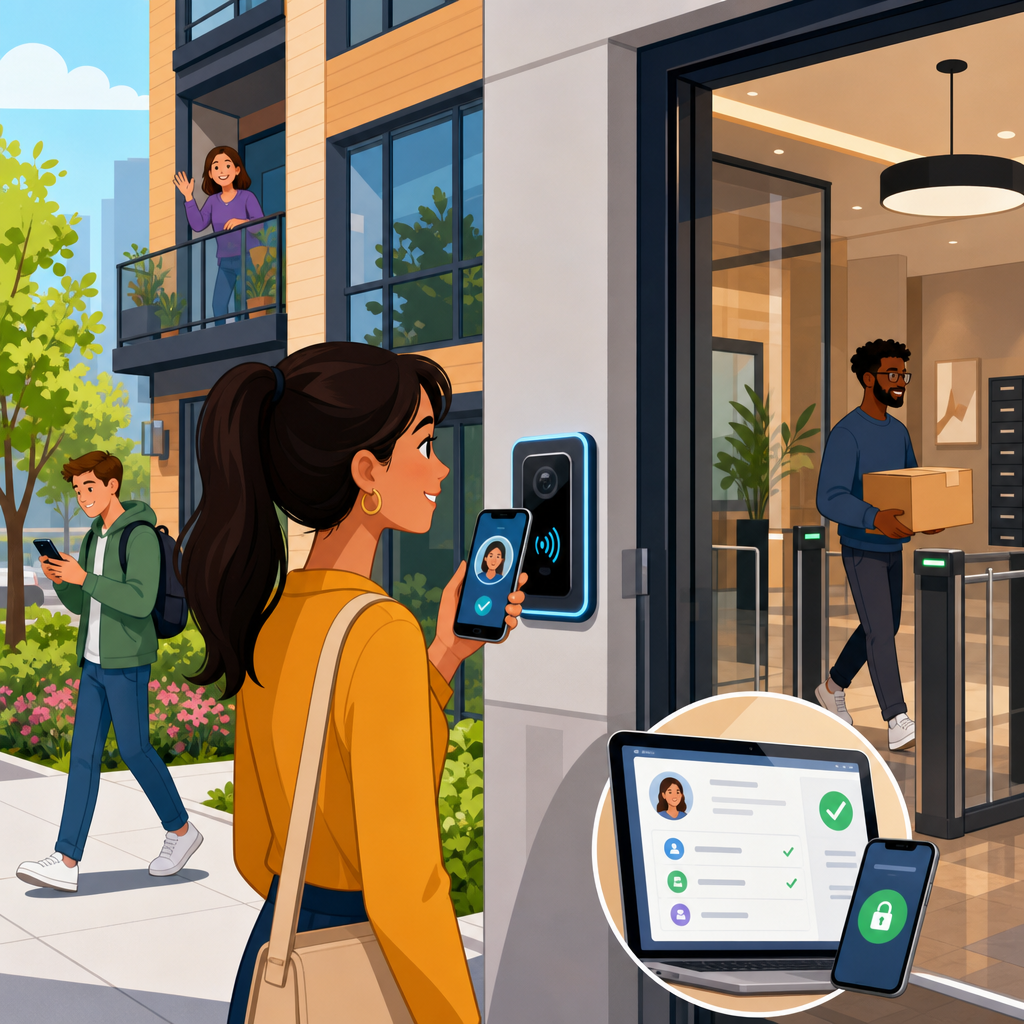
Digital identity and access systems in multifamily buildings are reshaping how apartments manage entry, verify residents, protect property, and deliver a smoother living experience. In practical terms, digital identity means the electronic credentials used to prove who someone is, such as a mobile key, encrypted fob, biometric template, or cloud-managed resident profile. Access systems are the hardware and software that decide where that person can go and when, from the front gate and lobby to package rooms, elevators, coworking spaces, garages, and amenity areas. In multifamily housing, these systems matter because buildings are dense environments with constant movement: residents come and go at all hours, deliveries arrive daily, maintenance teams need controlled access, and prospective renters expect convenience without sacrificing security.
I have seen the shift firsthand in lease-ups, retrofits, and stabilized communities. A decade ago, many properties still relied on brass keys, standalone intercoms, and handwritten move-in logs. Today, managers are evaluating cloud dashboards, mobile credentials, visitor workflows, and audit trails as core operating infrastructure. This change is not cosmetic. According to industry reporting from the National Multifamily Housing Council and major proptech vendors, resident demand for self-service access, package management, and contactless entry accelerated sharply after 2020 and has remained high. Owners now view identity and access controls as part of net operating income protection because they influence staffing efficiency, amenity usage, insurance risk, and resident retention. As a hub topic within housing market trends, digital identity and access systems deserve close attention because they sit at the intersection of property operations, renter expectations, cybersecurity, and asset value.
What digital identity and access systems include in multifamily housing
A multifamily access stack usually combines credential types, control hardware, management software, and policy rules. Credentials may include key cards, encrypted fobs, one-time PINs, QR-based visitor passes, mobile wallet credentials, or biometrics in limited high-security areas. Hardware includes smart locks, electric strikes, magnetic locks, door controllers, elevator destination controls, garage readers, video intercoms, and sensors that detect forced entry or held-open doors. Software ties everything together through resident databases, role-based permissions, leasing integrations, and event logs. The best systems are not just digital locks. They create an identity layer that maps a person to a verified profile, a unit, a lease term, and authorized spaces.
That distinction matters operationally. If a resident renews a lease, transfers units, or adds a roommate, access rights should update through a controlled workflow rather than requiring a manager to manually rekey doors across the property. If a contractor is approved for mechanical room work between 9 a.m. and 4 p.m., the system should grant only those areas and only for that time window. If a package courier needs temporary access to a delivery room, the credential should expire automatically. In properties I have worked on, the biggest gains came not from the lobby door itself but from replacing fragmented permissions with a single source of truth that leasing, maintenance, and security teams could trust.
Why owners and operators are investing now
Three forces are driving adoption: labor pressure, resident expectations, and risk management. On-site teams are expected to do more with fewer hours. Manual key control consumes time through key cutting, rekeying, lockouts, amenity bookings, and contractor escorting. Digital systems reduce that burden by automating issuance and revocation. Residents also increasingly expect smartphone-based convenience similar to hotels and office buildings. They want to let in a dog walker, retrieve a package after hours, or access a fitness room without carrying multiple keys and fobs. Buildings that cannot meet those expectations may look dated, especially in competitive Class A and upper midmarket segments.
Risk management is the third driver and often the deciding factor in budget approvals. Traditional keys are difficult to track. Copies can be made, returns are inconsistent, and proving who accessed a space is nearly impossible. Cloud-based access logs are not perfect evidence for every dispute, but they provide far better accountability. They also support incident reviews, policy enforcement, and insurance conversations. In student housing and mixed-use communities, where turnover and foot traffic are higher, that visibility is especially valuable. At the same time, owners must balance security with privacy, fair housing obligations, and reliability. A failed network connection, drained phone battery, or poorly configured credential policy can create frustration fast, so strong system design is essential.
Core system models and where each fits best
Not every building needs the same architecture. Broadly, multifamily properties choose among standalone smart locks, networked property-wide systems, or hybrid models. Standalone locks suit small properties or unit-only upgrades because they are cheaper to install and can work without extensive wiring. Their weakness is administration at scale. Networked systems connect common areas and unit doors to centralized software, making them ideal for mid-rise and high-rise communities where amenity control, visitor management, and audit history are priorities. Hybrid models are increasingly common in garden-style portfolios, where unit doors may use battery-powered wireless locks while entrances, gates, and critical rooms use hardwired controllers for higher uptime.
| System model | Best fit | Main advantage | Main limitation |
|---|---|---|---|
| Standalone smart locks | Small buildings, retrofit unit doors | Lower upfront cost, faster deployment | Weaker centralized oversight |
| Networked access control | Mid-rise, high-rise, mixed-use | Unified permissions and audit trails | Higher installation complexity |
| Hybrid architecture | Large portfolios, garden communities | Balances cost, control, and flexibility | Requires careful integration planning |
When selecting a model, operators should evaluate credential lifecycle, battery maintenance, offline operation, integration support, and fire life safety requirements. Doors on egress routes must comply with local code and standards such as NFPA 101, and electrified hardware must be coordinated with the authority having jurisdiction. I have seen promising pilots stall because teams chose attractive mobile access features without confirming how elevator control, intercom routing, or emergency unlock sequences would work. The right answer is usually the model that reduces operational friction while preserving safe, code-compliant fail states.
Resident experience, leasing impact, and retention
Digital identity and access systems can materially improve the renter journey from first tour to renewal. Prospects can receive scheduled tour credentials or video intercom links. Approved applicants can complete identity verification and receive move-in instructions before arriving. Residents can use one credential across the front entrance, parking, package room, and amenities instead of juggling separate systems. In my experience, this consistency is what residents notice most. They may not care what controller brand is in the riser closet, but they care deeply whether the garage opens reliably at night and whether guests can enter without confusion.
There is also a measurable leasing story. Self-guided tours have expanded in many markets, particularly for suburban and Sun Belt properties, because controlled digital access makes them possible. Managed correctly, that can increase tour volume beyond staffed hours. Frictionless access can also support premium pricing in newer communities where tech-enabled convenience is part of the brand. Still, operators should avoid treating access technology as a gimmick. If enrollment is cumbersome, support is weak, or residents are forced into one credential type, adoption falls. The best programs offer options: mobile first for those who want it, physical credentials for residents without compatible phones, and clear guest workflows for households with varying needs.
Security, privacy, and cybersecurity considerations
Any system that stores identities and controls doors becomes part of a building’s security perimeter and its cyber risk profile. Effective multifamily access programs use encrypted credentials, secure controller communication, role-based administration, multi-factor authentication for staff accounts, and documented revocation procedures. Vendor due diligence matters. Operators should ask whether data is encrypted in transit and at rest, whether penetration testing is performed, how firmware updates are managed, and whether the platform supports audit exports for incident review. Recognized frameworks such as SOC 2 reporting, NIST-aligned security practices, and least-privilege administration provide useful benchmarks.
Privacy deserves equal attention. Residents should know what data is collected, how long logs are retained, and when video, biometric, or location-linked information is used. Biometrics, in particular, require caution because state laws vary, including Illinois BIPA and similar rules elsewhere. In most multifamily settings, mobile or encrypted token credentials provide a better balance of convenience and privacy than facial recognition at every entrance. Another common mistake is giving too many employees broad administrative rights. Leasing, maintenance, concierge, and regional managers do not all need the same privileges. Segmented permissions reduce the chance of accidental changes and strengthen accountability if something goes wrong.
Implementation strategy, costs, and common pitfalls
Successful deployment starts with a door-by-door survey, not a software demo. Teams should inventory openings, frame conditions, fire ratings, power availability, internet pathways, existing intercoms, and resident traffic patterns. Then they should define use cases: resident entry, guest access, deliveries, vendors, amenity reservations, lockout handling, and emergency response. Budgeting must cover more than locks and readers. Include cabling, power supplies, electrified hardware, mobile onboarding, training, credential stock, replacement batteries, service agreements, and integration fees. For retrofit communities, installation labor and remedial door work often surprise owners more than software pricing.
Common pitfalls are predictable. One is overbuying features that the site team will not use. Another is underinvesting in resident onboarding and support. A third is ignoring fallback procedures for outages. Every property should have defined methods for emergency entry, resident assistance, and controller failure scenarios. Procurement should also examine vendor stability and open integration support. Property management systems, package platforms, visitor tools, and work-order software all influence access policies. When these systems remain siloed, staff ends up duplicating data and making manual exceptions, which erodes the value of digital identity. The strongest projects treat access as operational infrastructure, coordinate early with IT, legal, and facilities teams, and pilot workflows before scaling across a portfolio.
How this topic fits broader housing market trends
Digital identity and access systems reflect broader shifts in multifamily economics and renter behavior. As operating costs rise, owners seek technologies that lower repetitive labor without reducing service quality. As competition increases in many submarkets, communities use convenience and perceived security to differentiate. As portfolios professionalize, standardized access data helps regional teams compare incidents, amenity usage, and policy compliance across assets. These systems also complement adjacent trends such as smart home packages, energy management, centralized maintenance, and self-service leasing. In other words, access control is no longer an isolated hardware decision. It is part of the digital operating model of modern rental housing.
For owners, managers, and developers, the practical takeaway is clear: choose systems that verify identity accurately, grant access precisely, and remain usable when real life gets messy. Favor open, secure platforms, flexible credentials, and workflows that match the building’s staffing model and resident mix. If you are evaluating upgrades, start with the resident journey and the property’s highest-friction access points, then build outward. Done well, digital identity and access systems make multifamily buildings safer to operate, easier to manage, and more appealing to rent. That combination is why this subject belongs at the center of housing market trend analysis and why it should guide future technology planning across the portfolio.
Frequently Asked Questions
What are digital identity and access systems in multifamily buildings?
Digital identity and access systems are the combined tools and technologies that let apartment communities verify who a person is and control what areas they can enter. In a multifamily setting, a digital identity can include a mobile credential on a smartphone, an encrypted key fob, a PIN code, a biometric template, or a cloud-based resident profile managed through property software. The access system is the larger framework that reads those credentials and makes decisions based on rules set by the property, such as allowing a resident into the front entrance 24/7 while limiting access to package rooms, fitness centers, coworking spaces, garages, or storage areas based on permissions.
What makes these systems especially valuable in apartment communities is that they replace many of the weaknesses of traditional keys and disconnected entry methods. Instead of physically rekeying locks after a move-out or trying to track copied keys, operators can issue, update, suspend, or revoke credentials digitally. That creates tighter control, better visibility, and a more convenient experience for residents and staff. In practice, these systems often tie together smart locks, intercoms, video entry, elevator controls, amenity reservations, visitor management, and audit trails into one ecosystem. The result is a more efficient and secure way to manage access across the full property, from the perimeter gate and lobby to private units and shared spaces.
How do digital access systems improve security in apartment communities?
Digital access systems improve security by giving property teams far more control, accountability, and real-time visibility than traditional lock-and-key setups. Every credential can be uniquely assigned to a resident, employee, vendor, or guest, which means building access is no longer anonymous or difficult to trace. If a resident loses a phone or fob, management can deactivate that credential immediately rather than replacing hardware throughout the building. If a staff member or contractor should only enter certain areas during defined hours, administrators can set those permissions precisely. That level of control helps reduce unauthorized entry, tailgating risk, and the operational gaps that come from shared keys or unmanaged copies.
Another major advantage is the availability of event logs and centralized monitoring. Many modern systems record when a door was opened, which credential was used, whether access was granted or denied, and sometimes even pair that information with video footage or intercom activity. This can be extremely useful during investigations, incident response, and compliance reviews. Just as important, digital systems support layered security strategies. A property can combine mobile credentials with PINs, biometrics, video verification, or remote staff approval for higher-risk areas. When integrated thoughtfully, these tools not only deter misuse but also help buildings respond faster and more effectively when something unusual happens.
What types of digital credentials are commonly used in multifamily buildings?
Multifamily properties commonly use several types of digital credentials, each with its own strengths depending on the building layout, resident expectations, and security goals. Mobile credentials are among the most popular because they allow residents to unlock doors using a smartphone app, digital wallet pass, Bluetooth, NFC, or cloud-connected access platform. Encrypted key fobs and access cards are also widely used because they are familiar, relatively simple to distribute, and more secure than older low-frequency proximity tokens. PIN codes are often used for secondary access points, temporary entry, self-guided tours, package rooms, or backup entry when a phone battery dies.
Some buildings also use biometric credentials such as fingerprint, facial recognition, or palm-based verification, though these are typically deployed selectively because they involve stricter privacy, consent, and data-handling considerations. In many cases, the most effective strategy is not relying on one credential alone but offering multiple options within the same platform. For example, a resident might use a mobile key for daily entry, a PIN for a delivery room, and a temporary guest pass for visitors. Staff and vendors may receive time-bound credentials with limited permissions, while property managers oversee all of it through a cloud dashboard. The flexibility to match the credential type to the user and use case is one of the biggest reasons digital identity systems are becoming standard in modern apartment operations.
How do these systems affect the resident experience?
When implemented well, digital identity and access systems can significantly improve the resident experience by making everyday building interactions faster, simpler, and more predictable. Residents no longer need to carry multiple physical keys or coordinate manual lockouts as often. They can enter the building, open common area doors, receive visitors, and access amenities through a single app or credential. For many renters, especially in tech-forward or high-traffic communities, that convenience translates into a more modern and seamless living experience. It can also reduce friction at move-in, because credentials can often be issued remotely before arrival, and at move-out, because access can be removed instantly without requiring a hardware exchange.
These systems also support service features that residents increasingly expect, such as remote guest access, delivery management, self-service intercom response, amenity scheduling, and integration with smart apartment platforms. A resident can let in a dog walker, house cleaner, or family member without handing over a physical key, and management can ensure that access only works during approved time windows. In large communities, that level of convenience matters because it reduces front desk interruptions and improves response times. Just as importantly, residents tend to feel more confident when they know the building has structured access controls instead of relying on unmanaged keys or open entry points. The best systems combine convenience with transparency, giving residents confidence that their community is both easier to navigate and better protected.
What should property owners and managers consider before choosing a digital identity and access platform?
Before selecting a platform, property owners and managers should first look at the building’s operational needs, physical layout, and long-term technology strategy. Not every multifamily community needs the exact same solution. A garden-style property with multiple exterior entry points may have different requirements than a high-rise with elevators, parking controls, package rooms, and staffed lobbies. Decision-makers should evaluate which doors and spaces need control, what types of users require access, how often permissions change, and whether the system must support residents, staff, vendors, prospects, and guests within one interface. Scalability is critical as well, especially for portfolios that may want to standardize access policies across multiple sites.
It is also important to assess cybersecurity, privacy protections, system reliability, and integration capabilities. The strongest platforms use encrypted credentials, secure communications, role-based permissions, and clear administrative controls. If biometrics are involved, managers should confirm how data is stored, whether templates are used instead of raw images, what consent process is required, and how the provider addresses legal and regulatory obligations. Integration matters too. A good system should work well with property management software, video surveillance, intercoms, visitor management tools, smart locks, and possibly elevator or parking systems. Finally, owners should examine vendor support, installation quality, maintenance requirements, resident onboarding, and total cost of ownership. The right platform is not just the one with the most features. It is the one that matches the property’s security goals, operational workflow, resident expectations, and ability to manage the system effectively over time.