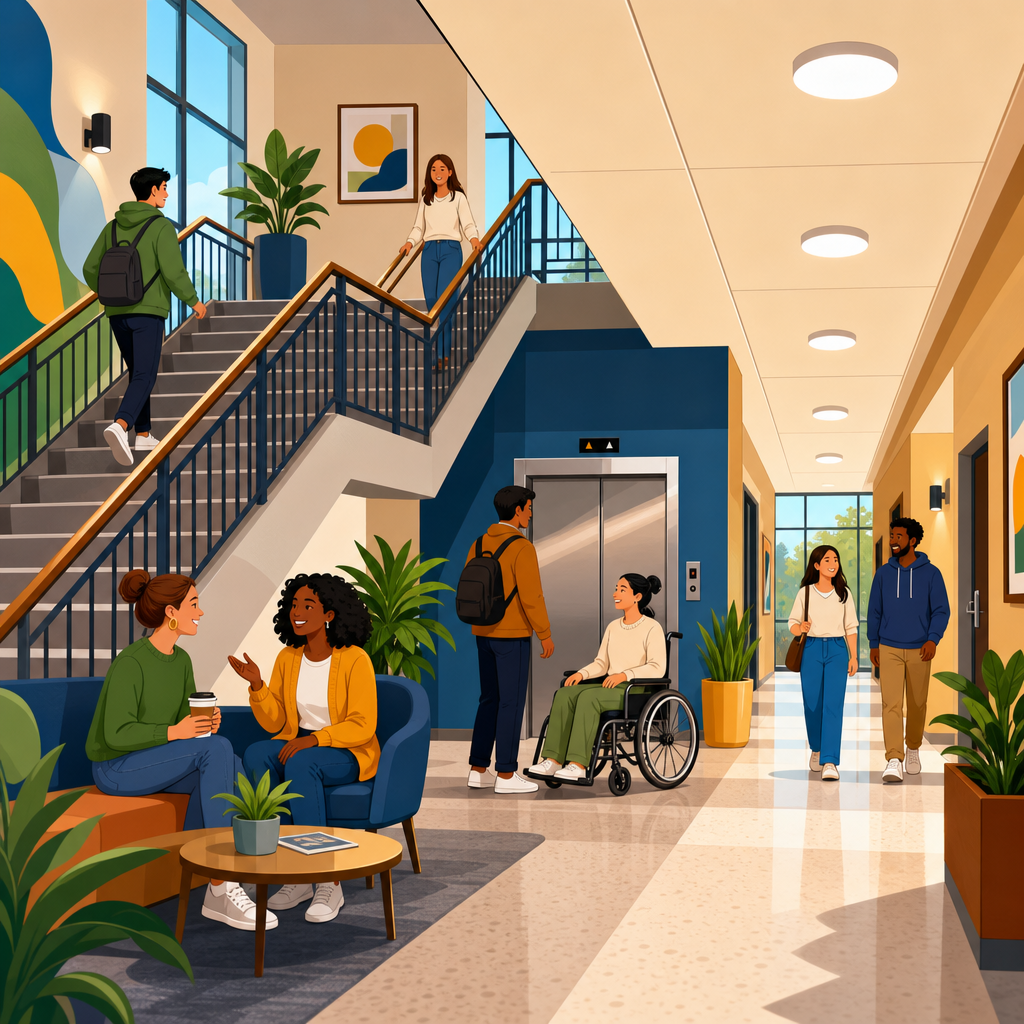
Designing stairwells, lobbies, and corridors for safety and social interaction requires treating circulation space as occupied space, not leftover square footage. In sustainable urban development, these shared interiors shape daily behavior, influence energy use, support accessibility, and determine whether residents, workers, students, and visitors feel secure enough to linger, greet neighbors, or simply move through a building without stress. Stairwells are the vertical routes that connect floors by steps and landings. Lobbies are the primary arrival and transition zones, often linking street, elevator, mail, reception, and amenities. Corridors are the horizontal pathways that connect rooms, units, exits, and common spaces. Together, they form the social spine of a building.
When these spaces are poorly designed, the problems are immediate and measurable. Dark stairs discourage use and push everyone toward elevators, increasing energy demand and reducing incidental exercise. Narrow corridors create bottlenecks, noise conflicts, and accessibility failures. Oversized but featureless lobbies can feel unsafe because they lack clear sightlines and purposeful activity. I have seen multifamily projects where a code-compliant corridor still failed in practice because residents could not see who was approaching around a blind corner, and office buildings where an attractive lobby underperformed because seating blocked circulation and confused the path to reception. Good design solves those issues by balancing life safety, universal access, comfort, security, acoustics, durability, and human connection.
This matters at the urban scale because the quality of shared interior circulation affects building performance, tenant satisfaction, public health, and long-term asset value. A well-lit stair with views can increase stair use. A lobby with clear zoning can reduce congestion and improve wayfinding. A corridor with daylight, alcoves, and acoustic control can become more than a passage without becoming a hangout that blocks egress. For developers and designers, the goal is straightforward: make movement intuitive, make occupancy safe, and create opportunities for brief, natural interaction. The most successful projects do not choose between safety and sociability. They design both into the same square meter from the first plan iteration.
Start with life safety, code, and universal access
The baseline for stairwells, lobbies, and corridors is compliance with building, fire, and accessibility requirements, but strong projects go beyond minimums. Egress capacity, travel distance, rated enclosures, door hardware, handrail geometry, guard heights, tactile warnings, slip resistance, emergency lighting, and smoke control are not decorative concerns. They determine whether people can exit quickly, orient themselves under stress, and move independently in normal conditions. Standards vary by jurisdiction, but design teams commonly work from the International Building Code, NFPA 101 Life Safety Code, local fire department rules, and accessibility standards such as the ADA Standards for Accessible Design or comparable national codes. In practice, coordination among architect, fire protection engineer, accessibility consultant, structural engineer, and authority having jurisdiction should happen early, not after schematic design.
Universal access should be embedded in circulation planning instead of treated as an exception route. In lobbies, that means flush entries where possible, weather mats that do not catch wheels, intuitive paths to elevators, and reception counters with accessible portions. In corridors, it means sufficient clear widths for passing, turning, and door maneuvering, especially near unit entries, classrooms, or hotel rooms where carts and mobility devices overlap. In stairwells, safety includes consistent riser and tread dimensions, graspable handrails on both sides where required, contrasting nosings where helpful, and landings sized to support rest and reorientation. Even when elevators provide the accessible route between floors, the stair should remain inviting for those who can use it, because an active stair strategy reduces elevator dependence and supports public health goals.
Design visibility, lighting, and surveillance without creating a fortress
People judge safety quickly, often within seconds of entering a space. The most reliable design tools are visibility, lighting quality, and predictable occupancy. Sightlines should be long enough to reduce surprise but broken intelligently so spaces do not feel exposed or institutional. In lobbies, users should immediately understand where to go: entry, reception, elevators, exits, mail, package room, and amenities. In corridors, avoid hidden recesses that create uncertainty unless they serve a clear function such as a supervised seating niche or doorway zone. In stairwells, vision panels in rated doors, borrowed light at landings where code permits, and occasional exterior glazing in scissor or open stairs can transform a feared back-of-house space into a trusted route.
Lighting is not only about illuminance levels. It is about uniformity, glare control, color rendering, and maintenance. LED systems with occupancy sensors and daylight dimming can lower energy use while keeping circulation areas visibly active. A lobby needs layered lighting: ambient light for orientation, vertical light on faces for recognition, and accents that mark the destination path. Corridors benefit from evenly distributed light that avoids alternating bright and dim patches, because contrast can increase perceived insecurity. Stairwells need clear tread visibility, well-lit landings, and emergency backup. Security technology supports design but does not replace it. Cameras work best when they cover clearly defined zones with proper lighting, and access control should separate public, semi-public, and private areas without turning every threshold into a barrier. The goal is natural guardianship: spaces that feel observed because legitimate users are present and visible.
Make circulation socially useful through programming and proportion
Social interaction in shared circulation does not come from adding random furniture. It comes from matching proportion, adjacency, and use. A lobby can support conversation if the main path remains legible and seating is placed at the edge of movement rather than in the middle of it. In multifamily housing, a mail area, package room window, concierge point, or coffee counter can create short, repeated encounters that build familiarity. In offices, stair landings widened near collaboration zones can encourage movement between floors. In schools and universities, corridors with daylight and bench niches near classrooms can support informal exchange without blocking travel. The rule I apply is simple: active edges, clear centerlines, and destinations that justify a pause.
Width alone does not create social value. An overwide corridor with blank walls often feels empty and loud. A better strategy is calibrated widening at nodes such as intersections, elevator lobbies, laundry access points, or shared amenity entries. These node spaces should be visible from the main route and furnished lightly so users can step aside without obstructing flow. Material transitions, ceiling changes, and lighting shifts can signal that a place supports brief interaction while the path continues. In stair design, social use works best in open communicating stairs that connect closely related floors, especially in offices, schools, and libraries. There, visible movement itself becomes a social cue. In required enclosed exit stairs, the opportunity is different: make the route dignified, bright, and easy to navigate so people choose it during everyday use rather than only emergencies.
| Space | Primary safety priorities | Primary social strategies | Common design mistake |
|---|---|---|---|
| Stairwell | Consistent dimensions, handrails, lighting, clear egress signage, durable slip-resistant finishes | Daylight, views, wider landings at key levels, art, visible connections to active floors | Treating it as a service shaft people avoid |
| Lobby | Sightlines, access control, intuitive wayfinding, non-slip entry zones, emergency communication | Edge seating, active front desk, mail or package touchpoints, readable destinations | Placing furniture in the main circulation path |
| Corridor | Adequate width, door clearance, uniform lighting, acoustic control, visible intersections | Node widening, daylight at ends, supervised niches, identity cues near entries | Long blank walls with no orientation markers |
Use materials, acoustics, and environmental comfort to support behavior
Shared circulation succeeds when it feels comfortable enough for a short pause and resilient enough for heavy use. Material selection should begin with slip resistance, cleanability, impact durability, fire performance, and maintenance cycles. Polished surfaces may photograph well but can increase glare and reveal wear quickly in high-traffic lobbies. In stairwells, resilient treads, textured porcelain, rubber flooring, or abrasive nosings often perform better over time than finishes chosen only for appearance. Corridors benefit from wall protection, durable corner guards where carts operate, and surfaces that resist scuffing without looking institutional. Sustainable specification means choosing materials with credible environmental product declarations, recycled content where appropriate, low volatile organic compound emissions, and proven maintenance requirements, because a green material that fails early is not sustainable.
Acoustics are equally important and often neglected. Hard, narrow corridors amplify conversation and door noise, which raises stress and reduces privacy. Lobbies with stone floors and glass walls can become echo chambers unless ceiling absorption, acoustic wall treatments, rugs in seating zones, or baffled lighting systems are integrated. Stairwells should avoid excessive reverberation because loud footfall and door slam can discourage use. Thermal comfort also affects whether people slow down or hurry through. Vestibules, air curtains, pressure control, and careful diffuser placement help prevent cold drafts in winter and overheated stagnant air in summer. Daylight improves orientation and mood, but solar control, low-e glazing, and shading are necessary to prevent glare and heat gain. Comfort is not a luxury in circulation space; it directly shapes occupancy patterns and perceived safety.
Wayfinding, identity, and maintenance determine long-term success
Even excellent layouts can fail if users cannot understand them. Effective wayfinding combines architecture, graphics, lighting, and naming conventions. In stairwells, floor numbers should be large, consistent, and visible from the landing door, with clear indicators of roof, exit discharge, and transfer levels. In lobbies, signage must confirm the destination path at decision points instead of relying on one master directory. In corridors, repeated markers such as color bands, artwork, or unit clusters help users judge distance and reduce the sameness that makes long hallways disorienting. Hospitals and universities use this well by organizing circulation into neighborhoods, while residential buildings often benefit from subtle identity cues that make each level memorable without overwhelming the interior.
Maintenance is a design issue, not an operations afterthought. Burnt-out lamps, chipped corners, malfunctioning closers, stained ceilings, and damaged handrails quickly communicate neglect, and neglected spaces feel less safe regardless of actual crime data. I advise owners to review circulation details with facility teams before final specification: Which finish can be patched cleanly? Which camera location can actually be serviced? Which entry mat system captures enough moisture to protect flooring? Which wall paint survives repeated cleaning? Smart buildings can add occupancy analytics, air quality sensors, and fault alerts, but basic upkeep remains decisive. The most socially successful shared spaces are usually the best maintained, because people linger where care is visible. Design should make that care easier through accessible lighting, replaceable finish systems, robust detailing, and realistic operational planning from day one.
Apply the principles by building type and urban context
The same principles apply differently across project types. In multifamily housing, the lobby often functions as a threshold between city and home, so security, package management, stroller access, and resident recognition matter as much as visual appeal. Corridors should support privacy at unit doors while avoiding dead, hotel-like monotony. In offices, visible communicating stairs can reduce elevator trips and increase cross-team contact when paired with attractive landings and nearby shared amenities. In schools, corridor supervision and acoustic control are critical, but so is creating informal learning space without obstructing egress. In hospitals and senior living, wayfinding clarity, rest opportunities, handrail continuity, and low-glare lighting are nonnegotiable. In transit-adjacent mixed-use buildings, lobbies must handle high arrival peaks, weather transitions, and public-private boundary management.
Urban context changes the design response. A building in a cold climate may need larger vestibules and salt-resistant flooring. A tropical climate may prioritize shaded open-air corridors, cross-ventilation, and moisture control. High-crime perception areas benefit from transparent frontages, active street interfaces, and staffed entries, but the solution should still avoid hostile architecture that drives away legitimate users. Adaptive reuse projects require special care because existing floor plates, stair geometry, and structural bays can constrain ideal layouts. Still, these buildings often offer rich opportunities: old industrial stairs can become celebrated features, deep lobbies can host community-facing uses, and former service corridors can be punctuated with borrowed light. The strongest results come from testing circulation with real user scenarios, including deliveries, school pickup, evacuation, accessibility needs, and peak-hour surges.
Stairwells, lobbies, and corridors work best when they are designed as essential shared places rather than residual space. Safety begins with code compliance, universal access, visibility, lighting, durable materials, and reliable maintenance. Social interaction grows from clear circulation, active edges, comfortable environmental conditions, and small moments of purposeful pause. When those elements are coordinated, people move through buildings more confidently, use stairs more often, find destinations faster, and experience more positive contact with others. That improves building performance and daily quality of life at the same time.
For teams working in sustainable urban development, the practical lesson is clear: evaluate circulation early, test it with real scenarios, and detail it for long-term use. Ask whether every stair invites use, whether every lobby explains itself, and whether every corridor supports movement without erasing human presence. Buildings earn trust in these ordinary spaces. Design them carefully, and they become safer, more efficient, and more social from the first day of occupancy onward.
Frequently Asked Questions
Why should stairwells, lobbies, and corridors be designed as active spaces instead of simple passageways?
Stairwells, lobbies, and corridors do much more than move people from one point to another. They shape first impressions, influence whether occupants feel calm or anxious, and affect how often people choose to walk, pause, interact, or avoid a space altogether. When these areas are treated as leftover square footage, they often become dim, confusing, acoustically harsh, and underused. When they are designed as active, occupied environments, they support safety, comfort, accessibility, and community at the same time.
In practical terms, circulation areas are where people repeatedly encounter one another during everyday routines. A lobby may be where residents greet neighbors, where office workers orient themselves before heading upstairs, or where visitors decide whether a building feels welcoming or intimidating. A corridor may serve as a threshold between public and private space, and a stairwell may become either a neglected emergency route or a healthy, visible, everyday vertical street. Thoughtful design can encourage positive social contact without forcing it. Wider clearances, better daylight, clear wayfinding, seating niches near but not obstructing flow, and visible destinations all help people feel secure enough to linger briefly and engage naturally.
These spaces also have a direct relationship to sustainability and building performance. If stairs are attractive, convenient, and easy to find, more occupants will choose them over elevators for short trips, reducing energy use and supporting physical activity. If corridors and lobbies are well-lit with efficient systems and designed to take advantage of daylight where possible, operational costs can improve while comfort increases. In short, circulation space is not secondary space. It is the connective tissue of the building, and its design has an outsized effect on safety, wellness, behavior, and social interaction.
What design features make stairwells safer, more inviting, and more likely to be used every day?
A safe and inviting stairwell begins with visibility and legibility. People are far more likely to use stairs when they can easily find them, see where they lead, and feel confident that the route is clean, open, and secure. Locating stair entrances in prominent areas rather than hiding them behind opaque doors sends a clear message that the stairs are meant for everyday use, not just emergencies. Glass panels, sidelights, or vision sections in doors can improve visibility while maintaining fire and life-safety requirements, depending on code and assembly conditions.
Lighting is one of the most important features. Stairwells need consistent, glare-controlled illumination that eliminates shadows and makes changes in level easy to read. Daylight, when safely incorporated, can transform a stair from a utilitarian shaft into a pleasant vertical circulation experience. Materials also matter. Slip-resistant treads, clearly defined nosings, durable handrails on both sides where required, and finishes that are easy to maintain all contribute to long-term safety. Good acoustics can further improve comfort by reducing echo and making the space feel less isolated.
To encourage daily use, the stairwell should feel like a continuation of the building’s main circulation network rather than a back-of-house route. That means generous width where occupancy demands it, intuitive floor numbering, clear signage, appealing colors or graphics, and landings that provide orientation rather than confusion. In some buildings, windows, artwork, or views into active areas can make stair travel more engaging. Security is equally important. Users should never feel trapped or hidden. Access control, strategic sightlines, emergency communication systems, and coordination with fire safety requirements help create a stairwell that feels both protected and welcoming. The best stair design balances code compliance, human comfort, and visual openness so that people choose the stairs because they feel safe, convenient, and dignified.
How can lobbies be designed to improve both security and social interaction?
An effective lobby manages a difficult balance: it must be secure without feeling hostile, organized without seeming rigid, and welcoming without becoming chaotic. The strongest lobby designs achieve this by clarifying zones and allowing users to understand the space immediately upon entry. People should be able to see where to check in, where to wait, where to move onward, and which areas are public versus restricted. This reduces stress, improves security oversight, and prevents congestion at peak times.
From a safety perspective, lobbies benefit from strong sightlines, durable finishes, high-quality lighting, and clearly defined circulation paths. Reception or concierge points should be positioned to observe entrances and key transitions without creating a barricade-like experience. Access control systems can be integrated discreetly so that security feels seamless rather than confrontational. Flooring should support slip resistance, especially in climates where rain or snow is tracked inside. Adequate vestibules, walk-off mats, and weather buffering can improve both safety and energy performance.
To support social interaction, the lobby should include spaces for brief dwell time that do not interfere with movement. Small seating areas, standing-height counters, package or information zones, and edges where people can pause comfortably can make a lobby feel active and human-scaled. Natural light, planting, acoustic control, and warm materials can soften the institutional feel that many shared interiors struggle with. The goal is not to turn every lobby into a lounge, but to create enough comfort and clarity that occupants feel welcome to pause, greet others, or orient themselves without standing awkwardly in a traffic lane. A well-designed lobby works as a social filter, a safety checkpoint, and a community threshold all at once.
What should designers consider in corridors to support accessibility, comfort, and a sense of safety?
Corridors are often underestimated because they are repetitive by nature, but they are among the most heavily used parts of any building. A good corridor must do more than meet minimum width requirements. It should support people of different ages, abilities, speeds, and comfort levels while remaining easy to navigate and visually coherent. Accessibility starts with adequate clear width, smooth transitions, compliant turning space where required, and doors, hardware, and thresholds that do not create barriers. Visual contrast, intuitive signage, and consistent wayfinding cues are especially important for users with low vision, cognitive differences, or unfamiliarity with the building.
Comfort depends on a combination of scale, lighting, acoustics, air quality, and material selection. Long, narrow, poorly lit corridors can feel stressful and unsafe even if they are technically code-compliant. Breaking up length with daylight opportunities, alcoves, landmarks, changes in material, or views to destinations can help occupants stay oriented and reduce monotony. Lighting should be even and sufficient, with attention to wall illumination so faces, doorways, and signs are easy to read. Acoustic control matters in residential, educational, healthcare, and office settings because excessive reverberation or noise transfer can increase stress and reduce perceived privacy.
A sense of safety also comes from predictability and visibility. Corridors should avoid hidden corners, dead ends where possible, and abrupt level changes that are difficult to detect. Where social use is appropriate, small nodes or widened areas can allow brief conversation without blocking circulation. In multifamily and institutional settings, this can foster casual community while preserving privacy at room or unit entries. Designers should also consider maintenance, because a corridor that quickly shows wear can begin to feel neglected, and neglect often reduces both perceived and actual safety. Durable finishes, easy-to-clean surfaces, and resilient detailing help corridors remain welcoming over time. The most successful corridors are efficient, accessible, intuitive, and calm, giving people confidence as they move through the building.
How do these shared interior spaces contribute to sustainable urban development and occupant well-being?
Stairwells, lobbies, and corridors play a surprisingly important role in sustainable urban development because they influence everyday behavior at scale. Sustainability is not only about high-performance envelopes and mechanical systems; it is also about designing buildings that encourage healthier, lower-impact patterns of use. If stairs are visible and pleasant, more people walk instead of taking elevators for short trips. If lobbies and corridors are daylit, efficiently lit, and well-ventilated, they can reduce energy demand while improving comfort. If circulation spaces support intuitive movement, they reduce stress and make buildings easier to use for everyone, including first-time visitors and people with mobility, sensory, or cognitive challenges.
There is also a strong social sustainability dimension. Buildings function better over the long term when occupants feel a sense of belonging and trust in shared space. Informal encounters in a lobby, a quick conversation at a corridor node, or frequent use of a bright, open stair can strengthen social ties in subtle but meaningful ways. These recurring moments help transform a building from a collection of separate rooms into a small community. In residential settings, this can support neighborly familiarity. In workplaces and schools, it can encourage interdisciplinary exchange and improve daily morale. In public or mixed-use buildings, it can make the environment feel legible and welcoming rather than alienating.
Well-being benefits are equally significant. Shared interior spaces affect physical activity, mental comfort, perceived safety, and stress levels. People are more likely to feel calm in spaces with clear wayfinding, balanced lighting, good acoustics, and visible human activity. They are more likely to move actively when stairs are accessible and attractive. They are more likely to feel included when circulation routes are equitable and accessible rather than segregated by ability or status. In that sense, designing these interiors well is both an environmental and a human-centered strategy. The circulation system becomes a daily framework for