Designing for aging in place in mid-rise and high-rise buildings means creating apartments, common areas, building systems, and management practices that let residents remain safely, comfortably, and independently in their homes as they grow older. Aging in place is not simply about adding grab bars or widening a doorway. In multifamily urban housing, it involves a coordinated approach to accessibility, life safety, social inclusion, maintenance, transportation, digital infrastructure, and long-term adaptability. Mid-rise and high-rise buildings present special opportunities because they concentrate services, transit access, and community in one location, yet they also create risks if elevators fail, egress is confusing, or daily tasks require physical effort that increases with age.
This matters because cities are aging rapidly. In many countries, the share of residents over sixty-five is rising while household sizes are shrinking and demand for centrally located housing is increasing. I have worked on retrofit planning and resident experience reviews for multifamily properties, and the same lesson appears repeatedly: older residents do not want a separate “senior” environment as much as they want housing that continues to work when vision, balance, strength, hearing, or stamina change. A well-designed building reduces avoidable moves to assisted living, lowers injury risk, supports caregivers, and protects asset value for owners. It also benefits younger residents, parents with strollers, visitors with temporary injuries, and delivery staff. Good aging-in-place design is therefore an inclusive urban housing strategy, not a niche amenity package.
Key terms are worth defining clearly. Accessibility refers to the extent a space can be used by people with varied physical and sensory abilities. Universal design describes environments that are usable by the widest possible range of people without special adaptation. Adaptability means a unit can be modified later with limited cost or disruption, such as reinforcing bathroom walls for future grab bars or planning electrical capacity for smart monitoring devices. Visitability is the baseline idea that a guest can enter a home, move through key spaces, and use a toilet on the main level. In taller residential buildings, these concepts intersect with building codes, fire and life safety standards, elevator planning, mechanical systems, and property operations. The best results come when design teams address them at concept stage rather than treating them as post-occupancy fixes.
Core planning principles for vertical aging-in-place housing
The starting point is circulation. Residents must be able to move from street to suite with minimal friction, clear orientation, and backup options during disruptions. That means step-free entries, weather-protected drop-off zones, slip-resistant surfaces, lever hardware, adequate turning clearances, and elevators sized for mobility devices and stretchers where local regulations require or permit. In practice, the most successful schemes simplify paths rather than merely meeting minimum dimensions. A lobby with obvious sightlines to reception, mail, elevators, and amenity areas reduces cognitive load. Corridors should avoid glare, dead ends, and abrupt level changes. Apartment entries should allow a wheelchair user or person with a walker to approach, unlock, and enter without awkward maneuvers.
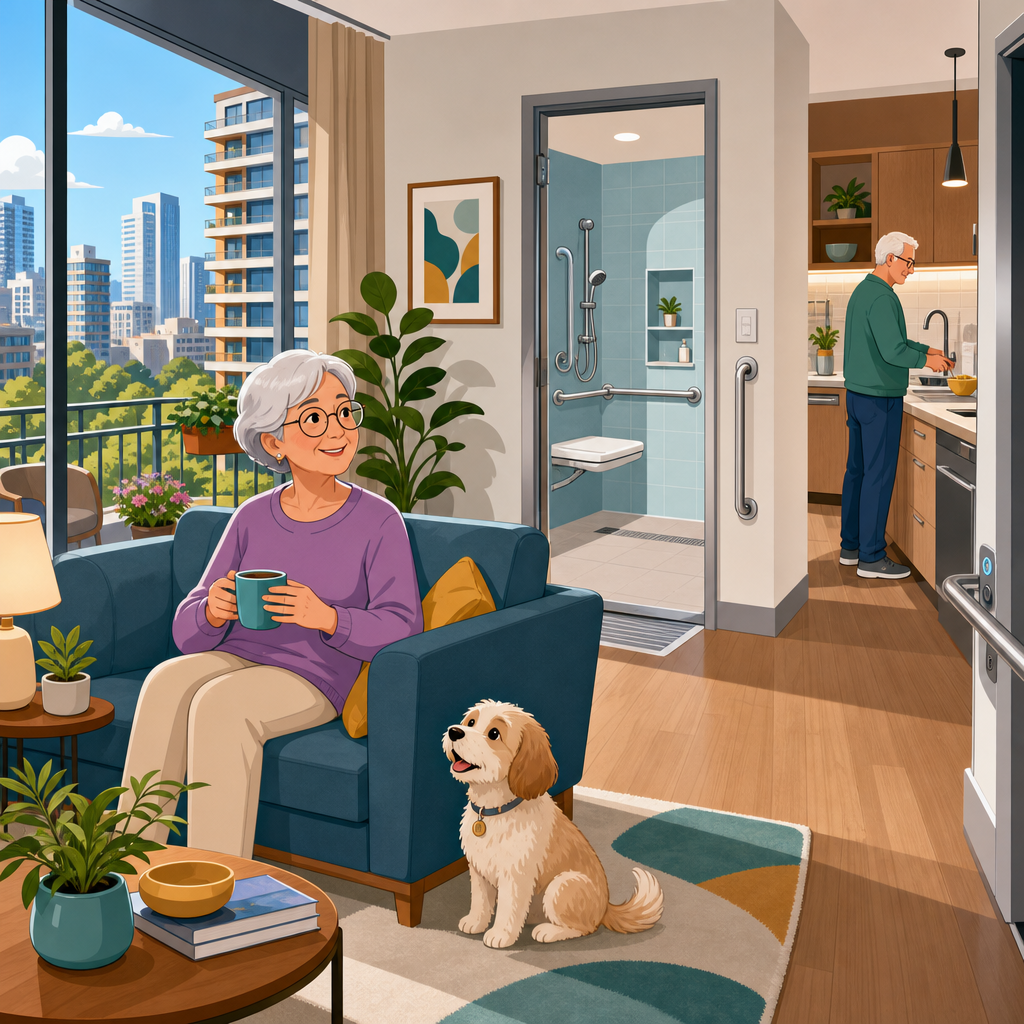
Unit planning matters just as much. Kitchens need usable work triangles without forcing long reaches; bathrooms need curbless showers, reinforced walls, handheld showerheads, anti-scald controls, and room for assisted transfers; bedrooms need enough clearance beside the bed for mobility aids and caregivers. I recommend teams think in scenarios: Can a resident recover from hip surgery here? Can a spouse help with dressing? Can home health staff access outlets, sinks, and storage? When those questions drive layouts, the result is housing that performs under real conditions. Acoustics are often overlooked, yet hearing loss is common with age. Better acoustic separation, lower background noise from mechanical systems, and induction loop or caption-ready communication systems in common rooms materially improve daily life.
Lighting and contrast deserve equal attention. Older eyes generally need more light and are more sensitive to glare. Layered lighting, higher vertical illumination at doors and switches, matte finishes, and visual contrast between floors, walls, counters, and hardware improve usability. Controls should be intuitive, consistently located, and easy to operate with limited dexterity. Smart systems can help, but they should not replace simple physical controls. Whenever I review resident complaints in older towers, a pattern emerges: many problems are not dramatic design failures but small repeated frictions such as dim corridor lighting, heavy doors, confusing thermostats, or inaccessible parcel rooms. Fixing those details often delivers more value than expensive showcase amenities.
Safety, resilience, and building systems that support independence
Aging in place in high-rise and mid-rise buildings depends heavily on reliable systems. Elevators are central. Long wait times, frequent outages, poor leveling accuracy, or cramped cabs can make the building effectively unusable for residents with walkers, wheelchairs, or limited endurance. Redundancy, preventive maintenance, destination control tuned for residential patterns, and emergency communication that works for hearing and vision impairments are practical priorities. In buildings with only one passenger elevator, outage planning should be treated as a resident welfare issue, not just an operational inconvenience. Owners should have vendor response protocols, temporary staffing plans, and communication procedures that identify residents who may need assistance.
Fire and life safety must be addressed with realism. Standard evacuation assumptions often do not reflect the needs of older adults. Refuge areas, clear signage, voice communication systems, backup power for critical equipment, and staff training can significantly improve outcomes. Designers should coordinate with applicable codes and recognized standards such as NFPA 101, ICC A117.1, and local accessibility requirements, but code compliance alone is not enough. Residents need understandable wayfinding, readable alarm information, and drills that consider mobility and sensory limitations. During severe weather or utility disruptions, backup power for elevators serving accessible units, refrigeration for medications, cooling for heat-vulnerable residents, and dependable water supply become essential supports for aging in place.
Indoor environmental quality directly affects health and independence. Better filtration can reduce respiratory stress; humidity control limits mold risk; operable windows, where appropriate and safe, give residents personal control; and thermal comfort systems should avoid large swings that are harder for older bodies to tolerate. Flooring should balance slip resistance with rollability for wheelchairs and walkers. Selection errors are common here: textured surfaces that appear safe may create excessive rolling resistance or trip hazards at transitions. Maintenance teams need guidance so later repairs do not undermine accessibility, for example by adding threshold strips, replacing lever handles with knobs, or storing carts in corridors. The building’s operational culture is part of the design outcome.
| Design focus | Why it matters for aging in place | Good practice in mid-rise and high-rise buildings |
|---|---|---|
| Elevators | Access to home, services, and emergency response depends on them | Redundant service where possible, accurate leveling, backup communication, fast maintenance contracts |
| Bathrooms | Most in-home falls and assistance needs occur here | Curbless showers, reinforced walls, non-slip floors, clear transfer space, anti-scald valves |
| Lighting | Supports vision, orientation, and fall prevention | Layered lighting, glare control, contrast at edges, illuminated switches and entries |
| Wayfinding | Reduces confusion for residents and visitors | Large readable signage, color zoning, consistent floor numbering, landmarks near elevators |
| Operations | Daily building management determines whether design works in practice | Staff training, outage protocols, accessible communication, resident support plans |
Social connection, services, and the neighborhood interface
Older residents can remain physically safe in a building yet still fail to age well if isolation becomes chronic. Vertical housing should therefore support everyday social contact without forcing participation. Successful buildings provide visible, comfortable shared spaces near natural circulation routes: seating near the lobby, mail and parcel areas that are easy to use, small lounges on amenity floors, shaded outdoor terraces, and multipurpose rooms with good acoustics and flexible furniture. The goal is to create low-pressure opportunities for familiar contact. In post-occupancy interviews, residents consistently value places where they can stop for ten minutes and see neighbors more than oversized amenity decks that feel performative and underused.
The interface with the neighborhood is equally important. Aging in place works best when the building sits within a fifteen-minute living pattern: groceries, clinics, pharmacies, parks, transit, and everyday services should be reachable without a car. For urban development teams, that means site selection and ground-floor design matter as much as unit interiors. Safe crossings, benches, canopies, curb ramps, bicycle and mobility scooter storage, and weather-protected pickup zones make local trips manageable. Buildings can also support service delivery through concierge coordination, secure package rooms, telehealth-ready private spaces, and policy frameworks for home care workers. In one tower retrofit I reviewed, simply relocating the parcel room from a stair-adjacent basement corner to the lobby reduced resident complaints and eliminated a major barrier for people with limited stamina.
Technology can strengthen connection and safety when deployed carefully. Video intercoms, digital notice systems, leak sensors, stove shutoff devices, wearable alert integration, and app-based maintenance requests all have value. But digital tools must not assume high technical confidence, perfect vision, or smartphone ownership. Every digital feature should have a plain-language backup: printed notices, staffed support, tactile buttons, and in-person help. Privacy also matters. Monitoring technologies should be opt-in, transparent about data use, and limited to legitimate safety functions. Residents accept supportive technology far more readily when it is presented as a choice that preserves independence rather than as surveillance imposed for management convenience.
Retrofit strategies, costs, and policy considerations
Most aging-in-place opportunities in cities involve existing buildings, not new construction. Retrofitting a 1970s or 1990s apartment tower requires prioritization because budgets are finite and technical constraints are real. The most cost-effective sequence usually starts with entrances, elevators, lighting, flooring transitions, hardware, bathrooms in turnover units, and communication systems. Structural changes such as stacking larger accessible bathrooms across multiple floors or enlarging elevator cores are possible but expensive, so teams should distinguish between essential life-quality improvements and highly disruptive reconstruction. A building audit should combine code review, resident interviews, maintenance logs, incident reports, and unit sampling. That process reveals where small investments can remove recurring barriers.
Costs vary by market and building type, but owners should view accessibility upgrades through lifecycle value rather than first cost alone. Falls, vacancy from forced moves, liability claims, emergency callouts, and rushed reactive modifications are expensive. Durable features installed during planned capital work are cheaper than one-off retrofits after a resident crisis. For example, adding bathroom wall reinforcement during unit renovation costs little compared with opening finished walls later. Likewise, replacing round knobs with lever hardware during a building-wide hardware cycle is straightforward and broadly useful. Financial incentives may also be available through local housing programs, energy retrofit packages that include health and comfort improvements, tax credits, or accessibility grants, though these vary widely by jurisdiction.
Policy and management complete the picture. Leasing practices should accommodate reasonable modifications, staff should be trained to communicate respectfully with older residents and caregivers, and emergency registries should be voluntary, secure, and current. Design guidelines should align with fair housing obligations and accessibility law while going beyond bare minimums where resident needs justify it. For developers and housing providers building a long-term portfolio, the strategic benefit is clear: apartments that support aging in place remain marketable to a wider range of households and are more resilient as demographics shift. If you are planning, renovating, or operating mid-rise or high-rise housing, start with a building-wide aging-in-place audit, prioritize the barriers residents encounter every day, and turn inclusive design into a standard operating principle rather than a special project.
Frequently Asked Questions
What does aging in place mean in the context of mid-rise and high-rise buildings?
Aging in place in multifamily buildings means enabling residents to remain in their own homes safely, comfortably, and independently as their needs change over time. In a mid-rise or high-rise setting, that goes far beyond a few unit-level accessibility upgrades. It includes step-free building entry, reliable elevators, accessible circulation routes, well-lit corridors, clear wayfinding, adaptable apartment layouts, safe bathrooms and kitchens, emergency communication systems, and property management practices that support long-term residency. The goal is to reduce the need for disruptive moves by making both private units and shared building spaces more usable for people with varying levels of mobility, vision, hearing, cognition, and stamina.
In urban multifamily housing, aging in place also depends on factors outside the apartment itself. Residents need easy access to transportation, healthcare, social opportunities, building staff support, package handling, digital connectivity, and maintenance services. A well-designed building anticipates changing needs before a crisis occurs. That means planning for flexibility, redundancy, and convenience from the start, rather than waiting to retrofit under pressure. When done well, aging in place supports dignity, social connection, and health while also making the building more practical and appealing for a wider range of residents.
Which design features matter most inside apartments for older residents?
The most important unit-level features are the ones that improve daily safety, reduce physical strain, and allow spaces to adapt over time. Step-free entries, wider doors, and clear circulation paths make it easier to move through the apartment using a walker, wheelchair, or other mobility aid. Bathrooms are especially critical. Curbless showers, reinforced walls for future grab bars, slip-resistant flooring, hand-held showerheads, comfort-height toilets, and enough turning space can dramatically reduce fall risk and improve usability. Kitchens should support seated and standing use, with easy-to-reach storage, lever-style faucets, task lighting, contrasting finishes for visibility, and appliances that are intuitive and safer to operate.
Comfort and ease of use also depend on details that are often overlooked. Lever door handles are easier than round knobs. Rocker light switches and electrical outlets placed at accessible heights reduce bending and gripping. Good lighting with minimal glare improves visibility, while acoustic control helps residents with hearing changes. Flooring should be stable and slip resistant, avoiding abrupt thresholds and surfaces that can catch mobility devices. Temperature controls, window hardware, and intercom systems should be simple to use and easy to reach. Ideally, units are designed with adaptability in mind, so residents can add support features later without major demolition. That future-ready approach is one of the strongest strategies for successful aging in place.
How do common areas and building systems affect aging in place outcomes?
Common areas and building infrastructure often determine whether a resident can truly remain independent in a mid-rise or high-rise building. A fully accessible apartment is not enough if the route from the sidewalk to the front door includes stairs, heavy doors, confusing circulation, or unreliable elevators. Entrances should be step-free, protected from weather, and easy to navigate with mobility aids. Lobbies, mail areas, trash rooms, amenity spaces, and outdoor areas should all be accessible without excessive walking distances or complicated transitions. Seating throughout shared spaces can help residents who fatigue easily, and clear signage with legible fonts and strong contrast supports navigation for everyone.
Building systems are equally important. Elevator reliability is essential in taller buildings, and backup power planning can be critical during outages. Emergency systems should include audible and visual alerts, accessible two-way communication, and evacuation planning that accounts for residents who may not be able to use stairs independently. Good lighting, security systems, controlled access, and visible staff support can improve both safety and confidence. HVAC systems, indoor air quality, and thermal comfort also matter because older adults can be more sensitive to heat, cold, and poor ventilation. In practice, aging in place works best when the entire building is treated as a connected environment, not just a collection of individual units.
Why are operations, management, and resident services so important for long-term independence?
Even the best building design can fall short if operations and management do not support residents as they age. Long-term independence depends on responsive maintenance, clear communication, consistent housekeeping standards in shared areas, and staff who understand accessibility and resident needs. For example, a broken automatic door, a poorly timed elevator repair, or unclear emergency notices can create serious barriers for older residents. Management policies should make it easy to request reasonable accommodations, schedule repairs, report hazards, and receive updates in accessible formats. Staff training is also important so frontline teams can recognize issues such as trip hazards, social isolation, or malfunctioning accessibility features before they become larger problems.
Resident services can further strengthen aging in place by filling the gap between housing and healthcare. Buildings may offer wellness programming, social activities, technology support, transportation coordination, visiting service providers, or partnerships with community organizations. These services help residents remain connected and reduce the likelihood that small challenges turn into relocation triggers. Digital systems should be user-friendly and not assume every resident is comfortable with apps-only communication. A strong aging-in-place strategy combines physical design with management practices that are predictable, respectful, and proactive. In many cases, that operational layer is what makes a building truly livable over the long term.
How can developers and designers plan for aging in place without making buildings feel institutional?
The best aging-in-place design is integrated, attractive, and nearly invisible in daily use. Features such as step-free access, wider passages, better lighting, comfortable acoustics, easy-to-operate hardware, durable slip-resistant flooring, and intuitive layouts benefit residents of all ages and do not need to look clinical. This is where universal design and inclusive design principles are especially valuable. Instead of treating accessibility as a special add-on, designers can create homes and amenities that feel modern, comfortable, and elegant while still accommodating changing physical and sensory needs. The focus should be on usability, flexibility, and dignity rather than on a medicalized appearance.
Planning early is what keeps the result from feeling like a patchwork of obvious retrofits. Developers can design structural backing for future grab bars, bathrooms sized for easier transfers, adaptable kitchens, robust digital infrastructure, and common spaces that support both privacy and social engagement. Materials, lighting, furnishings, and finishes can all be selected to improve safety and perception without sacrificing aesthetics. Just as important, teams should think about the full resident journey: arriving at the building, receiving deliveries, accessing amenities, finding transportation, using technology, and staying connected to neighbors and support networks. When aging in place is treated as a core performance goal from the start, the outcome is not institutional at all. It is simply a better building.