Designing public spaces next to affordable housing is one of the most practical ways cities can improve health, safety, and social connection without displacing the residents those neighborhoods are meant to serve. In this context, affordable housing means homes priced so lower- and moderate-income households can meet rent or mortgage costs without becoming cost burdened, while public space includes parks, plazas, sidewalks, courtyards, play streets, transit forecourts, community gardens, and shared civic amenities open to daily use. I have worked on housing-adjacent site plans where the difference between a well-used courtyard and an empty one came down to basic decisions: where benches faced, whether lighting reached the path edge, and how many entrances connected homes to the street. These spaces matter because residents of affordable housing often rely more heavily on nearby public amenities than higher-income households with private yards, cars, or club access. When design is weak, families get isolation, conflict, and underused land. When design is strong, they get safer walking routes, informal childcare support, shaded summer gathering areas, and a visible sense that investment in the neighborhood includes them.
Good public space beside affordable housing is not a decorative add-on. It is part of the housing system itself, influencing leasing stability, public health, resident satisfaction, and long-term operating costs. The most successful examples treat the open space network, building edges, stormwater strategy, and maintenance plan as one coordinated project. That is why this topic sits at the center of sustainable urban development: a durable neighborhood needs homes people can afford and shared places where daily life can happen with dignity.
Start with daily life, not just site aesthetics
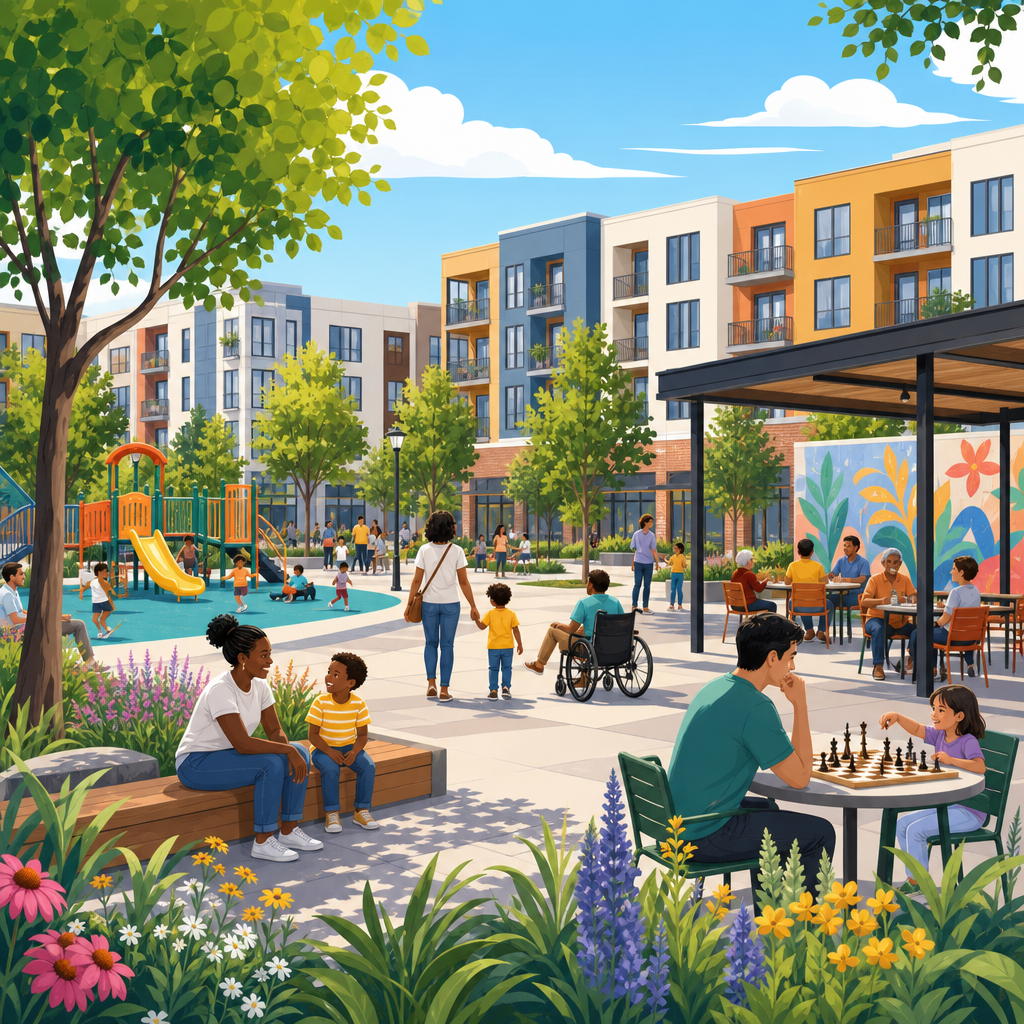
The first question is not what style the public space should have. It is how residents will actually use it on a Tuesday at 7 a.m., after school at 3:30 p.m., and on a hot Saturday evening. Affordable housing serves households with varied schedules, ages, and mobility needs, so a public space next door must support routine use, not occasional events. In practice, that means mapping desire lines, stroller routes, school walks, bus stops, loading needs, and places where caregivers can see children while talking with neighbors. A plaza that photographs well but lacks shade, toilets nearby, or comfortable seating will fail quickly. I have seen courtyards transformed simply by adding moveable chairs, a visible drinking fountain, and low planting that preserved sightlines.
Designers should separate active and quiet zones while keeping them connected. Older adults often want sheltered seating near pedestrian flow, not isolated corners. Teenagers need places to gather without being treated as a security problem by default. Small children need play opportunities near front doors and windows, where parents can supervise casually. Workers returning from late shifts need lighting that feels safe and does not create glare into bedrooms. These are not luxury refinements. They are baseline functional requirements that determine whether a space is welcoming or avoided.
Make safety visible through layout, lighting, and active edges
Safety in housing-adjacent public space is created more by form and management than by signage. The established principles are straightforward: clear sightlines, predictable paths, active ground floors, durable lighting, and enough legitimate activity throughout the day to create natural surveillance. Front doors, stoops, community rooms, laundry windows, leasing offices, and shared kitchens can all contribute eyes on the space when they face it directly. Blank walls, dead-end walkways, hidden alcoves, and deep shrub masses do the opposite. Crime prevention approaches work best when they support normal daily life rather than turning the site into a fortress.
Lighting deserves special attention. Pedestrian lighting should prioritize uniformity, facial recognition, and path legibility instead of dramatic brightness contrasts. Warm LED fixtures around 2700K to 3000K often create a calmer nighttime environment than harsh cool light, while cutoff optics reduce spill into apartments. In mixed-income and affordable developments I have reviewed, maintenance teams consistently report that simpler fixture families with accessible parts outperform bespoke lighting that becomes expensive to repair. Safety also depends on edge conditions at the public-private boundary. Low fences, raised porches, transparent lobby glazing, and frequent entry points make it easier for residents to claim space without excluding the broader neighborhood.
Design for climate comfort and environmental performance
Public spaces next to affordable housing should reduce heat, manage stormwater, and remain usable through seasonal change. Lower-income residents are often more exposed to climate risk because they have fewer cooling options, less flexible transportation, and less access to private outdoor space. Shade is therefore not an amenity; it is resilience infrastructure. Tree canopy, trellises, deep overhangs, and seat walls placed under shade can lower surface temperatures dramatically compared with bare paving. In many North American cities, shaded pavement can be tens of degrees cooler than unshaded asphalt during summer peaks, which directly affects whether elders and children can use the space safely.
Stormwater systems should be visible and useful. Bioswales, rain gardens, permeable paving, and cistern-fed irrigation can help public space double as green infrastructure while reducing burden on municipal systems. The key is to make these features legible and maintainable. A rain garden with clear edging and hardy planting reads as intentional; a poorly maintained depression reads as neglect. Material choice matters too. Light-colored pavements can mitigate heat, but glare must be controlled. Native or climate-adapted planting can reduce irrigation demand, but species selection must consider visibility, allergen load, and maintenance cycles. Public space becomes truly sustainable when environmental performance and everyday comfort reinforce each other.
Connect affordable housing to mobility, services, and the wider neighborhood
An excellent public space can still underperform if it is isolated from the places residents need to reach. Housing-adjacent open space should stitch the development into the surrounding urban fabric through sidewalks, protected crossings, bike parking, transit stops, and intuitive wayfinding. The most successful sites feel permeable and connected rather than inward-looking compounds. That does not mean every path should be fully open at all hours, but it does mean circulation should match real movement patterns. If residents regularly cut across a lawn to reach the bus, that is a design signal, not misbehavior.
Public space should also support access to essential services. Seating near transit matters for elders and people with disabilities. Covered waiting areas matter in rain and extreme heat. Secure bicycle storage and visible scooter parking can extend affordable mobility. Ground-floor space for childcare, clinics, food cooperatives, or resident services can animate a plaza while reducing travel burdens. Projects near schools should prioritize wide sidewalks, curb extensions, and traffic calming. Projects near commercial corridors should manage deliveries and ride-share pick-up so they do not overwhelm pedestrian areas. The public realm works best when it helps residents move efficiently between home, work, school, shopping, and care.
Program spaces for inclusion, stewardship, and long-term use
Programming is often the deciding factor between a space that merely exists and one that residents value enough to protect. Beside affordable housing, programming should be modest, recurring, and resident-informed rather than expensive and top-down. Weekly produce markets, after-school activities, outdoor exercise classes, repair cafés, legal aid pop-ups, and cultural events can build trust and consistent use. Community gardens and shared grilling areas are especially effective when rules, storage, water access, and maintenance responsibilities are defined early. I have seen small budgets produce strong results when managers partnered with resident leaders and local nonprofits instead of relying solely on seasonal events.
Stewardship needs a clear operating model. Who empties bins, prunes plantings, opens movable furniture storage, and responds to vandalism? Too many projects celebrate ribbon cuttings and ignore year three. For affordable housing operators, durability and staffing realities matter. Powder-coated steel, replaceable pavers, robust benches, and easy-access irrigation controls usually outperform fragile custom elements. Resident participation helps, but it should complement professional maintenance, not substitute for it. Inclusive design also means multilingual signage, flexible seating, accessible routes meeting recognized standards, and policies that avoid over-policing normal social behavior. A public space feels fair when residents can use it without navigating unnecessary barriers.
| Design priority | Recommended approach | Common mistake | Why it matters near affordable housing |
|---|---|---|---|
| Shade and heat | Layer trees, canopies, and shaded seating | Large exposed paved areas | Supports elders, children, and residents without private outdoor alternatives |
| Safety | Face doors, windows, and active rooms onto public space | Blank walls and hidden corners | Improves natural surveillance and perceived security |
| Mobility | Provide direct paths to transit, schools, and shops | Disconnected internal walkways | Reduces travel burden and supports car-light living |
| Maintenance | Choose durable materials and simple systems | High-concept features without upkeep plans | Protects operating budgets and long-term quality |
| Inclusion | Offer mixed seating, play, and quiet areas | One-size-fits-all open lawns | Serves different ages, cultures, and daily routines |
Avoid displacement and design with residents, not around them
One of the hardest truths in urban development is that better public space can increase neighborhood desirability and, without safeguards, contribute to rising rents and displacement nearby. That risk is real, especially where new parks or greenways are not paired with tenant protections, permanent affordability tools, or community ownership mechanisms. Designing next to affordable housing therefore requires policy awareness as well as site design skill. The goal is to create dignified, high-quality public space that benefits existing residents first and does not become a signal that the area is being remade for someone else.
Resident engagement must go beyond one listening session. Effective processes compensate participants, offer childcare and translation, and test options with drawings, models, or temporary installations people can react to. Questions should be concrete: Where do conflicts happen now? Which areas feel unsafe after dark? What seating works for elders? What would make teenagers stay visible but comfortable? I have found that residents often identify operational issues professionals miss, such as where delivery drivers idle, where drainage leaves ice in winter, or which play features attract a broader age range. Co-design does not eliminate tradeoffs, but it produces spaces with stronger legitimacy and better long-term use.
Measure success with clear metrics and learn from built examples
Public spaces next to affordable housing should be evaluated with the same seriousness as the housing itself. Useful metrics include pedestrian counts, dwell time, resident satisfaction, tree canopy growth, stormwater capture, maintenance costs, incident reports, and participation in programmed activities. Post-occupancy evaluation is essential because drawings never fully predict behavior. A shaded bench that looks peripheral on plan may become the social heart of the site. A shortcut through planting may reveal a missing connection to transit. Data allows managers and designers to adjust furniture layouts, lighting levels, programming schedules, and maintenance practices before small problems become chronic failures.
Built examples show consistent patterns. New York City Housing Authority campuses with improved lighting, seating, and play areas have demonstrated how modest public-realm upgrades can increase use and resident satisfaction when paired with maintenance. In Vienna, social housing is often integrated with courtyards, kindergartens, and shared green space that function as everyday infrastructure rather than isolated amenities. In Singapore, Housing and Development Board precincts show the value of void decks, shaded walkways, elder fitness zones, and food access woven into housing blocks. Different governance systems produce different forms, but the lesson is universal: public space works best when it is treated as a daily service, not a branding exercise.
Designing public spaces next to affordable housing succeeds when the work begins with residents’ routines, responds to climate and safety realities, and connects homes to the wider city with dignity. The strongest projects do not chase spectacle. They provide shade where people wait, seating where neighbors talk, play where caregivers can watch, lighting that supports safe movement, and durable materials that operators can maintain. They also recognize the larger policy context: beautiful spaces are not enough if surrounding residents are priced out or if maintenance collapses after opening. Quality comes from aligning design, management, and affordability goals from the start.
For planners, architects, housing providers, and local officials, the practical takeaway is simple. Treat housing-adjacent public space as essential infrastructure, not leftover land. Audit the site through the eyes of a child, an elder, a night-shift worker, and a wheelchair user. Invest in shade, visibility, direct connections, and stewardship plans before spending on signature features. Use resident knowledge to refine every move. If you are shaping a sustainable urban development strategy, start here: create public spaces beside affordable housing that people can use comfortably, safely, and proudly every day.
Frequently Asked Questions
Why is it important to design public spaces next to affordable housing?
Designing public spaces next to affordable housing helps neighborhoods work better for the people who already live there. When residents have access to safe, attractive, and useful outdoor spaces close to home, they are more likely to walk, meet neighbors, supervise children, exercise, wait for transit comfortably, and participate in community life. That matters in affordable housing settings because many households are balancing tight budgets, long commutes, caregiving responsibilities, and limited access to private outdoor space. A well-designed park, courtyard, plaza, sidewalk network, or community garden can function as an everyday extension of the home.
These spaces also improve public health and safety. Good lighting, clear sightlines, shade, seating, traffic calming, and accessible walking routes make it easier for people of different ages and abilities to use the space confidently. Small design decisions can reduce isolation for older adults, create informal play opportunities for children, and support mental well-being by adding greenery and places to rest. Public spaces near affordable housing can also strengthen social ties, which is one of the most effective but overlooked forms of neighborhood resilience. People are more likely to look out for one another when they regularly share a common space.
Just as importantly, thoughtful design can help cities invest in neighborhoods without triggering displacement. The goal is not simply to beautify an area for future higher-income residents. It is to create amenities that reflect current community needs, protect long-term affordability, and deliver real daily benefits to existing households. In that sense, public space design next to affordable housing is not just a physical planning issue; it is a fairness and quality-of-life issue.
What features make a public space successful beside affordable housing?
A successful public space beside affordable housing is useful, welcoming, safe, easy to maintain, and shaped by the people who will actually use it. The best spaces are not defined by expensive materials or iconic design gestures. They succeed because they support everyday routines. That usually means comfortable seating, shade, lighting, trees, visible entrances, accessible paths, durable surfaces, play opportunities, and flexible areas that can host both informal use and organized events. Spaces should feel open enough to invite the public while still offering enough structure and visibility to discourage unsafe or exclusionary behavior.
Accessibility is essential. Paths should accommodate wheelchairs, strollers, mobility devices, and older adults. Seating should include backs and armrests. Crosswalks, curb ramps, wayfinding, and transit connections should be integrated from the beginning rather than treated as afterthoughts. In family-oriented housing developments, successful spaces often include a mix of active and quiet uses: places for children to play, teens to gather, adults to sit and talk, and elders to rest in the shade. In denser settings, even widened sidewalks, pocket plazas, play streets, and transit forecourts can make a significant difference when designed carefully.
Programming and stewardship also matter. A space can be physically well designed and still fail if no one feels responsible for it or if its rules are unclear. Partnerships among housing providers, resident groups, local nonprofits, and city agencies can support cleaning, gardening, events, and conflict resolution. The most durable public spaces next to affordable housing are those that balance physical design with management, maintenance, and community ownership. Residents should be able to see themselves in the space, use it without feeling surveilled or unwelcome, and trust that it will be cared for over time.
How can cities improve public spaces without causing displacement or gentrification?
This is one of the most important questions in equitable urban design. Public space improvements can raise neighborhood desirability, but they do not have to lead to displacement if cities pair design investments with strong housing protections. The key is to treat public space planning and housing policy as inseparable. If a city builds better parks, sidewalks, plazas, and green infrastructure next to affordable housing, it should also strengthen rent stabilization where applicable, preserve subsidized units, support nonprofit and mission-driven ownership, protect tenants from unjust eviction, and require long-term affordability in nearby development.
Community engagement must also be real and early. Residents should not only be asked what color benches they prefer after major decisions have already been made. They should help shape priorities from the start: what kind of space is needed, what hours it should support, what safety concerns exist, what cultural practices should be accommodated, and what tradeoffs feel acceptable. Engagement should include renters, youth, elders, immigrants, people with disabilities, and residents who may not attend conventional public meetings. That often requires multilingual outreach, childcare, stipends, trusted local partners, and events held at accessible times and locations.
Another important strategy is to invest in spaces that serve current needs rather than importing a generic redevelopment model. A successful anti-displacement approach might prioritize shaded seating, play areas, public restrooms, bus stop improvements, community gardens, market space for local vendors, and safer walking routes to schools and services. These are practical amenities that improve daily life for existing residents. When cities measure success by resident stability, health, affordability, and belonging rather than by rising land values alone, public space improvements become a tool for neighborhood support rather than neighborhood turnover.
How should safety be addressed in public spaces near affordable housing?
Safety should be approached as a design, management, and community trust issue, not just a policing issue. People feel safer in public spaces when they can see and be seen, when routes are clear, when lighting is consistent, and when there are enough legitimate reasons for many different people to use the space throughout the day. This is sometimes described as creating positive activity and natural surveillance. Entrances should be visible, landscaping should not create hidden corners, and seating should be placed where users feel both comfortable and connected to surrounding activity. Traffic safety is equally important, especially near homes with children, seniors, and people walking to transit. Narrower crossings, slower vehicle speeds, curb extensions, raised intersections, and protected pedestrian paths can dramatically improve safety.
Comfort and maintenance are also part of safety. Broken lights, damaged paving, overflowing trash, and inaccessible routes send a message that a space is neglected. Regular cleaning, prompt repairs, and clear maintenance responsibilities help residents feel that the space belongs to them and will remain usable. Safety planning should include considerations for weather protection, emergency access, visibility from nearby homes, and design elements that reduce conflict between users without making the space feel hostile. Overly defensive design can discourage exactly the community use that makes a space feel secure.
Most importantly, residents themselves should define what safety means in their context. For some communities, that may include better lighting and more activity after school hours. For others, it may mean reducing harassment, improving transit waiting conditions, creating safer spaces for girls and women, or designing welcoming areas for teens so they are not treated as a problem. When cities listen to those concerns and combine environmental design with resident-led stewardship, public spaces near affordable housing become safer in ways that are practical, lasting, and respectful.
What role does community input play in designing public spaces next to affordable housing?
Community input is not an optional step; it is central to whether the space will work. Residents who live next to affordable housing understand the daily rhythms of the site better than any outside consultant. They know where flooding happens, which routes feel unsafe at night, when children gather after school, where elders prefer to sit, how cultural events are celebrated, and what amenities are missing. That knowledge leads to better design decisions and helps avoid costly mistakes. Without meaningful input, cities risk creating spaces that look appealing in renderings but fail in daily use.
Effective engagement goes beyond a single public meeting or online survey. It should be multilingual, accessible, and continuous across planning, design, implementation, and management. Workshops, walking audits, pop-up demonstrations, school-based outreach, resident advisory groups, and on-site conversations can all help capture a fuller picture of community needs. Compensation and logistical support matter too. If residents are asked to contribute their time and expertise, offering childcare, food, interpretation, transportation support, or stipends can make participation more equitable and representative.
Community input also builds legitimacy and long-term stewardship. When residents see their priorities reflected in the final design, they are more likely to use, defend, and help care for the space. That can lead to stronger partnerships with housing organizations, local businesses, service providers, and parks or public works departments. In the best cases, the design process itself strengthens neighborhood relationships. Public spaces next to affordable housing are most successful when they are created with residents, not just for them, and when the final result reflects both professional design expertise and lived experience.