Designing efficient Bus Rapid Transit systems starts with a simple goal: move large numbers of people quickly, reliably, and affordably using buses that perform more like rail. Bus Rapid Transit, usually shortened to BRT, is a high-capacity bus-based transit mode built around dedicated running ways, frequent service, fast boarding, strong stations, and disciplined operations. In practice, the difference between an ordinary bus corridor and true BRT is not branding or vehicle styling. It is whether the system consistently protects travel time, minimizes delay at stops and intersections, and offers riders a legible, dependable experience.
This matters because cities need transport investments that improve access without waiting decades for metro construction or carrying heavy rail costs on every corridor. I have worked on corridor planning exercises where the same arterial street moved fewer people in general traffic lanes than it could have moved with median busways and all-door boarding. That pattern is common. According to the Institute for Transportation and Development Policy and the World Bank, well-designed BRT can deliver metro-like throughput on the right corridors at a fraction of rail capital cost, while also improving safety, emissions, and street organization. Yet many projects fail to reach that potential because key design choices are watered down during political negotiation or squeezed by mixed-traffic compromises.
As the miscellaneous hub within urban mobility and transportation, this article maps the full design landscape: corridor selection, lanes, stations, fares, service plans, intersection treatment, fleet strategy, passenger information, governance, and performance measurement. If a planner, engineer, policymaker, or operator asks what makes BRT efficient, the answer is straightforward. Efficient BRT reduces friction at every point in the passenger and vehicle journey. Riders should walk a short distance to a visible station, pay quickly, board through multiple doors, travel in an exclusive lane, clear signals with minimal interruption, and arrive on a schedule they can trust. Everything else in this article supports that chain.
Choose the right corridor and define the operating model
The first design decision is not vehicle type. It is corridor suitability. BRT works best where travel demand is already strong or clearly latent, where buses suffer recurring delay, and where a dedicated right-of-way can be protected for long enough segments to create meaningful speed gains. Good candidates usually connect dense housing with job centers, universities, hospitals, intercity terminals, or major transfer hubs. Analysts should examine peak passenger volumes per direction, stop spacing, curbside activity, turning movements, crash patterns, and land-use change potential. In my experience, corridors with heavy existing bus demand but inconsistent travel times often produce the clearest early wins, because operators can convert lost time into higher frequency or lower operating cost.
The operating model must then match corridor demand. A single all-stops pattern is easy to understand and often adequate on moderate-demand corridors. Higher-demand corridors may require layered service: trunk routes in the median, branches feeding into the trunk, short-turn services for the busiest section, or limited-stop overlays to reduce end-to-end travel time. Bogotá’s TransMilenio popularized this approach, pairing infrastructure with operational complexity to raise corridor capacity. By contrast, systems that simply paint curb lanes red and keep local stopping patterns unchanged usually struggle to deliver true rapid transit performance. The design question is always the same: how many passengers need to move, over what distance, and with what reliability target?
Build dedicated lanes that stay dedicated
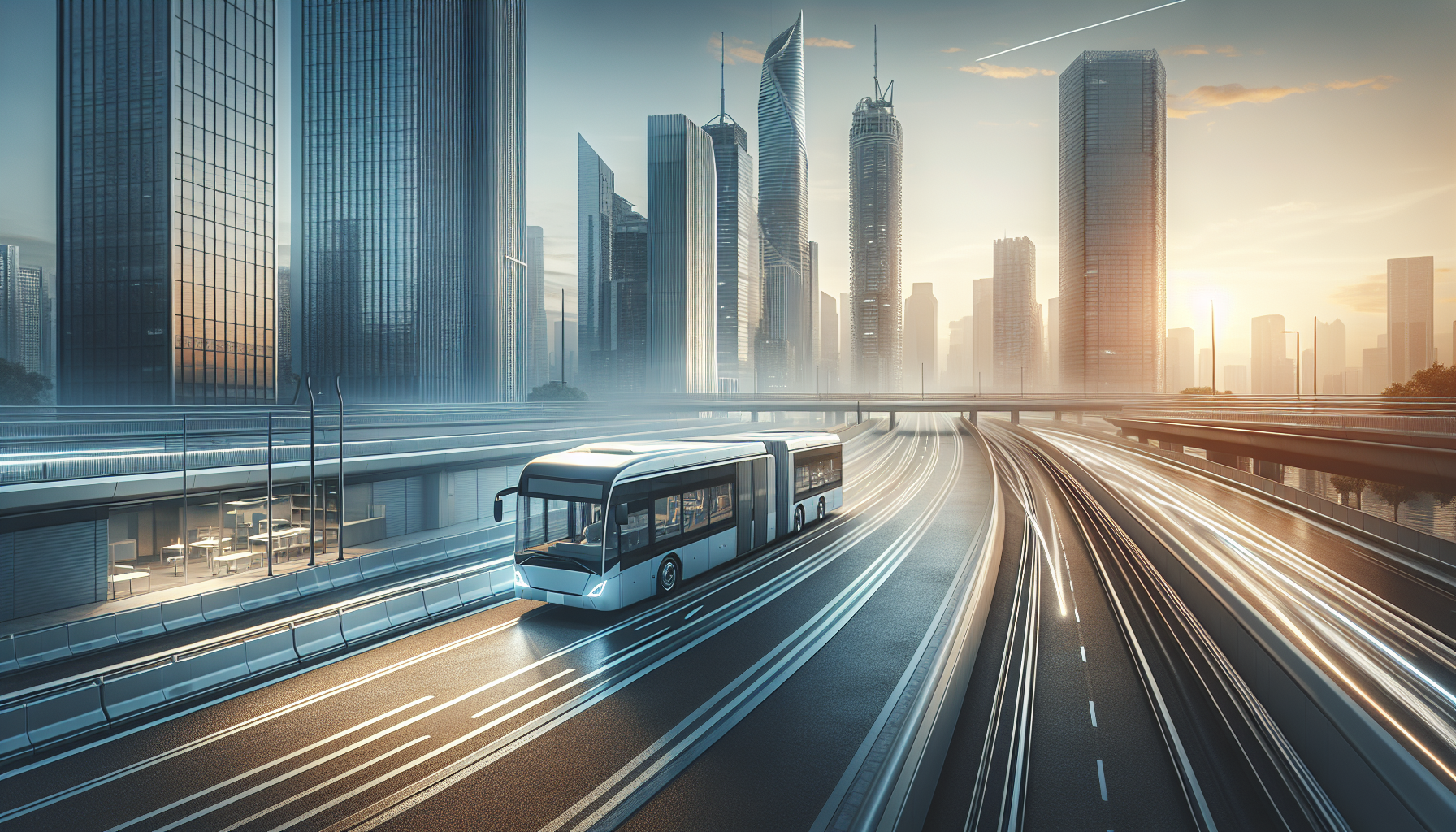
Dedicated running ways are the heart of efficient BRT. Without them, buses remain exposed to congestion, illegal parking, delivery vehicles, and ride-hail pickups. Median busways generally outperform curbside lanes because they avoid most curb friction and reduce conflicts with turning vehicles and loading activity. Center-running configurations also support more consistent station design and can simplify signal priority. Curbside lanes can still work, especially where street width or access needs limit alternatives, but they require stronger enforcement and careful management of freight, parking, and right turns. Physically separated lanes, clear pavement markings, camera enforcement, and frequent violation processing matter far more than decorative branding.
Lane continuity is equally important. A corridor that offers exclusive lanes for only part of its length often loses most of the benefit in constrained segments near downtowns, bridges, terminals, or major intersections, precisely where delays are worst. Effective design focuses on bottlenecks first. Queue bypass lanes, turn restrictions, transit-only phases, and protected entry into stations can preserve speed through these pinch points. Cleveland’s HealthLine and Guangzhou BRT show why these details matter: both integrated corridor-level design rather than treating bus lanes as isolated segments. The lesson is practical. If a city cannot fully separate the lane everywhere, it should still prioritize the sections where delay, bus bunching, and passenger accumulation are greatest.
Design stations and boarding for fast passenger flow
Stations determine dwell time, accessibility, and perceived quality. Efficient BRT stations are not oversized monuments; they are boarding machines. Level boarding reduces wheelchair ramp deployment, shortens stop time for all users, and improves safety. Off-board fare collection removes payment delay from the doorway. Multiple wide doors and precise docking let passengers distribute themselves along the platform instead of crowding one front entrance. Platform length must reflect service pattern and vehicle length, especially where platoons or overtaking are expected. Shelters, lighting, sightlines, seating, and weather protection influence comfort, but the core design objective remains fast, predictable passenger exchange.
Accessibility is non-negotiable. Stations need tactile guidance, step-free entry, audible information where appropriate, and gap management between platform and vehicle. Fare gates can support proof-of-payment control, yet they should not create choke points. I have seen stations where narrow access channels saved a little capital cost but imposed daily delay on thousands of riders. That is false economy. Good station design also considers the approach: crosswalk placement, refuge islands, bicycle parking, curb ramps, and safe transfers to local buses. The station is where street design and transit design meet. If riders cannot reach it safely and intuitively, the speed benefits of the corridor are undermined before the trip begins.
Integrate fares, service planning, and intersections
Fare policy has direct operational consequences. Proof-of-payment systems with off-board validation usually outperform on-board cash collection because they cut dwell time dramatically. Integrated fares across buses, metro, and suburban services also make the network easier to use and increase transfer willingness. The best systems treat BRT as the backbone of a wider network, not a standalone line. Feeder routes, timed connections, fare capping, and unified wayfinding all reduce generalized travel cost. A rider judges one trip, not separate agencies or modes. If fares penalize transfers or ticket media are fragmented, system efficiency falls even when the corridor itself is well designed.
Intersections are where much of BRT performance is won or lost. Transit signal priority can extend green phases or shorten red time when a bus approaches, but more robust corridors often need queue jumps, protected signal phases, banned turns, and redesigned cycle lengths. For very high-demand routes, passing lanes at stations allow express services to overtake local buses, preventing a single long dwell from disrupting the line. Service control also matters: headway-based management, real-time dispatching, and active regulation at terminals help avoid bunching. The table below summarizes common design choices and their operational effect.
| Design element | Primary benefit | Main tradeoff | Best use case |
|---|---|---|---|
| Median dedicated lanes | Higher speed and reliability | More complex station access | Busy arterials with heavy curb activity |
| Off-board fare collection | Shorter dwell times | Requires inspection and equipment | High boarding volumes |
| Level boarding platforms | Faster, accessible boarding | Needs precise docking and maintenance | Frequent all-day service |
| Passing lanes at stations | Supports express and overtaking | Wider right-of-way needed | Very high-demand corridors |
| Transit signal priority | Lower intersection delay | May affect cross-street timings | Signalized urban corridors |
| Proof-of-payment enforcement | Maintains fast boarding | Needs staff and fair inspection policy | Networked BRT systems |
Match vehicles, depots, and technology to operations
Vehicle choice should follow service design, not precede it. Standard 12-meter buses suit lower-volume corridors and feeder services. Articulated and bi-articulated buses are more efficient where stop volumes are high and driver labor is a constraint, because one operator can carry far more passengers per trip. Door configuration matters as much as length. Wide, multiple doors support all-door boarding and faster alighting; narrow front-door layouts belong to conventional bus operations, not serious BRT. Propulsion technology also requires realism. Battery-electric buses can reduce local emissions and noise, but charging strategy, range under air-conditioning loads, and depot power capacity must be tested against the actual duty cycle. Trolleybus and hybrid options remain valid depending on topography, climate, and grid conditions.
Technology should solve operational problems, not merely add dashboards. Automatic vehicle location, real-time passenger information, computer-aided dispatch, and automated passenger counting are now standard tools for running efficient corridors. The data they generate should feed schedule refinement, terminal management, crowding analysis, and maintenance planning. Depots need enough circulation space, charging or fueling resilience, spare ratio planning, and cleaning capacity to support the peak requirement without creating hidden bottlenecks overnight. Agencies often underinvest in back-of-house assets because they are less visible than stations. That is a mistake. A polished corridor cannot perform reliably if spare vehicles are unavailable, charging bays are oversubscribed, or maintenance windows are routinely missed.
Make BRT part of the street and the city
Efficient BRT is also urban design. A corridor should improve walking, support safe crossings, organize curb use, and encourage compact development around stations. If the project widens road space only to maximize bus throughput while neglecting sidewalks, shade, drainage, or cycling access, it solves one mobility problem by worsening another. The strongest projects use BRT investment to reorder the street: fewer chaotic turns, clearer loading zones, better public realm, and more predictable traffic behavior. This is one reason systems in cities such as Curitiba and Bogotá influenced planning debates far beyond transport engineering. They demonstrated that bus infrastructure can shape land use and corridor identity when paired with zoning, public space, and service discipline.
Governance is often the hidden determinant of success. Someone must own standards, manage contracts, coordinate police enforcement, monitor performance, and adjust service as demand changes. Fragmented governance is a common failure point. One agency builds stations, another controls signals, a private operator runs buses, and no institution has both authority and accountability for passenger outcomes. Strong contracts should define on-time performance, vehicle condition, safety reporting, fare reconciliation, and customer service expectations. Public communication matters too. When lanes are reallocated from cars, cities need to explain person-throughput, access benefits, and expected tradeoffs clearly. BRT succeeds politically when residents can see who benefits, how operations will work, and what safeguards will protect reliability over time.
Measure performance and improve continuously
No BRT system is finished on opening day. Efficient operations depend on measurement and regular adjustment. Core indicators include commercial speed, end-to-end travel time, dwell time by station, headway adherence, passenger load profile, fare evasion rate, collisions, mean distance between failures, customer complaints, and access time to stations. These metrics should be tracked by time of day and direction, not only as daily averages. A corridor that looks healthy on a monthly dashboard may still fail badly during the school peak or the evening shoulder. In practice, the most useful reviews combine operations data with direct field observation. Ride the line, stand on platforms, watch boarding behavior, and compare what the data says with what riders actually experience.
The clearest takeaway is that designing efficient Bus Rapid Transit systems is an exercise in removing delay from an entire mobility chain, not just adding buses to a roadway. Dedicated lanes, strong stations, off-board fares, disciplined service control, intersection priority, and integrated network planning are the non-negotiable foundations. Vehicle technology, branding, and streetscape improvements add value only when those fundamentals are protected. For cities building an urban mobility and transportation strategy, BRT remains one of the most practical tools for delivering faster travel, broader access, and lower per-passenger cost on busy corridors. Start with the corridor, design for operations, measure relentlessly, and refine the system as conditions change. That is how BRT becomes genuinely rapid transit rather than a bus service with a new name.
Frequently Asked Questions
What makes a Bus Rapid Transit system different from a regular bus service?
A true Bus Rapid Transit system is defined by performance, not by appearance. Many cities label upgraded bus routes as BRT because they use larger vehicles, painted lanes, or improved branding, but those features alone do not create rapid transit. What separates BRT from conventional bus service is a coordinated set of design and operational choices that allow buses to move with speed, reliability, and high passenger throughput. The most important of these is a dedicated running way, which protects buses from general traffic congestion and gives them a clear path through the corridor.
Efficient BRT also depends on stations designed for fast, predictable passenger movement. That usually means level boarding, off-board fare collection, multiple wide doors, and platforms that reduce dwell time at stops. Frequent service is another defining feature. Riders should not need to plan around long wait times, especially on major corridors. Strong operations, including signal priority, well-managed intersections, overtaking strategies where needed, and consistent service patterns, are what turn a bus line into a high-capacity transit service.
In practical terms, the difference is whether the system delivers rail-like outcomes using buses. If buses still sit in mixed traffic, stop too often, board slowly through a front door farebox, and operate with inconsistent headways, then the service is still a regular bus route with some enhancements. Efficient BRT is built around corridor performance. Its purpose is to move large numbers of people quickly and reliably, and every design decision should support that objective.
Why are dedicated lanes so important in designing efficient BRT corridors?
Dedicated lanes are the backbone of an efficient BRT system because they protect transit from the delays that make regular bus service slow and unreliable. In mixed traffic, buses are affected by the same congestion, turning movements, parking maneuvers, double-parked vehicles, and signal delays as private cars. That means travel times become unpredictable, buses bunch together, and the rider experience deteriorates. A dedicated lane creates a controlled operating environment where transit vehicles can maintain more consistent speeds and schedules.
The value of dedicated running ways goes beyond speed alone. Reliability is often even more important than absolute travel time. Riders can tolerate a trip that takes twenty-five minutes if it is consistently twenty-five minutes. What frustrates people is when the same trip takes fifteen minutes one day and forty minutes the next. Dedicated lanes reduce that uncertainty. They also improve system capacity because buses can be scheduled more tightly and spend less time recovering from traffic-related disruptions.
Lane design matters as much as lane designation. Center-running lanes are often more effective than curb-running lanes because they avoid conflicts with parking, deliveries, right-turning vehicles, and curbside activity. Physical separation, clear pavement markings, strong enforcement, and carefully designed station access all help preserve the integrity of the corridor. Without these protections, a dedicated lane can quickly become a shared lane in practice. In short, if a city wants BRT to function as rapid transit rather than as a slightly improved bus route, protected right-of-way is usually the single most important design element.
How do stations and boarding design affect BRT efficiency?
Stations are one of the most important determinants of BRT performance because much of the delay on any bus corridor happens while vehicles are stopped, not while they are moving. Poor boarding design causes long dwell times, inconsistent service, and crowding at doors. Efficient BRT stations are built to move passengers on and off vehicles quickly, safely, and predictably. That typically includes level boarding between the platform and the bus floor, which helps all riders board faster and significantly improves accessibility for passengers using wheelchairs, walkers, strollers, or luggage.
Off-board fare collection is another major efficiency tool. When passengers pay before boarding, the vehicle can load through all doors instead of relying on a single front-door queue. This can cut station dwell times dramatically, especially at busy stops. Platform width, shelter design, lighting, wayfinding, and real-time information also matter. Stations should be comfortable and legible so that riders can understand where to wait, which service is arriving, and how to transfer. A strong station environment increases usability and can make the system feel more permanent and trustworthy.
At higher-demand locations, station design may also need to support overtaking or multiple stopping bays so that express and local patterns can coexist without creating delays. Safe pedestrian access to stations is essential as well. If riders have to cross dangerous intersections or walk long indirect paths to reach platforms, the quality of the transit service suffers no matter how fast the buses are. In efficient BRT design, stations are not decorative add-ons. They are operating infrastructure, and they must be planned with the same rigor as lanes, vehicles, and schedules.
What operational strategies help a BRT system stay fast and reliable over time?
Efficient BRT is not achieved by infrastructure alone. Even a well-designed corridor can underperform if operations are weak. Strong operations begin with disciplined service management. Frequent all-day service reduces wait times and makes the system useful for more than just peak commuting. Headway-based management, rather than strict schedule adherence in very frequent corridors, can help prevent bus bunching and uneven service gaps. Transit agencies also need clear control center oversight and rapid incident response so minor disruptions do not cascade into major delays.
Traffic signal priority and intersection design are especially important. If buses save time between stations but lose it all at red lights and turning conflicts, the corridor will not perform like rapid transit. Signal priority can reduce delay, while turn restrictions, queue jumps, and intersection simplification can further improve bus movement. Stop spacing is another critical decision. Stops that are too close together slow the service and reduce corridor competitiveness. Stops that are too far apart can limit accessibility. Efficient systems strike a careful balance based on demand, land use, and transfer needs.
Vehicle choice and fleet management also influence performance. High-capacity buses with multiple doors support faster boarding and higher passenger volumes. Preventive maintenance, operator training, platform docking consistency, and clear service plans all contribute to long-term reliability. Perhaps most importantly, agencies must monitor corridor performance continuously using metrics such as travel time, dwell time, commercial speed, headway regularity, passenger loads, and on-time terminal departures. BRT should be managed as a high-performance transit product. Continuous measurement and adjustment are what keep the system efficient after the ribbon cutting.
How can cities design BRT systems that are both affordable and high-capacity?
One of the biggest advantages of Bus Rapid Transit is that it can deliver major mobility gains at a lower cost than rail, but affordability should never be confused with underbuilding. The key is to invest in the features that produce the greatest operational benefit and rider value. Dedicated lanes, high-quality stations, level boarding, off-board fare collection, signal priority, and frequent service usually generate far more benefit than cosmetic upgrades. A city can control costs by focusing capital spending on corridor elements that directly improve speed, reliability, capacity, and ease of use.
High-capacity design starts with understanding demand patterns. Not every corridor needs the same treatment. Some routes can perform well with median-running lanes and standard articulated buses, while others may require passing lanes at stations, larger bi-articulated vehicles, or multiple service patterns to handle peak loads. Designing for current demand alone can be shortsighted. Cities should plan for future growth by preserving right-of-way, enabling station expansion where possible, and ensuring depots, terminals, and fleet strategies can scale over time.
Affordability also depends on integration with the larger transit network. BRT performs best when it is part of a connected system with easy transfers, unified fares, and complementary local feeder service. That allows the high-capacity corridor to do what it does best while local routes extend reach into surrounding neighborhoods. When designed this way, BRT can attract more riders, improve access to jobs and services, and reduce the need for costly road expansion. The most successful systems are not the cheapest possible systems; they are the ones that spend wisely on the features that preserve rapid transit performance over the long term.