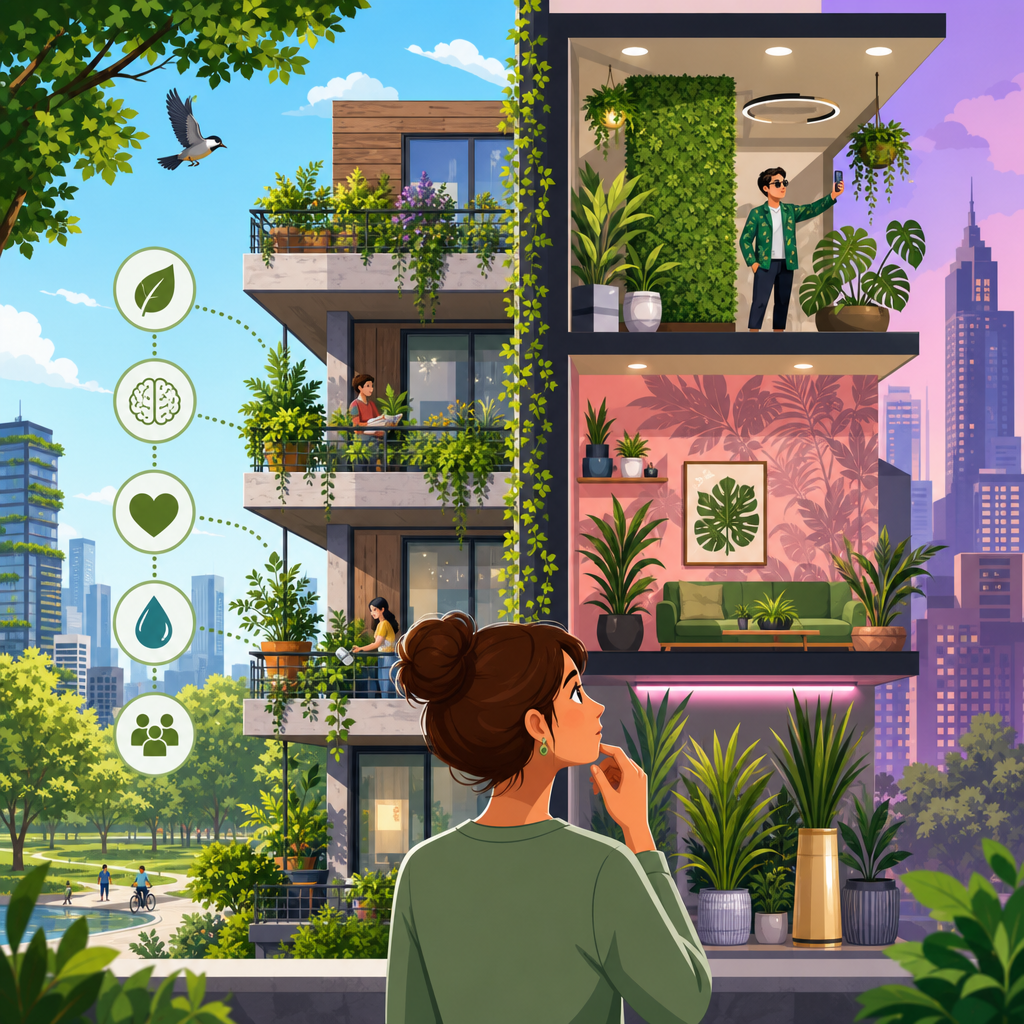
Biophilic design in urban housing is often presented as a cure for the stress, heat, and social disconnection of city living, yet the strongest projects separate measurable health and performance benefits from aesthetic branding. In practice, biophilic design means shaping homes and residential buildings to support human responses to nature through daylight, vegetation, views, natural materials, airflow, water, and spatial patterns that resemble outdoor environments. Urban housing includes apartments, towers, mixed-use blocks, affordable housing, senior housing, student residences, and infill developments where land is limited and tradeoffs are constant.
The topic matters because housing is where urban residents spend most of their time. The World Health Organization has repeatedly linked housing quality with respiratory health, mental wellbeing, injury risk, and thermal comfort. At the same time, cities are densifying, air temperatures are rising, and small apartments are becoming more common. Developers have noticed that buyers and renters respond strongly to words like green, natural, wellness, and restorative. As a result, the market now contains both serious, evidence-based strategies and superficial features that photograph well but do little for occupants. I have worked on residential briefs where a single lobby planter was marketed as a wellness intervention, while the same project ignored operable windows, solar control, and acoustic privacy that would have produced meaningful daily benefits.
To judge what is real, it helps to define evidence-based design. In housing, evidence-based means design decisions are tied to research, post-occupancy evaluation, building science, and measurable outcomes such as lower overheating hours, improved daylight autonomy, reduced stress indicators, higher satisfaction, or better stormwater performance. Marketing, by contrast, leans on nature imagery without proving effect. A green wall can improve visual quality, but if irrigation fails, maintenance is poor, or residents never see it from their apartments, its claimed health value is weak. The best urban housing treats biophilic design as a layered system, not a decorative add-on.
Residents also need a clear framework for common questions. Does indoor planting improve air quality? Usually less than mechanical ventilation and source control. Do natural materials improve wellbeing? Sometimes, especially through tactile quality and visual warmth, but outcomes depend on durability, emissions, and maintenance. Are rooftop gardens always beneficial? They can reduce heat gain and create amenities, but only if access, shade, structure, irrigation, and management are resolved. Evidence-based biophilic design is therefore not anti-market; it simply insists that every claimed benefit be tied to a mechanism. In urban housing, the mechanism matters as much as the mood board.
What the research actually supports
The strongest evidence in urban housing supports several recurring strategies. First is daylight with glare control. Good daylight access is associated with better sleep timing, mood, and satisfaction, but only when solar gain, privacy, and contrast are managed. Metrics such as spatial daylight autonomy and annual sunlight exposure are more useful than vague promises of bright spaces. In one multifamily review process I joined, apartments with floor-to-ceiling west glazing initially looked premium in renderings, yet simulations showed severe afternoon overheating. External shading and lower window-to-wall ratios produced better comfort and lower cooling loads without sacrificing daylight.
Second is access to views and nearby greenery. Research in environmental psychology consistently finds that visible vegetation, tree canopy, and restorative outdoor spaces can reduce perceived stress and support attention recovery. The effect is not mystical. Views offer cognitive relief, visual depth, and a lower sensory load than blank walls or traffic corridors. In dense housing, this can mean orienting living rooms toward planted courtyards, preserving mature street trees, or using shared terraces where residents actually spend time. Third is natural ventilation where climate, pollution, and noise conditions allow it. Cross-ventilation and mixed-mode strategies can improve comfort and occupant control, but they must be assessed against outdoor air quality, wildfire smoke, and façade noise.
Materiality is another area with both real value and exaggerated claims. Occupants often respond positively to timber, textured stone, cork, and other materials that feel natural and legible. There is useful evidence around reduced stress responses in wood-rich interiors, especially in schools and offices, and some of that learning transfers to residential settings. However, material choice should be evaluated alongside volatile organic compound emissions, fire performance, maintenance, embodied carbon, and moisture behavior. A “natural” finish that off-gasses heavily or degrades quickly is not a health strategy. In urban housing, the evidence is strongest when natural materials are part of a broader package that also improves acoustics, thermal stability, and indoor air quality.
Where marketing gets ahead of performance
The most common marketing move is to equate visible plants with holistic wellbeing. Indoor plants can improve perceived attractiveness and may modestly influence mood, but the famous claim that a few houseplants meaningfully clean indoor air in real apartments is overstated. Chamber studies often use unrealistic plant densities and controlled conditions. In lived housing, source control, filtration, airtightness, and ventilation rates dominate air quality outcomes. If a brochure highlights potted plants while omitting MERV-rated filtration, kitchen exhaust capture, and low-emission materials, it is leaning on symbolism rather than performance.
Another weak area is the overuse of the word natural for finishes that are mainly synthetic composites with printed wood grains or petrochemical binders. Residents do not benefit simply because a laminate resembles oak. Likewise, a rooftop garden is not inherently restorative if it is closed most of the year, lacks seating, has no shade, or is reached only through a service corridor. I have seen developments advertise biophilic living because they used green-colored branding, leaf motifs, and an arrival courtyard that residents passed through in thirty seconds. Meanwhile, the units had sealed windows, deep single-aspect plans, and poor daylight distribution. Nature-themed styling cannot compensate for weak fundamentals.
Water features are another example. Small fountains may provide masking sound and visual interest, but they can also create maintenance burdens, humidity problems, legionella risk if poorly managed, and unnecessary energy use. Claims about sensory restoration should be tested against cleaning schedules, acoustic measurements, and accessibility. The same skepticism applies to “forest-inspired” amenity rooms with artificial foliage and digital bird sounds. If the space does not improve social use, comfort, or stress recovery compared with a well-lit common room, the concept is marketing. Real biophilic housing can be simple: shade trees, daylight, fresh air, durable materials, and courtyards that residents use every day.
How to evaluate biophilic features in urban housing
A reliable evaluation process asks four questions. What outcome is being claimed? What mechanism would produce that outcome? How will it be measured? Who will maintain it over time? This method prevents design teams from confusing appearance with function. If a proposal says green roofs improve resident wellbeing, the mechanism might be cooler roof surfaces, better views, habitat value, and usable outdoor amenity. Measurement could include surface temperature reduction, occupancy counts, resident surveys, and irrigation performance. If none of these are defined, the claim is weak.
Standards and tools matter. WELL, Fitwel, LEED, BREEAM, Passive House, and local healthy building guidelines each address pieces of the puzzle, though none should be treated as a substitute for project-specific evidence. Daylight simulation can be run in Radiance-based tools. Thermal comfort can be assessed with EnergyPlus or IESVE. Outdoor comfort can be explored through ENVI-met or CFD studies in wind-sensitive sites. Post-occupancy evaluation should include resident interviews, seasonal walk-throughs, complaint logs, and utility review. In housing, design intent often fails at handover because planting dies, blinds are unusable, or common gardens have no maintenance budget.
| Feature | Evidence strength | Main benefit | Common limitation |
|---|---|---|---|
| Daylight with shading | High | Better comfort, mood, sleep support | Glare and overheating if uncontrolled |
| Views to greenery | Moderate to high | Lower perceived stress, higher satisfaction | Benefit drops if views are distant or obstructed |
| Indoor plants | Low to moderate | Visual appeal, possible mood lift | Minimal air cleaning in real homes |
| Natural ventilation | Moderate to high | Occupant control, comfort, lower cooling demand | Noise, pollution, smoke, security concerns |
| Accessible roof gardens | Moderate | Amenity, cooling, social use | Maintenance, irrigation, structural load |
Cost should also be tested honestly. Many high-value biophilic measures are not expensive if integrated early: better orientation, operable windows, courtyard geometry, tree preservation, and shading devices. By contrast, retrofitted living walls and complex water features often consume budget while adding risk. Affordable housing can absolutely use evidence-based biophilic design, but it should prioritize essentials with strong daily impact: cross-ventilation, robust planting at grade, communal outdoor rooms, low-toxicity materials, and comfortable circulation spaces with daylight. These choices outperform luxury branding gestures because residents encounter them constantly.
Design strategies that hold up in dense city contexts
Urban housing has constraints that suburban case studies often ignore: narrow sites, overshadowing, traffic noise, privacy conflicts, and hard limits on open space. The most effective strategies are therefore compact and adaptable. Courtyard housing remains one of the best examples. A well-proportioned courtyard can bring daylight deeper into plans, create shared green outlooks, improve wayfinding, and support social contact without forcing interaction. Success depends on width-to-height ratios, planting depth, drainage, and seating. Tiny decorative courtyards visible only from corridors have weaker effects than larger ones aligned with kitchens, living spaces, and children’s play areas.
Another strong strategy is the layered threshold between private and public space. Balconies, winter gardens, stoops, shared landings, and semi-open galleries can give residents both prospect and refuge, two spatial qualities often associated with positive responses to environments. In practice, these spaces work best when they provide shade, privacy screening, planting capacity, and real usability. A narrow balcony that fits one person standing is not the same as an outdoor room. Likewise, street trees and planted setbacks can improve the microclimate around lower floors, filter views, and make entrances calmer. On one mid-rise project, simply deepening balcony slabs and adding side screens increased resident use far more than the ornamental planting package.
Climate sensitivity is essential. In hot humid cities, shading, airflow, mold control, and drought-tolerant planting may matter more than timber-heavy interiors. In cold climates, winter sun, vestibules, thermal bridging control, and evergreen wind protection become more important. In polluted corridors, sealed façades with filtered fresh air may produce healthier outcomes than always-open windows. This is why evidence-based biophilic design is not a fixed checklist. It is a climate-responsive approach that combines environmental performance with psychological benefit. Projects that ignore local conditions usually drift into marketing because they copy visual cues instead of solving real urban housing problems.
Why operations, equity, and resident experience decide success
Biophilic design in urban housing succeeds or fails during operation. Landscapes need irrigation strategies, pruning, pest management, and replacement budgets. Shared gardens need clear access rules, lighting, seating, and security. Natural materials need cleaning protocols suited to their wear patterns. Without these basics, the original design intent decays quickly, and residents lose trust. I have seen excellent schemes underperform because maintenance contracts excluded planter care and because management prohibited residents from using terraces after early evening. A space cannot support wellbeing if policy makes it inaccessible.
Equity is equally important. Premium towers often market landscaped rooftops and wellness lounges, while affordable housing receives only token planting at the perimeter. That split misses the point. Residents with fewer resources often gain the most from safe outdoor rooms, heat mitigation, daylight, and calmer common areas. Children, older adults, and people working from home are especially sensitive to housing quality. Evidence-based planning therefore looks at who benefits, not just what looks desirable in sales material. Universal design, stroller access, shaded seating, and visible play space are biophilic considerations because they determine whether nature-linked amenities are usable.
The clearest takeaway is simple: in urban housing, biophilic design is credible when it improves everyday conditions residents can feel and operators can sustain. Look for measurable gains in daylight, thermal comfort, views, access to planted outdoor space, low-emission materials, and resident control. Be cautious when a project relies on slogans, staged greenery, or expensive features without a maintenance and measurement plan. For developers, designers, and housing providers, the main benefit of an evidence-based approach is better-performing homes that remain attractive after the marketing campaign ends. Use this page as the starting point for every decision in sustainable urban development, and test every nature claim against lived performance.
Frequently Asked Questions
What does biophilic design actually mean in urban housing, beyond the marketing language?
In urban housing, biophilic design refers to design decisions that intentionally strengthen residents’ beneficial contact with nature or nature-like conditions inside homes and residential buildings. That can include access to daylight, operable windows for fresh air, views of trees or sky, planted courtyards, balconies, shaded outdoor areas, natural materials, water-sensitive landscape features, and spatial layouts that feel more like healthy outdoor environments than sealed boxes. In apartments, condos, and mixed-use residential buildings, it can also involve circulation routes with daylight, shared gardens, roof terraces, semi-open spaces, and interior materials that reduce glare, noise, and visual fatigue.
The evidence-based version of biophilic design is not simply “making a building look natural.” It focuses on outcomes that can be measured, such as indoor air quality, thermal comfort, daylight exposure, acoustic comfort, stress reduction, sleep support, social use of common areas, and in some cases cognitive performance and perceived well-being. A wood-look wall graphic, for example, may contribute to a certain aesthetic, but it is not equivalent to improving ventilation, adding real shade, creating usable green space, or designing a unit so residents receive healthy morning light. The difference matters because some strategies have stronger research behind them than others.
That is why the strongest urban housing projects separate symbolic nature cues from functional environmental design. A lobby full of decorative plants may photograph well, but if the apartments overheat, have poor ventilation, little daylight, and no meaningful access to outdoor space, the health claims are weak. Evidence-based biophilic design starts with how residents actually live: how they sleep, cool their homes, recover from stress, interact with neighbors, and gain access to light, air, and vegetation in dense city conditions.
Which biophilic design features in residential buildings have the strongest evidence behind them?
The features with the strongest support are usually the ones tied to well-studied building science and environmental health outcomes. Daylight is one of the clearest examples. Good daylight access can support circadian rhythms, improve visual comfort, reduce dependence on artificial lighting, and make homes feel more spacious and usable. The quality of daylight matters, however. Excessive glare or heat gain from poorly controlled glazing can create discomfort, so successful design combines daylight with shading, orientation, and window design that fit the local climate.
Ventilation and thermal comfort are also strongly evidence-based. Operable windows, cross-ventilation, well-designed airflow paths, and exterior shading can improve comfort and help reduce overheating, especially in dense urban housing where heat stress is a serious concern. These are often more meaningful than purely decorative “nature-inspired” elements because they directly affect whether a resident can sleep, cook, work, and recover comfortably at home. Access to real vegetation, especially visible and usable greenery such as courtyards, street trees, green roofs, or planted terraces, also has better support than superficial interior styling. The greatest benefits tend to come from greenery people can actually see, use, maintain, or spend time near.
Views matter too, particularly views to trees, sky, or open space rather than blank walls or traffic-dominated streetscapes. Natural materials may contribute to comfort and perceived warmth, but the evidence is generally stronger when they are part of a broader strategy that includes acoustics, air quality, lighting, and temperature control. In shared residential settings, the design of common spaces is important as well. Semi-open thresholds, daylighted stairs and corridors, communal gardens, and comfortable outdoor rooms can support casual social contact, which is valuable in cities where loneliness and isolation are common concerns. In short, the strongest evidence usually supports biophilic design when it improves actual environmental conditions and everyday behavior, not just appearance.
How can you tell whether a housing project’s biophilic claims are evidence-based or mostly branding?
A useful test is to ask what, exactly, is being measured and for whom. If a project claims that its biophilic features improve health, well-being, or productivity, there should be specific design strategies and clear performance outcomes behind those claims. For example, a developer might be able to describe daylight targets, overheating mitigation, access to planted outdoor areas, tree-canopy coverage, window operability, air quality goals, stormwater landscape performance, acoustic standards, or resident use patterns for shared green spaces. These are concrete indicators. By contrast, vague claims about “bringing nature indoors” without describing thermal comfort, ventilation, resident access, or actual ecological performance often signal marketing more than substance.
Another warning sign is an overemphasis on visual cues detached from real function. Renderings may show abundant greenery that is difficult to maintain, inaccessible to residents, or limited to small decorative zones. Some projects use a few planters, wood textures, or leaf-patterned finishes to imply a wellness experience while leaving the core housing issues untouched: poor floor plans, no cross-ventilation, limited daylight in bedrooms, heat buildup on exposed facades, noisy interiors, or barren outdoor areas that are unusable for much of the year. In those cases, “biophilic” becomes a lifestyle label rather than a performance strategy.
The most credible projects usually demonstrate integration. Their landscape, facade, unit layout, building services, and communal spaces work together. They often consider maintenance, water use, plant survival, resident safety, and long-term affordability. They are also more likely to acknowledge tradeoffs. For instance, large areas of glass may improve views but increase overheating unless shading and insulation are well handled. Real evidence-based design is rarely simplistic. It shows how nature-related features support measurable comfort, health, resilience, and resident experience over time, not just on opening day.
Can biophilic design really improve health and well-being in apartments and dense city housing?
Yes, it can help, but it should not be presented as a universal cure. In dense urban housing, biophilic design can contribute to lower stress, better comfort, stronger connection to place, and improved daily routines when it is implemented in practical, well-designed ways. Access to daylight can support sleep-wake cycles. Better ventilation and cooling can reduce heat-related discomfort and fatigue. Views of trees or planted areas can improve perceived well-being and provide visual relief from traffic, hard surfaces, and crowding. Shared green spaces can encourage incidental social contact and give residents a place to sit, move, and recover mentally without leaving the building.
That said, outcomes depend heavily on context, building quality, and social conditions. A planted courtyard is beneficial only if residents can access it comfortably and safely. A balcony supports restoration only if it is shaded, usable, and not overwhelmed by noise or air pollution. Indoor plants may be pleasant, but they do not substitute for adequate ventilation, healthy materials, or enough daylight. Housing quality, affordability, crowding, maintenance, and neighborhood conditions still play a major role in resident well-being. Biophilic design works best as part of a larger healthy-housing framework rather than as a cosmetic add-on.
It is also important to distinguish between short-term emotional effects and long-term health outcomes. Many residents may immediately perceive natural materials, greenery, and daylight as calming or uplifting. Stronger claims, such as reduced illness, significantly improved mental health, or major gains in social cohesion, require more careful evidence and usually depend on multiple factors. So the honest answer is that biophilic design can meaningfully improve daily living conditions in urban housing, especially when it addresses light, heat, air, views, and usable green space, but its benefits are strongest when paired with sound building performance and equitable design.
What are the biggest mistakes developers and designers make when applying biophilic design to urban residential projects?
One of the biggest mistakes is confusing visible greenery with effective environmental design. A project may include green walls, potted plants, or lush marketing images while neglecting the fundamentals that residents feel every day: summer overheating, stale indoor air, poor acoustic privacy, lack of shaded outdoor space, and dark interior layouts. In urban housing, especially apartments, success depends on how units perform in all seasons and how shared spaces support actual resident use. If the design does not improve comfort, resilience, and access to nature in practical ways, the biophilic label is doing more work than the building itself.
Another common mistake is ignoring maintenance and long-term operations. Vegetation requires irrigation, soil volume, species selection, drainage, pruning, and stewardship. Water features require upkeep and can become liabilities if poorly detailed. Timber and other natural materials need to be selected appropriately for wear, moisture, fire regulations, and indoor air quality goals. When these realities are overlooked, supposedly biophilic features can deteriorate quickly, lose ecological value, or become inaccessible. Good projects treat planting and natural materials as serious performance systems, not decorative afterthoughts.
A third mistake is designing for image rather than residents’ routines. In dense city housing, people need comfortable thresholds between private and shared life, opportunities for daylight and fresh air, places to sit outdoors without excessive heat or noise, and layouts that support both retreat and social contact. Projects fail when they provide dramatic but impractical spaces, such as rooftops with little shade, courtyards with no seating, or facades optimized for visual impact rather than climate response. The best biophilic housing is usually less about spectacle and more about repeated daily benefits: a cooler