Biodiversity-friendly urban development means planning, building, and managing cities in ways that protect habitats, support native species, and restore ecological functions instead of replacing them with sealed surfaces and simplified landscapes. In practice, it is not a decorative layer added after a project is approved; it is a design approach that shapes streets, buildings, parks, drainage, lighting, and maintenance from the earliest concept stage. I have worked on development reviews where a token green roof or a few ornamental shrubs were presented as ecological mitigation, and those measures rarely changed outcomes for wildlife. What actually helps is a coordinated set of design moves tied to species needs, hydrology, soil health, and long-term stewardship.
The topic matters because urban areas are expanding fast while many species are declining due to habitat loss, fragmentation, pollution, invasive plants, and climate stress. According to the United Nations, more than half of the global population already lives in cities, and that share continues to rise. Urban form therefore has direct consequences for birds, pollinators, amphibians, bats, soil organisms, and the people who depend on functioning ecosystems for cooling, flood control, cleaner air, and mental health benefits. Biodiversity in cities is not limited to large parks or rare species. It includes everyday ecological processes such as pollination, seed dispersal, decomposition, water infiltration, and predator-prey balance that reduce pests naturally.
Good urban biodiversity design starts with several key terms. Habitat is the combination of food, shelter, breeding conditions, and movement pathways a species needs to survive. Connectivity refers to how easily species can move between habitat patches without being blocked by roads, blank walls, fencing, or hostile ground conditions. Native planting means selecting species that evolved in the local region and support local food webs, rather than relying on ornamental plants with low ecological value. Blue-green infrastructure combines water systems and vegetation, including wetlands, bioswales, rain gardens, street trees, ponds, and permeable surfaces. Ecological performance means measuring outcomes such as canopy cover, infiltration rates, nesting opportunities, and species richness, not just counting planted areas on a site plan.
This hub article explains the design moves that consistently produce better ecological results in urban development. It covers site analysis, habitat networks, native planting, water-sensitive design, building-level interventions, light and collision reduction, soil protection, maintenance, policy tools, and metrics. The goal is straightforward: help planners, developers, architects, landscape designers, and city officials move from symbolic greening to urban development that actually helps biodiversity while still delivering housing, mobility, safety, and economic value.
Start with ecological baseline data, not aesthetic assumptions
The first move is to understand what is already on the site and around it. Before massing studies or planting palettes begin, teams should map existing trees, soil conditions, drainage lines, sunny and shaded zones, nearby habitat patches, migratory pathways, and species records from local databases, universities, naturalist groups, or municipal inventories. On many projects, the most damaging error happens early: a site is treated as biologically empty because it looks disturbed. Yet vacant lots, drainage corridors, brownfields, railway edges, and informal green spaces can support pollinators, reptiles, small mammals, and ground-nesting birds if they contain undisturbed soils, early successional vegetation, or seasonal water.
A useful baseline includes four layers. First, identify habitat assets worth retaining, such as mature native trees, wetlands, hedgerows, deadwood, and permeable ground. Second, identify constraints, including contamination, erosion risk, flood exposure, invasive species, and high road mortality edges. Third, identify opportunities to connect the site to wider ecological networks such as river corridors, street tree systems, schoolyards, cemeteries, or neighboring parks. Fourth, define target species or guilds appropriate to the local landscape. Designing for general biodiversity is too vague. A project may set goals for native bees, swifts, bats, amphibians, and urban forest birds, each of which requires different nesting substrates, plant timing, water conditions, and disturbance controls.
When I review site assessments, the strongest ones avoid a simple green-versus-built map. They explain seasonal use, edge conditions, and life-cycle needs. For example, a pond that appears dry in summer may still be crucial amphibian breeding habitat in spring. A single old tree can host cavities, fungi, and invertebrates that young replacement trees cannot provide for decades. Baseline data prevents false equivalence and helps teams prioritize retention over compensation.
Protect and connect habitat before adding new features
Retaining functioning habitat is almost always more effective than recreating it later. Mature canopy, intact soils, and established wetland edges deliver ecological value immediately, while new landscapes often need years before they support complex food webs. The best biodiversity-friendly urban development therefore follows a clear order: avoid damage where possible, minimize impacts where avoidance is impossible, restore degraded systems on site, and compensate only as a last resort. This sequence is embedded in many environmental assessment frameworks because it reflects ecological reality.
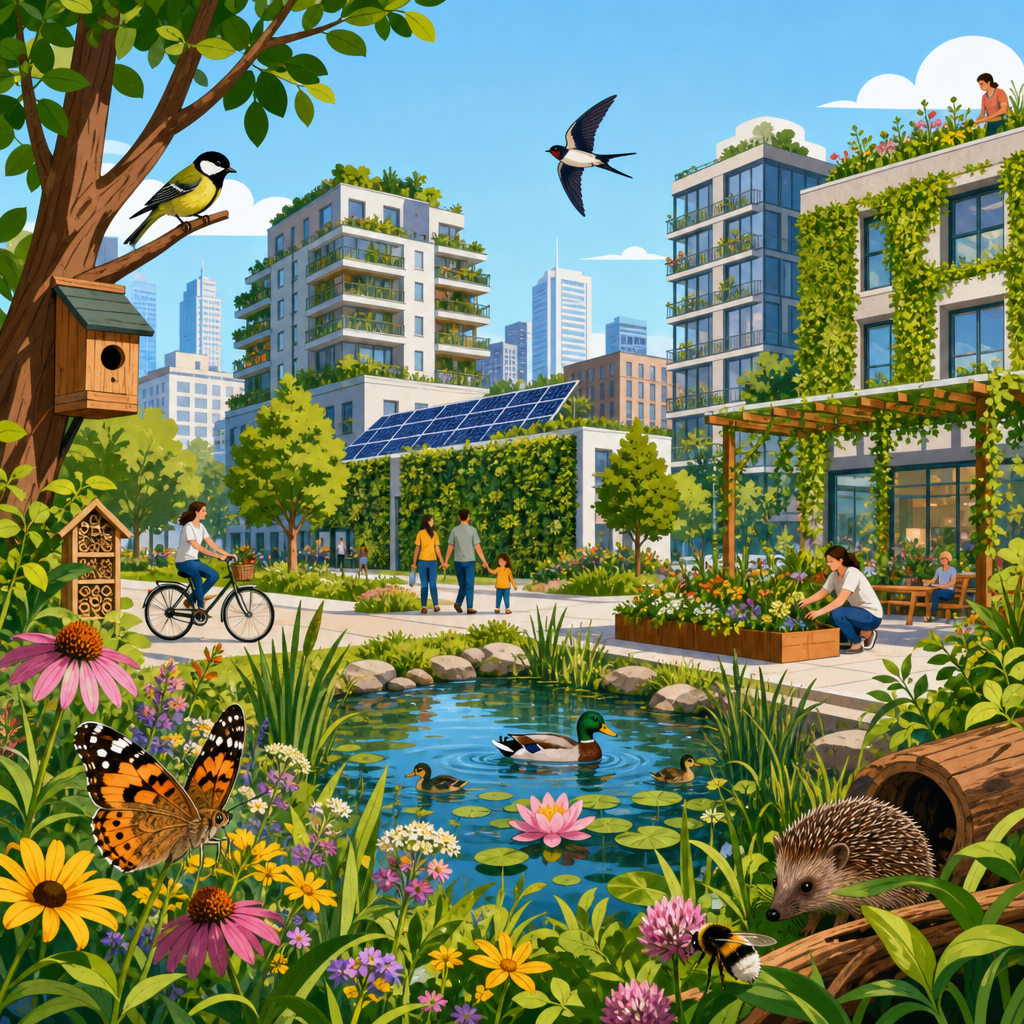
Connectivity is the second half of the equation. Species can survive in cities when habitat patches are linked by stepping stones and corridors. That can mean riparian buffers along streams, continuous tree-lined streets, vegetated rail verges, green roofs placed within flight range of pollinators, or small pocket habitats spaced across dense districts. The key is permeability. A city may have a respectable percentage of green cover yet still function as a fragmented landscape if roads are wide, fences are sealed, lighting is excessive, and plantings are isolated. In one redevelopment area I advised on, the biggest improvement came not from increasing total planted area, but from linking three disconnected courtyards to a canal edge with native understory planting and reduced fencing gaps. Bird use increased within a year because movement became easier.
Developers often ask what widths or distances are needed. There is no universal number, but some principles are firm. Wider and structurally diverse corridors support more species. Continuous canopy helps birds and arboreal species. Dense understory and leaf litter matter for insects and small fauna. Shallow slopes and varied water depths improve wetland performance. Even when land is limited, the objective should be to remove barriers and create repeatable habitat cues across the district.
Use native planting as habitat infrastructure, not visual decoration
Native planting works when it is designed as a food web, not as a style. Many ornamental landscapes look green but offer little nectar, few host plants for larvae, limited seed production, and almost no shelter. A biodiversity-oriented palette should include canopy trees, understory shrubs, grasses, sedges, and flowering perennials matched to local soils and hydrology. Plant communities should provide resources across seasons: early blooms for emerging pollinators, summer forage, autumn berries and seed heads, and winter structure. The National Wildlife Federation and many regional ecological landscaping guides emphasize host plants because insect larvae are foundational food for birds and other wildlife. A city that wants more birds needs more caterpillars, and that means the right native plants.
Species selection must also address urban stress. Heat, compacted soil, reflected light, de-icing salts, and drought can kill otherwise appropriate plants if the planting detail is weak. I have seen beautifully specified native meadows fail because topsoil was stripped, irrigation was temporary, and weeds were allowed to dominate in the first two seasons. Establishment planning matters as much as species choice. That includes soil preparation, mulch strategy, watering plans, seasonal mowing limits, and adaptive maintenance rather than blanket pruning.
| Design move | How it helps biodiversity | Common failure mode |
|---|---|---|
| Retain mature native trees | Provides cavities, shade, prey habitat, and immediate canopy connectivity | Root damage during construction |
| Layered native planting | Supports pollinators, birds, and shelter across seasons | Using only one stratum or ornamental cultivars |
| Rain gardens and bioswales | Creates wet-dry habitat gradients and improves water quality | Engineered for drainage only, with sterile planting |
| Green roofs with varied substrate depths | Adds foraging habitat and microclimates in dense districts | Thin sedum-only roofs with no nesting value |
| Bird-safe glazing and reduced night lighting | Cuts collision risk and nocturnal disruption | Large reflective façades and decorative uplighting |
Public expectations also need managing. Native landscapes can look less manicured, especially during establishment or in winter. Clear communication, good edging, and intentional composition help residents see ecological planting as cared for rather than neglected. That social acceptance is critical to long-term success.
Design water systems that create habitat while managing flood risk
Water-sensitive urban design is one of the most reliable ways to improve biodiversity because it restores hydrological patterns that many species depend on. Conventional development sends rainwater quickly into pipes, increasing downstream flooding, reducing infiltration, warming waterways, and removing opportunities for habitat. By contrast, bioswales, retention basins, daylighted streams, constructed wetlands, rain gardens, and permeable pavements slow runoff, filter pollutants, recharge groundwater, and create moisture gradients. Those gradients support dragonflies, amphibians, wetland plants, birds, and beneficial insects.
The best systems are designed for both hydraulic and ecological performance. A bioswale planted with one hardy grass may drain water, but it will support less life than one with varied native sedges, rushes, flowering species, coarse woody debris, and safe side slopes. Constructed wetlands should include shallow shelves, deeper refuges, emergent vegetation, and pretreatment for sediment. Water quality is essential. If road runoff carries hydrocarbons, heavy metals, or excessive nutrients directly into habitat features, the result can be an attractive-looking but degraded system. Maintenance crews must know which zones can be cut back, which should be left undisturbed during breeding seasons, and how to remove litter without stripping habitat.
Real projects show the benefits. In several European and North American districts, daylighting buried streams has reduced peak runoff, cooled local microclimates, and increased urban species observations. Singapore’s ABC Waters approach demonstrated that drainage infrastructure can be redesigned as ecological public space rather than hidden concrete channels. The lesson is not to copy a style, but to integrate stormwater engineering and habitat design from the start.
Make buildings part of the habitat network
Buildings can support biodiversity when façades, roofs, podiums, courtyards, and edges are designed as habitat surfaces instead of blank barriers. Green roofs are the most familiar example, but results vary widely. Extensive roofs with shallow substrate and sedum can reduce heat and manage runoff, yet they usually provide modest biodiversity gains unless substrate depth, topographic variation, native species, and nesting features are added. Brown roofs using recycled mineral substrates and spontaneous colonization have worked well for some invertebrates in post-industrial landscapes. Intensive roofs and rooftop gardens can support richer communities but require greater structural capacity and long-term maintenance.
Façades can include climbers, trellises, integrated planters, and nesting elements for swifts, swallows, bats, or solitary bees where locally appropriate. Nest boxes should not be scattered randomly. They need the correct height, orientation, thermal conditions, predator protection, and maintenance access. Building-integrated biodiversity also includes bird-safe glass. Collisions kill large numbers of birds annually, especially where reflective or transparent glazing creates false flight paths. Effective measures include fritted or patterned glass using the two-by-four rule for spacing, external screens, angled glazing, and avoiding see-through corners near vegetation.
Lighting design matters just as much. Excessive nighttime illumination disrupts insects, migratory birds, and bats. Warm-color LEDs, lower intensity, curfews, motion controls, and shielded fixtures reduce harm while maintaining safety. From experience, lighting consultants respond well when ecological criteria are written into performance specifications rather than raised as late objections.
Protect soils, manage maintenance, and measure outcomes
Soil is often overlooked, yet healthy soil underpins almost every urban biodiversity goal. Compacted, disturbed, nutrient-poor, or contaminated soils limit rooting depth, water storage, microbial life, and plant resilience. Before construction, teams should designate tree protection zones, limit heavy equipment access, strip and store topsoil carefully, and specify decompaction where needed. After construction, mulch, leaf litter retention, and reduced chemical inputs help rebuild soil food webs. Deadwood, logs, brush piles, and stone features can provide habitat if placed safely and intentionally.
Maintenance is where many promising schemes fail. Frequent mowing, excessive tidying, blanket pesticide use, and pruning during nesting season can erase ecological gains. Biodiversity-friendly maintenance plans should define differentiated regimes: meadow cuts once or twice annually, selective weeding of invasives, pond edge management by rotation, and seasonal restrictions around nesting or breeding periods. Procurement matters too. If the maintenance contract rewards neat uniform appearance above ecological outcomes, crews will do exactly that. Contract language should specify habitat retention, monitoring, and acceptable seasonal variation.
Finally, measure performance. Useful indicators include native canopy cover, number of habitat trees retained, percentage of permeable area, floristic diversity, pollinator counts, breeding bird observations, runoff reduction, and survival rates of planted species after three and five years. Tools such as i-Tree, SITES, local biodiversity net gain metrics, and municipal habitat scorecards can help, but no tool substitutes for field observation. The most credible projects publish monitoring results and adjust management when outcomes fall short. That feedback loop is what turns good intentions into biodiversity-friendly urban development that actually helps.
Biodiversity-friendly urban development succeeds when cities treat ecology as core infrastructure rather than leftover landscaping. The design moves that matter are consistent across project types: establish a real ecological baseline, retain high-value habitat, connect green and blue spaces, use native planting as food-web support, build water systems that restore hydrology, make buildings safer and more useful for wildlife, protect soils, and align maintenance with ecological goals. None of these steps is mysterious, but each requires decisions early enough to influence site layout, budgets, engineering, and contracts.
The main benefit is practical as well as environmental. Developments that support biodiversity are typically cooler, more flood-resilient, more comfortable for residents, and less dependent on high-input maintenance over time. They also age better. A mature native landscape with functioning soils and habitat layers gains value as it establishes, while shallow cosmetic greening often declines quickly and needs replacement. For municipalities, this approach helps meet climate adaptation, public health, stormwater, and urban forestry goals through the same coordinated investments.
If you are shaping a plan, design brief, zoning update, or capital project, start by asking a simple question: what species and ecological functions should still be present here ten years after completion? Use that answer to guide retention, connectivity, planting, water design, building details, and maintenance standards. Then link this hub to your project-specific guidance, district standards, and monitoring framework so biodiversity is designed, delivered, and verified rather than merely promised. That is how urban development moves from greener appearance to measurable ecological performance.
Frequently Asked Questions
What does biodiversity-friendly urban development actually mean in practice?
Biodiversity-friendly urban development means designing cities so they continue to function as living ecosystems rather than becoming sealed, simplified environments that push nature out. In practice, that starts much earlier than landscaping plans or final planting palettes. It influences site selection, building placement, street layout, stormwater strategy, lighting design, materials, soil protection, habitat retention, and long-term maintenance. The goal is not to make a project look green on opening day, but to make it support native plants, insects, birds, amphibians, and other species over time while also improving ecological processes such as water infiltration, pollination, shade, and soil health.
On real projects, this usually means asking different questions at the concept stage. Instead of beginning with maximum paving and then trying to add trees later, the design team identifies existing habitat features worth keeping, protects mature vegetation and soils where possible, reduces unnecessary hardscape, and creates connected green spaces rather than isolated fragments. It may also include preserving drainage patterns, integrating bioswales and rain gardens, limiting light spill, using native and climate-suitable planting, avoiding monocultures, and planning maintenance so habitat value is not destroyed by routine operations. The most effective projects treat biodiversity as a core performance issue, not an optional amenity.
Which urban design moves actually help biodiversity instead of just looking sustainable?
The design moves that help most are usually the ones that improve habitat quality, connectivity, and ecological function at the same time. Protecting what already works is often more valuable than replacing it later. Retaining mature trees, remnant vegetation, wetlands, healthy soils, and existing watercourses can preserve nesting sites, food sources, microclimates, and complex ecological relationships that are extremely difficult to recreate from scratch. Where disturbance is unavoidable, minimizing fragmentation and keeping habitat patches connected across streets, parks, courtyards, rooftops, and drainage corridors can make a major difference for species movement and survival.
Other high-impact strategies include reducing impervious surface area, designing stormwater systems as ecological assets, and planting with diverse native species that provide nectar, seeds, shelter, and seasonal variation. Green roofs, living walls, curbside bioswales, pocket habitats, permeable paving, layered understory planting, deadwood habitat features, and bird-safe glazing can all be useful when they are matched to local ecological conditions rather than copied from generic sustainability checklists. Lighting is another overlooked factor. Lower-intensity, shielded, warm-spectrum lighting can reduce disruption to nocturnal species, especially insects and migratory birds. The strongest biodiversity outcomes usually come from combining these moves into a coherent site-wide strategy rather than relying on one signature feature.
Why is native planting so important, and is it always the best choice?
Native planting matters because local species evolved alongside local insects, birds, fungi, and soil communities. That means native plants are often better at supporting food webs, breeding cycles, and ecological resilience than ornamental species chosen mainly for appearance or low upfront cost. A native tree or shrub may host far more insect life than a non-native equivalent, and that insect life becomes food for birds and other animals. Native grasses, flowering plants, and shrubs can also be better adapted to local rainfall patterns, temperature swings, and soil conditions, which may reduce irrigation and replacement needs once they are established properly.
That said, biodiversity-friendly planting is not just a matter of labeling everything native and assuming the job is done. The planting design still needs to match the site. Species selection should respond to sun exposure, water availability, soil depth, compaction, heat island effects, and long-term maintenance realities. In highly altered urban settings, a carefully chosen mix of mostly native species with a limited number of non-invasive, climate-resilient support species may sometimes be practical, especially where future climate conditions are shifting faster than historic planting assumptions. What matters most is whether the landscape provides real habitat value, structural diversity, seasonal resources, and long-term survivability. A thin layer of decorative planting, even if technically native, will not perform like a well-designed urban habitat system.
How do stormwater, paving, and drainage design affect urban biodiversity?
Stormwater and surface design have a huge effect on biodiversity because they shape how water moves through a site, how much soil remains biologically active, and whether landscapes function as habitat or simply as visual buffers. Conventional urban development often pushes water off-site as quickly as possible through pipes, sealed surfaces, and hard-edged channels. That approach increases runoff, reduces infiltration, degrades receiving waterways, and creates hotter, drier, more hostile site conditions for plants and animals. It also disconnects urban landscapes from the natural water cycles many species depend on.
Biodiversity-friendly development takes the opposite approach by slowing, spreading, filtering, and absorbing water close to where it falls. Permeable paving, rain gardens, swales, tree trenches, constructed wetlands, infiltration zones, and restored riparian edges can support habitat while also improving water quality and reducing flood pressure. These systems can create moist microhabitats, support pollinators, protect aquatic ecosystems from polluted runoff, and help urban vegetation survive dry periods. Just as important, reducing unnecessary paving preserves room for root growth, soil organisms, and understory vegetation. When drainage systems are designed as ecological infrastructure rather than hidden engineering, they often deliver better outcomes for biodiversity, climate resilience, and urban livability all at once.
Can dense urban development still support biodiversity, or is this only realistic in low-density projects?
Dense urban development can absolutely support biodiversity, but it requires more deliberate design and stronger coordination across architecture, landscape, civil engineering, and operations. Density itself is not the problem. In fact, compact development can reduce pressure to sprawl into valuable habitats at the urban edge. The issue is whether dense projects use every remaining square meter for sealed surfaces, sterile planting, and overlit public space, or whether they build ecological value into rooftops, podiums, setbacks, courtyards, streetscapes, and drainage systems. Well-designed density can create a network of small but functional habitats that contribute to a larger urban ecology.
In higher-density settings, the most successful strategies usually focus on quality, layering, and connectivity. That can include green roofs designed for invertebrates and birds, deep soil zones for canopy trees, vegetated corridors linking parks and waterways, bird-safe facades, nesting and roosting opportunities integrated into buildings, reduced nighttime light pollution, and public realm planting that goes beyond decorative groundcover. Maintenance standards also matter enormously. If every planted area is heavily pruned, over-mulched, chemically treated, and kept biologically simple, habitat value drops fast. Dense urban projects can perform surprisingly well when biodiversity is treated as infrastructure with measurable outcomes, not as leftover space filling. The key is to make ecological function part of the development logic from day one, even when the site is constrained.