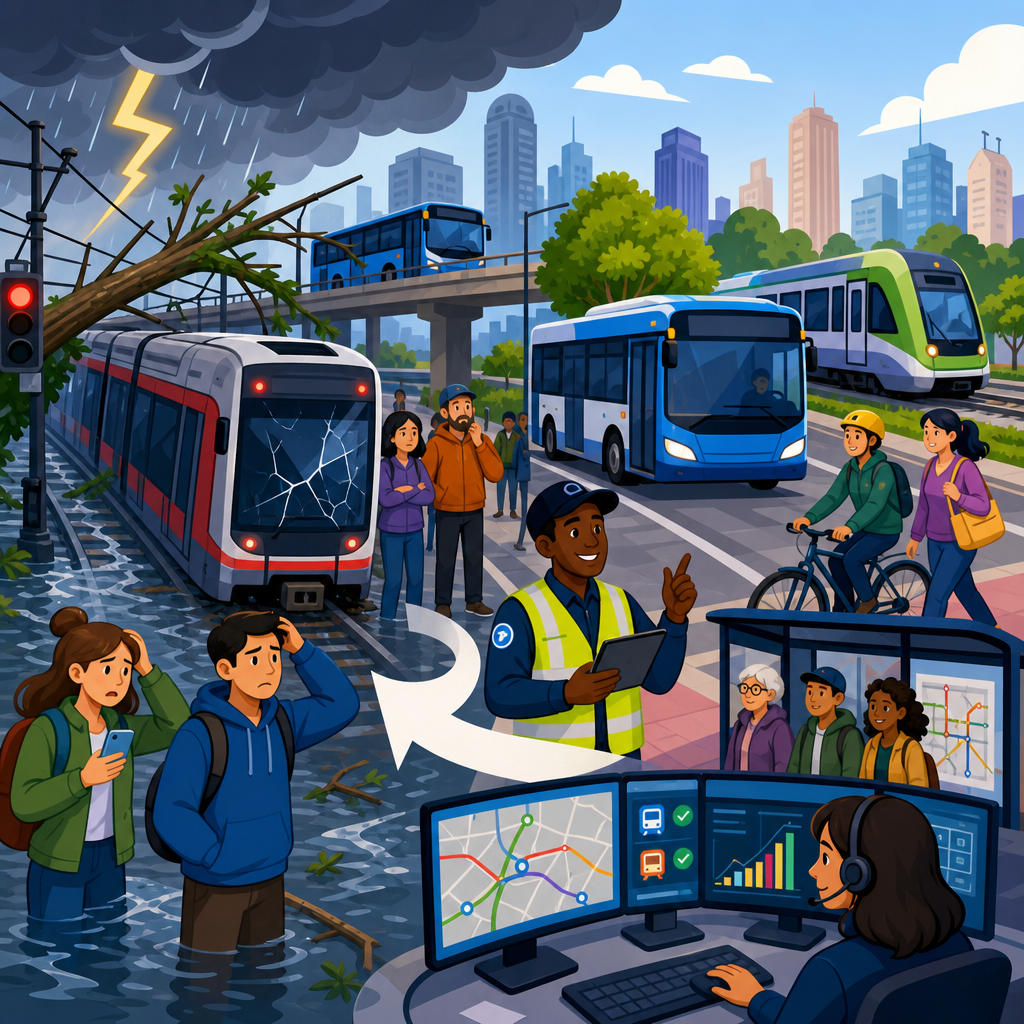
Public transit resilience is the ability of buses, trains, stations, staff, power systems, depots, and control centers to absorb disruption, continue essential service, and recover quickly without prolonged harm to riders or city life. In transit operations, resilience is not the same as reliability, although the two are closely related. Reliability measures whether service runs as scheduled in normal conditions. Resilience measures whether the network can withstand shocks such as floods, heat waves, labor shortages, software failures, bridge strikes, supply chain delays, cyberattacks, and sudden surges in demand. The resilience problem in public transit operations matters because cities depend on transit to move workers, students, patients, and emergency personnel. When transit fails, road congestion worsens, economic output falls, and vulnerable riders are stranded first.
I have worked with operating teams that treated resilience as an engineering issue only, then learned the hard way that it is equally an operations, governance, procurement, and communications issue. A rail line can have redundant substations and still collapse under a crew availability problem. A bus network can have spare vehicles and still break down if dispatch lacks real-time visibility into blocked streets. Climate change, aging infrastructure, digitized control systems, and tighter public budgets have made the resilience problem sharper in the last decade. Transit agencies are expected to deliver frequent service, cut emissions, modernize fleets, and keep fares affordable while facing more volatile risks. The result is a difficult balancing act: building enough redundancy and flexibility to survive shocks without locking in wasteful cost.
For a sustainable urban development strategy, resilient public transit is foundational. Dense, low-carbon cities work only when large numbers of people can trust shared mobility every day and during abnormal events. This hub article explains the operational roots of resilience, the common failure points across bus and rail systems, the metrics agencies should track, and the practical actions that improve service continuity. It also clarifies tradeoffs. Full redundancy everywhere is unaffordable. The goal is targeted resilience: protecting critical corridors, shortening recovery time, and designing operations that degrade gracefully rather than fail all at once.
Why Public Transit Operations Become Fragile
Public transit operations are fragile when tightly coupled assets depend on one another with little slack. A missed handoff in one area cascades quickly. On rail systems, a failed interlocking, a traction power trip, or a disabled train can block an entire corridor because trains cannot easily pass each other. On bus networks, congestion, curb conflicts, fare disputes, and irregular boarding times create bunching, which reduces effective capacity even when the published schedule looks adequate. Fragility rises when agencies run close to the edge on fleet spare ratio, operator availability, maintenance windows, or control room staffing.
Several structural pressures make this worse. Many agencies carry deferred maintenance backlogs on track, signals, elevators, drainage, overhead wire, or bus garages. Legacy systems often lack modern condition monitoring, so teams discover failures late. Procurement cycles for rolling stock, transformers, switchgear, and specialized parts can stretch for months or years. Labor markets are also tighter than they were before the pandemic. Operator absenteeism or vacancies reduce the ability to restore service after disruption. Meanwhile, riders increasingly expect accurate, app-based information; when customer communications fail, the operational problem expands into a trust problem.
Urban networks are also exposed to external dependencies they do not control. Electric utilities, municipal drainage, police response, road maintenance, telecommunications providers, and regional emergency management all influence service continuity. During major storms, I have seen transit agencies with solid internal plans still struggle because utility restoration priorities did not align with rail restart needs or because roadway flooding blocked bus bridges. Resilience planning therefore cannot stop at the agency boundary. It must include memoranda of understanding, shared incident protocols, and realistic assumptions about outside support.
Main Risk Categories in Bus and Rail Systems
The resilience problem becomes manageable when agencies sort threats into operationally useful categories. Climate and weather risks now sit at the top of the list. Extreme rainfall can flood tunnels, substations, and low-lying bus depots. Heat can warp rail, strain catenary, degrade battery performance, and force speed restrictions. Wildfire smoke reduces visibility and creates health risks for operators and riders. Cold snaps freeze switches, doors, air lines, and third-rail equipment. These events are no longer rare edge cases in many regions.
Asset and technology risks are equally important. Signaling failures, software defects in computer-aided dispatch systems, radio outages, fare gate faults, and cybersecurity incidents can cripple operations. The 2021 ransomware attack on the Massachusetts Bay Transportation Authority did not stop all service, but it highlighted how digital systems have become embedded in dispatch, customer information, and business operations. Rolling stock failures remain a classic source of disruption, especially when fleets are diverse and maintenance teams must manage multiple part inventories and training requirements.
Human and organizational risks often determine whether a disruption stays localized or becomes network-wide. Crew shortages, weak incident command, unclear authority, poor rule compliance, and fragmented maintenance accountability all extend recovery time. Public transit is a shift-based operation; resilience depends on having supervisors, dispatchers, maintainers, and operators who can make good decisions under pressure. Financial risk matters too. Agencies with unstable funding often delay state-of-good-repair work, cut training, and carry fewer spares, creating a brittle system that appears efficient until a shock exposes its weakness.
How Agencies Measure Transit Resilience
Agencies should measure resilience with operational indicators that show both resistance to disruption and speed of recovery. Mean distance between failures and on-time performance are useful, but they are not enough. Better resilience metrics include mean time to restore service after a major incident, percentage of service hours delivered during disruptive events, spare fleet availability, power and communications redundancy at critical nodes, drainage exceedance frequency, and the share of riders who receive accurate disruption information within a defined number of minutes. For rail, agencies should track single points of failure by corridor and the time required to isolate damaged infrastructure. For bus, they should measure detour readiness and the percentage of routes with preplanned emergency diversions.
Scenario testing is essential. An agency should know what happens if one depot is unusable for seventy-two hours, if a major bridge closes, if a control center loses connectivity, or if twenty percent of operators are unavailable. In practice, tabletop exercises reveal hidden dependencies faster than static risk registers do. I have seen agencies discover during drills that bus bridge plans assumed vehicles with luggage racks they did not actually own, or that call trees depended on outdated phone numbers. Those are fixable problems if found before an incident.
| Metric | What it shows | Operational use |
|---|---|---|
| Mean time to restore | Recovery speed after disruption | Tests incident response and maintenance readiness |
| Service hours delivered during event | Ability to sustain core mobility | Identifies critical corridors for protection |
| Spare ratio by mode | Fleet flexibility under stress | Supports vehicle allocation and procurement planning |
| Passenger information accuracy | Quality of rider communications | Improves trust and reduces unsafe crowding |
| Single-point-of-failure count | Network fragility hotspots | Prioritizes capital hardening projects |
Operational Strategies That Improve Resilience
The most effective resilience strategies are practical and layered. First, protect critical assets. Flood barriers, pump redundancy, raised electrical equipment, heat-resistant components, backup generators, and switch heaters reduce exposure at known weak points. New York’s Metropolitan Transportation Authority, for example, invested heavily in tunnel pump rooms, vent protection, and substations after Hurricane Sandy exposed severe vulnerabilities. Second, simplify restoration. Standardized fleets, interchangeable parts, modular components, and clear emergency operating procedures shorten repair and restart times. Complexity is the enemy of recovery.
Third, build flexible service plans. Bus networks should have preapproved detours, emergency layover locations, and agreements for temporary curb access. Rail agencies need bus bridge contracts that include realistic travel times, dispatch protocols, and rider wayfinding. Fourth, invest in maintenance as a resilience function, not just an asset function. Condition-based monitoring for bearings, traction power, rail geometry, and HVAC systems helps agencies intervene before failures multiply under extreme conditions. Fifth, strengthen control centers. Resilience depends on integrated operations where dispatch, maintenance control, customer information, security, and field supervision share a common operating picture.
Workforce design is another decisive lever. Cross-training maintainers, certifying supervisors for multiple emergency roles, and preserving overtime rules that support surge response can keep service moving when incidents overlap. Agencies should also maintain mutual aid pathways with neighboring operators and private contractors, though they should not assume external drivers can step into specialized rail or bus rapid transit environments without route knowledge and safety training. Finally, communications must be treated as core operations. A disruption handled transparently with accurate updates, station staff, and consistent replacement-service instructions will produce less rider harm than a smaller incident managed poorly.
Governance, Funding, and Climate Adaptation
Resilience is often framed as a maintenance or engineering problem, but governance determines whether operational fixes happen at scale. Agencies need board-level risk oversight, an enterprise risk register tied to capital planning, and budget rules that distinguish resilience investments from discretionary enhancements. Without this structure, visible expansion projects tend to outrank drainage upgrades, signal renewal, or depot hardening even when the latter produce greater public value. The Federal Transit Administration and similar national bodies increasingly require asset management planning, but compliance alone does not create resilience. Agencies must convert plans into funded renewal pipelines.
Climate adaptation should be embedded in design standards, not treated as a one-off study. If historical rainfall assumptions no longer match current storm intensity, culverts, station entrances, and power rooms must be redesigned accordingly. If extreme heat days are rising, fleet procurement should evaluate HVAC capacity, battery thermal management, and rail neutral temperature policy. These are operational decisions because they affect speed restrictions, worker safety, and service availability. Good agencies combine capital projects with revised playbooks: temporary timetable adjustments, prepositioned maintenance teams, and threshold-based service plans activated before conditions deteriorate.
Funding remains the hardest constraint. Resilience work competes with expansion, fare affordability, accessibility upgrades, and decarbonization. The answer is not to stop modernizing. It is to prioritize projects that serve multiple goals. Electrified bus depots, for example, should be designed with resilient power architecture, load management, and flood protection from the start. Accessibility upgrades should include backup power for elevators and better station wayfinding during outages. When agencies frame resilience as protection of everyday service, political support improves because riders understand the payoff immediately.
The Sustainable Urban Development Payoff
Resilient public transit operations support sustainable urban development in direct, measurable ways. They preserve access to jobs and education, reduce the temptation to shift trips to private cars during disruptions, and make compact land use more viable because residents can trust high-capacity mobility. They also protect social equity. Lower-income households, older adults, people with disabilities, and workers on inflexible schedules are least able to absorb canceled trips or long delays. A resilient network therefore reduces both emissions and exclusion.
City leaders should treat transit resilience as essential urban infrastructure, not as a technical back-office concern. The agencies that perform best are the ones that know their failure modes, protect their most important corridors, train for ugly scenarios, and communicate honestly when things go wrong. Start with a corridor-level resilience assessment, identify single points of failure, tie those findings to maintenance and capital budgets, and update emergency service plans before the next heat wave, storm, or systems outage tests the network. Public transit does not need to be invulnerable. It needs to be ready, adaptable, and fast to recover.
Frequently Asked Questions
What does resilience mean in public transit operations, and how is it different from reliability?
In public transit operations, resilience is the system’s ability to prepare for disruption, absorb shocks, keep essential service running, and recover quickly without causing lasting harm to riders, workers, or the broader city. That includes the performance of vehicles, stations, power systems, signaling, depots, communications, control centers, maintenance teams, and frontline staff under stress. A resilient network does not need to avoid every problem. Instead, it is designed so that when problems do occur, they do not cascade into prolonged breakdowns.
Reliability, by contrast, is mostly about routine performance in normal or expected conditions. It asks whether buses arrive on schedule, whether trains maintain headways, and whether service meets daily operational targets. Reliability is essential, but it is not enough. A system can be highly reliable on ordinary days and still be fragile when confronted by severe weather, power loss, staffing shortages, cyber incidents, flooding, heat waves, or major equipment failures. That is why resilience should be understood as a broader operational capability. Reliability helps transit run well when conditions are stable; resilience determines whether transit can still function when conditions are not.
Why has resilience become such a major issue for transit agencies?
Resilience has become a central concern because public transit systems now face a wider range of disruptions, many of them more frequent, more complex, and more interconnected than in the past. Extreme weather is a major factor. Floods can inundate tunnels, substations, and depots. Heat can warp rails, strain power systems, and create unsafe conditions for passengers and staff. Storms can knock out signals, block roads, and disrupt communications. At the same time, many agencies operate aging infrastructure that was not designed for today’s climate risks, service expectations, or urban growth patterns.
There is also a growing operational interdependence that makes resilience harder to manage. Transit depends on electricity, telecommunications, road access, digital control systems, supply chains, emergency services, and workforce availability. A failure in any one of those areas can quickly spread. For example, a power issue can affect train movement, station ventilation, fare systems, and customer information at the same time. A staffing shortfall can reduce service frequency, slow maintenance response, and limit incident recovery. As cities rely more heavily on transit to support employment, education, healthcare access, and emissions goals, the consequences of disruption become much larger. In other words, resilience is no longer a technical side issue. It is a core operational, economic, and public safety challenge.
What kinds of disruptions test the resilience of a public transit network?
A resilient transit network must be able to handle both sudden shocks and slower, sustained stresses. Sudden shocks include events such as flash floods, severe storms, collisions, signal failures, substation outages, derailments, cyberattacks, station fires, hazardous material incidents, and major traffic blockages that affect bus operations. These events often demand immediate decisions under uncertainty, rapid coordination across departments, and a clear plan for service continuity.
Longer-duration stresses can be just as serious. Prolonged heat waves may reduce equipment performance, increase vehicle failures, and create health risks for workers and riders. Chronic underinvestment can weaken assets over time and leave little margin for recovery. Labor shortages can make it harder to maintain schedules, inspect equipment, or restore service after an incident. Even demand surges tied to special events, emergencies, or changing commuting patterns can expose hidden weaknesses in fleet allocation, passenger information systems, and crowd management. The key point is that resilience is not only about rare catastrophes. It is also about how well a transit agency manages repeated operational pressure without allowing service quality, safety, or public trust to erode.
How can transit agencies improve resilience without simply spending more on everything?
Improving resilience is not just a matter of adding cost; it is a matter of making smarter operational and capital choices. Agencies can begin by identifying their most critical vulnerabilities and focusing on assets or functions whose failure would cause the greatest disruption. That often means prioritizing drainage protection for flood-prone sites, hardening power and communications systems, adding redundancy to control centers, protecting depots, improving emergency stockpiles, and ensuring that key routes have practical detour options. Scenario planning is equally important. Agencies that regularly train for extreme weather, power loss, or network shutdowns tend to respond faster and recover more effectively.
Operational flexibility also matters. Cross-trained staff, reserve fleets, modular maintenance practices, backup communications, and stronger coordination with utilities and emergency services can greatly improve recovery without requiring wholesale reconstruction of the system. Better data can help as well. Real-time asset monitoring, predictive maintenance, weather integration, and clearer incident command structures allow agencies to detect problems earlier and deploy resources more effectively. Perhaps most importantly, resilience should be built into everyday planning rather than treated as a separate emergency function. When procurement, design, scheduling, maintenance, staffing, and customer communications all account for disruption risk, agencies can achieve far more resilience from the investments they already make.
How should public transit resilience be measured?
Measuring resilience requires more than traditional on-time performance metrics. Because resilience is about how a system responds under stress, agencies need indicators that capture both resistance to disruption and speed of recovery. Useful measures include how much service can still be operated during a disruption, how quickly critical routes are restored, how long passengers experience severe delays, how many stations or vehicles remain functional, how well backup systems perform, and how effectively information reaches riders during an incident. Recovery time is especially important. Two systems may experience the same disruption, but the more resilient one restores safe and usable service much faster.
Agencies should also assess resilience across multiple layers of the operation, including infrastructure, rolling stock, workforce readiness, communications, passenger management, supply chains, and interagency coordination. Stress testing and after-action reviews are valuable tools because they reveal weaknesses that ordinary service statistics may hide. For example, a line may look reliable in normal conditions but show poor resilience if a single point of failure shuts down a large section of the network. Strong resilience measurement therefore combines operational data, risk analysis, incident performance, and lessons learned from real events. The goal is not merely to count disruptions, but to understand how well the system continues to serve the city when normal conditions break down.