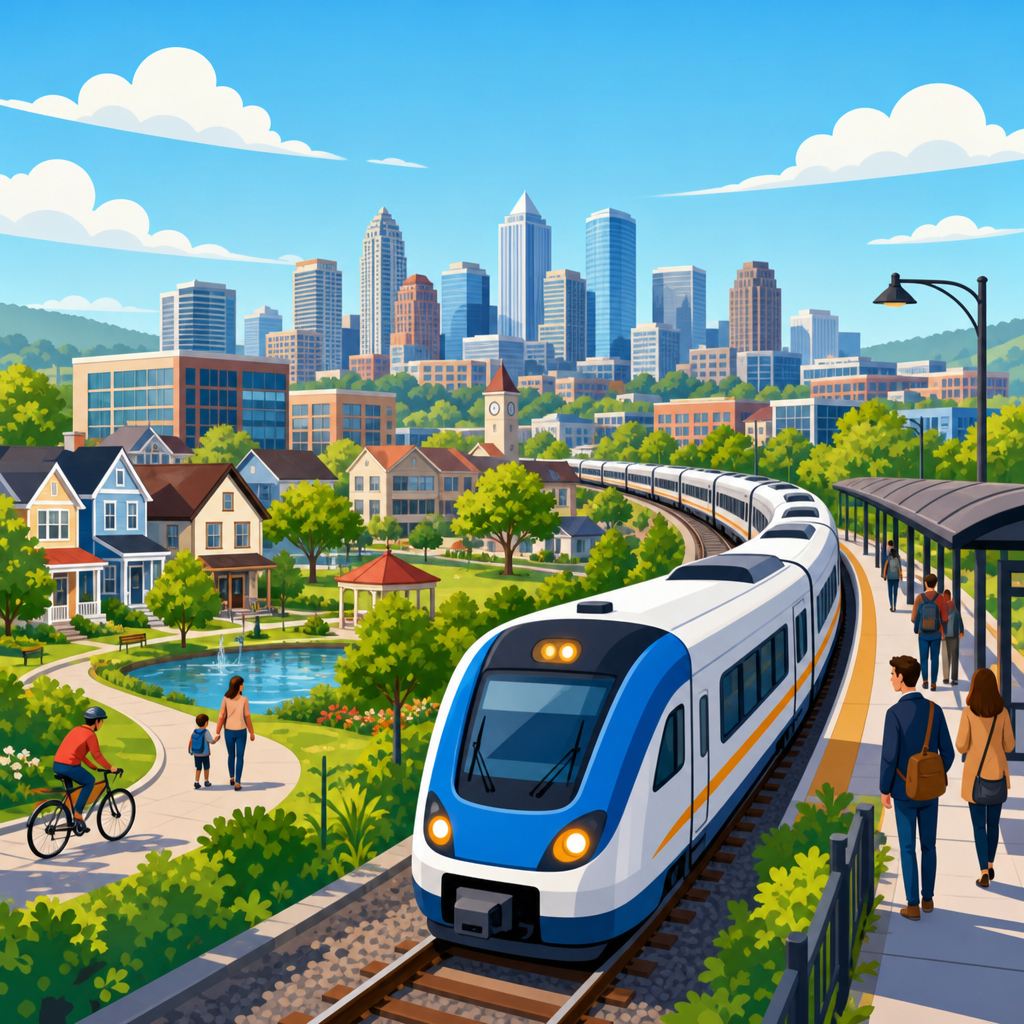
Regional commuter rail and the growth of satellite cities are tightly linked because fast, reliable rail changes how labor markets, housing demand, and business investment spread across a metropolitan region. A satellite city is an urban center located outside a dominant core city but economically connected to it through commuting, trade, education, and shared infrastructure. Regional commuter rail refers to medium- and long-distance passenger rail designed for frequent trips between suburban municipalities, secondary cities, and the main metropolitan center. When planners, developers, and public agencies align rail service with land use, satellite cities can absorb growth without simply becoming low-density bedroom suburbs.
I have worked on transit-oriented planning reviews where the same pattern appeared repeatedly: once travel times became predictable, employers expanded recruitment catchments, households reconsidered housing tradeoffs, and local governments gained leverage to reshape downtown districts around stations. That dynamic matters for sustainable urban development because unmanaged metropolitan growth often produces longer car trips, fragmented infrastructure spending, and rising housing pressure in the primary city. Regional commuter rail offers a structural alternative. It supports polycentric growth, meaning several connected urban nodes share jobs, housing, civic institutions, and cultural life instead of concentrating everything in one core.
This hub article explains how commuter rail drives the growth of satellite cities, what conditions make that growth successful, and where the model can fail. It covers transportation economics, station-area development, governance, housing, labor markets, environmental performance, and implementation risks. For readers building strategy across this subtopic, the central idea is simple: rail does not automatically create thriving satellite cities, but it can anchor them when service quality, zoning, public investment, and local identity reinforce one another.
How Regional Commuter Rail Reshapes Metropolitan Geography
Regional commuter rail expands the practical distance people can live from the largest city while remaining tied to its job market. The key variable is not absolute distance but generalized travel cost: total time, fare, reliability, transfers, and comfort. A town fifty kilometers away with a direct thirty-five-minute train can function more closely with the core than a suburb fifteen kilometers away reached by congested roads and two bus transfers. This is why rail corridors often produce development arcs rather than simple concentric rings.
In mature metropolitan regions, commuter rail strengthens polycentricity by connecting multiple centers, not only funneling workers inward. Paris RER lines link suburbs to each other and to central Paris. German S-Bahn systems tie secondary municipalities into larger labor sheds while supporting strong independent city centers. In Greater Tokyo, extensive rail allows many outer cities to maintain vibrant station districts with retail, schools, and offices. The lesson is clear: the most successful satellite cities are not merely export points for commuters. They become complete urban places because rail gives them sustained accessibility.
Accessibility changes land values and investment logic. Around well-served stations, developers can justify higher-density residential projects, office space for back-office or knowledge firms, and mixed-use formats that depend on foot traffic. Municipalities can also justify upgrades to utilities, public spaces, and civic services because concentrated growth improves the return on infrastructure spending. Without rail, similar growth often scatters into car-dependent subdivisions that raise public maintenance costs over time.
What Makes a Satellite City Grow Instead of Sprawl
A growing satellite city needs more than a station. It needs a local economic base, coherent land use policy, and enough frequency that rail feels usable throughout the day rather than only at peak commute hours. In practice, I look for five conditions: direct and frequent rail service, a walkable station district, zoning that permits mixed densities, civic amenities such as schools and healthcare, and a development strategy tied to local strengths. If those elements are missing, growth often defaults to peripheral sprawl while the station area underperforms.
Timing matters. When rail arrives after low-density expansion is already entrenched, station-area intensification faces higher political resistance, fragmented parcels, and expensive retrofits. When rail investment is paired early with precinct planning, municipalities can reserve land for housing, offices, bus interchanges, cycling access, and public space. Hong Kong’s rail-plus-property model is the most famous integrated example, though its institutional structure is unusual. More widely replicable examples come from Dutch and German station planning, where municipalities use land readjustment, public realm design, and incremental density increases to shape growth around transit.
Identity matters too. Successful satellite cities usually offer something distinct from the core city: lower housing costs, a university, a specialized industry cluster, waterfront access, heritage districts, or stronger family-oriented amenities. Rail broadens access, but local differentiation retains residents and attracts employers. A city that only markets itself as “cheaper than downtown” remains vulnerable to market swings. A city that combines rail access with a recognizable economic and civic profile develops resilience.
| Factor | Why it matters | Example outcome |
|---|---|---|
| High service frequency | Reduces schedule friction and supports nontraditional work hours | More residents choose rail over driving |
| Walkable station area | Concentrates foot traffic and raises retail viability | Active main street near the station |
| Mixed-use zoning | Allows housing, offices, and services to co-locate | Balanced all-day district rather than empty peak-only area |
| Local job anchors | Prevents one-way commuter dependence on the core city | Bidirectional travel and stronger local economy |
| Housing diversity | Supports students, families, seniors, and workforce households | More stable demographic growth |
Housing Pressure, Affordability, and Urban Form
One major reason regional commuter rail matters is housing affordability. In expensive core cities, households often move outward in search of larger or less costly homes. Without rail, that outward shift can lock families into long car commutes and raise regional emissions. With rail, satellite cities can absorb some of that demand more sustainably. However, better rail access also increases local land values, so affordability gains are not automatic. I have seen station announcements alone trigger speculative pricing well before service improvements materialized.
The most effective response is to treat rail investment and housing policy as one program. Municipalities can upzone station areas, reduce minimum parking requirements, require or incentivize inclusionary housing where legally feasible, and use public land for mixed-income development. Mid-rise apartments, courtyard blocks, secondary suites, and family-sized units all matter. Too many rail-oriented projects overproduce small luxury units and underdeliver the everyday housing that teachers, nurses, service workers, and young families need.
Urban form determines whether satellite city growth supports sustainability goals. Compact development within walking and cycling distance of stations reduces vehicle kilometers traveled and lowers per-capita infrastructure costs. It also improves the viability of local shops, schools, and buses. By contrast, if most new housing lands beyond easy station access, residents still drive for daily needs and may drive to the station as well, creating congestion and expensive parking demand. Density alone is not enough; the layout must support short trips and multiple modes.
Labor Markets, Productivity, and Business Location Decisions
Commuter rail expands labor markets in both directions. Employers in the core city gain access to workers from farther away, while firms in satellite cities can recruit from a larger regional pool. That larger matching market improves productivity because businesses are more likely to find workers with the right skills, and workers are more likely to find suitable jobs. Urban economists often describe this as an agglomeration benefit distributed across a network rather than trapped in one center.
Business location decisions reflect more than rent. Firms compare talent access, travel reliability, office costs, and client connectivity. A satellite city with strong rail service can attract government back offices, medical facilities, educational campuses, logistics management, and professional services that do not require a prestige central business district address. In the United Kingdom, towns connected by fast rail to London have seen shifting patterns of residential demand and selective office decentralization, though results vary depending on local planning and national economic cycles. In Spain, commuter rail and regional links have similarly shaped development around Madrid and Barcelona, but secondary centers performed best where service was frequent and local amenities were already strong.
Remote and hybrid work have changed, not eliminated, the value of regional rail. Peak commuting may be less dominant, but workers still travel for collaboration, client meetings, and part-time office presence. This raises the importance of all-day service. Satellite cities that depend entirely on traditional nine-to-five inbound commuting are exposed. Those with universities, healthcare, municipal employment, and local entrepreneurship remain active throughout the day and gain more from modern rail patterns.
Environmental Performance and Infrastructure Efficiency
Regional commuter rail can materially reduce transport emissions when it attracts riders away from private cars and when station-area development shortens daily travel needs. Electrified rail systems generally deliver better local air quality and lower operational emissions than diesel systems, especially where electricity grids are decarbonizing. The environmental benefit is strongest when trains are well used and integrated with walking, cycling, and feeder buses. Empty trains serving isolated park-and-ride lots do not produce the same return as rail embedded in compact urban districts.
There are also infrastructure efficiency gains. Concentrating growth in satellite cities along rail corridors can reduce pressure to extend roads, sewers, and utilities across scattered greenfield sites. Schools, healthcare facilities, and public services can serve denser catchments more efficiently. From a public finance perspective, this matters as much as carbon reduction. Low-density expansion often creates a long-term maintenance burden that tax revenues do not fully cover. Rail-oriented growth, if managed well, produces a more durable fiscal pattern.
Still, sustainability claims need realism. Rail construction has high upfront capital costs and embodied carbon. Tunnels, viaducts, and major stations are resource intensive. The payoff depends on ridership, land use outcomes, and decades of operation. That is why corridor selection, phased delivery, and integration with existing lines are so important. The goal is not to build rail everywhere, but to build it where it can anchor lasting urban structure.
Governance, Funding, and the Risks That Undermine Results
The hardest part of building successful satellite cities around commuter rail is governance. Rail lines are usually planned at regional or national scale, while zoning, permitting, and public realm decisions sit with local governments. If those institutions work at cross purposes, rail investment underdelivers. I have seen municipalities resist housing near stations to protect low-density character while simultaneously asking for better service and economic growth. That contradiction is common and costly.
Strong results usually require coordinated institutions, transparent phasing, and stable funding. Value capture can help, including tax increment mechanisms, joint development, special assessment districts, or land value sharing around stations. But these tools are not magic. They work best in high-demand corridors and where legal frameworks are clear. Core public funding remains essential for track upgrades, signaling, rolling stock, and accessibility improvements. Internationally, the most reliable systems are those treated as long-term public infrastructure rather than short-term real estate plays.
Several risks can undermine the satellite city model. One is displacement: rising land values may push out lower-income residents and small businesses unless protections and mixed-income housing are in place. Another is monoculture: towns that become overwhelmingly residential can hollow out during the day and remain economically dependent on the core city. A third is service mismatch: infrequent trains, poor fare integration, and weak feeder transit reduce rail’s practical value. Finally, political cycles can interrupt station-area plans before benefits appear. Successful places stay focused on the full corridor, not only ribbon-cutting moments.
Regional commuter rail and the growth of satellite cities belong at the center of sustainable urban development because they offer a practical way to distribute growth across a metropolitan region without defaulting to car-dependent sprawl. The evidence from Europe and Asia, reinforced by planning practice elsewhere, shows that rail works best when it is frequent, reliable, integrated with local transit, and paired with deliberate land use policy. A station alone does not create prosperity. A connected urban strategy does.
The core takeaways are straightforward. First, accessibility reshapes metropolitan geography by making secondary cities viable places to live, work, and invest. Second, housing outcomes depend on whether municipalities link rail expansion to mixed-income, mixed-use development near stations. Third, labor market and productivity gains are real when service supports two-way and all-day travel, not just peak-hour commuting. Fourth, environmental benefits are strongest when rail supports compact urban form and reduces car dependence. Finally, governance determines whether public investment translates into durable local value.
Use this hub as the foundation for deeper work on transit-oriented development, rail funding, station-area planning, housing delivery, and regional governance. If you are shaping policy, designing projects, or evaluating growth scenarios, start with one question: will this rail investment help a satellite city become a complete urban center rather than a distant suburb? Answer that honestly, and better decisions follow.
Frequently Asked Questions
How does regional commuter rail help satellite cities grow?
Regional commuter rail helps satellite cities grow by reducing the practical distance between those cities and the dominant metropolitan core. When trains are frequent, reliable, and reasonably fast, workers can live farther from the central city without giving up access to major employment centers. That immediately expands the housing appeal of satellite cities, especially for households looking for more space, lower costs, or a different quality of life than the core city can offer. Over time, this increased demand supports new housing construction, retail activity, schools, healthcare services, and public amenities.
Rail also changes the economics of business location. Employers that do not need a central business district address may find satellite cities attractive if they can still draw talent from the broader metro labor pool. Office parks, light industrial districts, logistics hubs, research campuses, and service-sector firms often benefit from being near a commuter rail station because it improves worker access and can reduce parking demand. In effect, rail allows satellite cities to participate more fully in the regional economy rather than functioning as isolated outer communities.
Just as important, commuter rail can support more balanced metropolitan growth. Instead of concentrating all new jobs, housing pressure, and infrastructure demand in the core city, rail distributes opportunity outward along connected corridors. That can strengthen multiple urban centers across the region. However, this growth is most successful when rail investment is paired with supportive land-use planning, station-area development, and local policies that encourage compact, walkable, mixed-use districts around stations rather than low-density sprawl.
What makes a satellite city different from a suburb in a commuter rail network?
A satellite city is more than a bedroom community or a typical suburb. While both may be connected to the main city through commuter rail, a satellite city usually has its own employment base, civic identity, commercial districts, institutions, and public services. It is economically linked to the larger metropolitan region, but it is not entirely dependent on the core city for jobs, shopping, education, or culture. In other words, a satellite city can stand on its own to a meaningful degree, even as rail strengthens its relationship with the main urban center.
In a commuter rail network, this distinction matters because rail does not only carry residents into the central city each morning and back out each evening. In a true satellite city, rail can support two-way and all-day travel patterns. People may commute from the core city to jobs in the satellite city, travel for university classes, connect to hospitals or government services, or visit for entertainment and retail. This broader range of trips reflects a more mature and diversified urban role.
Suburbs often grow around residential demand first, with employment and institutional functions added later if at all. Satellite cities, by contrast, usually have a stronger historical, economic, or administrative foundation. They may have preexisting downtowns, municipal governments with broader service capacity, and a regional profile that attracts investment. Regional commuter rail reinforces that status by making the satellite city more accessible and visible within the metro system, but it does not create urban importance out of nothing. The strongest rail-linked satellite cities combine transportation connectivity with genuine local economic depth.
Why do housing markets in satellite cities often change after commuter rail improves?
Housing markets in satellite cities often shift quickly after commuter rail improves because accessibility is one of the most powerful drivers of real estate demand. When travel times become shorter and more predictable, households that previously considered a location too distant may suddenly see it as practical. That increases the number of potential buyers and renters, especially among people priced out of the core city or seeking larger homes, lower monthly costs, or a different neighborhood environment. As demand rises, property values, rents, and development interest usually rise as well.
Improved rail service can also reshape what kinds of housing get built. Areas near stations become especially valuable because they offer the greatest convenience. Developers may respond with apartments, condominiums, townhomes, and mixed-use projects designed for commuters and households that prefer walkable access to transit. In stronger markets, this can create a more urban development pattern in places that were previously lower density. If local zoning allows it, station districts can become focal points for compact growth and new community investment.
At the same time, these changes can create affordability challenges. Existing residents may face higher rents, rising taxes tied to increasing property values, or pressure from speculative land purchases. That is why rail-led growth works best when local governments plan for housing diversity early. Inclusionary housing policies, affordable housing preservation, zoning reform, and infrastructure upgrades can help ensure that growth benefits both new arrivals and long-term residents. Without that planning, the rail connection may improve access but also intensify displacement and inequality within the satellite city.
Can regional commuter rail reduce pressure on the main city, or does it just expand commuting?
It can do both, depending on how the rail system and regional land use are managed. On one hand, commuter rail can reduce pressure on the main city by spreading housing demand, job growth, and public investment across a wider metropolitan geography. If satellite cities become stronger employment and service centers, the region does not need to rely as heavily on the core city for every major activity. That can ease strain on central housing markets, road congestion, and overloaded public infrastructure while creating more options for households and businesses.
On the other hand, if rail is designed mainly as a one-direction, peak-hour funnel into the core, it may simply expand the commuting shed of the dominant city. In that scenario, people live farther out but remain heavily dependent on the center for jobs and services. The result can be a larger regional labor market without the full development of independent satellite-city economies. This is common when station areas are surrounded by park-and-ride lots, low-density zoning, and limited local employment growth.
The difference lies in whether the region treats commuter rail as a metropolitan development tool rather than only a transportation service. Frequent all-day operations, strong connections between lines, integrated local transit, and supportive station-area planning make it easier for satellite cities to attract employers, institutions, and mixed-use development. When that happens, rail can help produce a more polycentric region with multiple thriving urban nodes. When it does not, rail still provides mobility benefits, but the deeper structural gains for satellite-city growth may be limited.
What policies are needed to make commuter rail support healthy satellite-city development?
Healthy satellite-city development depends on more than tracks and trains. The most important supporting policies usually begin with land use. Local governments need zoning that allows compact, mixed-use, walkable development near stations, including a range of housing types and sufficient commercial space. If station areas are restricted to low-density uses or dominated by surface parking, the city misses much of the economic value that rail can generate. Good planning should also protect room for civic facilities, public spaces, and future employment uses so that growth does not become purely residential.
Service policy matters just as much. Rail that runs only a few times a day or only during rush hour will not create the same development effect as service that is frequent, reliable, and usable for many trip purposes. Fare integration with buses, metro systems, and local transit is essential, because the station-to-destination connection often determines whether rail is truly convenient. First-mile and last-mile access through walking, cycling, feeder buses, and safe street design also plays a major role in how broadly the benefits are shared.
Finally, strong governance and equity policies are critical. Regional agencies and municipalities need to coordinate on infrastructure funding, housing targets, economic development, and environmental goals. Satellite-city growth should include affordable housing, workforce development, and anti-displacement measures so that prosperity is not limited to higher-income newcomers. Investments in schools, utilities, digital infrastructure, and public services help ensure that rising population and business activity can be absorbed sustainably. In the best cases, commuter rail becomes the backbone of a broader regional strategy that supports resilient, inclusive, and economically diverse satellite cities.