Bus network redesign is the process transit agencies use to rethink routes, frequencies, stop spacing, transfer patterns, and service standards so the bus system matches how people actually travel today. In practice, it is one of the most consequential tools in sustainable urban development because a bus map shapes access to jobs, schools, health care, and housing at a metropolitan scale. I have worked on service planning teams where outdated route structures, inherited from streetcar eras or decades-old commuting patterns, continued operating long after land use and travel demand had changed. Redesign starts by asking a blunt question: if the agency could rebuild the network from scratch with the same budget, would it draw the same map? Usually, the answer is no.
Three ideas sit at the center of any serious redesign: coverage, ridership, and equity. Coverage means geographic reach, including service to low-density neighborhoods, seniors, and riders with fewer travel options. Ridership refers to maximizing useful trips by focusing resources where demand is strongest, often through frequent all-day service on major corridors. Equity means evaluating who benefits, who bears burdens, and whether service decisions reduce or reinforce disparities for low-income riders, people of color, disabled riders, and households without cars. Agencies rarely get to maximize all three at once. That tension is why redesign is both technical and political.
This matters because bus networks are under constant pressure from limited operating funds, changing travel patterns, operator shortages, congestion, and public expectations for reliability. A route that appears generous on a map can fail riders if it comes once an hour, deviates through every subdivision, and misses connections. A simpler frequent grid can increase total access dramatically, but it may require longer walks or transfers for some households. Modern redesign efforts therefore combine travel data, census analysis, on-board counts, schedule adherence records, and intensive public engagement. The result is not just a new map. It is a policy statement about what mobility a city values, who transit is for, and how scarce service hours should be allocated.
Why agencies redesign bus networks in the first place
Most bus systems evolve incrementally. A new subdivision gets a loop. A hospital requests a deviation. A rail station opens, and a route is modified to feed it. Over years, the network becomes difficult to understand and expensive to operate. I have seen routes with one-seat rides preserved for historical reasons even though they were slow, unreliable, and poorly used. Redesign becomes necessary when the existing structure no longer reflects current demand or broader city goals such as emissions reduction, economic inclusion, or safer streets.
Several triggers are common. Population growth may shift from the historic center to suburban job clusters. Remote and hybrid work can weaken the old peak-only commuter pattern while increasing all-day discretionary trips. Major capital projects, including bus rapid transit or light rail, can justify reorganizing feeder service. Budget crises also force action. Houston’s 2015 redesign is a widely cited example because the agency reallocated existing resources into a more legible high-frequency grid without increasing operating hours, and ridership gains followed on the frequent network. Jarrett Walker’s ridership-versus-coverage framework remains influential because it gives boards and the public a clear way to discuss priorities rather than pretending every route can do everything well.
Coverage, ridership, and equity are not interchangeable goals
Coverage service prioritizes presence. It ensures that most residents live near a bus stop, even if service is infrequent. Ridership service prioritizes productivity, often measured by boardings per revenue hour, passenger miles, or access to dense destinations. Equity overlays both, but it is not identical to either one. An equity-focused redesign may preserve service in communities with high transit dependence even if ridership is modest, while also improving frequency on corridors serving many low-income workers. The point is to evaluate outcomes for protected and underserved groups, not merely system averages.
Agencies formalize these tradeoffs through service guidelines. A common policy might define a frequent corridor as service every 10 to 15 minutes for most of the day, while coverage routes may run every 30 to 60 minutes. Span of service matters as much as frequency. A bus every 15 minutes that stops running at 7 p.m. is inadequate for late-shift workers. Reliability matters too. Riders experience waiting time more painfully than in-vehicle time, which is why irregular headways can damage a corridor that looks acceptable on paper.
| Goal | Primary planning focus | Typical network choice | Main tradeoff |
|---|---|---|---|
| Coverage | Geographic access and social inclusion | More routes, wider stop reach, lower frequency | Long waits and limited spontaneity |
| Ridership | High-demand corridors and strong all-day use | Frequent grid, direct alignments, stronger transfers | Some riders walk farther or lose one-seat trips |
| Equity | Fair distribution of benefits and burdens | Targeted investment based on need and barriers | Requires nuanced metrics beyond productivity alone |
The best redesigns make these choices explicit. They do not hide behind neutral language. If an agency says it values equity, it should show which indicators it uses, such as zero-car households, disability prevalence, low-income population, race and ethnicity data, and access to essential destinations within 45 minutes. If it says it values ridership, it should identify the corridors where frequency creates a network effect through seamless transfers and shorter door-to-door travel times.
How planners build a redesign from data and street-level reality
A credible redesign starts with a current network diagnosis. Agencies pull automatic passenger counter data, fare transactions, automatic vehicle location feeds, and schedule adherence reports to understand where riders board, where bunching occurs, and where runtime padding is excessive. Census and employer data from the American Community Survey and LEHD Origin-Destination Employment Statistics help map who lives and works along corridors. Accessibility tools then estimate how many jobs, clinics, grocery stores, or colleges riders can reach within a set travel time by transit and walking.
But the spreadsheet never tells the whole story. Field checks matter. I have ridden corridors where the data showed moderate demand, yet on-site observation revealed a stop environment so unsafe or uncomfortable that latent demand was being suppressed. Sidewalk gaps, hostile arterials, missing shelters, and unrealistic transfer walks can undermine an elegant network plan. Good planners also separate structural delay from schedule design problems. A route may look unreliable because the timetable ignores chronic congestion at two intersections, not because the operator is underperforming.
Scenario testing is the core of redesign. Teams usually model several concepts: a ridership-oriented frequent network, a balanced network, and a higher-coverage option. They compare expected ridership, access changes, transfer rates, Title VI implications, operating cost, and fleet requirements. Software may assist, but experienced planners still rely on professional judgment because local institutions, labor agreements, school bell times, and street geometry all affect what is feasible.
Network design choices that make bus systems work better
The most effective redesigns simplify route structures. Direct routes outperform meandering ones because they reduce travel time and make schedules easier to keep. Frequent grids are especially powerful in cities with multiple destinations rather than one dominant downtown. Instead of designing every line around a single central terminal, planners create intersecting corridors so riders can transfer quickly in many directions. This structure supports all-day travel, not just nine-to-five commuting.
Stop spacing is another underappreciated lever. Closely spaced stops may feel convenient, but they slow buses dramatically. Many agencies now target average stop spacing of roughly one-eighth to one-quarter mile in urban areas, while retaining tighter spacing near senior housing, steep grades, or major trip generators. Bus lanes, transit signal priority, all-door boarding, and off-board fare collection can further improve speed, but those tools work best when the route itself is legible and direct.
Transfers are often politically sensitive, yet they are essential to a strong network. Riders generally dislike unnecessary transfers, but they accept them when frequencies are high, stops are safe, and the travel time savings are obvious. The lesson from successful redesigns in cities such as Columbus, Austin, and Houston is that agencies must design timed or turn-up-and-go connections intentionally. A transfer penalty created by 30-minute headways is a planning failure, not an inevitable feature of buses.
Equity analysis must shape decisions before and after launch
Equity cannot be treated as a final compliance memo. It has to influence where service is added, where cuts are unacceptable, and how implementation is staged. In the United States, agencies receiving federal funds must evaluate major service changes under Title VI of the Civil Rights Act. That means analyzing whether changes create disparate impacts on minority riders or disproportionate burdens on low-income riders, using board-approved thresholds and methods. The strongest agencies go further by integrating equity metrics at the beginning of scenario development, not after the map is mostly fixed.
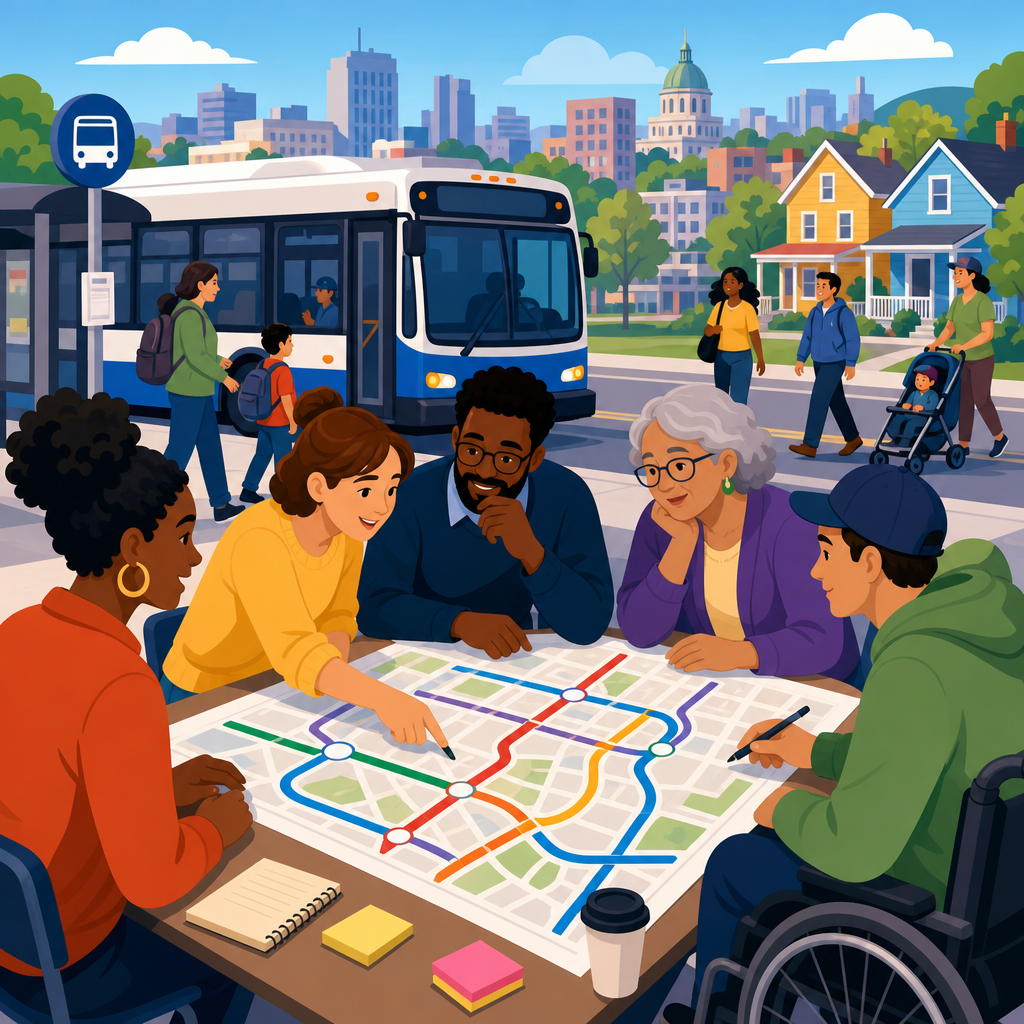
Meaningful equity analysis includes cumulative burden. A low-income neighborhood should not be asked to accept longer walks, more transfers, and reduced evening span simultaneously just because each individual change appears modest. Community engagement also has to be accessible. Meetings held only downtown in the middle of the day exclude many bus riders. Effective outreach uses multilingual materials, pop-up events at transit centers, on-board surveys, partnerships with community organizations, and compensation for participant time when possible.
There are limits to what bus redesign alone can solve. If affordable housing is being displaced away from frequent corridors, or if sidewalk infrastructure is missing, transit planning must coordinate with land use and public works. Still, agencies have more control than they sometimes admit. They can prioritize weekend service for essential workers, protect crosstown mobility to hospitals and community colleges, and publish transparent equity dashboards that show whether promised benefits were delivered.
Implementation is where redesigns succeed or fail
A technically sound network can still collapse in rollout if agencies underestimate operations. Running more frequent service on paper requires enough operators, spare ratio, recovery time, and dispatch discipline to sustain it. I have seen launch plans compromised by weak run-cutting assumptions and terminal layouts that made on-time departures impossible. Implementation should include operator training, updated stop infrastructure, revised passenger information, and realistic scheduling based on observed running times by time of day.
Customer communication matters just as much. Riders need simple maps, corridor branding, stop-level notices, trip-planner updates, and clear explanations of what changed and why. Launch periods benefit from ambassadors at key transfer points, especially where legacy one-seat rides are being replaced. Agencies should monitor complaints, missed trips, crowding, and overloads daily during the first weeks and be prepared to make tactical adjustments quickly.
Post-launch evaluation is nonnegotiable. The agency should report whether ridership changed, whether access improved for priority populations, whether travel times fell, and whether reliability targets were met. Standard measures include on-time performance, excess wait time, passenger loads, boardings per revenue hour, and destination access within a fixed time threshold. When redesigns are treated as living programs rather than one-time map releases, they become more resilient and more credible.
Bus network redesign works when agencies state their priorities plainly, design around current travel patterns, and measure who benefits from every service hour invested. Coverage, ridership, and equity are all legitimate goals, but they require deliberate choices, not slogans. The strongest redesigns use hard data, field observation, and transparent policy tradeoffs to create simpler routes, better frequencies, stronger transfers, and more reliable service.
For sustainable urban development, the payoff is substantial. A well-designed bus network expands access without waiting for expensive rail projects, supports lower car dependence, and connects residents to opportunity across the entire day. It also gives cities a practical way to align transportation spending with climate, housing, and public health goals. If your agency, city, or advocacy group is evaluating service today, start with one question: does the current network reflect how people live now? If not, redesign is not a luxury. It is the next essential step.
Frequently Asked Questions
What is a bus network redesign, and why do transit agencies undertake one?
A bus network redesign is a comprehensive reevaluation of how a bus system is structured and operated. Rather than making small adjustments to individual routes one at a time, agencies step back and examine the full network: where routes go, how often buses arrive, how far apart stops should be, how easy transfers are, what span of service is offered during the day, and what service standards should guide future decisions. The goal is to align the system with current travel patterns instead of preserving route structures that may have been designed decades ago for very different land uses, commuting habits, and demographic realities.
Agencies undertake redesigns because cities and regions change, but bus networks often lag behind. Job centers decentralize, housing shifts to new corridors, medical and educational destinations expand, and all-day travel becomes more important than the traditional peak-hour downtown commute. In many places, the existing network still reflects inherited patterns from streetcar alignments or long-standing political compromises rather than present-day mobility needs. A redesign gives planners the chance to build a network that is more legible, more frequent where demand is strongest, and more useful for a wider range of trips.
It is also one of the most important policy tools in sustainable urban development. A bus map is not just a transportation diagram; it is a map of opportunity. The design of the network directly influences access to jobs, schools, health care, grocery stores, and social services. When agencies redesign a system well, they can improve regional mobility, reduce dependence on private cars, support climate goals, and better connect historically underserved communities. That is why bus network redesign is often framed not as a technical exercise alone, but as a major public policy decision with long-term economic, environmental, and equity implications.
How do agencies balance coverage, ridership, and equity when redesigning a bus network?
Balancing coverage, ridership, and equity is at the heart of every serious bus network redesign, and it is one of the hardest parts of the process. These goals are related, but they are not identical. Ridership-oriented planning usually prioritizes frequent, direct service in places with high existing or latent demand, which can produce more riders per service hour and better all-day usefulness. Coverage-oriented planning tries to ensure that more neighborhoods have at least some transit access, even if service is less frequent or less productive. Equity-oriented planning asks who most depends on transit, who has historically been underserved, and whether the benefits and burdens of the redesign are being shared fairly.
In practice, agencies typically begin by defining policy priorities before drawing lines on a map. Many boards and planning teams establish explicit service allocation frameworks, such as dedicating a portion of service hours to a high-frequency network and another portion to coverage routes. They may also identify equity priority communities based on factors such as income, race and ethnicity, disability, age, car ownership, limited English proficiency, and historic disinvestment. This helps shift the redesign from a vague debate into a more transparent decision-making process grounded in adopted goals.
Equity does not simply mean preserving every existing route. Sometimes a low-frequency, circuitous route looks equitable because it remains on the map, but in reality it may offer poor access and unreliable travel times to the very communities it is meant to serve. A redesign can improve equity by creating faster, more frequent corridors, better transfer opportunities, longer service spans, and more reliable weekend service in neighborhoods where transit dependence is high. At the same time, agencies must carefully analyze tradeoffs so they do not remove geographically broad access without a clear mitigation strategy.
The strongest redesigns use data and community engagement together. Planners analyze boarding patterns, travel times, origin-destination flows, demographic indicators, and access to essential destinations, then compare multiple scenarios. They also listen closely to riders who understand barriers the data may not capture, such as unsafe transfer conditions, difficult hills, language access issues, or destinations that matter locally but are easy to overlook in regional models. The final network is usually a negotiated balance: enough frequency to make transit competitive, enough coverage to maintain a meaningful public service, and enough equity analysis to ensure the redesign improves mobility for people who rely on the system most.
What changes are most common in a bus network redesign?
Although every city is different, several recurring changes appear in many bus network redesigns. One of the most common is simplifying routes. Agencies often replace long, winding lines with straighter, more direct corridors that are easier to understand and faster to operate. Directness matters because every deviation adds travel time, complicates schedules, and reduces reliability. A simpler network may ask some riders to transfer more often, but it can also create a system that gets more people to more places in less time.
Another common change is increasing frequency on key corridors. Instead of spreading service thinly across many low-frequency routes, agencies may concentrate resources on a smaller set of frequent lines where buses arrive every 10 to 15 minutes or better. This approach improves spontaneity and reduces the “schedule penalty” riders face when service is too infrequent to be convenient. Frequent service is especially valuable because it multiplies access: a strong corridor combined with coordinated transfer opportunities can serve many trip pairs more effectively than a one-seat ride that runs only once or twice per hour.
Stop spacing is also frequently revisited. Over time, many bus systems accumulate closely spaced stops that slow service and increase dwell time. Redesign efforts often remove some stops to improve speed and reliability while still maintaining reasonable walk access. This can be controversial, especially for riders with limited mobility, so agencies usually need a careful stop balancing process that accounts for pedestrian infrastructure, topography, safety, and nearby rider generators such as senior housing or clinics.
Other common changes include restructuring transfer points, revising service spans, improving weekend and evening service, and redefining route hierarchy. Agencies may introduce a clearer family of services, such as frequent routes, local routes, crosstown connections, express overlays, school-oriented trips, or microtransit in limited cases where fixed-route service is not feasible. Many redesigns also align service more deliberately with rail stations, bus rapid transit corridors, and major activity centers. The overarching pattern is the same: make the network more readable, more useful all day, and more reflective of where people actually need to travel now.
Why can bus network redesigns be controversial, even when the goal is better service?
Bus network redesigns can be controversial because they make tradeoffs visible. Any meaningful redesign changes existing travel patterns, and even when the overall system improves, some riders may lose a familiar one-seat ride, experience longer walks to a stop, or need to adapt to new transfer patterns. For riders who have built work schedules, child care routines, or medical trips around the current network, these changes can feel risky and disruptive. What planners see as a rational network optimization may be experienced by the public as a very personal change in daily life.
Another reason for controversy is that transit decisions are never purely technical. Route alignments, frequencies, and stop locations are tied to neighborhood identity, political expectations, and long-standing perceptions of fairness. A route that performs poorly on paper may still matter deeply to a community because it represents recognition, access, or a connection that has existed for generations. Conversely, agencies may propose changes that improve regional access but struggle to explain the benefits clearly enough for riders to trust the outcome. If the public process feels rushed, opaque, or overly data-driven without real listening, skepticism grows quickly.
Transfers are a particularly sensitive issue. In many redesigns, agencies shift from trying to provide as many one-seat rides as possible toward building a stronger frequent grid or trunk-and-feeder system. From a network perspective, that can be highly effective. But riders often judge the experience based on whether the transfer is safe, sheltered, coordinated, and reliable. If sidewalks are poor, buses are late, or waiting environments feel unsafe, a theoretically efficient transfer becomes a real hardship. That is why successful redesigns usually need complementary investments in bus stops, passenger information, shelters, accessibility, and operations management.
Controversy also arises when expectations are mismatched. Some members of the public assume a redesign will increase service everywhere, when in reality agencies are often reallocating a fixed budget rather than adding substantial new resources. The best agencies address this directly: they explain the constraints, present alternatives transparently, identify who benefits and who is affected, and show how decisions connect back to adopted priorities around ridership, coverage, and equity. Public trust improves when people can see not just what is changing, but why it is changing and how the agency will monitor outcomes afterward.
How do agencies know whether a bus network redesign has been successful?
Agencies evaluate success by looking beyond a single metric. Ridership is important, but it is not the whole story. A successful redesign is usually assessed through a combination of measures, including boardings, ridership per service hour, travel time improvements, on-time performance, transfer quality, access to jobs and essential destinations, passenger loads, customer satisfaction, and the distribution of benefits across different communities. The question is not only whether more people ride, but whether the network works better for the trips people need to make.
One of the clearest indicators is whether the redesigned network delivers more useful service. That may show up as faster trips on major corridors, better frequency