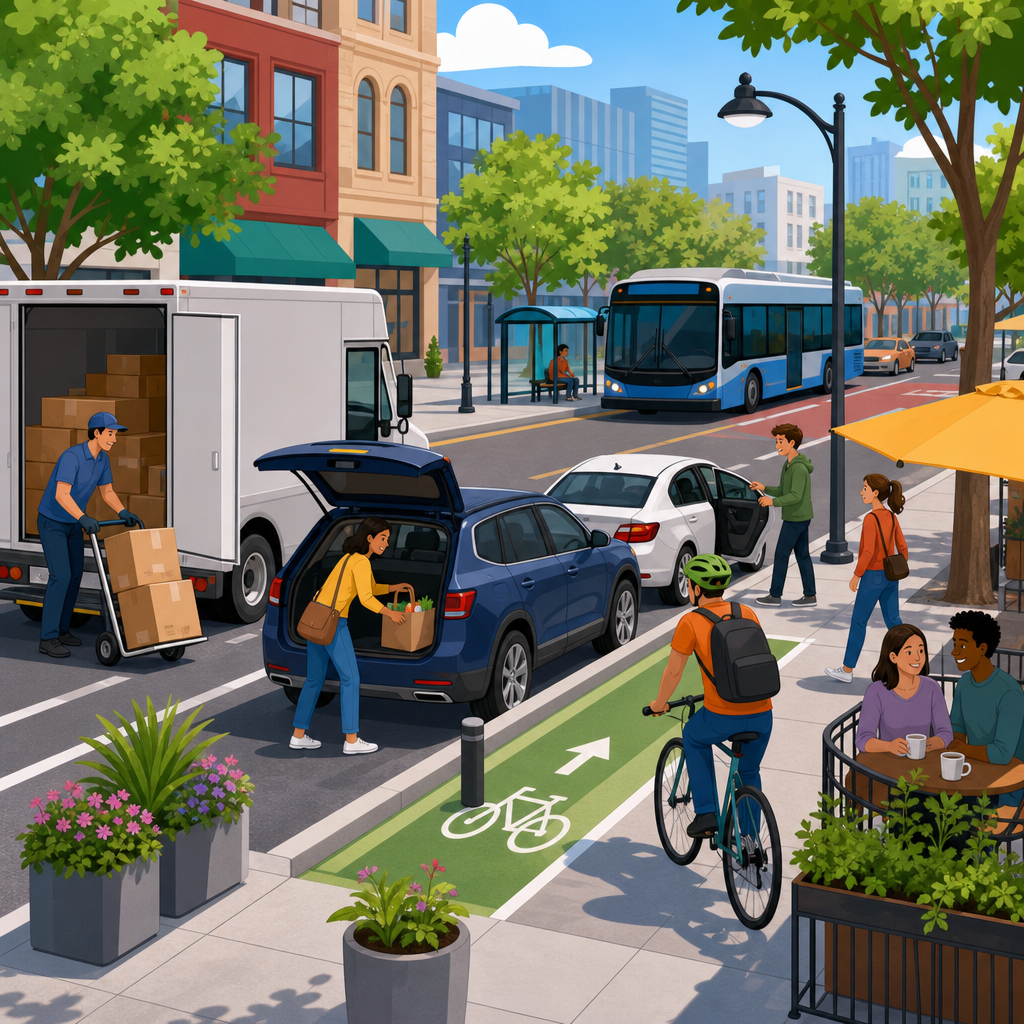
Curb management is the practice of allocating, pricing, regulating, and enforcing access to the narrow strip of public right-of-way where the street meets the sidewalk. That strip accommodates freight deliveries, passenger pick-ups and drop-offs, bus stops, bike lanes, parklets, loading bays, accessible parking, construction staging, micromobility parking, and private vehicle storage, often all on the same block face. In city transportation work, I have seen more conflict emerge from a single poorly managed curb than from an entire corridor redesign, because the curb concentrates scarce space, commercial urgency, and political pressure into a few feet of asphalt.
For sustainable urban development, curb management matters because it determines whether streets support access without forcing unnecessary traffic, double parking, emissions, and safety risks. E-commerce growth has increased urban parcel deliveries. Ride-hailing has expanded short-duration stopping. Restaurants and retailers rely on convenient pick-up zones. Transit agencies need reliable bus operations. Residents need accessible access, and emergency vehicles need clear paths. When cities leave curb space unmanaged, the result is predictable: drivers circle for parking, delivery vans stop in travel lanes, buses are delayed, bike lanes are blocked, and pedestrians face more conflict at crossings.
Good curb management treats the curb as dynamic public infrastructure rather than free storage for private vehicles. The key terms are straightforward. A loading zone reserves space for commercial freight activity. A passenger loading zone supports short pick-up and drop-off activity. A flex zone changes use by time of day or day of week. Pricing uses meters, permits, or digital payments to influence demand. Enforcement applies rules through officers, cameras, permits, and data systems. Together, these tools help cities assign the right use to the right place at the right time, improving reliability, safety, and economic productivity.
Why the curb has become a critical urban systems issue
The curb used to be managed mainly as parking. That assumption no longer matches city travel patterns or commercial activity. The rise of app-based food delivery, same-day parcel shipping, transportation network companies, and micromobility has transformed the curb into a high-turnover operations zone. A block that once needed a few metered spaces may now require morning freight loading, midday customer pick-up, evening restaurant loading, and overnight resident parking. If policy does not evolve with demand, street users create their own informal rules, usually by occupying the nearest legal or illegal space.
Research from city pilot programs consistently shows that unmanaged loading creates measurable congestion and safety costs. Delivery vehicles that double park reduce roadway capacity and trigger lane changes around stopped vehicles. In dense commercial districts, that disruption can ripple across intersections and delay buses. Passenger pick-ups near corners can obscure visibility for people walking and biking. Bike lane blockages force riders into mixed traffic. These are not edge cases. They are recurring operational failures caused by a mismatch between curb supply and curb demand.
Curb management also affects climate and equity outcomes. Cruising for parking adds vehicle miles traveled and emissions with no transportation benefit. Prioritizing long-term private vehicle storage over bus access or freight turnover can disadvantage lower-income riders and small businesses that depend on reliable deliveries. At the same time, poorly designed restrictions can burden independent drivers, tradespeople, and disability access if cities ignore real operating needs. The goal is not to eliminate curb access. It is to organize it so public space serves the most valuable uses with the least harm.
Core curb uses and how cities should prioritize them
Every curb use has a constituency, but not every use delivers the same public value in every location. In practice, cities should prioritize safety first, then person throughput and access, then economic activity, and finally long-duration storage where demand remains. Safety means daylighting intersections, preserving accessible loading, protecting fire hydrants, and keeping crosswalks and bike lanes clear. Throughput means supporting buses, shuttles, and high-turnover passenger activity where many people need access. Economic activity means giving commercial districts dependable freight space so businesses receive goods without disrupting traffic.
Context matters. On a downtown retail block, one commercial loading zone may support dozens of businesses and hundreds of deliveries per week, creating more value than two all-day parking spaces. Near a hospital, patient drop-off and paratransit access may outrank curbside parking. Outside a school, timed pick-up and drop-off controls can reduce unsafe stopping. In entertainment districts, evening passenger loading can reduce random ride-hail stops in travel lanes. A residential side street may still reserve space for permit parking, but even there, construction staging, waste collection, and moving trucks require managed access.
The strongest curb programs move beyond one-size-fits-all rules. They use land use, building type, traffic volume, and turnover data to assign curb functions block by block. Cities such as Seattle, Washington, DC, and New York have tested dynamic curb uses because curb demand changes by hour. A florist may need freight access at 7 a.m., cafés may need customer pick-up at noon, and bars may need passenger loading at 10 p.m. Static regulations cannot perform well in that environment. Flexible designations usually outperform permanent parking allocations.
Deliveries: designing freight access that reduces double parking
Urban freight is the backbone of curb management because deliveries are frequent, time-sensitive, and hard to substitute. Parcel carriers, beverage distributors, linen services, grocery vendors, and contractors all need close access to buildings. When no legal space is available within a workable carrying distance, drivers double park. From field audits I have done in commercial districts, drivers usually double park for one reason: the legal loading space is too far away, occupied by non-loading vehicles, or restricted during the wrong hours. Enforcement alone will not solve that. Supply and scheduling must match actual operations.
Effective freight curb design starts with demand analysis. Cities can study land uses, business delivery windows, vehicle types, dwell times, and repeat stop frequency. A restaurant cluster receiving food and beverage deliveries may need early-morning loading with 20- to 40-minute dwell times. A pharmacy may need smaller but more frequent parcel stops. Loading zones should be placed where trucks can approach safely, unload without crossing active bike lanes where possible, and avoid blocking bus stops. Signage must be unambiguous, and curb paint should reinforce the rule visually.
Technology can improve freight management, but only if grounded in operations. Digital loading permits, geofenced curb inventory, and reservation pilots help cities understand who is using space and for how long. Commercial vehicle permits can prioritize legitimate freight users over general parking. Larger developments should be required through site review to provide off-street loading when trip generation warrants it. The Institute of Transportation Engineers and municipal freight plans provide practical guidance, but the essential lesson is simple: if the city wants freight compliance, it must provide realistic legal access close to destination doors.
Pick-up and drop-off zones: managing short stays without creating chaos
Passenger pick-up zones serve taxis, ride-hail vehicles, hotel shuttles, caregivers, and private drivers. Their operational signature is short dwell time, high turnover, and strong location sensitivity. People want to be picked up at the front door, not halfway down the block. Without designated space, drivers stop wherever demand occurs, often in bus stops, bike lanes, crosswalk approaches, or travel lanes. That behavior is especially common at airports, nightlife districts, schools, medical buildings, and multifamily housing with limited frontage.
Well-designed pick-up zones separate short passenger activity from freight and longer parking. They are usually located near major generators, signed for active loading only, and limited to brief dwell times, often two to five minutes. In some districts, the best approach is to establish one clearly marked mobility zone that accommodates passenger loading, taxis, and micromobility corrals while preserving bus stop operations nearby. At hotels and event venues, staff management can matter as much as curb geometry, because attendants can move waiting passengers away from the curb until vehicles arrive.
Ride-hail activity illustrates why curb policy must be explicit. Transportation network company vehicles often behave like neither taxis nor private cars. They need fast turnover but operate at broad scale and respond to app demand peaks. Cities that designate ride-hail pickup points in congested districts typically reduce random stopping and improve pedestrian safety. The tradeoff is walking distance for passengers, which must be reasonable and accessible. The curb cannot serve every door directly. It should serve the district predictably, with designated points that drivers and users can find without confusion.
Matching curb tools to street context
The most successful curb management programs use a mix of regulations, pricing, design, and enforcement rather than relying on one tool. Different contexts require different combinations. Downtown commercial streets may need paid loading, time-of-day freight zones, passenger loading areas, and bus lane protection. Mixed-use neighborhood main streets may need flexible spaces that convert from freight in the morning to customer parking or pick-up in the afternoon. Residential streets near schools or stations may need permit parking, accessible loading, and no-stopping controls near crossings.
| Street context | Primary curb demand | Best-fit tools | Main risk if unmanaged |
|---|---|---|---|
| Downtown retail corridor | Freight, ride-hail, short visits | Timed loading zones, paid parking, passenger loading bays, camera enforcement | Double parking and bus delay |
| Restaurant district | Food delivery and evening pick-up | Daypart flex zones, clear signage, pickup areas near corners but outside sight triangles | Travel-lane stopping and pedestrian conflict |
| Hospital or clinic frontage | Accessible loading, paratransit, patient drop-off | Reserved medical loading, strict turnover limits, staffed curb operations | Access barriers for vulnerable users |
| School frontage | Short-duration drop-off and bus access | Timed restrictions, curb marshals, no-stopping near crossings | Unsafe queuing and blocked crosswalks |
| Residential permit area | Longer parking with occasional service access | Permit systems, moving truck permits, construction loading rules | Chronic spillover and illegal staging |
Pricing deserves special attention because it is often politically difficult but operationally effective. Properly set prices improve availability and turnover. Donald Shoup’s work on parking economics remains influential because it showed that underpriced curb space creates cruising and scarcity. The same logic applies to premium curb uses. If a district has overwhelming demand for short-term access, pricing and permits can ration use more effectively than static time limits alone. Still, pricing is not a cure-all. Essential access for disability users, transit, and safety functions should not be treated as simple market transactions.
Enforcement, data, and measurement
Rules only work when users understand them and believe they will be enforced. Traditional meter enforcement is too narrow for modern curb conditions. Cities now need integrated enforcement that covers loading misuse, bus stop blocking, bike lane obstruction, permit compliance, and timed curb conversions. Camera enforcement can be especially effective for bus lanes and clearways where stopping causes immediate operational harm, though legal authority varies by jurisdiction. Officers still matter because curb conditions are nuanced, and visible enforcement changes behavior in ways back-office processing does not.
Measurement should focus on outcomes, not just citation counts. The right metrics include turnover, occupancy by curb type, double-parking frequency, dwell time, bus delay near curbs, bike lane blockage, loading compliance, and business feedback. Before-and-after studies are essential. If a new loading zone reduces double parking by 30 percent and improves delivery reliability, that is a meaningful success even if adjacent parking supply declines. If a passenger zone remains empty because it is placed too far from demand, the city should relocate it rather than defend a failing design.
Data collection methods range from simple curb observations to license plate surveys, payment records, probe vehicle traces, and computer vision. None is perfect on its own. In my experience, the best programs combine quantitative data with direct outreach to drivers, merchants, building managers, disability advocates, and transit operators. Those users understand patterns that datasets can miss, such as repeated conflicts with trash pickup times or security staff informally directing vehicles into prohibited areas. Strong curb management is iterative. Cities should pilot, measure, refine, and scale rather than freeze early assumptions into permanent rules.
Building a curb management program that lasts
Institutional design often determines whether curb reform succeeds. In many cities, parking, freight, transit, enforcement, permitting, and street design are split across separate departments with different goals and databases. That fragmentation produces contradictory rules and slow responses. A durable curb program needs clear ownership, shared inventory, and a formal process for changing curb regulations. The curb should be mapped block by block in a digital inventory that records use, hours, signs, payment rules, and accessibility features. Without a reliable inventory, policy becomes guesswork.
Public communication is equally important. Businesses are more willing to support curb changes when cities explain the problem in operational terms: fewer blocked lanes, more reliable deliveries, easier customer access, safer crossings. Pilots help because people can observe results instead of debating abstractions. Quick-build materials, temporary signs, and measured evaluations allow cities to test morning loading zones, evening pickup spaces, or consolidated delivery areas before making capital investments. The strongest message is practical: managed curbs reduce friction for everyone by replacing random stopping with predictable access.
Looking ahead, curb management will become more important as cities electrify fleets, support cargo bikes, expand bus priority, and regulate autonomous delivery activity. Charging zones for commercial vehicles, microhubs for last-mile delivery, and designated spaces for accessible on-demand services will add new layers of demand. The principle will remain the same. The curb is limited public space, and its highest value comes from purposeful, well-enforced, adaptable use. Cities that manage it well can improve safety, support commerce, cut congestion, and make streets work better for people, not just parked vehicles.
Curb management works when cities stop treating the curb as leftover space and start treating it as a transportation system. Deliveries need legal, well-located loading zones. Pick-up activity needs short-stay areas near real demand. Transit, biking, walking, and accessibility needs must be protected before long-duration parking claims the street edge by default. Pricing, permits, signage, enforcement, and digital inventories are not separate tactics. They are parts of one operating framework for assigning scarce curb space to the uses that create the most public value.
The central lesson is that competing street uses can be reconciled, but only through active management. A downtown block may need freight access at dawn, customer turnover at lunch, passenger loading at night, and clear safety setbacks all day. Static rules rarely fit that reality. Time-based allocation, measurable pilots, and block-by-block analysis produce better outcomes than blanket policies. Cities should evaluate turnover, double parking, bus delay, and user compliance, then adjust quickly. The curb is dynamic, and successful policy must be dynamic too.
For planners, public works teams, business districts, and elected officials, the next step is straightforward: inventory your curbs, identify the highest-conflict blocks, and pilot one targeted change with clear metrics. Start where double parking, unsafe stopping, or delivery failure is most visible. Measure results, publish them, and expand what works. Better curb management is one of the fastest, lowest-cost ways to improve street safety, reliability, and economic access across a city.
Frequently Asked Questions
What is curb management, and why does it matter so much on busy city streets?
Curb management is the process of deciding how the space along the edge of the street is assigned, regulated, priced, and enforced. Although it looks like a narrow strip of pavement, the curb is one of the most contested pieces of public right-of-way in any city. On a single block, that space may need to support parcel deliveries, food drop-offs, ride-hail pick-ups, bus boarding, bike lanes, accessible parking, short-term passenger loading, construction activity, micromobility parking, outdoor dining, and long-term vehicle storage. Because all of those uses compete for limited space, poor curb management quickly leads to double-parking, blocked travel lanes, delayed buses, unsafe crossings, and frustration for everyone using the street.
Effective curb management matters because it turns a chaotic, first-come-first-served edge condition into a system that reflects actual public priorities. Cities can use curb management to improve safety, reduce congestion, support local businesses, speed up deliveries, protect transit operations, and make streets more accessible for people with disabilities. In practice, it is less about painting a curb one color and more about matching curb space to time of day, land use, demand, and policy goals. A school zone in the morning, a commercial corridor at midday, and an entertainment district at night may all need very different curb rules on the same block face. When cities treat the curb as an actively managed asset rather than leftover space, the entire transportation network tends to function better.
How do cities decide which curb uses should get priority when so many activities compete for the same space?
The most effective approach is to start with public goals rather than with the loudest stakeholder or the historical default. In many places, curb space was traditionally given over to private vehicle parking, even when that use delivered less public value than bus loading, freight access, or accessible passenger drop-off. A modern curb management framework asks a clearer question: what use of this space best supports safety, mobility, access, commerce, and the surrounding neighborhood at this specific location and time? That usually means cities evaluate transit needs, pedestrian volumes, crash history, adjacent businesses, delivery patterns, school activity, land use, and accessibility requirements before setting rules.
Priority decisions often follow a practical hierarchy. Safety-sensitive uses typically come first, including clear sightlines at intersections, ADA access, crosswalk visibility, and bus stop operations. Next come high-efficiency and high-need uses such as transit, freight loading in commercial districts, and designated passenger loading where constant pick-up and drop-off activity would otherwise spill into travel lanes. After that, cities may consider bike corrals, micromobility parking, short-term parking, parklets, or general vehicle storage depending on local goals. The key point is that curb management works best when priorities are explicit and evidence-based. A block serving restaurants, apartment buildings, and frequent delivery vehicles may need loading zones and short-term pick-up space instead of all-day parking. A transit-heavy corridor may justify removing parking altogether to keep buses moving and improve reliability.
Good policy also recognizes that priorities can change by hour, day, or season. Dynamic curb management is increasingly important because demand is not static. Commercial loading may be most critical in the morning, passenger pick-ups in the evening, and outdoor public space on weekends. Cities that use time-based regulations, clear signage, permits, and digital tools can allocate the same curb more efficiently across different periods. That flexibility is often what makes competing street uses coexist rather than collide.
Why are deliveries and pick-up zones such a major focus in curb management programs?
Deliveries and passenger pick-ups concentrate intense demand into short windows of time, and when there is no legal, convenient place for those activities to happen, they spill into traffic lanes, bike lanes, bus stops, and crosswalks. That is why they sit at the center of many curb management efforts. Freight carriers need close, reliable access to storefronts, offices, and residential buildings. At the same time, ride-hail vehicles, taxis, family drop-offs, non-emergency medical transport, and app-based food delivery drivers all need space to stop briefly without creating safety hazards. Even when each individual stop is short, the cumulative effect on a busy corridor can be significant.
Designated loading and pick-up zones help cities channel those activities into predictable locations. For freight, that can reduce double-parking, improve turnover, and make deliveries more efficient for businesses and carriers alike. For passenger activity, it can reduce mid-block stopping, blocking of bike facilities, and conflicts near intersections. The value of these zones is not just operational; it is also about street order. When curb users know where they are expected to stop, and when those locations are signed and enforced, behavior becomes more consistent and easier to manage.
Another reason these uses receive so much attention is that they have changed dramatically in the last decade. E-commerce has increased the volume and frequency of deliveries, while ride-hail platforms and app-based services have created stopping patterns that many streets were never designed to accommodate. Traditional parking regulations often do not fit these newer demands. A curb space signed for general parking may look harmless on paper, but in front of a busy apartment building or retail cluster it may function in reality as an unmanaged loading zone. Cities that study actual activity and redesign the curb accordingly can reduce friction, improve compliance, and support both economic activity and safer street operations.
What tools do cities use to manage the curb effectively, beyond just putting up signs?
Signs and curb paint matter, but successful curb management usually combines policy, design, data, pricing, permits, and enforcement. A city may begin by inventorying curb regulations and studying how space is actually used throughout the day. That can include occupancy counts, dwell times, delivery observations, GPS or camera data where appropriate, business outreach, and analysis of violations or transit delay patterns. Once officials understand where demand is highest and what conflicts are recurring, they can redesign curb allocation with much more precision.
Common tools include converting general parking to commercial loading zones, creating dedicated passenger loading areas, setting time limits to encourage turnover, and using time-of-day regulations so the same curb serves different purposes at different times. Pricing is another powerful lever. Meter rates, loading fees, or permit structures can help manage demand and discourage long stays in spaces intended for quick turnover. In dense areas, digital curb management platforms may allow reservations, permit validation, or real-time monitoring for commercial operators. These systems can be especially useful where freight demand is heavy and predictable access is valuable.
Enforcement is essential because even the best curb design will fail if violations carry no real consequence. That does not mean enforcement should be purely punitive. The strongest programs pair enforcement with clarity: understandable rules, visible markings, communications with delivery companies and local businesses, and curb regulations that match real-world behavior. Street design also plays an important role. Curb extensions, daylighting near intersections, protected bike lanes with designated loading pockets, and bus boarding islands can physically organize the edge of the street and reduce conflict points. In other words, effective curb management is not one tool but a coordinated system that aligns design, regulation, and operations.
How can curb management balance business needs, accessibility, transit, safety, and neighborhood quality of life?
Balancing these goals starts with accepting that the curb is a public asset, not an entitlement for any one user group. Every allocation decision has tradeoffs. A loading zone may help merchants but reduce available parking. A bus zone may speed transit but limit stopping for private vehicles. A bike lane may improve safety yet require rethinking delivery access. The goal of curb management is not to eliminate those tradeoffs, but to handle them transparently and strategically so the street serves the broader public interest.
In practice, balance comes from context-sensitive design and active management. Commercial districts often need dependable freight access and short-term turnover more than long-term parking. Residential areas may need designated pick-up and drop-off space, visitor access, and accessible loading close to building entrances. Transit corridors typically require strong protections for bus stops and lane reliability. School zones, medical facilities, and senior housing may require tailored curb treatments that prioritize vulnerable users and assisted passenger loading. Accessibility should never be an afterthought; curb regulations must preserve ADA access, clear paths of travel, and safe loading opportunities for people with disabilities.
Community engagement also matters, but it should be paired with measurable outcomes. Cities should talk with residents, businesses, delivery operators, transit agencies, disability advocates, and emergency services to understand practical needs and pain points. At the same time, decisions should be tested against data such as turnover, violations, bus delay, crashes, and pedestrian conditions. Pilots are often useful because they allow cities to try a new curb layout, monitor results, and refine the design before making it permanent. When done well, curb management can improve business access, reduce illegal stopping, support reliable transit, protect bike and pedestrian space, and create a street environment that feels more orderly and less stressful. The curb will always involve competition, but thoughtful management can turn that competition into a more workable and equitable system.