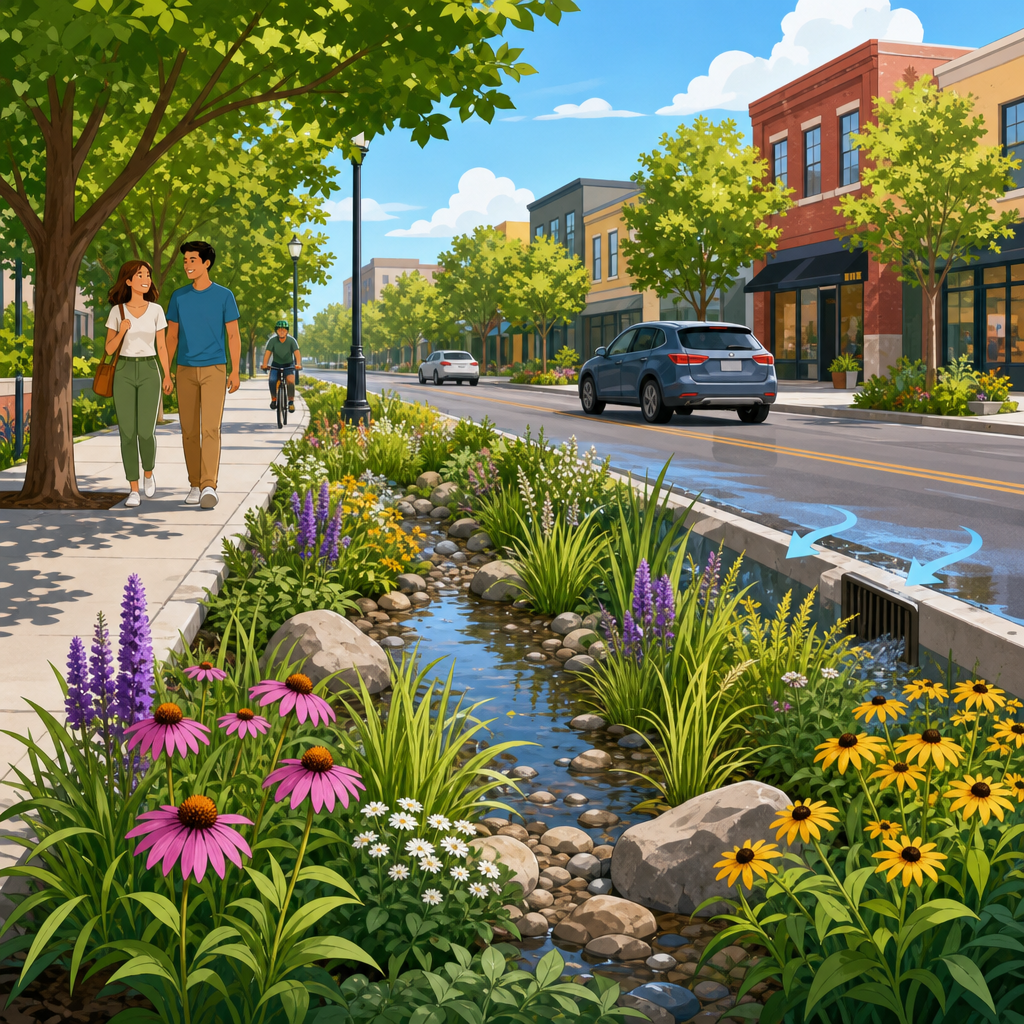
Bioswales and rain gardens improve streetscapes by managing stormwater where it falls, reducing flooding, filtering pollution, cooling paved corridors, and making ordinary streets feel healthier and more inviting. In sustainable urban development, these systems are not decorative add-ons. They are functional landscape infrastructure designed to intercept runoff from roads, sidewalks, parking lanes, and roofs, then slow, store, and clean that water before it reaches storm drains, streams, or treatment plants. A bioswale is typically a long, shallow, vegetated channel that conveys and infiltrates runoff along a street edge or median. A rain garden is usually a planted basin that temporarily holds water in a smaller, localized area. Both rely on engineered soil, carefully selected plants, underdrains when needed, and controlled overflow structures. I have worked on streetscape planning where conventional curb-and-gutter designs moved water away quickly but also transferred pollution and peak flows downstream. Green stormwater systems solve that problem at the source. They matter because cities are adding more hard surfaces, facing more intense rainfall, and trying to create public spaces that perform better socially, environmentally, and financially over the life of the street.
When people ask what bioswales and rain gardens actually do, the direct answer is simple: they turn a street from a runoff conveyor into a living treatment system. Instead of sending the first flush of oil residue, tire particles, heavy metals, sediment, and litter directly into pipes, these features capture water and let physical, chemical, and biological processes remove contaminants. The vegetation slows flow velocity. The soil media traps sediment and supports microbial activity. The root zone improves infiltration and evapotranspiration. The result is not only cleaner water, but a more resilient public realm. Streets with visible green infrastructure often feel calmer, narrower, and safer because planting changes driver perception and reduces the visual dominance of asphalt. That combination of utility and placemaking is why transportation departments, water utilities, landscape architects, and neighborhood groups increasingly use bioswales and rain gardens as core streetscape elements rather than niche sustainability gestures.
How bioswales and rain gardens function in street design
The performance of a bioswale or rain garden depends on details that many casual observers never notice. The inlet elevation controls how runoff enters the facility. The ponding depth determines short-term storage volume. The engineered soil mix, often combining sand, fines, and organic matter in measured proportions, balances infiltration with plant health. An underdrain may be installed when native subsoils infiltrate too slowly or when groundwater separation is limited. Check dams can slow flow in linear bioswales on sloped streets. Overflow structures protect nearby buildings and ensure storms larger than the design event bypass safely. In practice, the best installations are designed around local rainfall data, utility conflicts, traffic loading, and maintenance capacity, not copied from a generic detail sheet.
Along streets, bioswales usually sit between the curb and sidewalk, in medians, or at the edge of parking bays. Rain gardens often fit into curb extensions, traffic calming islands, building setbacks, and small plazas. Many North American cities size these facilities to treat a water quality storm or the first inch of rainfall, because that volume often carries a disproportionate share of pollutants. The U.S. Environmental Protection Agency and many municipal stormwater manuals support this treatment-first approach. In dense corridors, curb cuts are especially important. A beautifully planted basin that is disconnected from runoff is only landscaping. A true stormwater practice must receive, temporarily store, and either infiltrate, evapotranspire, or drain treated water through an outlet or underdrain.
Plant selection is equally technical. Street-edge systems face heat, deicing salts, compaction, periodic inundation, and drought between storms. That is why successful plant palettes include species proven to tolerate hydrologic swings rather than simply looking attractive in a nursery container. Sedges, rushes, blue flag iris, switchgrass, red osier dogwood, and some native asters are common choices in many temperate regions, but local performance always matters more than trend. I have seen projects fail because designers chose species for appearance alone, then discovered they could not handle snow storage or reflected heat from adjacent pavement. Durable, layered planting with deep roots usually outperforms shallow ornamental mixes in real curbside conditions.
Environmental benefits that extend beyond stormwater control
The most obvious environmental benefit is runoff reduction, but the wider gains are what make bioswales and rain gardens so valuable in streetscapes. By increasing infiltration and slowing discharge, they reduce erosive peak flows in receiving streams. By filtering particulate matter and associated pollutants, they improve water quality. Research from university extension programs and municipal monitoring studies has repeatedly shown meaningful reductions in total suspended solids and metals when runoff passes through well-designed bioretention media. Nutrient removal varies more by design and maintenance, but systems with proper soil composition, healthy vegetation, and appropriate residence time consistently outperform conventional gutters that provide no treatment at all.
These installations also contribute to urban heat mitigation. A planted curb extension stores less heat than bare concrete, and evapotranspiration from vegetation can lower localized surface and air temperatures. That cooling effect is not a complete answer to urban heat islands, but on long streets with little canopy, every shaded and planted segment matters. Biodiversity improves too. Even compact rain gardens provide habitat resources for pollinators and birds, especially when they use regionally appropriate species and avoid sterile, heavily mulched monocultures. In cities where fragmented green space is the norm, bioswales can function as ecological connectors linking parks, schoolyards, and private landscapes. They also reduce pressure on combined sewer systems, which is critical in older cities where heavy rain can trigger sewer overflows into waterways.
| Streetscape feature | Primary hydrologic role | Typical location | Main public benefit |
|---|---|---|---|
| Bioswale | Convey, slow, and infiltrate linear runoff | Curbside edge, median, parking lane buffer | Flood reduction plus continuous greenery |
| Rain garden | Capture and pond runoff in a basin | Curb extension, plaza edge, setback | Localized treatment and visual amenity |
| Conventional gutter | Move runoff rapidly to inlets | Road edge | Simple drainage but no pollutant treatment |
| Underground pipe expansion | Increase conveyance capacity | Below grade network | Handles flow, but does not improve street life |
How they make streets safer, more attractive, and more valuable
People often support bioswales and rain gardens first because they look better than bare pavement, but their social benefits are deeper than aesthetics. Streets with planted edges read differently to drivers. Narrower visual corridors and curb extensions can calm traffic by making motorists feel they are moving through a defined place instead of an open speedway. That can improve pedestrian comfort, shorten crossing distances, and increase visibility at intersections. In commercial districts, greener streets encourage walking and lingering, which supports storefront activity. In residential areas, these features can make a block feel cared for, reducing the stark, heat-radiating character that often comes with all-concrete frontage.
Property value effects vary by market, but quality green infrastructure generally strengthens perceived neighborhood appeal. Buyers and tenants respond to shade, landscaping, and reduced flooding risk. Municipalities benefit as well. When bioswales and rain gardens reduce the stormwater burden on downstream pipes, detention basins, and treatment systems, they can defer expensive gray infrastructure upgrades. They also support compliance with stormwater permit requirements under municipal separate storm sewer system programs. Importantly, the public tends to understand and appreciate visible infrastructure more than buried pipe replacement. A planted system at the curb shows residents where public investment is going and what service it provides, which can build support for broader sustainable urban development efforts.
Accessibility and safety still require careful design. Inlets must not create wheel hazards. Sidewalk cross slopes must remain compliant. Plantings should preserve sightlines near intersections and driveways. Ponding depth should be controlled so water drains within the expected drawdown period, often within 24 to 48 hours, reducing mosquito concerns and protecting plant roots. Snow storage plans matter in cold climates. If maintenance crews routinely pile salt-laden snow into a rain garden not designed for that stress, performance will drop quickly. The lesson from built projects is clear: green streetscapes work best when civil engineering, planting design, accessibility, and operations planning are coordinated from the beginning.
Design, maintenance, and common mistakes cities should avoid
The biggest misconception is that bioswales and rain gardens are low-maintenance because they are naturalistic. In reality, they are managed systems and need routine care, especially in the first two years. Establishment watering, invasive weed removal, mulch management, inlet clearing, sediment removal, pruning, and periodic plant replacement are basic tasks. If trash accumulates at the curb cut or sediment seals the soil surface, infiltration drops and the public concludes the concept failed, when the actual failure was maintenance. The best city programs assign responsibility clearly, train crews on what healthy performance looks like, and use simple inspection checklists after major storms.
Another common mistake is undersizing overflow routes. Every stormwater practice has a design limit. During intense events, excess flow must bypass safely without flooding basements, undermining pavement, or drowning plantings. I have reviewed projects where attractive basins were installed but no one modeled how a ten-year or larger storm would move once the storage volume filled. That omission creates avoidable risk. Soil testing is also essential. Native infiltration rates, compaction levels, and groundwater depth determine whether infiltration is feasible, whether an underdrain is needed, and how fast the facility will empty. Standard guidance from agencies such as the Federal Highway Administration and local stormwater manuals consistently emphasizes site investigation because performance is site-specific.
Materials and detailing deserve equal attention. Pretreatment at inlets can prolong soil life by capturing coarse sediment before it enters the planting bed. Stone diaphragms, forebays, or sump structures are common solutions. Edge restraint and curb design affect durability where pedestrians step in and out of parked cars. Plant community design should account for moisture zones, with species suited to the wetter bottom and more drought-tolerant species on the side slopes and upper edges. Monitoring should not be an afterthought. Even simple metrics like drawdown time, plant survival, sediment accumulation, and overflow frequency can help a city refine future installations. For communities building a hub of sustainable urban development strategies, that feedback loop is what turns pilot projects into reliable street standards.
Where bioswales and rain gardens fit in a broader urban strategy
Bioswales and rain gardens deliver the strongest results when they are planned as part of a network rather than as isolated demonstration pieces. A single curbside basin can improve a block, but a connected sequence along a corridor can reduce runoff volumes, shape identity, calm traffic, expand habitat, and support tree health at a district scale. That is why transportation plans, complete streets policies, climate adaptation strategies, and capital improvement programs should all reference green stormwater integration. These systems also pair well with permeable pavement, street trees, green roofs, and stormwater harvesting. Each practice handles water differently, and together they create layered resilience.
There are limits. Extremely tight rights-of-way, contaminated soils, high groundwater, or dense utility corridors can constrain what is possible. Maintenance budgets and institutional silos can delay adoption even when technical feasibility is clear. Yet those constraints usually call for adaptation, not abandonment. Smaller cells, lined systems, modular planters, or hybrid designs with underdrains can still provide meaningful benefits. The key takeaway is straightforward: bioswales and rain gardens improve streetscapes because they solve real drainage problems while making streets more comfortable, attractive, and ecologically functional. Cities that treat them as infrastructure, design them carefully, and maintain them consistently see better stormwater performance and better public space at the same time. If you are shaping a sustainable urban development agenda, make green street stormwater systems a standard part of every corridor conversation.
Frequently Asked Questions
What is the difference between a bioswale and a rain garden in a streetscape?
A bioswale and a rain garden both manage stormwater at the surface, but they are usually designed for slightly different roles in the street environment. A bioswale is typically a linear, gently sloped planted channel that captures runoff and directs it along a defined path while slowing it down and filtering out sediment and pollutants. You often see bioswales running alongside curbs, parking lanes, medians, or sidewalks where water flows off pavement and enters through curb cuts or sheet flow. A rain garden is generally more like a shallow planted basin that temporarily holds water in one place so it can soak into the soil below. In streetscapes, rain gardens are often used at corners, in bump-outs, near downspouts, or within planting zones that collect runoff from nearby hard surfaces.
In practice, the two terms sometimes overlap because both systems rely on engineered soil, vegetation, and temporary ponding to improve water quality and reduce runoff. The most important distinction is functional form: bioswales convey and treat water as it moves, while rain gardens mostly capture and infiltrate water where it lands. Both can be integrated into a complete street design to make roads safer, greener, and more resilient. Instead of sending stormwater directly into pipes, these systems turn visible landscape areas into working infrastructure that supports drainage, planting, and public realm improvements at the same time.
How do bioswales and rain gardens reduce flooding on urban streets?
Bioswales and rain gardens reduce flooding by intercepting stormwater close to the source before it can rapidly accumulate on pavement and overwhelm storm drains. In a conventional street, rain hits roofs, roads, sidewalks, and parking areas, then runs off almost immediately because those surfaces are impervious. That fast-moving runoff often causes ponding at intersections, curb overflow, and pressure on drainage networks during even moderate storms. By contrast, a bioswale or rain garden creates a shallow storage area where runoff can enter, spread out, and slow down. Once captured, the water either infiltrates into the soil, is taken up by plants, or is released at a much slower rate through an underdrain or overflow structure.
This change in timing matters just as much as the total volume captured. When many small landscape systems are distributed along a corridor, they flatten the peak flow that normally rushes into inlets and underground pipes. That helps reduce nuisance flooding, standing water near curbs, erosion downstream, and the risk of combined sewer overflows in older urban systems. In well-designed streetscapes, these green infrastructure features also create redundancy. If one drain is partially blocked, the planted areas can still provide temporary detention and treatment. The result is a street that performs better in everyday rain events and is more adaptable to increasingly intense storms linked to changing climate conditions.
Do bioswales and rain gardens actually clean stormwater, or do they mainly store it?
They do both, and their water quality role is one of the main reasons they are so valuable in sustainable urban development. Stormwater running off streets often carries oil, tire residue, brake dust, heavy metals, trash, sediment, nutrients, and other pollutants. If that runoff goes directly into a storm drain, it can reach streams, rivers, or coastal waters with very little treatment. Bioswales and rain gardens interrupt that pathway. As water enters these planted systems, its speed drops, which allows sediment and attached pollutants to settle out. The engineered soil media then filters finer particles while also supporting biological processes that help break down or immobilize contaminants.
Plants contribute in several ways. Their roots create pore spaces in the soil, improve infiltration, and support microbes that transform pollutants. Vegetation can also take up some nutrients and help stabilize the soil so it continues to function over time. In systems designed with check dams, mulch layers, and appropriate planting, the treatment effect is even stronger because runoff spends more time in contact with soil and roots. While these landscapes are not a replacement for all forms of water treatment, they are highly effective first-line infrastructure for improving runoff quality before water enters the municipal system or nearby waterways. That is why they are considered functional environmental infrastructure, not just attractive planting beds.
How do bioswales and rain gardens make streets feel cooler, healthier, and more inviting?
The benefits go well beyond drainage. Streets dominated by asphalt, concrete, and exposed curb lines tend to absorb and radiate heat, creating hotter and less comfortable pedestrian environments. Bioswales and rain gardens replace some of that hardscape with living vegetation and permeable soil, which helps cool the surrounding area through shading, evapotranspiration, and reduced heat storage. Even small planted interventions can noticeably soften the visual and thermal character of a corridor, especially where there are long stretches of pavement and limited tree canopy.
They also improve the everyday experience of a street by making infrastructure visible in a positive way. Instead of seeing runoff rush through gutters filled with debris, people see planted areas that signal care, ecological function, and neighborhood investment. This can make commercial corridors, residential streets, and civic spaces feel calmer and more welcoming. Healthier streetscapes are not only about aesthetics; they are also about better air movement, reduced splash and spray from standing water, more habitat for pollinators, and a stronger connection between public space and environmental performance. When integrated thoughtfully with sidewalks, crossings, lighting, and street trees, bioswales and rain gardens help transform ordinary transportation corridors into multi-functional public landscapes.
What does it take to design and maintain bioswales and rain gardens successfully along streets?
Successful performance depends on good planning, correct sizing, proper soil design, and consistent maintenance. A streetscape bioswale or rain garden cannot simply be dug like a decorative planter and expected to work. Designers need to understand the drainage area, slope, runoff volume, soil infiltration rate, utility conflicts, and how water will enter and overflow during larger storms. Details such as curb cuts, pretreatment forebays, ponding depth, engineered soil composition, underdrains, and overflow structures all influence whether the system functions reliably. Plant selection is equally important. Species must tolerate both periodic inundation and dry periods, as well as road salt, compaction, urban heat, and constrained rooting conditions.
Maintenance is what preserves long-term performance. These systems need routine inspection to remove trash, clear inlets, manage sediment buildup, control weeds, replace mulch where appropriate, and ensure that vegetation remains healthy and dense enough to support filtration and infiltration. During the establishment period, watering and plant care are especially important. Over time, municipalities and property owners should monitor whether water drains within the intended timeframe and whether curb openings, check dams, or underdrains are functioning as designed. When maintenance is treated as part of infrastructure operations rather than optional landscaping, bioswales and rain gardens can deliver durable flood reduction, water quality improvement, and streetscape enhancement for many years.