Repositioning dead malls through architecture and mixed-use design has become one of the most practical strategies in sustainable urban development because these aging properties already sit on valuable land, near roads, utilities, and neighborhoods that still need housing, services, jobs, and public space. A dead mall is generally a retail center with high vacancy, declining foot traffic, and shrinking sales productivity, often following anchor closures, overbuilt retail supply, suburban demographic shifts, or the rise of e-commerce. In my work reviewing adaptive reuse plans and redevelopment briefs, I have seen the same pattern repeatedly: the building itself is rarely the only problem. More often, the site was designed for a single use, inward-facing circulation, and peak holiday parking demand that no longer exists. Repositioning means changing both the physical form and the economic role of the property so it can support multiple uses over time. That usually involves architecture, zoning reform, phasing, financing, and public-private coordination working together rather than a cosmetic renovation.
This matters because dead malls are not isolated real estate failures; they are urban design liabilities and opportunities at the same time. A shuttered mall depresses surrounding property values, weakens local tax revenue, and leaves behind vast asphalt surfaces that worsen heat island effects and stormwater runoff. Yet the same site can become a compact district with apartments, clinics, offices, schools, entertainment, civic space, and better transit access. The sustainability case is strong. Reusing existing structures can reduce demolition waste and preserve embodied carbon where the frame remains sound. Converting oversized parking lots into parks, housing, and streets improves land efficiency. Mixed-use design also shortens trips by placing daily needs closer together, which supports walking, biking, and transit ridership. For municipalities facing housing shortages and aging commercial corridors, mall repositioning offers a rare chance to retrofit suburbia without starting from raw farmland at the edge of town.
The core idea is straightforward: successful mall redevelopment replaces a single-purpose retail box with a flexible district organized around human-scale streets, active ground floors, diverse tenants, and buildings that can adapt as demand changes. The details, however, determine whether the project becomes a thriving town center or a costly half-measure. Site access, parcelization, anchor reuse, structured parking economics, stormwater design, tenant mix, entitlement timing, and community trust all shape outcomes. This hub article explains the main architectural and mixed-use design principles behind repositioning dead malls, the development models that work, the constraints that routinely stall projects, and the implementation choices that separate durable places from short-lived real estate experiments.
Why dead malls fail and what mixed-use design changes
Most enclosed malls were planned as controlled retail environments optimized for car access, long internal corridors, and large anchor tenants at either end. That formula worked when department stores drove visits and households concentrated spending in regional centers. It performs poorly when consumer spending fragments across online channels, discount formats, lifestyle centers, grocery-anchored centers, and direct-to-consumer brands. Once an anchor closes, co-tenancy clauses can allow smaller tenants to reduce rent or leave. Vacancy compounds quickly. The architecture then amplifies decline because inward-facing storefronts hide activity from surrounding streets, and blank walls make the property feel private, hostile, and hard to repurpose.
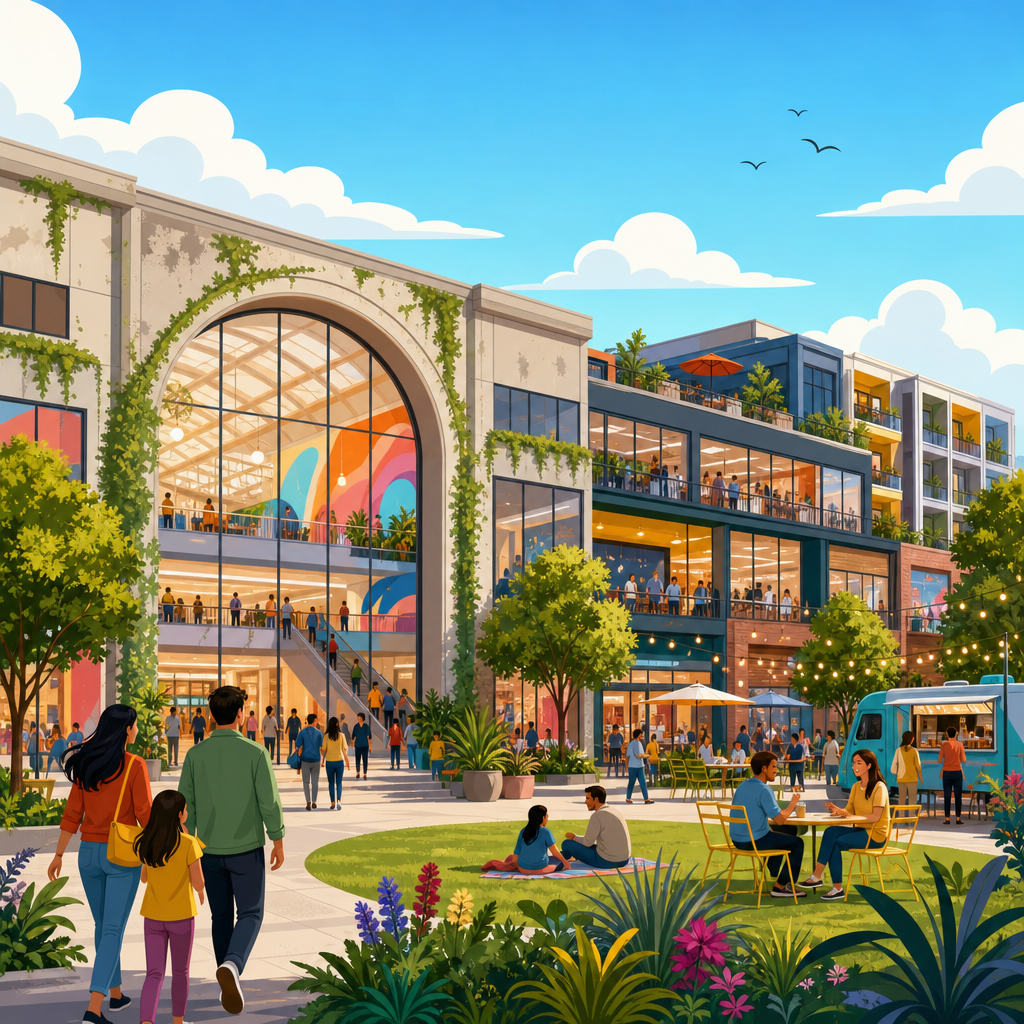
Mixed-use design changes the economics by adding several revenue streams and broadening the times of day when people use the site. Housing creates a built-in customer base for shops and restaurants. Offices and medical space generate weekday demand. Entertainment, fitness, and food uses activate evenings. Civic uses such as libraries, colleges, or municipal service centers bring reliable foot traffic and institutional credibility. From a design perspective, the critical shift is from superblock retail to connected urban fabric. New internal streets, smaller building pads, frequent entrances, and visible public spaces make the district legible and permeable. That is why the best repositioning plans do not simply fill empty stores; they reorganize circulation, frontage, and land use so the property behaves like a neighborhood rather than a single asset.
Architecture strategies for adaptive reuse and selective demolition
There is no single architectural answer for every failing mall. Some projects keep large portions of the existing structure, especially when the roof, span, and floor plates suit new programs such as education, healthcare, self-storage, last-mile logistics, or office loft space. Others pursue selective demolition, removing anchor boxes or middle sections to create open-air streets and development parcels. The right approach depends on structural condition, ceiling heights, loading capacity, code requirements, daylight access, and market demand. In practice, I have found that developers often overestimate the value of preserving everything and underestimate the cost of forcing obsolete geometry into contemporary uses.
Adaptive reuse works best where the building can accommodate a clear target use with limited intervention. Former department stores, for example, can become medical outpatient centers because they offer large floor plates, high visibility, and generous parking fields for patients. Educational institutions also fit well, particularly community colleges and vocational schools that need classrooms, labs, and convenient access. Industrial conversion is possible on some sites, but truck circulation, floor loads, and municipal expectations around job quality must be reviewed carefully. When the enclosed common mall is retained, inserting atriums, skylights, exterior entrances, and vertical circulation can improve orientation and leasing potential. However, these moves are expensive, so they need to align with durable tenant demand rather than design ambition alone.
Selective demolition is often more powerful because it restores daylight, creates developable pads, and allows phasing. Removing an anchor to build multifamily housing or a hotel can cross-subsidize improvements elsewhere on the site. Carving new streets through parking fields breaks the site into smaller blocks that lenders and builders understand. The architecture should establish a street wall, active frontages, weather protection, and adaptable ground floors with sufficient depth for retail or service uses. Public realm details matter. Shade trees, seating, transparent facades, bicycle parking, and visible building entrances are not cosmetic features; they directly affect dwell time, leasing performance, and perceived safety.
The mixed-use program that makes redevelopment viable
A balanced program is what turns mall repositioning from a rescue effort into a long-term district strategy. Retail still has a role, but it should be curated around convenience, food, services, and experience rather than nostalgia for department-store-driven traffic. Grocery, fitness, childcare, dental clinics, urgent care, and fast-casual restaurants tend to produce frequent visits. Residential uses are increasingly central because they monetize underused land and create demand every day. Depending on the market, projects may include market-rate apartments, workforce housing, senior living, or student housing. Office remains viable in selected suburban nodes, especially for medical office, flexible small suites, and government tenants, but speculative traditional office is far riskier than it was before 2020.
The strongest districts mix uses horizontally and vertically. Ground floors along primary streets should prioritize transparent, publicly accessible uses. Upper floors can carry apartments, offices, or hospitality. Civic and institutional uses strengthen resilience because they are less vulnerable to retail cycles. Adding a branch library, a satellite university center, or municipal service counters can widen the user base and support transit upgrades. Entertainment also matters when chosen carefully. Food halls, cinemas, climbing gyms, and family recreation can draw regional visitors, but they need parking management and realistic revenue assumptions.
| Use | Main Benefit | Design Requirement | Common Risk |
|---|---|---|---|
| Multifamily housing | Steady demand and daily foot traffic | Privacy, amenities, separate access, open space | Community resistance to density |
| Medical office | Credit tenants and daytime visits | Accessible drop-off, clear wayfinding, robust MEP systems | High conversion cost |
| Grocery and services | Frequent repeat visits | Convenient parking, loading, visible storefronts | Thin operating margins |
| Civic or education | Stable occupancy and public trust | Transit access, security zoning, flexible interiors | Long procurement timelines |
Program mix should respond to local gaps, not generic formulas. In a growing suburb with a housing shortage, residential density may be the economic engine. In a mature area with an aging population, healthcare and senior living may outperform entertainment. In a transit-served location, reducing parking and intensifying development can unlock value. The key is complementarity: each use should support the others through different demand patterns, shared infrastructure, and mutual visibility.
Planning, entitlement, and infrastructure hurdles
Many dead malls sit in jurisdictions where zoning still assumes single-use commercial development, excessive parking minimums, and rigid setbacks. That framework can kill otherwise sound redevelopment concepts. Entitlement reform is therefore not a side issue; it is central to repositioning. Municipalities often need to adopt mixed-use overlays, form-based standards, parking reductions, and street connectivity requirements. Planned unit development mechanisms are frequently used because they allow phased implementation and negotiated public benefits. When I evaluate feasibility, entitlement duration is one of the first variables I test, because delay can erase the value created by a strong plan.
Infrastructure also determines viability. Old malls were engineered for cars, not complete neighborhoods. Water, sewer, power, broadband, stormwater, and fire access may all need upgrades. Surface parking lots create major runoff problems, so redevelopment should integrate bioswales, detention, permeable paving, and tree canopy expansion. If transit service is nearby, the site plan should connect directly to stops with safe crossings and weather-protected paths. Structured parking can free land for higher uses, but it is expensive and usually requires density, public participation, or premium rents to pencil out. Shared parking analysis, using standards from the Urban Land Institute and the Institute of Transportation Engineers, can often reduce unnecessary supply and lower costs.
Financial models, phasing, and public-private partnership
Redeveloping a dead mall is capital intensive because it combines demolition, environmental work, infrastructure replacement, tenant improvements, and often years of phased leasing. That is why financial structure matters as much as design. Typical capital stacks may include senior debt, developer equity, tax increment financing, sales tax sharing, tax abatements, special assessment districts, New Markets Tax Credits for eligible areas, or tax-exempt bonds for certain civic components. Public participation is justified when the project delivers measurable community benefits such as housing, public space, transit improvements, stormwater upgrades, and a stronger long-term tax base.
Phasing reduces risk. A common sequence starts with one or two high-visibility wins, such as demolishing a vacant anchor for apartments and opening a grocery or medical tenant in another portion of the site. Those moves signal momentum, create cash flow, and improve lender confidence. Later phases can introduce streets, plazas, offices, and additional housing as the market proves itself. The most successful teams treat phasing as a design discipline, making sure each interim stage functions independently instead of looking like a construction leftover. Temporary programming helps too. Farmers markets, food truck events, art installations, and pop-up recreation can reintroduce the community to the site before full buildout.
Case patterns and what successful projects consistently do
Across North America, the same success patterns appear. Belmar in Lakewood, Colorado replaced the enclosed Villa Italia Mall with a street grid, housing, offices, civic uses, and walkable retail, proving that suburban retrofit can create a true downtown environment. Mizner Park in Boca Raton, while not a dead mall conversion in the usual sense, demonstrated earlier how mixed-use urban form can outperform conventional retail layouts in high-value markets. More recent projects have converted failing anchors into healthcare campuses, higher education centers, and distribution facilities, showing that not every site needs a lifestyle district to recover. The lesson is not to copy one format. It is to align architecture, market reality, and public policy from the start.
Successful projects also communicate clearly with neighbors. Traffic, school capacity, building height, and affordability concerns are real, and ignoring them invites years of opposition. Good teams bring visualizations, parking studies, and phasing plans early. They explain tradeoffs directly, including why some parking remains necessary, why density supports better amenities, and how stormwater and public space will improve. Repositioning dead malls through architecture and mixed-use design works best when it is framed not as saving an old shopping center, but as building a more resilient district on land that has already been urbanized.
For cities, owners, and designers, the practical takeaway is clear. Dead malls are not just retail problems; they are redevelopment platforms with embedded infrastructure, strategic locations, and the scale to solve multiple urban needs at once. The strongest repositioning strategies combine selective reuse, targeted demolition, connected street networks, complementary uses, realistic phasing, and entitlement reform. They treat sustainability as a measurable outcome of better land use, lower trip lengths, greener infrastructure, and more adaptable buildings. If you are planning within a struggling commercial corridor, start with a site and market audit, identify the missing uses your community actually needs, and build a redevelopment roadmap that turns a failing property into a lasting neighborhood asset.
Frequently Asked Questions
What does it mean to reposition a dead mall through architecture and mixed-use design?
Repositioning a dead mall means transforming an underperforming retail property into a more resilient, multi-purpose place that better matches current market demand and community needs. Instead of trying to revive an outdated enclosed shopping center with the same retail-only formula that failed, developers, planners, and architects rethink the site as a mixed-use district that may include housing, offices, medical space, education, entertainment, hospitality, civic facilities, green space, and a smaller, better-curated retail component. The architectural goal is not simply cosmetic renovation. It is a structural and spatial reorganization of the property so it functions as a real neighborhood destination rather than a single-use retail box.
In practice, this often involves breaking down superblocks, opening inward-facing malls to the street, adding walkable public spaces, improving access for pedestrians, cyclists, and transit users, and introducing buildings that create activity throughout the day and evening. A former anchor store might become apartments, a health care campus, a university satellite center, or municipal offices. Surface parking lots may be replaced with housing, plazas, stormwater landscapes, and structured parking. The result is typically a more flexible urban environment that can adapt over time, generate multiple revenue streams, and reduce the risk associated with dependence on a single retail category. This is why mall repositioning is increasingly viewed as both an architectural opportunity and a sustainable urban development strategy.
Why are dead malls considered strong candidates for redevelopment instead of demolition alone?
Dead malls are often located on some of the most strategically positioned land in suburban and edge-urban areas. Even when the retail model has failed, the underlying real estate usually retains major advantages: large parcels under unified ownership, established road access, existing utility infrastructure, proximity to residential neighborhoods, and zoning or entitlement histories that make redevelopment more feasible than starting from scratch on an undeveloped site. These properties were originally built to capture regional traffic, so they tend to sit at highly visible, well-connected locations that remain valuable for a wide range of new uses.
From a sustainability perspective, redevelopment is attractive because it can reuse land and infrastructure that already exist rather than pushing growth farther outward. That helps limit sprawl, shortens development timelines in many cases, and can lower the environmental costs associated with extending roads, sewer, water, and power systems into greenfield areas. Demolition may still be part of the process, especially when buildings are obsolete or structurally unsuitable, but the broader redevelopment strategy goes beyond clearing the site. It takes advantage of the property’s embedded value and repositions it to serve modern needs such as housing supply, last-mile logistics, health services, recreation, and community gathering space. In short, the mall may be “dead” as a retail format, but the site itself is often very much alive in economic and urban terms.
What architectural strategies are most effective when converting a dead mall into a mixed-use destination?
The most effective architectural strategies start with acknowledging that traditional enclosed malls were designed for a different era. They often turned inward, separated uses, prioritized cars over people, and created oversized parking fields that weakened the public realm. Successful repositioning typically reverses those conditions. Architects often introduce a finer-grained street network, create visible entrances from surrounding roads, add active ground-floor uses, and carve out outdoor public spaces that make the site feel like a connected district rather than a private retail island. This may include converting blank facades into transparent storefronts, inserting new residential or office buildings along pedestrian routes, and designing plazas, courtyards, and landscaped edges that encourage lingering and social interaction.
Flexibility is another critical design principle. Because market conditions continue to shift, buildings and site plans need to accommodate change over time. Large-format retail shells can be adapted into medical offices, maker spaces, fitness centers, self-storage, food halls, classrooms, or even residential components where code and structure allow. Parking design is also central to the strategy. Many dead malls have far more parking than they need, so architects and developers often repurpose those areas for new buildings, parks, stormwater management systems, and mobility improvements. The strongest projects also focus on human-scale design, wayfinding, safety, and placemaking, ensuring the redevelopment feels inviting to residents and visitors rather than like a patched-together former mall. Done well, architecture becomes the tool that converts a failing property into a durable piece of city-building.
How does mixed-use redevelopment of dead malls benefit communities and local economies?
Mixed-use redevelopment can deliver substantial community benefits because it replaces a declining, low-performing property with a more active and productive environment. One of the biggest advantages is land efficiency. A single-use mall that no longer attracts shoppers can be reimagined to provide housing, jobs, services, public amenities, and tax-generating commercial space on land that is already connected to infrastructure. That can help communities address housing shortages, expand access to health care or education, create public gathering places, and support small business activity without consuming additional undeveloped land. It also helps restore value to surrounding areas that may have suffered from the mall’s decline.
Economically, mixed-use projects are often more resilient than retail-only centers because they diversify income sources and activity patterns. Residents create daily demand for goods and services. Offices, clinics, schools, and entertainment uses bring people at different times of day. Public or civic functions can stabilize occupancy and increase long-term relevance. This diversity can improve leasing performance, support local employment, and increase municipal revenue over time. There are also social benefits that matter just as much. A former dead mall can become a walkable community hub where people live, work, shop, gather, and access services in one place. When designed thoughtfully, these projects can reduce dependence on car-only trips, improve neighborhood connectivity, and create a stronger sense of identity than the original enclosed mall ever provided in its final years of decline.
What are the biggest challenges in turning a dead mall into a successful mixed-use project?
Although the redevelopment potential is strong, repositioning a dead mall is rarely simple. One major challenge is financial complexity. These sites are large, expensive, and often require phased implementation over many years. Demolition, environmental remediation, infrastructure upgrades, structured parking, and public space improvements can all drive up costs before the project begins generating meaningful returns. Financing may require a combination of private capital, public incentives, tax increment tools, public-private partnerships, or anchor institutional tenants. The business plan must also reflect realistic demand for each use, because replacing failed retail with more retail alone usually does not solve the underlying problem.
There are also design, regulatory, and political hurdles. Existing zoning may not allow residential density, civic uses, or a more urban street pattern. Traffic assumptions from the original mall era may be outdated, yet still shape approvals. Legacy buildings may be difficult to adapt due to floor plates, loading configurations, mechanical systems, or code limitations. Community concerns can emerge around housing type, affordability, school impacts, traffic, and changes to neighborhood character. That is why successful projects usually involve deep market analysis, careful phasing, strong municipal coordination, and a clear design vision from the beginning. The most effective redevelopments are not treated as isolated real estate deals but as long-term district transformations that balance economics, architecture, infrastructure, and public value.