Passive house apartments promise something rare in urban housing: dramatically lower energy use without sacrificing comfort, quiet, or healthy indoor air. The term “Passive House” refers to a rigorous building performance standard, formalized by the Passive House Institute in Germany, that limits heating and cooling demand through insulation, airtight construction, high-performance windows, thermal-bridge control, and balanced mechanical ventilation with heat recovery. In apartments, the concept matters even more because dense multifamily buildings sit at the intersection of affordability, climate policy, tenant wellbeing, and long-term asset value.
I have worked on apartment retrofits and new multifamily projects where the biggest surprise for owners was not the energy model; it was how strongly residents responded to stable temperatures, filtered fresh air, and the near absence of street noise. Those benefits explain why passive house apartments have moved from niche demonstration projects into mainstream housing discussions across North America and Europe. Cities such as New York, Vancouver, Brussels, and London increasingly treat high-performance multifamily construction as a practical path to emissions reduction and resident resilience. For developers, housing authorities, and cooperatives, the central questions are straightforward: what do passive house apartments cost, how do they perform in real life, and are the comfort gains worth the added design discipline?
The short answer is yes, but the value depends on climate, building form, construction quality, and operational goals. A passive house apartment building is not simply “green” in a general sense. It is designed to meet quantified targets for heating demand, cooling demand or load, airtightness, and primary energy use. That means outcomes are measured rather than assumed. For urban development, this makes passive house apartments especially important. They can reduce peak energy demand, improve health outcomes, support electrification, and create more durable housing stock in a period of rising utility costs and climate stress.
What Defines Passive House Apartments
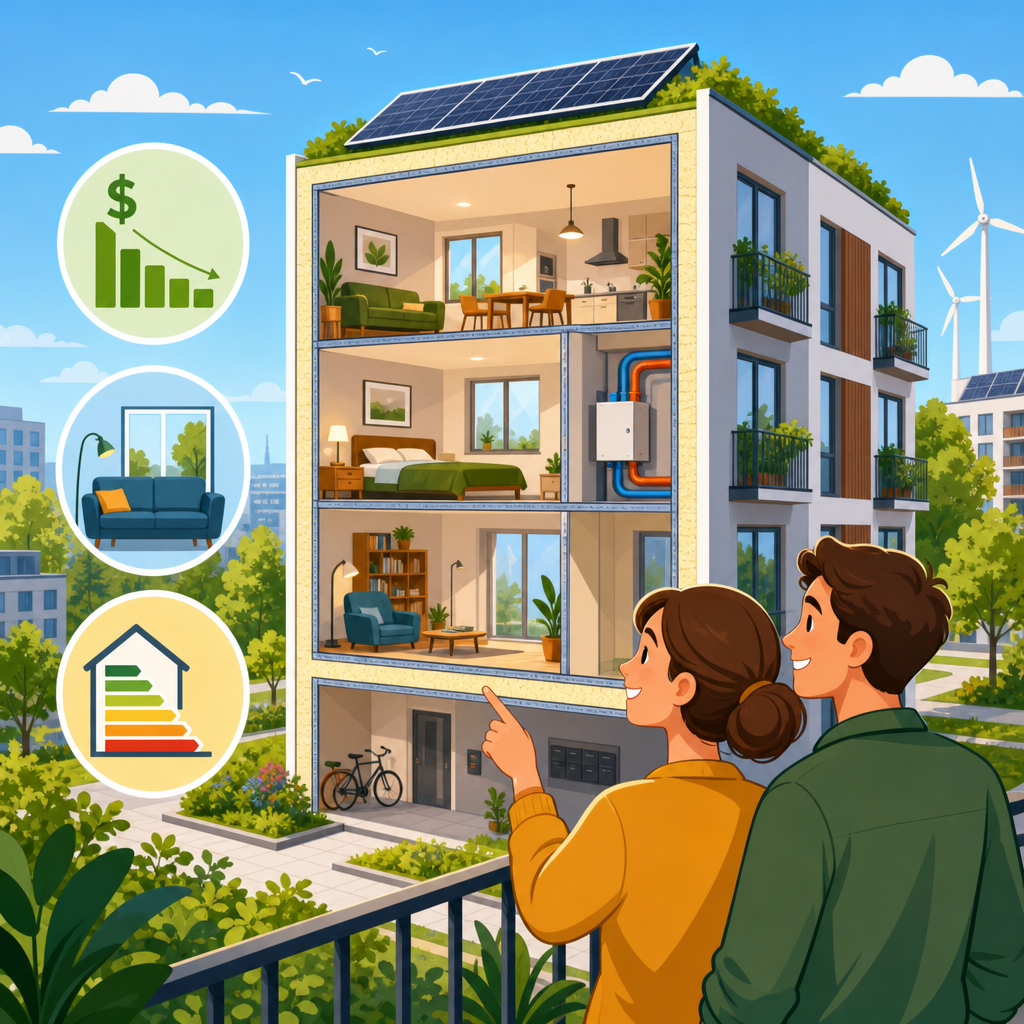
Passive house apartments are multifamily dwellings designed to achieve very low space-conditioning demand through a tightly coordinated enclosure and ventilation strategy. The core principles are well established: continuous insulation, minimal thermal bridges, airtightness verified by blower door testing, high-performance glazing, and mechanical ventilation with heat recovery or energy recovery. In practice, the standard is often delivered through the Passive House Planning Package, or PHPP, which models annual energy balance in detail. Some teams also use WUFI Passive, EnergyPlus, or THERM to refine assemblies and analyze heat flow at critical junctions.
Compared with a conventional apartment building, a passive house building usually has thicker walls or better insulation efficiency, higher-spec windows, stricter air-sealing details, and ventilation systems designed for continuous balanced airflow. The result is not just lower energy bills. It is a measurable improvement in interior surface temperatures, reduced drafts, lower condensation risk, and more stable indoor conditions during weather extremes. In multifamily projects, compartmentalization between units is also crucial. Good airtightness limits odor transfer, smoke migration, and sound leakage, which tenants recognize immediately even if they never read the energy report.
Certification pathways vary. The Passive House Institute offers Classic, Plus, and Premium levels, while Phius in the United States uses a climate-specific standard. The numbers and terminology differ, but the logic is the same: minimize demand first, then meet remaining loads efficiently. For apartment developers, that sequencing matters because it protects performance even if occupants use the building in different ways.
Costs: Upfront Premiums, Design Choices, and Long-Term Economics
The most common question is whether passive house apartments cost too much to build. In my experience, the honest answer is that they usually cost more upfront than code-minimum apartments, but the premium is highly variable and often overstated. On early projects, teams routinely paid a penalty for unfamiliar details, fragmented procurement, and late-stage redesign. On repeat projects with integrated design, the gap narrowed significantly. Recent market experience often places the incremental cost for multifamily passive house projects in the low single digits to low teens as a percentage of hard construction cost, though local labor conditions and façade complexity can push this higher.
Cost drivers are predictable. Windows are a major item, especially if the project requires certified high-performance frames and glazing with excellent thermal performance. Airtightness detailing adds labor and requires supervision. Ventilation equipment, duct routing, and commissioning can also increase costs. On the other hand, the reduced heating and cooling loads may allow smaller boilers, smaller heat pumps, simplified distribution, and less perimeter equipment. In well-optimized all-electric buildings, avoiding oversized systems can offset part of the enclosure premium.
| Cost or Value Factor | Typical Effect in Passive House Apartments | Why It Changes the Budget |
|---|---|---|
| High-performance windows | Raises upfront cost | Better frames, glazing, and installation details reduce heat loss and condensation |
| Airtightness detailing | Raises labor and QA cost | Requires careful sequencing, mockups, and blower door testing |
| Ventilation with heat recovery | Raises equipment and commissioning cost | Continuous balanced fresh air needs dedicated fans, ducts, controls, and testing |
| Smaller heating and cooling systems | Can lower mechanical cost | Low loads reduce equipment size and distribution complexity |
| Lower utility consumption | Improves operating economics | Reduced demand cuts tenant or owner energy bills over the building life |
| Durability and fewer comfort complaints | Improves long-term value | Better envelopes reduce moisture risk and management issues |
Life-cycle economics are where passive house apartments become compelling. Utility savings vary with climate and fuel prices, but the reduction in heating demand can be dramatic. More important for owners is predictability. Efficient buildings are less exposed to volatile energy markets, and residents in affordable housing are less vulnerable to utility burden. Some lenders and agencies now recognize this through green financing, utility incentives, tax credits, or local decarbonization programs. In cities with strict carbon rules, building to passive house levels can also reduce future compliance costs.
Comfort, Health, and Daily Living Experience
Comfort is the reason many residents become advocates. In a conventional apartment, you often feel hot near one window, cool near another, and drafty whenever wind pressure shifts. In passive house apartments, interior surface temperatures stay closer to room temperature because the enclosure performs consistently. That means fewer cold walls in winter and less radiant overheating in summer. Occupants describe the effect as calm rather than dramatic: the apartment simply feels even, with fewer spikes and fewer annoying edge conditions.
Ventilation is equally important. Balanced mechanical ventilation with heat recovery supplies filtered outdoor air while exhausting stale indoor air. In practical terms, this reduces stuffiness, lowers indoor pollutants from cooking and cleaning, and helps control humidity. Good systems use filters that can meaningfully reduce fine particulates and outdoor pollution, a major benefit in dense urban corridors near traffic. During wildfire smoke events, high-quality filtration and airtight construction can make a significant difference in indoor exposure when paired with proper operations.
Acoustics are another underappreciated advantage. The same envelope measures that improve thermal performance often improve sound isolation. Better windows, tighter assemblies, and more deliberate compartmentation reduce traffic noise, sirens, and neighbor transfer. Families notice this immediately. So do older adults and shift workers. For apartment operators, fewer complaints about drafts, cold rooms, and noise can translate into stronger retention and lower management friction.
There are tradeoffs. Residents need basic orientation on how ventilation systems work, why trickle vents are unnecessary, and why opening windows in mild weather is a choice rather than a requirement. Poorly commissioned systems can create noise or airflow imbalance. But when design, installation, and maintenance are done correctly, passive house apartments deliver a level of indoor environmental quality that conventional multifamily buildings rarely match.
Measured Performance, Energy Use, and Resilience
Performance claims should be grounded in measurement, not marketing. Passive house apartments generally achieve far lower heating demand than conventional apartments because the enclosure reduces losses at the source. In multifamily buildings, the compact shape already helps performance, and passive house design pushes this advantage further. Internal gains from occupants and appliances, plus heat recovery from ventilation, can cover a meaningful share of winter needs in many climates. This is why some apartments require only small heating systems even in cold regions.
Measured outcomes vary, especially once plug loads, domestic hot water, and occupant behavior are included. Space conditioning may fall sharply, while total building energy depends on hot water recirculation losses, common-area loads, elevators, lighting, and appliance efficiency. That is why experienced teams distinguish between low heating demand and low total energy use. They are related but not identical. Good developers track both through submetering and post-occupancy reviews.
Resilience is a major performance benefit. During power outages or equipment failures, passive house apartments tend to maintain habitable temperatures longer because the enclosure slows heat loss or heat gain. In cold snaps and heat waves, that “thermal battery” effect buys time and reduces health risk. Urban policy makers increasingly value this feature because climate resilience is now a housing issue, not just an energy issue. Buildings that can coast through disruptions support public safety, especially for elderly residents, children, and medically vulnerable households.
For best results, performance verification should include airtightness testing, ventilation balancing, commissioning, and occupant feedback after move-in. A beautiful energy model means little if site crews puncture the air barrier or controls are left confusing. Passive house succeeds when quality assurance is treated as part of construction, not a paperwork exercise.
Design and Delivery Challenges in Multifamily Projects
Passive house apartments are straightforward in principle and demanding in execution. The biggest challenge is coordination across disciplines. Architects, envelope consultants, structural engineers, and mechanical designers need to resolve thermal bridges early, especially at slab edges, balconies, parapets, and window interfaces. Every penetration matters. A seemingly minor change to façade support or vent routing can undermine airtightness or create condensation risk if not reviewed carefully.
Multifamily layouts introduce additional complexity. Corridor pressurization, unit entry leakage, shaft sealing, and compartmentation between apartments all affect real performance. Kitchens and bathrooms need exhaust strategies that work with balanced ventilation, fire safety, and acoustics. Domestic hot water is another critical issue. In efficient apartment buildings, hot water often becomes the largest operational energy load, so distribution design, pipe insulation, recirculation controls, and low-flow fixtures deserve as much attention as wall R-values.
Construction quality is where many projects either succeed or lose value. I have seen teams spend months refining details only to miss targets because subcontractors were not trained on sequencing and protection of the air barrier. The fix is practical: mockups, clear responsibility matrices, milestone inspections, and blower door testing before finishes conceal defects. Repeatable details matter more than heroic detailing. Simple forms, consistent window types, and rationalized façades usually outperform highly articulated architecture at lower cost.
Retrofit projects deserve special mention. Converting existing apartment buildings to passive house levels can deliver major benefits but is harder than new construction. Existing structure, limited cavity depth, occupied conditions, and legacy mechanical systems constrain options. EnerPHit, the retrofit-focused pathway, acknowledges these realities with stepwise targets. For urban housing portfolios, deep retrofit remains one of the most important and difficult frontiers.
Who Benefits Most and How to Evaluate a Project
Passive house apartments are especially well suited to affordable housing, student housing, senior living, and market-rate rental in noisy or climate-stressed cities. Affordable housing benefits because lower energy demand can reduce utility burden and improve resident health. Senior housing benefits from thermal stability, filtration, and resilience during outages. Market-rate projects benefit from comfort, acoustics, and brand differentiation, though the best case is still made on operational quality rather than lifestyle marketing.
To evaluate a project, start with six questions. First, what standard or certification pathway is the team targeting? Second, is the energy model detailed enough to reflect local climate, shading, occupancy, and hot water loads? Third, how will airtightness be achieved and tested? Fourth, what ventilation system is proposed, and who will commission and maintain it? Fifth, how are thermal bridges being handled at typical and unique details? Sixth, what is the plan for resident education, building operations, and post-occupancy verification?
Developers should also examine incentives, utility rates, and future regulation. In many cities, electrification mandates and building performance standards are changing the economics quickly. A building that only meets today’s minimum code may face retrofit pressure later. A passive house apartment building is more likely to remain compliant, comfortable, and financially resilient over decades.
Passive house apartments are not a fad or a luxury specification. They are a disciplined way to build urban housing that costs less to operate, feels better to live in, and performs more reliably under climate and energy stress. The upfront premium is real in many markets, but it is often offset by smaller mechanical systems, lower utility use, stronger durability, and reduced resident complaints. More important, the standard delivers outcomes people can feel every day: steadier temperatures, cleaner air, less noise, and fewer drafts.
For sustainable urban development, that combination matters. Cities need apartment buildings that reduce emissions without compromising livability. Owners need assets that can handle rising energy costs and tightening regulations. Residents need homes that are healthy, quiet, and resilient. Passive house apartments meet all three needs when they are designed carefully, built with quality control, and operated with clear attention to ventilation and maintenance.
If you are planning, financing, designing, or managing multifamily housing, treat passive house as a serious benchmark rather than an optional add-on. Review case studies, ask teams for measured results, and compare life-cycle value instead of first cost alone. That approach will lead to better apartments and better urban housing decisions.
Frequently Asked Questions
What is a Passive House apartment, and how is it different from a standard apartment?
A Passive House apartment is a home designed to meet a strict building-performance standard focused on dramatically reducing heating and cooling demand while maintaining exceptional indoor comfort. Instead of relying mainly on oversized HVAC equipment to compensate for energy loss, Passive House design starts with the building envelope. That means very high levels of insulation, extremely airtight construction, high-performance windows and doors, careful control of thermal bridges, and balanced mechanical ventilation with heat recovery. Together, these features allow the apartment to stay comfortable year-round with far less energy than a conventional unit.
In practical terms, the difference is something residents can feel every day. A standard apartment may have cold exterior walls in winter, drafts near windows, hot spots in summer, and noticeable swings in temperature from room to room. A Passive House apartment is designed to avoid those issues. Interior surfaces stay warmer in winter and cooler in summer, drafts are minimized, and temperatures tend to remain much more stable throughout the space. The ventilation system also continuously supplies filtered fresh air, which improves indoor air quality without requiring occupants to open windows for basic ventilation.
Another important distinction is that Passive House is not just a marketing phrase for “energy efficient.” It refers to a measurable, performance-based standard with specific targets for energy demand, airtightness, and overall building performance. In apartment buildings, this often translates into lower operating costs, less outside noise penetration, and a healthier indoor environment. For urban residents, the combination of lower utility use, better acoustic comfort, and more consistent temperatures is a major part of the appeal.
Do Passive House apartments cost more to build or buy, and are they worth it over time?
Passive House apartments typically do involve a higher upfront cost compared with standard code-built apartments, but the premium varies widely depending on the market, design team experience, building size, and how early Passive House goals are integrated into the project. Costs are often driven by better windows, thicker insulation, careful detailing to achieve airtightness, higher-quality ventilation systems, and more coordination during design and construction. However, in multifamily buildings, some of that added envelope cost can be partially offset by downsizing heating and cooling systems because the apartments need less mechanical conditioning in the first place.
From a buyer or renter perspective, the bigger financial picture is about total cost of occupancy rather than construction cost alone. Passive House apartments can significantly reduce utility bills, especially for heating and cooling. Over time, those lower energy expenses can help balance a higher purchase price or rent premium. In addition, better durability and moisture control may reduce maintenance risks associated with condensation, air leakage, and temperature-related building stress. While the exact payback period depends on local energy prices and financing conditions, the long-term economics often become more compelling as utility costs rise.
The value proposition also goes beyond direct energy savings. Residents are often paying for superior comfort, quieter interiors, and better indoor air quality, all of which can improve quality of life in ways that are difficult to capture on a utility statement. In some markets, high-performance apartments may also offer stronger resale appeal as buyers become more aware of energy efficiency, resilience, and health-related housing features. So, yes, Passive House apartments can cost more upfront, but for many households and developers, the combination of lower operating costs, higher comfort, and stronger performance makes them a worthwhile investment.
Are Passive House apartments actually more comfortable to live in?
Yes, comfort is one of the strongest arguments in favor of Passive House apartments, and it comes from the way the whole building is designed rather than from one single feature. In a conventional apartment, comfort is often uneven. You might feel chilly near windows in winter, overheated on sunny afternoons, or bothered by drafts created by leaks in the building envelope. Passive House design minimizes those problems by keeping the indoor environment much more stable. Better insulation and airtightness reduce unwanted heat loss and heat gain, while high-performance windows help maintain more even interior surface temperatures.
That stability matters because human comfort depends on more than just air temperature. If walls and windows are cold, a room can feel uncomfortable even if the thermostat says otherwise. Passive House apartments are designed so interior surfaces stay closer to the desired room temperature, which makes the living space feel more consistently pleasant. Occupants also tend to notice fewer temperature differences between rooms, less need to adjust thermostats constantly, and less dependency on space heaters, fans, or other workarounds.
Comfort also includes air quality and noise. Because Passive House apartments use balanced ventilation with heat recovery, fresh filtered air is supplied continuously while stale indoor air is exhausted. That can help reduce odors, indoor pollutants, and excess humidity. At the same time, the airtight envelope and high-performance windows can significantly reduce outdoor noise, which is especially valuable in dense urban neighborhoods near traffic, transit, or commercial activity. For many residents, the result is not just an efficient apartment but a home that feels calmer, cleaner, and easier to live in every day.
How do Passive House apartments perform in terms of energy savings and environmental impact?
Passive House apartments are designed to deliver major reductions in heating and cooling demand, often far beyond what is achieved by standard building code compliance. The exact savings depend on climate, building orientation, occupancy patterns, and the quality of execution, but the core objective is to reduce the energy needed to keep the apartment comfortable. Because multifamily buildings already benefit from shared walls and compact forms, apartments can be especially well suited to Passive House strategies. When those advantages are combined with excellent insulation, airtightness, and heat-recovery ventilation, the result can be a substantial drop in operational energy use.
Environmental impact improves primarily because lower energy demand means fewer emissions associated with building operation, particularly in regions where electricity or heating fuels still carry a carbon footprint. Passive House buildings also support electrification more effectively because their loads are smaller and easier to meet with efficient electric systems. In a broader sustainability context, reducing peak heating and cooling demand can lessen strain on energy infrastructure and improve resilience during extreme weather. Buildings that stay comfortable longer during outages or equipment interruptions can offer an important performance advantage as climate conditions become less predictable.
It is also worth noting that strong real-world performance depends on design, construction quality, commissioning, and operation. A Passive House apartment is not efficient simply because it has thick insulation or advanced windows; the system works because all components are carefully integrated. When done well, the result is a home that uses less energy, supports lower emissions, and maintains high comfort without sacrificing livability. For environmentally conscious renters, buyers, and developers, that combination is a major reason Passive House apartments continue to gain attention in urban housing.
Do Passive House apartments need special maintenance or lifestyle changes from residents?
Passive House apartments do not usually require major lifestyle changes, but residents may need a basic understanding of how the apartment is intended to operate. The biggest difference is the ventilation system. Instead of relying on random leakage or occasional window opening for fresh air, Passive House apartments use balanced mechanical ventilation with heat recovery to provide a steady supply of filtered outdoor air. Residents typically do not need to manage it constantly, but they should know how to use controls properly and understand the importance of changing filters on schedule, whether that is handled by building management or the occupant.
Day-to-day living in a Passive House apartment is otherwise fairly conventional. You can still open windows, cook, shower, entertain guests, and use the apartment normally. In fact, many residents find the space easier to live in because temperatures are more even and indoor air feels fresher. That said, because the apartment is so airtight, it is especially important that kitchen and bathroom exhaust systems function properly and that any maintenance issues are addressed promptly. Residents should also avoid making unapproved penetrations in exterior walls or windows, since those can compromise airtightness and performance.
From a building management perspective, maintenance quality matters. Ventilation equipment, seals, windows, and controls should be inspected and maintained according to manufacturer recommendations. In well-managed Passive House apartment buildings, this is not a burden so much as a shift toward more deliberate performance stewardship. For residents, the experience is usually simple: lower energy use, fewer drafts, cleaner air, and less outside noise, with only minimal attention needed to understand the systems that make those benefits possible.