Urban agriculture is no longer a novelty pitched through glossy rooftop photos and investor decks; it is now a practical question of which farming models can survive high land costs, tight margins, labor shortages, and city policy. In this context, urban agriculture means producing food within or at the edge of cities through methods such as community gardens, rooftop farms, greenhouse operations, aquaponics, and vertical farming. “After the hype” matters because the early conversation often focused on possibility rather than durability. I have worked with city food system plans and evaluated operating budgets for controlled-environment projects, and the pattern is consistent: successful urban agriculture is less about futuristic technology than about matching a production model to a market, a building, and a realistic cost structure. For planners, developers, nonprofit operators, and entrepreneurs, the central issue is not whether food can be grown in cities. It is which urban farming models produce reliable revenue, measurable public value, or both, without depending on constant rescue funding. That is the difference between an inspiring pilot and a durable part of sustainable urban development.
The strongest urban agriculture models survive because they solve a local problem that cities already pay for or consumers already value. A rooftop greenhouse can work when it captures waste heat, shortens supply chains for high-value greens, and sells consistently to nearby institutions. A community garden survives when the goal is food access, neighborhood stewardship, or public health rather than commercial yield. A vertical farm can operate successfully, but usually only with disciplined crop selection, predictable off-take agreements, and very low tolerance for energy waste. Across the sector, the durable operators understand that urban land is expensive, logistics are unforgiving, and fresh produce is perishable. They choose crops with high turnover, keep post-harvest handling tight, and treat water, energy, labor, and distribution as core design variables from day one. The hype phase promised that every vacant warehouse could become a profitable farm. The evidence shows something narrower and more useful: a handful of specific models can survive, especially when they are integrated into broader urban systems such as schools, hospitals, housing developments, district energy networks, and municipal resilience plans.
What urban agriculture gets right, and where it fails
Urban agriculture delivers real benefits, but the viable business and operating models are not all the same. The first thing to separate is mission-driven value from commercial value. Cities often support farms because they improve food education, stormwater management, biodiversity, heat-island mitigation, or social cohesion. Those outcomes matter, yet they do not automatically translate into positive farm cash flow. I have seen projects praised publicly while losing money on every harvested pound because distribution, labor scheduling, and equipment maintenance were treated as secondary details. The surviving models are explicit about what success means: profit, workforce training, public health, open-space activation, or some blend. Once that is clear, design decisions become rational.
The biggest failure pattern is overbuilding. Operators install expensive technology before proving demand, choose crop mixes that require too much labor, or lease premium urban space without a long enough runway to absorb early losses. Another common mistake is assuming consumers will pay a premium simply because food is local and hydroponic. In practice, customers pay for freshness, consistency, convenience, and trust. Restaurants want uniform product and dependable delivery windows. Grocers want low shrink and recognizable packaging. Institutions want food safety compliance and contract reliability. Urban farms that survive understand these buyer requirements and build operations around them. Those that fail often chase visibility instead of operational discipline.
Community gardens and nonprofit farms endure because their value is civic
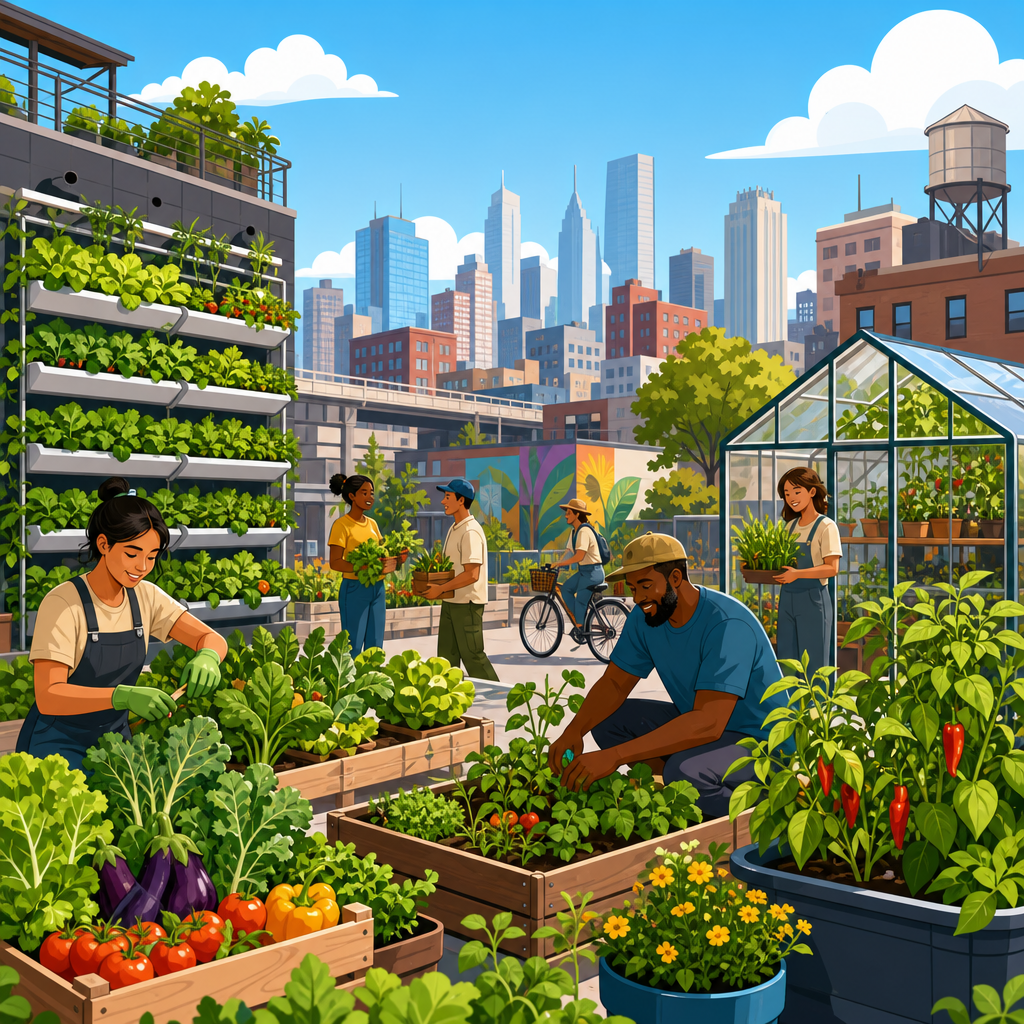
Community gardens are among the most durable urban agriculture models precisely because they are not judged only as businesses. Their economics work differently. Land is often publicly owned or held by land trusts, labor is partly volunteer, and the main returns are social: neighborhood stewardship, mental health benefits, cultural expression, and supplemental food access. Programs in New York City, Chicago, and Philadelphia have lasted decades because they are embedded in community organizations, schools, parks systems, and extension networks. The American Community Gardening Association and many municipal park departments have documented gains in neighborhood engagement and food literacy that justify continued support even when total yield is modest.
Nonprofit urban farms can also survive when they tie production to funded services such as job training, youth development, culinary education, composting, or reentry programs. The farm itself may not carry the entire budget; instead, produce sales complement grants, contracts, philanthropy, and public programming. This blended revenue model is often more durable than a weak commercial model pretending to be scalable. The limitation is obvious: nonprofit farms depend on institutional relationships, and many remain vulnerable to grant cycles. Still, as part of sustainable urban development, they are proven survivors because their purpose aligns with public-sector goals that cities already finance.
Commercial rooftop farms survive when buildings and markets fit
Rooftop farms are frequently cited as emblematic urban agriculture, but only a subset works over time. The survivors tend to fall into two categories: lightweight soil-based roofs tied to hospitality or direct sales, and greenhouse roofs integrated with large buildings. In both cases, structural capacity, access, drainage, insurance, and food safety are decisive. A roof that can technically hold planters is not automatically suitable for profitable farming. Elevators, wash-pack space, winter access, and worker safety regulations all shape operating costs. This is why experienced operators evaluate the building first, not the crop list.
Greenhouse rooftops can be especially resilient when they use synergies from the host building. Projects inspired by controlled-environment principles demonstrated in Montreal and other cold-climate cities have shown that waste heat, captured CO2 streams, and reduced transportation can materially improve economics. The crop mix usually centers on tomatoes, herbs, lettuce, or specialty greens sold into nearby retail and foodservice channels. These are not generic farms dropped on any roof. They are infrastructure partnerships. When the building owner values amenity, branding, energy integration, or stormwater performance, the farm gains a second layer of justification that improves survival odds.
Vertical farming survives in narrow lanes, not as a universal answer
Vertical farming remains the most misunderstood urban agriculture model. Technically, it can produce very high yields per square foot using stacked hydroponic or aeroponic systems under LEDs in controlled environments. Operationally, it faces relentless energy, depreciation, maintenance, and labor pressures. The bankruptcies and restructurings seen across the sector were not random. Many companies assumed scale would erase weak unit economics, but if electricity is expensive, crop prices are soft, and utilization rates are uneven, scaling can magnify losses. The surviving vertical farms are usually disciplined operators focused on a few crops with short cycles and premium markets.
Leafy greens, microgreens, herbs, seedlings, and some nutraceutical crops fit best because they are lightweight, perishable, and sensitive to cleanliness and consistency. Strawberries, staple vegetables, and commodity crops are much harder to justify indoors at city energy prices. The most credible operators use detailed climate recipes, integrated pest management, HACCP-based food safety protocols, and production planning linked to purchase orders. They do not sell a dream of replacing regional agriculture. They sell highly predictable output into dense urban markets where freshness, low pesticide use, and local delivery matter enough to support the cost structure.
| Model | What usually makes it survive | Main weakness | Best-fit outputs |
|---|---|---|---|
| Community garden | Public land access, volunteer labor, strong local stewardship | Limited commercial revenue | Food access, education, neighborhood cohesion |
| Nonprofit urban farm | Blended funding tied to training or social services | Grant dependence | Programs plus moderate produce sales |
| Rooftop farm or greenhouse | Building integration, premium local markets, amenity value | High capital and structural constraints | Greens, herbs, tomatoes, hospitality supply |
| Vertical farm | Strict crop focus, efficient energy use, contracted buyers | Electricity and depreciation costs | Leafy greens, herbs, microgreens, starts |
| Peri-urban soil farm | Lower land cost, mechanization, CSA or wholesale channels | Development pressure at city edge | Diverse vegetables, flowers, eggs, agritourism |
Peri-urban farms often outperform inner-city farms on economics
When people discuss urban agriculture, they often overlook the urban fringe, where some of the most durable operations actually sit. Peri-urban farms near metropolitan markets benefit from lower land costs than downtown sites while still reaching consumers quickly. They can use tractors, tunnels, wash-pack sheds, and cold storage more efficiently than tight urban parcels allow. This makes them especially strong for mixed vegetables, cut flowers, eggs, and community supported agriculture subscriptions. In many regions, these farms are the practical backbone of local food systems, even if they are less photogenic than rooftop installations.
The challenge is land security. Edge farmland is vulnerable to rezoning and speculative development, which can discourage long-term soil investment. This is where policy matters. Agricultural easements, urban growth boundaries, public procurement commitments, and farmland trusts can make peri-urban production far more durable. From a city resilience standpoint, these farms often deliver better value per public dollar than heavily capitalized downtown projects because they produce larger volumes with simpler infrastructure. If the goal is actual regional food supply rather than symbolism, protecting peri-urban land is one of the highest-return moves a metropolitan area can make.
The real survival factors: land, energy, labor, logistics, and policy
Across all models, five variables determine survival. First is land tenure. A farm cannot mature if it can be displaced at the moment soil improves or customer relationships stabilize. Long leases, ownership, land trusts, and rooftop agreements with clear maintenance responsibilities are essential. Second is energy. For indoor systems, electricity pricing, backup power, HVAC design, and lighting efficiency can decide the entire margin. Third is labor. Urban farms need skilled growers, packers, delivery coordination, and compliance knowledge, not just enthusiasm. High turnover or undertrained staff quickly erodes quality.
Fourth is logistics. Harvesting beautiful produce is only half the job; cooling, packing, routing, invoicing, and shrink control determine whether revenue is real. I have seen farms lose restaurant accounts because a late delivery window mattered more than flavor. Fifth is policy. Zoning, water rates, compost rules, farmstand permits, tax treatment, and procurement standards can either lower friction or make survival harder than it should be. The best city governments do not merely fund pilot projects. They remove structural barriers, protect suitable land, streamline approvals, and connect producers to schools, hospitals, and public agencies that can buy consistently.
What survives best in sustainable urban development
The models that actually survive are the ones that fit a clear role within the city. Community gardens and nonprofit farms endure as civic infrastructure. Rooftop greenhouses survive where building integration and premium markets align. Vertical farms survive in carefully chosen niches, not as broad replacements for field agriculture. Peri-urban farms often deliver the strongest food production economics and deserve more policy attention than they usually receive. In every case, durability comes from disciplined matching: crop to market, site to system, and mission to revenue.
For anyone building an urban agriculture strategy, the practical next step is simple: start by defining the outcome you need, then choose the lightest, most resilient model that can deliver it. If you want community health and neighborhood activation, support gardens and nonprofit farms. If you want year-round specialty produce close to dense demand, evaluate greenhouse or vertical systems with honest energy assumptions and secure buyers. If you want meaningful local food volume, protect peri-urban land before it disappears. Urban agriculture after the hype is better, not smaller, because the surviving models are grounded in evidence. Use that evidence to plan smarter projects, stronger partnerships, and cities that treat food production as real infrastructure.
Frequently Asked Questions
1. Which urban agriculture models are actually proving durable after the early excitement faded?
The models that tend to survive are the ones built around realistic economics, clear local demand, and tight operational control rather than novelty alone. In practice, that often means community-supported gardens, peri-urban farms near city edges, rooftop farms with established restaurant or direct-to-consumer buyers, and greenhouse operations producing high-value crops with predictable turnover. These models usually work because they match production methods to what cities can support: short supply chains, premium freshness, and strong local relationships. They do not rely on the assumption that urban land will somehow become cheap or that technology alone will erase basic agricultural constraints.
What usually separates durable models from short-lived ones is a mixed revenue structure. The strongest operations often sell food, but they may also earn income through education, events, composting partnerships, grants, workforce training, or institutional contracts with schools, hospitals, and food hubs. That diversification matters because urban farming margins are often narrow, and depending on one crop or one buyer can be risky. Surviving operators are also disciplined about crop selection, labor use, infrastructure costs, and season extension. Instead of trying to grow everything, they focus on products that justify urban costs, such as salad greens, herbs, seedlings, mushrooms, specialty vegetables, or culturally specific crops with dependable demand.
By contrast, the models that struggle most are usually those with heavy capital costs and optimistic assumptions about scale. Large vertical farms and high-tech indoor operations can produce impressive yields, but many have found that electricity, climate control, financing, maintenance, and labor costs are difficult to overcome unless the business has an unusually strong market, a very efficient operating system, or access to cheap power and capital. The broader lesson is simple: urban agriculture survives when it acts like a grounded local food business, not just a compelling innovation story.
2. Why have so many highly publicized vertical farming and high-tech indoor agriculture ventures struggled?
The main issue is that technical possibility is not the same as financial sustainability. Vertical farming can produce food in controlled conditions with remarkable precision, but that precision comes at a cost. Indoor farms must pay for artificial lighting, HVAC systems, water management, sensors, software, specialized equipment, and ongoing maintenance. They also need trained labor to manage seeding, transplanting, monitoring, harvesting, sanitation, and packing. When energy prices rise or financing tightens, the economics can deteriorate quickly. A business model that looked promising on a spreadsheet during a low-interest, growth-focused funding period can become fragile in a more disciplined market.
Another challenge is product-market fit. Many indoor farms focus on leafy greens and herbs because those crops grow quickly and suit stacked systems. But those same categories can become crowded, and consumers may not always pay enough of a premium to support the production costs. Retail buyers also expect consistency, packaging standards, food safety compliance, and competitive pricing. If a vertical farm is producing high-cost greens into a market already served by field growers, greenhouse operators, and regional distributors, it can be difficult to defend margins. The technology may work beautifully while the business still struggles.
There is also a scaling problem that gets overlooked. Expanding from one pilot site to multiple facilities introduces new complexity in logistics, staffing, procurement, quality control, and financing. Some ventures tried to scale before proving long-term unit economics at a manageable size. Others relied too heavily on investor enthusiasm rather than durable operating profits. None of this means controlled-environment agriculture has no future. It means the surviving versions will likely be more disciplined, more selective about crops and markets, and more careful about where technology genuinely improves profitability instead of simply adding cost.
3. How do land costs, labor shortages, and city policy shape which urban farms can survive?
These three factors often matter more than growing technique alone. Land costs are one of the biggest structural pressures in urban agriculture because cities assign high value to space. If a farm must compete directly with housing, retail, office, or industrial uses, it starts at a disadvantage. That is why many successful operations use land at the urban edge, underutilized parcels, institutional property, rooftops with favorable agreements, or publicly supported sites where tenure is stable. Secure land access is critical. A farm cannot invest in soil, irrigation, infrastructure, and relationships if it may lose the site after a short lease term.
Labor is equally important. Urban farms often depend on intensive hand work, especially in diversified vegetable production. Seeding, transplanting, harvesting, washing, packing, delivery, and customer communication all require time and skill. In cities with high wage expectations and a tight labor market, that can put serious pressure on margins. The more resilient operators design systems to reduce unnecessary labor, standardize workflows, and focus on crops that justify the effort. Some also integrate volunteer support, apprenticeships, or mission-driven workforce programs, but those approaches still require management and should not be mistaken for free labor.
City policy can either make survival easier or much harder. Supportive zoning, water access, composting systems, tax treatment, procurement programs, and land-use protections can help farms become part of urban infrastructure rather than temporary experiments. On the other hand, unclear regulations, restrictive zoning, expensive permitting, and weak land security can undermine even well-run projects. The farms that endure are often not just good at growing food; they are good at navigating municipal systems, building community legitimacy, and aligning with broader city goals such as climate resilience, neighborhood revitalization, food access, stormwater management, and public health.
4. Is urban agriculture mainly about food production, or does it survive by delivering other kinds of value too?
In most cases, urban agriculture survives precisely because it delivers more than food. If the only measure were bulk food output at the lowest possible cost, conventional rural agriculture would outperform most city-based production. Urban farms become viable when they combine food production with other forms of value that cities care about and are sometimes willing to support. Those values can include education, job training, youth engagement, neighborhood beautification, biodiversity, waste reduction, heat-island mitigation, stormwater capture, and stronger local food networks. In other words, many urban farms are hybrid institutions as much as they are farms.
That does not mean food production is secondary or unimportant. It means the most realistic urban agriculture models understand where they fit in the broader system. A community garden may not feed an entire city, but it can improve local food literacy, social cohesion, and access to culturally meaningful crops. A rooftop farm may not replace regional vegetable production, but it can supply premium produce to nearby restaurants while also serving as a demonstration site, event venue, or sustainability asset for a building. A greenhouse near the city edge may produce substantial volumes while benefiting from shorter distribution routes and stronger local branding.
The key is being honest about what the operation is designed to do. Problems emerge when urban farms are promoted as if they will solve food security, climate, employment, and land use all at once without a credible business or policy structure behind them. The surviving models are usually clearer and more humble. They define their role, measure the right outcomes, and build revenue or support around the full package of benefits they provide. That blend of production value and civic value is often what keeps them alive.
5. What should investors, policymakers, and local communities look for when evaluating whether an urban agriculture project is likely to last?
They should start with the basics: land security, realistic unit economics, crop strategy, buyer commitments, and operational competence. A durable urban agriculture project should be able to explain exactly what it grows, who buys it, why those buyers will keep buying, and how the farm manages labor, distribution, utilities, and compliance. It should also show that the physical site makes sense. That includes access to water, light or energy, transportation, storage, and neighborhood compatibility. If the project depends on temporary access to expensive land or on future assumptions that are not yet proven, that is a warning sign.
It is also important to ask whether the project has chosen a model appropriate to its context. A neighborhood nonprofit farm, a commercial rooftop enterprise, a peri-urban greenhouse, and a high-tech indoor facility should not be judged by the same metrics. Some projects are designed to maximize commercial yield; others are designed to create social, educational, or environmental outcomes alongside food production. The strongest proposals are explicit about those priorities and do not hide weak farm economics behind vague claims of impact. If public support is involved, the non-market benefits should be clearly identified and measured rather than treated as marketing language.
Finally, long-term survival often comes down to management quality and adaptability. Urban agriculture is exposed to changing weather, shifting policy, energy volatility, labor constraints, and consumer behavior. Operators who survive usually track costs carefully, build strong local partnerships, adjust crop plans quickly, and resist overexpansion. They are skeptical of hype, disciplined about capital spending, and clear about where they create value. For investors, policymakers, and communities, that is the best lens to use: not whether a project looks innovative, but whether it is grounded enough to keep functioning when the excitement wears off.