
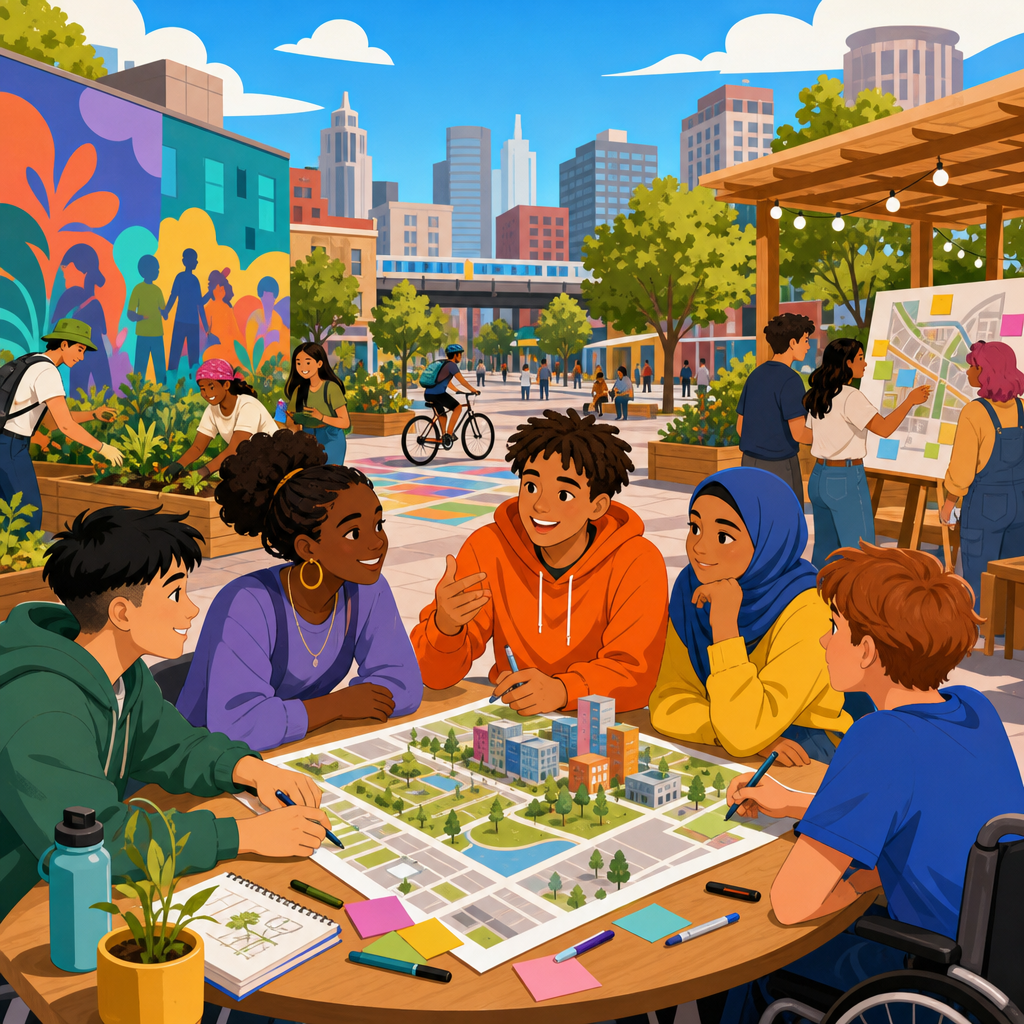
Youth-led placemaking gives young people real authority to shape parks, streets, libraries, transit stops, housing edges, and public programs in the neighborhoods where they live. In practice, that means moving beyond symbolic engagement and sharing decisions about budgets, design priorities, site selection, programming, and long-term stewardship. I have worked on community planning processes where teenagers were asked to place stickers on boards, then watched adults finalize every meaningful choice behind closed doors. That is not youth-led placemaking. Real decision-making power exists when youth can influence outcomes, see their recommendations adopted, and hold institutions accountable for implementation.
This matters across the affordable housing landscape because homes do not function in isolation. A below-market apartment in a poorly lit corridor without safe crossings, recreation space, transit access, or youth-serving amenities does not create lasting neighborhood stability. Placemaking is the process of improving the social, physical, and cultural life of a place. When led by young residents, it often surfaces needs adults miss: after-school safety routes, affordable third places, flexible recreation, culturally relevant art, free Wi-Fi, late library hours, and public spaces where teens are welcome rather than managed out. Cities that integrate youth leadership into placemaking build stronger housing outcomes, better public space investments, and more durable civic trust.
For municipal leaders, housing agencies, developers, school districts, and nonprofit partners, the core question is straightforward: how do you give young people actual power without turning the process into tokenism or chaos? The answer is structured power-sharing. Cities need defined roles, compensated participation, transparent decision rules, youth-accessible information, and measurable follow-through. This article explains how youth-led placemaking works, why it belongs inside affordable housing policy, and what local governments can do to create systems where young residents are not consulted as an afterthought but recognized as decision-makers with expertise rooted in lived experience.
Why Youth-Led Placemaking Belongs in Affordable Housing Strategy
Affordable housing policy often focuses on units, subsidies, land costs, financing stacks, and production targets. Those are essential, but they are not sufficient. Families evaluate housing by the surrounding environment as much as by rent. Young residents experience neighborhood quality directly every day through walking routes, school commutes, sports fields, bus stops, courtyards, corner stores, and community centers. When cities exclude youth from shaping those environments, they miss practical intelligence about how space is actually used. I have seen project teams spend months refining a plaza design only to learn from local teens that the most urgent need was shaded seating near the bus transfer point where students waited forty minutes each afternoon.
There is also a clear equity case. Young people, especially in low-income communities, are heavily regulated in public space but rarely trusted with authority over it. Research from organizations such as Project for Public Spaces and the National League of Cities has consistently shown that inclusive public engagement improves relevance and community buy-in. Youth-led processes can reduce the mismatch between investment and use. A basketball court placed where girls report harassment on the path to reach it will underperform. A mixed-use open space co-designed by youth may include lighting, storage, visible sightlines, and programming choices that support broader participation.
In affordable housing contexts, youth leadership strengthens resident retention, intergenerational trust, and stewardship. Developments that include youth advisory boards, resident-led art, peer programming, and participatory site planning often see stronger social cohesion than sites where design is imposed from outside. The placemaking lens also helps cities think beyond parcel boundaries. If a new affordable housing project increases family density near an unsafe arterial, then safer crossings and public realm improvements are housing interventions too, not separate amenities to consider later.
What Real Decision-Making Power Looks Like
Sharing power with youth does not mean asking for ideas and promising to “take them into consideration.” It means defining formal authority. The strongest models use one or more of these mechanisms: youth seats with voting rights on steering committees, participatory budgeting set-asides controlled by young residents, youth-majority design juries for public space projects, co-authorship of requests for proposals, and binding response requirements from agencies when youth recommendations are rejected. If an agency can disregard every recommendation without explanation, power has not been shared.
Youth power-sharing also requires compensation and capacity building. Adults are usually paid to attend planning meetings; young people should be as well. Stipends, transit passes, meals, childcare for young parents, and flexible meeting times are basic infrastructure for equitable participation. Training matters too. In my experience, youth participants engage at a much higher level when they are given readable site plans, budget ranges, precedent images, zoning basics, and project constraints upfront. They do not need information simplified into slogans; they need it translated into accessible terms.
Successful cities establish clear decision stages. For example, youth might define the design brief, narrow three concept options, allocate a programming budget, and evaluate post-occupancy performance. Adults still manage legal compliance, procurement, insurance, and engineering, but they do so within a framework that protects youth choices. This balance is practical. It recognizes that governments have statutory responsibilities while refusing to use technical complexity as an excuse to hoard control.
| Power-Sharing Method | How It Works | Best Use in Housing-Linked Placemaking | Main Risk if Poorly Designed |
|---|---|---|---|
| Youth participatory budgeting | Young residents decide how a defined pot of money is spent | Courtyards, play streets, murals, micro-grants, programming | Tiny budgets create symbolic rather than real power |
| Youth voting seats on project committees | Teens hold formal votes alongside agency staff and residents | Public space redesigns tied to affordable housing sites | Adults can still dominate if agendas are not accessible |
| Youth design juries | Youth review and score design concepts or development teams | Play spaces, libraries, mobility hubs, school-adjacent spaces | Juror feedback ignored during value engineering |
| Co-authored project briefs | Youth help write goals, success metrics, and user needs | Master planning, resident services, neighborhood amenities | Brief becomes aspirational with no enforcement mechanism |
Building the Civic Infrastructure That Makes Youth Leadership Work
Most cities fail at youth-led placemaking not because young people are uninterested, but because institutions do not create durable participation systems. One-off workshops cannot carry long-term authority. Cities need infrastructure: a standing youth planning council, memoranda of understanding between planning departments and school districts, annual budget allocations for youth-led public realm projects, and staff roles specifically responsible for implementation. Boston’s youth participatory budgeting model and initiatives in cities such as Seattle and Oakland show that recurring structures outperform ad hoc outreach because they normalize youth governance rather than treating it as an experiment.
Recruitment must also be intentional. If a city only works with student government members or youth already connected to nonprofits, it will reproduce privilege. Effective outreach includes public housing residents, foster youth, multilingual families, disabled youth, recent immigrants, and young people who are not in school or formal programs. Trusted partners matter here: libraries, school social workers, recreation staff, resident associations, tenant organizers, and youth employment programs often reach participants that city hall does not. Representation should reflect the neighborhood affected by the project, not just the easiest youth voices to convene.
Institutional trust depends on transparency. Publish timelines, budgets, design constraints, and final decisions in plain language. When agencies disagree with youth recommendations, explain why, what alternatives were considered, and what can still be changed. I have found that young residents are highly pragmatic when treated honestly. They can accept a stormwater regulation, fire code, or procurement limit if officials explain the issue clearly and early. What destroys trust is performative openness followed by opaque decision-making.
Methods Cities Can Use From Visioning to Stewardship
Youth-led placemaking should cover the full project cycle, not just visioning. At the discovery stage, cities can use walking audits, photo mapping, intercept surveys, and behavior observation to understand how youth actually use places. Mobile tools like ArcGIS Survey123, Maptionnaire, and simple QR-based forms can help collect location-specific feedback, but offline options remain essential for equitable access. During concept development, model-making, precedent reviews, and scenario testing allow young people to compare tradeoffs. For example, should a small budget prioritize shade structures, sports equipment, seating, or lighting? A structured process helps participants weigh use patterns and maintenance implications.
At design review, youth can evaluate plans against criteria they helped set, such as safety after dark, cultural relevance, universal access, climate comfort, and affordability of programming. During implementation, paid youth fellows can document construction impacts, communicate updates to residents, and prepare activation plans for opening day. The final phase, stewardship, is often overlooked. Spaces succeed when there is local ownership after ribbon cuttings. Youth advisory groups can manage event calendars, public art rotations, peer mediation, garden maintenance, or data collection on space use. This creates continuity and builds civic skills that extend well beyond a single site.
For affordable housing developers, these methods are especially useful around shared open space, ground-floor community rooms, and streetscape interfaces. A developer may know how to deliver units on budget, but young residents know whether the courtyard will feel welcoming, whether benches invite supervision or socializing, and whether a community room layout supports tutoring, dance practice, or gaming nights. Those details shape whether a development becomes a stable home environment or just another building.
Common Barriers and How to Address Them
The most common barrier is adultism: the assumption that young people lack the judgment to contribute meaningfully to planning decisions. In reality, youth routinely navigate complex systems, social risks, and spatial constraints adults overlook. The solution is not motivational rhetoric but process design. Give youth formal roles, clear information, and deadlines matched to school and work schedules. Another barrier is legal and administrative caution. Municipal attorneys may worry about procurement integrity, labor rules, or public meeting requirements. These concerns are manageable when agencies define advisory versus voting functions carefully and document procedures from the start.
Funding is another challenge. Youth stipends, facilitation, translation, food, and staff time cost money. Yet these expenses are modest compared with the cost of underused capital projects or community opposition caused by poor engagement. Cities can braid funding from planning budgets, parks departments, federal community development funds, violence prevention programs, philanthropic grants, and developer community benefits. The important point is to fund participation as core project delivery, not as optional outreach.
There are also risks of overburdening youth leaders. A small group of highly engaged teens can become the default representatives for every issue. Rotate roles, expand cohorts, and provide trauma-informed support. Not every young person wants public visibility, and not every contribution must occur in meetings. Some will prefer digital feedback, paid research, art-based engagement, or event-based participation. Good youth-led placemaking offers multiple paths to influence while keeping final accountability visible.
How to Measure Success and Keep Power Shared Over Time
Cities should measure youth-led placemaking with both process and outcome indicators. Process metrics include how many youth were compensated, demographic representation, attendance retention, percentage of recommendations adopted, and average time between recommendation and agency response. Outcome metrics should track changes in space use, perceived safety, programming participation, maintenance quality, and resident satisfaction. For housing-linked projects, cities should also examine lease stability, family retention, and use of shared amenities. If a redesigned plaza is beautiful but teens avoid it after school, the intervention has not succeeded.
Qualitative evidence matters too. Interviews, focus groups, and post-occupancy evaluations can show whether youth feel respected and whether adults changed how they make decisions. In several projects I have seen, the biggest long-term impact was institutional, not physical: planning staff began bringing youth in at project scoping rather than after concepts were already drawn. That shift is a sign of genuine power redistribution.
To sustain progress, cities should write youth authority into policy. Comprehensive plans, public engagement standards, parks master plans, and affordable housing guidelines can all require youth participation thresholds and response protocols. Agencies should publish annual results and create internal training so staff understand facilitation, accessibility, and shared governance. The goal is simple: make youth-led placemaking routine, budgeted, and enforceable rather than dependent on one sympathetic mayor, planner, or nonprofit director.
Youth-led placemaking works when cities stop treating young residents as a focus group and start recognizing them as civic partners with decision-making rights. The strongest approach is structured, compensated, transparent, and tied to real authority over budgets, design, programming, and stewardship. For affordable housing, this matters because neighborhood quality, public space, and daily safety directly shape whether housing is truly livable and stable. Young people often identify the missing ingredients faster and more accurately than adult-led processes do.
The practical agenda is clear. Build standing youth governance structures, recruit beyond the usual participants, share readable information early, protect youth influence through formal rules, and measure whether recommendations actually change outcomes. Cities do not need to choose between professional planning and youth leadership. They need systems that combine technical expertise with lived experience, then hold institutions accountable for acting on both. That is how placemaking becomes equitable rather than decorative.
If your city is updating an affordable housing plan, designing a new development, or rebuilding public space around family housing, start by asking where young people already hold power and where they do not. Then move one level deeper: assign budget, votes, timelines, and public accountability. When youth shape place, cities build neighborhoods that work better not only for young residents, but for everyone who calls those communities home.
Frequently Asked Questions
What does youth-led placemaking actually mean in practice?
Youth-led placemaking means young people are not just invited to react to adult ideas; they are given meaningful authority to help define what gets built, where resources go, and how public spaces are used over time. In practical terms, that can include shared control over design priorities for parks and streets, direct input on site selection for amenities, decision-making power over a portion of public budgets, and formal roles in programming and stewardship after a project is completed. The difference between youth-led work and symbolic engagement is simple: young people can visibly change outcomes.
In a genuine youth-led process, teenagers and young adults are involved early enough to shape the agenda before key decisions are locked in. They are given access to the same information adults use, including budget constraints, safety requirements, maintenance realities, and implementation timelines. They are compensated for their labor, supported with training, and included in meetings where real tradeoffs are discussed. Their ideas are then carried through into adopted plans, contracts, pilot projects, and evaluation metrics. If youth are only asked to place stickers on boards or respond to a near-final concept, that is consultation, not shared power. Youth-led placemaking begins when cities create structures that let young people influence decisions in ways that are visible, documented, and durable.
Why is sharing real decision-making power with young people better than traditional community engagement?
Traditional engagement often treats youth as an audience rather than as civic actors. Cities may hold a workshop at a school, gather opinions, and then move forward with decisions made entirely by adults. That approach misses both the lived expertise of young people and the long-term value of building civic trust early. Young residents experience public space differently from many adult planners and officials. They know which transit stops feel unsafe after school, which park edges are over-policed or underused, where social life actually happens, and what amenities support belonging rather than surveillance. When cities ignore that knowledge, they often produce spaces that are technically complete but socially disconnected from the people who use them most.
Sharing real power leads to better outcomes because it improves relevance, legitimacy, and long-term use. Projects shaped by youth are more likely to reflect actual patterns of movement, comfort, gathering, and access. They can also surface needs that adults underestimate, such as places to sit without being forced to buy something, lighting that feels safe without feeling hostile, flexible recreation spaces, charging stations, bathrooms, Wi-Fi, shade, and programming that reflects neighborhood culture. Just as important, shared decision-making helps repair a common civic failure: asking communities for input while withholding authority. When young people see their decisions influence budgets, designs, and operations, they learn that public systems can respond to them. That trust matters not only for one project, but for future participation in planning, voting, advocacy, and neighborhood stewardship.
How can cities move from token youth engagement to genuine shared power?
Cities make this shift by changing structures, not just meeting formats. The first step is to involve young people before plans are drafted and priorities are settled. Youth should help frame the problem, identify goals, and define what success looks like. The second step is to assign real authority through formal mechanisms. That may include youth advisory boards with voting power, participatory budgeting processes led by young residents, youth seats on design review panels, memorandums of understanding that require agencies to respond to youth recommendations, or dedicated project funds that youth can allocate within clear parameters. Without a formal pathway from input to action, even well-intentioned engagement can remain symbolic.
Support systems matter just as much as governance. Young people need transportation, food, scheduling that works around school and jobs, interpretation, disability access, digital access, and adult facilitators who know how to share power without controlling the process. Compensation is essential because unpaid participation often excludes the very youth whose experience is most important. Cities should also make technical information understandable without oversimplifying it. That means explaining procurement, maintenance, zoning, liability, and budget limitations in plain language so youth can make informed choices. Finally, agencies must publicly document what youth recommended, what was adopted, what changed, and why. Transparency turns participation into accountability, and accountability is what distinguishes genuine power-sharing from performative outreach.
What are the biggest barriers to youth-led placemaking, and how can cities address them?
The biggest barrier is often adult control disguised as concern. Officials may say young people are too inexperienced, that timelines are too tight, or that legal and technical issues are too complicated to share. In reality, most of these concerns reflect systems that were not designed to include youth in the first place. Other common barriers include lack of compensation, inaccessible meeting times, school and work conflicts, skepticism from agencies, risk-averse procurement rules, and a tendency to prioritize polished presentations over lived experience. There can also be equity barriers within youth engagement itself, where the same high-achieving or already-connected students are repeatedly invited while working-class youth, disabled youth, immigrant youth, unhoused youth, and young people of color are underrepresented or excluded.
Cities can address these barriers by designing for inclusion from the beginning. That means recruiting through trusted community partners, schools, libraries, youth organizers, and neighborhood networks rather than relying on one public call for participation. It means paying youth, offering flexible engagement options, and creating multiple ways to contribute, from workshops and walks to digital feedback, pop-ups, peer interviews, and youth-led storytelling. Agencies should train staff on power-sharing, trauma-informed facilitation, and anti-bias practices so that youth participation is not filtered through dismissive adult assumptions. Legal or technical constraints should be explained clearly, but not used as excuses to shut down creativity. When a youth proposal cannot be implemented exactly as imagined, staff should collaborate on alternatives rather than rejecting it outright. The goal is not to remove every constraint; it is to build a process where constraints are transparent and youth still retain meaningful influence over real choices.
What does success look like in a youth-led placemaking process?
Success is not measured by how many young people attended a workshop or how enthusiastic the event felt in the moment. Those metrics can be useful, but they do not reveal whether power was actually shared. A successful youth-led placemaking process shows up in decisions, budgets, built outcomes, and ongoing governance. You can see success when youth priorities are written into capital plans, when funding is allocated according to their recommendations, when designs reflect the features they identified, and when completed spaces are programmed and maintained in ways they helped establish. Success also means the process leaves behind a durable civic structure, such as a standing youth council, recurring participatory budgeting, a stewardship agreement, or agency rules requiring documented responses to youth proposals.
Strong evaluation should look at both outcomes and power. Cities should ask: Did youth influence final decisions on design, programming, and spending? Were their recommendations adopted in full, in part, or not at all? Were they compensated and supported equitably? Did the process reach youth who are usually excluded? Are the finished spaces more heavily used, more welcoming, and more reflective of neighborhood life? Over time, success also includes whether young participants continue engaging in civic life and whether agencies change their own practices as a result. The most meaningful sign of success is that youth no longer have to fight to be heard on every project because the city has normalized their role as decision-makers. At that point, placemaking is not simply about designing better spaces; it is about building a more democratic local government.


