
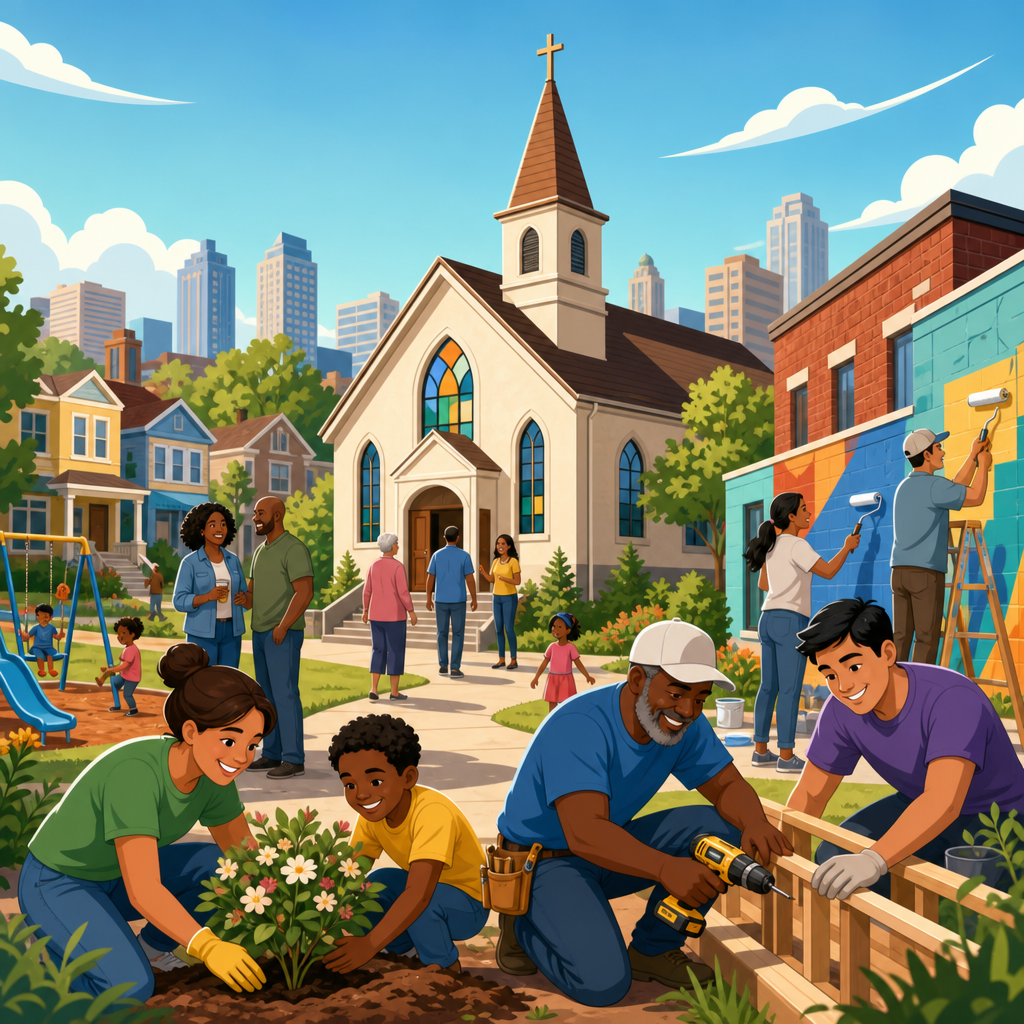
Faith-based real estate has become one of the most practical tools for community revitalization because congregations often control land, buildings, trust, and long-term local relationships that many public agencies and private developers struggle to build. In this context, faith-based real estate means property owned, leased, financed, or stewarded by religious institutions and mission-aligned partners for housing, social services, neighborhood commerce, and civic uses. Community revitalization means strengthening a place without displacing the people who already give it identity. I have worked with church boards, affordable housing developers, and municipal planning staff on projects that turned underused parking lots, vacant parish houses, and aging fellowship halls into homes, childcare centers, clinics, and small business space. These projects matter because communities across the United States face a simultaneous shortage of affordable housing, rising land costs, declining congregational attendance in some traditions, and increasing demand for trusted neighborhood institutions. When a congregation uses its real estate strategically, it can protect mission, unlock dormant value, and create durable benefits that extend beyond a Sunday gathering. Done well, faith-based development can reduce blight, stabilize families, support elders, and generate revenue for ministry while preserving neighborhood character.
The reason this approach deserves serious attention is simple: houses of worship are often embedded in neighborhoods that need investment most, yet their land is frequently underutilized. Surface parking used only a few hours each week, obsolete educational wings, rectories no longer needed for clergy housing, and large parcels acquired decades ago can become productive community assets. Unlike speculative investors, many religious owners hold property for generations and think in terms of stewardship rather than quick resale. That time horizon changes decision-making. A church can prioritize deeply affordable apartments, a mosque can pair housing with family support services, or a synagogue can structure a ground lease that preserves ownership while enabling development. This article serves as a hub for faith-based real estate within the affordable housing field by explaining how these projects work, why they succeed or fail, what models are available, which legal and financial issues matter, and how congregations can move from vision to execution with discipline.
Why faith-based real estate matters in affordable housing
Faith communities occupy a unique position in the housing ecosystem because they combine physical assets with social capital. The physical asset is obvious: land in built-out neighborhoods is scarce and expensive, and many congregations already own it free and clear or at very low carrying cost. The social asset is just as important. Congregations know which families are overcrowded, which seniors are isolated, where eviction pressure is rising, and which services are missing. In my experience, that local knowledge improves project design more than many market studies do. A church that has operated a food pantry for twenty years understands transportation barriers, childcare needs, and trust gaps in ways outside consultants often miss.
There is also a policy reason faith-based real estate matters. Public subsidy programs such as Low-Income Housing Tax Credits, HOME funds, Community Development Block Grants, project-based vouchers, and state housing trust funds can finance affordability, but they rarely solve the land problem. Congregational land can close that gap. A below-market ground lease or discounted land contribution can make a project financially feasible without reducing quality. In high-cost markets, that single intervention can determine whether a development reaches households at 30 percent to 60 percent of area median income or becomes impossible to underwrite. Faith institutions can therefore function as catalytic land partners, not just charitable sponsors.
Core development models and when to use them
There is no single template for faith-based real estate. The right model depends on the congregation’s mission, finances, governance capacity, and appetite for complexity. The most common structures include direct development, joint ventures with experienced affordable housing developers, long-term ground leases, adaptive reuse of existing buildings, and mixed-use campus redevelopment. Direct development gives the congregation maximum control but also exposes it to entitlement, financing, and construction risk. I rarely recommend it unless leadership has substantial development experience or a very strong consultant team.
Joint ventures are usually the most practical option. In a typical arrangement, the congregation contributes land and community legitimacy while the developer manages predevelopment, financing, construction, and compliance. The parties negotiate ownership percentages, developer fees, board rights, design priorities, and mission protections. Ground leases are especially useful when a congregation wants to preserve long-term ownership. Instead of selling land outright, it leases the site for 60 to 99 years, receives steady income, and imposes use restrictions aligned with ministry goals. Adaptive reuse works well when historic sanctuaries, schools, or convents can be converted into housing or service space, though code compliance can be expensive. Mixed-use redevelopment can combine worship space, affordable apartments, offices for nonprofits, and neighborhood retail, creating a more active and financially resilient campus.
| Model | Best Use Case | Main Advantage | Main Risk |
|---|---|---|---|
| Joint venture | Congregation owns land but lacks development staff | Balances mission control with professional execution | Partnership terms can become misaligned |
| Ground lease | Institution wants to retain long-term ownership | Preserves stewardship and creates recurring income | Lease terms must anticipate future disputes |
| Adaptive reuse | Historic or obsolete structures have strong bones | Can preserve identity and reduce demolition waste | Hidden rehabilitation costs are common |
| Mixed-use campus | Large sites in transit-served neighborhoods | Supports housing plus services and local commerce | Entitlements and phasing are complex |
How projects create community revitalization without displacement
Community revitalization fails when it improves buildings but weakens belonging. Faith-based real estate is valuable precisely because it can anchor anti-displacement strategies from the start. The first strategy is affordability depth. If the housing serves only moderate-income households in a neighborhood with severe rent burden, it may look beneficial on paper while excluding current residents. Projects should match local need by layering subsidies so a meaningful share of units reach very low-income households, seniors on fixed income, or people exiting homelessness. The second strategy is service integration. Housing linked with case management, childcare, workforce support, legal aid, or health services does more than add units; it improves stability.
The third strategy is community participation with real decision rights. Congregations already know how to convene people, but development engagement must go beyond listening sessions. Residents need clarity on what is negotiable, what is constrained by finance, and how design choices affect cost. Fourth, revitalization should strengthen the neighborhood economy. Ground-floor space can prioritize local entrepreneurs, cooperatives, community health providers, or credit unions instead of only national chains. Finally, projects should protect cultural continuity. Preserving a chapel façade, public plaza, memorial garden, or longstanding social ministry can help long-time residents recognize the site as an evolving community asset rather than a takeover. I have seen opposition soften significantly when people understand that the project keeps the institution rooted while meeting urgent local needs.
Financing, underwriting, and the economics of mission-driven projects
Faith-based real estate succeeds when moral purpose is translated into a financeable capital stack. That stack often includes tax credit equity, conventional or agency debt, soft loans from city or state housing agencies, philanthropic grants, Federal Home Loan Bank Affordable Housing Program funds, and land value from the congregation. Every source has conditions. LIHTC financing requires strict income and rent compliance, reserve funding, cost certification, and long-term asset management. Public soft debt may impose prevailing wage rules, environmental review, relocation obligations, or minority and women-owned business participation targets. Congregational leaders need to understand that mission does not exempt a project from technical underwriting discipline.
Land contribution is one of the strongest tools available, but it should be documented carefully. An institution can donate land, discount it, or contribute it through a ground lease valued as part of project sources. Each choice affects appraised value, tax treatment, lender comfort, and future control. Replacement worship space is another major cost driver. If redevelopment requires a new sanctuary, fellowship hall, or classrooms, the budget can become too burdened for affordable housing rents to support. In those cases, phasing, simpler design, or separate capital campaigns may be necessary. Conservative assumptions are essential. I advise boards to pressure-test operating income, reserves, insurance, and construction contingencies because nonprofit optimism often collides with real carrying costs. A project can be mission-perfect and still fail if debt service, lease-up timing, and long-term maintenance are underestimated.
Legal structure, governance, and risk management
The legal side of faith-based real estate is where many well-intentioned projects get into trouble. Before any term sheet is signed, the congregation must confirm who actually owns the property and what approvals are required under denominational polity, trust clauses, corporate bylaws, and local law. Some traditions require approval from a diocese, presbytery, conference, bishop, or national board. Cemeteries, donor restrictions, historic easements, or reversionary interests may also limit use. Title review, survey work, zoning analysis, and environmental due diligence are not optional.
Governance matters just as much as legal form. A congregation needs a clear owner’s team: board leaders, clergy, finance representatives, legal counsel, and an owner’s representative who understands development. Conflicts of interest must be disclosed, especially when contractors, brokers, or donors are members of the institution. Decision thresholds should be defined early so the developer knows who can approve design changes, budget increases, or financing terms. Risk allocation in the development agreement should cover guarantees, indemnities, construction overruns, delays, default remedies, and exit rights. Insurance requirements, reserve policies, and property management standards should also be explicit. Strong governance does not slow a project; it protects mission from confusion and pressure.
From vision to implementation: a practical roadmap
The most effective projects move through a disciplined sequence. Start with mission alignment. Leadership should answer basic questions directly: Why are we using this property? Who are we trying to serve? What uses are nonnegotiable, and what are optional? Next comes site and market feasibility. Commission a highest-and-best-use analysis that includes zoning, density, parking, environmental constraints, utility capacity, and comparable rents or operating costs. Then build community input into concept design before promises are made publicly. Early certainty is often false certainty.
After concept testing, issue a request for qualifications or proposals to select a developer with relevant affordable housing experience, not just general real estate credentials. Evaluate track record, financial capacity, references, resident outcomes, and willingness to respect institutional mission. Negotiate a memorandum of understanding before spending heavily on predevelopment. As plans advance, keep communication disciplined. Congregants need regular updates on tradeoffs, timelines, and approvals. Municipal officials need a clear narrative on housing need, site benefits, and compliance with local plans. Finally, prepare for operations before construction closes. Decide who will manage the property, coordinate services, maintain worship functions, and monitor mission commitments. The project is not complete at ribbon cutting; long-term stewardship is where credibility is earned.
The long-term opportunity for congregations and neighborhoods
Faith-based real estate is not a niche idea. It is a scalable neighborhood strategy that can unlock affordable housing, preserve trusted institutions, and channel investment toward places that have been overlooked or priced out. The core advantage is not simply cheap land. It is the combination of land, legitimacy, patience, and mission. When those assets are matched with professional development partners, disciplined underwriting, and transparent governance, congregations can create housing and community facilities that remain useful for decades. They can support seniors aging in place, working families facing rent pressure, and people who need services close to home. They can also strengthen their own future by replacing deferred maintenance and unstable budgets with sustainable real estate stewardship.
The key takeaway is straightforward: community revitalization works best when development grows from institutions that residents already know and trust. Faith-based real estate can do that, but only when leaders treat it as both ministry and asset management. Start with a realistic property assessment, map community needs, and assemble experienced legal, financial, and development advisors. Then pursue a structure that protects mission while making the numbers work. If your congregation, nonprofit, or local housing partner is evaluating a site, use this hub as a starting point and begin the due diligence that turns underused property into lasting neighborhood value.
Frequently Asked Questions
What is faith-based real estate, and why does it matter for community revitalization?
Faith-based real estate refers to land, buildings, and development projects that are owned, leased, financed, or stewarded by religious institutions and their mission-aligned partners for community-serving purposes. That can include affordable housing, mixed-use developments, childcare centers, health clinics, food distribution sites, small business space, senior housing, classrooms, and public gathering areas. What makes it especially important in community revitalization is that congregations often hold underused property in locations where land is scarce, expensive, or difficult to assemble. Many also have deep roots in the neighborhood, long-standing trust with residents, and a mission that prioritizes service over short-term profit.
In practical terms, faith-based real estate can help transform dormant or underutilized properties into assets that directly respond to local needs. A church parking lot might become affordable housing with community space on the ground floor. A former parish school could be adapted into workforce training classrooms or supportive housing. A congregation with excess land may partner with a nonprofit developer to create mixed-income homes while preserving worship and community functions. Because these institutions are often committed to staying in place for generations, they can support revitalization strategies that are more patient, community-centered, and resistant to purely speculative development pressures.
It matters because revitalization is not just about physical redevelopment. It is about stabilizing neighborhoods, expanding access to services, strengthening local relationships, and creating places where residents can remain and thrive. Faith-based real estate can advance those goals by aligning property use with community mission, social impact, and local accountability in ways that traditional market-driven development often does not.
How can congregations use their property to address housing and neighborhood needs without losing their mission?
Congregations can address housing and neighborhood needs by starting with a clear mission framework before making any real estate decision. The most effective projects do not begin with the question, “What can we build?” but rather, “What is our calling in this neighborhood, and how can our property support it?” That distinction helps religious institutions evaluate whether a proposed development truly serves residents, strengthens the congregation’s long-term presence, and reflects its values. Some may focus on affordable family housing, while others may prioritize seniors, formerly unhoused individuals, education space, community health, or neighborhood-serving retail.
There are several models that allow a congregation to remain mission-centered while putting real estate to work. One option is a ground lease, where the congregation retains ownership of the land and leases it to a development partner for a long term. Another is a joint venture with a nonprofit or socially responsible developer that shares decision-making and embeds community benefits into the agreement. In other cases, a congregation may repurpose existing structures for direct ministry uses such as food access, counseling, legal aid, or after-school programs. These approaches allow the institution to preserve control over core values while leveraging professional development expertise where needed.
Protecting mission also requires strong governance, careful legal review, and broad stakeholder engagement. Congregational leaders should assess zoning, title issues, financing structures, construction risk, and long-term operating responsibilities. Just as important, they should involve members, neighbors, and community partners early in the planning process so the project reflects real needs and not assumptions. When handled thoughtfully, faith-based real estate can expand ministry rather than dilute it, turning property into a lasting platform for housing stability, economic opportunity, and local well-being.
What types of community revitalization projects are most commonly supported through faith-based real estate?
Faith-based real estate most commonly supports projects that meet foundational neighborhood needs while strengthening the surrounding social fabric. Affordable housing is one of the most visible examples, especially in communities facing rising rents, displacement pressures, and limited land availability. Congregations may support new construction, adaptive reuse, transitional housing, permanent supportive housing, or mixed-income residential projects. These developments are often designed to serve families, seniors, veterans, or households with special needs, and they may include onsite services that improve long-term housing stability.
Another common category includes social service and community facilities. Religious properties frequently host food pantries, childcare centers, health services, counseling offices, educational programs, youth activities, and workforce training. In many neighborhoods, these uses are more than supplemental; they are essential infrastructure. Because congregations already function as trusted civic anchors, their sites can become accessible hubs where residents receive multiple forms of support in a familiar environment. This is especially powerful in areas where public investment has been inconsistent or where residents face transportation and access barriers.
Faith-based real estate can also support neighborhood commerce and public life. Mixed-use projects may include space for locally owned businesses, nonprofit offices, community meeting rooms, arts programming, or civic events. Some institutions create incubator space for entrepreneurs or lease storefronts at reasonable rates to mission-aligned tenants that provide needed goods and services. Others redesign campuses to include plazas, gardens, recreation areas, or multi-use spaces that encourage connection and visibility. The most successful revitalization efforts usually blend physical redevelopment with community-serving uses, ensuring that property improvements lead to broader neighborhood stability rather than isolated real estate gains.
What are the biggest challenges in faith-based real estate development, and how can they be managed?
One of the biggest challenges is balancing vision with capacity. Congregations may own valuable property, but many do not have in-house expertise in development, finance, land use law, construction, or asset management. That can make it difficult to evaluate proposals, negotiate from a position of strength, or fully understand long-term obligations. There is also the emotional dimension of church property: these sites often carry spiritual, historical, and cultural meaning, which can make redevelopment decisions deeply sensitive. Internal disagreement, fear of losing identity, and uncertainty about financial risk are all common and understandable concerns.
Financial complexity is another major issue. Even mission-driven projects often require layered capital stacks that combine grants, loans, tax credits, philanthropic support, and public subsidies. Timelines can be long, approvals can be uncertain, and predevelopment costs can accumulate before a project ever breaks ground. On top of that, zoning restrictions, historic preservation rules, environmental issues, and neighborhood opposition may delay or reshape the development plan. Congregations also need to think beyond construction to long-term operations, maintenance, tenant relationships, and governance structures.
These challenges can be managed with preparation and disciplined partnerships. Institutions should begin with a property assessment, mission analysis, and feasibility study before committing to any path. They should retain experienced legal counsel, financial advisors, and development consultants who understand both real estate and faith-based organizational dynamics. Equally important, leaders should establish clear decision-making processes and communicate transparently with members and neighbors throughout the project. A strong partnership agreement, realistic timeline, and clearly defined community benefits can prevent misunderstandings later. Faith-based real estate works best when congregations combine moral clarity with professional rigor.
How does faith-based real estate help create long-term community impact instead of short-term redevelopment?
Faith-based real estate can create long-term community impact because religious institutions are often rooted in place for decades, sometimes centuries, and typically view property through a stewardship lens rather than a quick-return investment lens. That long horizon changes how projects are conceived and measured. Instead of focusing only on immediate financial gain, congregations and mission-aligned partners may prioritize affordability, social services, intergenerational stability, and neighborhood relationships. This makes it easier to design projects that continue serving residents over time rather than simply improving a site’s market value.
Long-term impact also comes from the ability to embed community-serving protections into the structure of the deal itself. For example, a congregation can use a ground lease to maintain land control, require affordability commitments, preserve civic or worship space, and ensure that future uses remain aligned with community needs. Partnerships can include resident services, local hiring goals, nonprofit tenancy, or dedicated space for healthcare, education, or food access. These are not temporary gestures; they are mechanisms that shape how the property functions for years to come. Because faith institutions often maintain direct relationships with neighborhood residents, they are also well positioned to monitor whether the project continues to deliver on its promises.
Most importantly, revitalization becomes more durable when it is relational as well as physical. A new building alone does not create trust, belonging, or resilience. Faith-based real estate can support those outcomes by connecting development to existing networks of care, volunteerism, leadership, and civic participation. When property is used to strengthen both the built environment and the social fabric, the result is not just redevelopment but a more stable, inclusive, and hopeful community trajectory.


