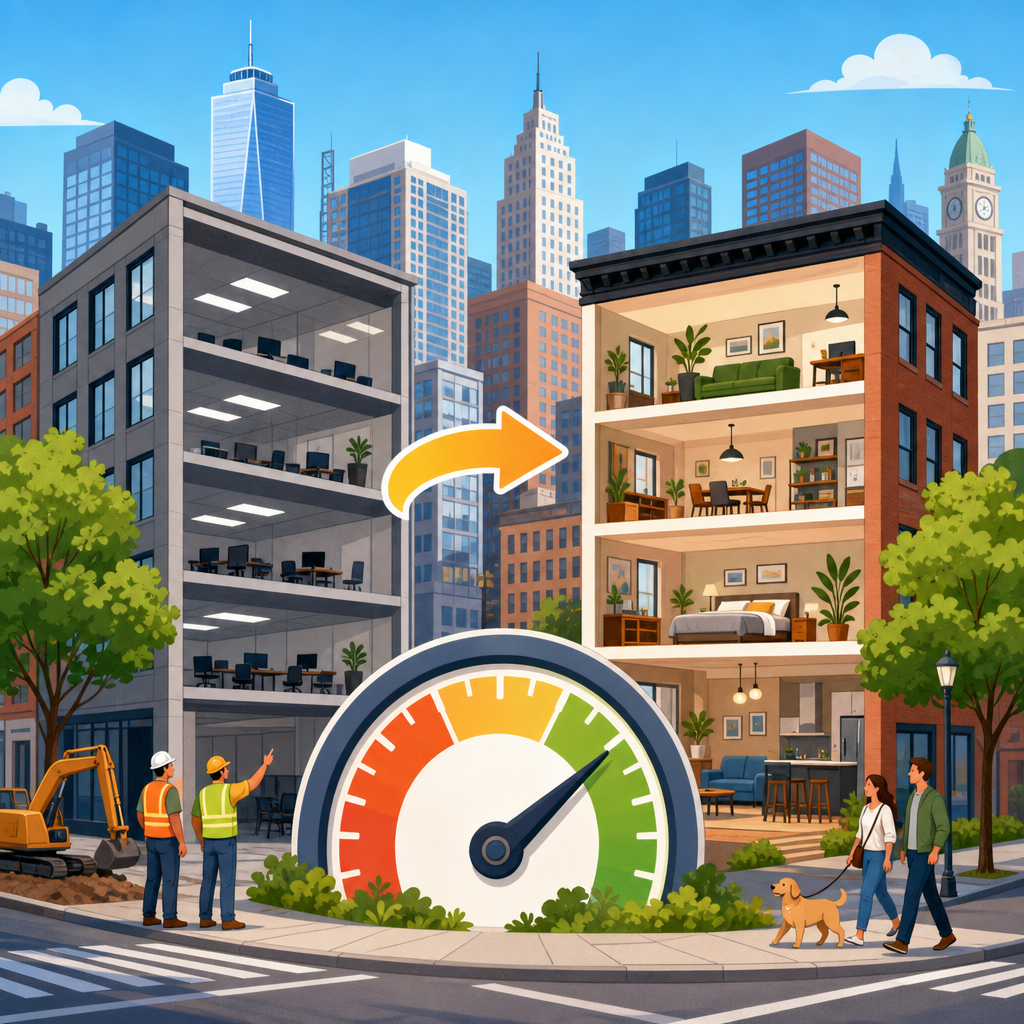
Office-to-residential conversion has become a defining question for city leaders, lenders, developers, and renters asking whether empty downtown towers can help relieve housing shortages. In simple terms, an office conversion turns a building designed for workplace use into apartments, condominiums, student housing, or mixed-income residences. The appeal is obvious: central business districts in many U.S. cities still carry elevated office vacancy after the pandemic, while housing costs remain high and supply remains constrained. I have worked on redevelopment and feasibility analyses around older commercial assets, and the first lesson is that conversions are neither a silver bullet nor a niche sideshow. They are a useful, limited tool whose impact depends on building design, financing, zoning, and local demand.
When people ask whether office conversions will move the needle on downtown housing supply, they usually mean three things at once. First, can conversions add enough units to matter at the city scale? Second, can they produce homes people can actually afford? Third, can they revive struggling downtowns by bringing in full-time residents who support restaurants, groceries, schools, and street activity? Those are related but different questions. A project can succeed as a building-level investment and still barely dent regional housing scarcity. It can also create valuable downtown foot traffic without meaningfully reducing rents across an entire metro area.
Definitions matter here. Downtown housing supply refers to the number of livable residential units available in the urban core, not the broader metropolitan inventory. A conversion differs from adaptive reuse more broadly because the target use is housing, with strict requirements for light, ventilation, egress, plumbing, acoustics, fire safety, accessibility, and sometimes seismic upgrades. Vacancy rate is the share of office space not leased. Feasibility is whether expected revenue from rents or sales can support acquisition, design, construction, financing, and operating costs. These concepts determine why some obsolete office buildings become apartments quickly while others sit empty despite favorable headlines.
This topic matters because downtowns are at an inflection point. Remote and hybrid work changed demand for office space, especially in older Class B and Class C buildings. At the same time, many cities need more housing near transit and jobs, and climate goals increasingly favor reuse over demolition when practical. Conversion can preserve embodied carbon, reduce blight, and diversify districts that once emptied after 5 p.m. Yet the economics are unforgiving. High interest rates, expensive construction labor, deep floor plates, and code compliance often limit what is possible. The real answer is nuanced: office conversions can help downtown housing supply, but only under specific conditions and usually as part of a larger housing strategy.
Why Office Conversions Attract So Much Attention
Office conversions attract attention because they promise to solve two visible urban problems with one intervention: too much obsolete office space and too little housing. In cities such as New York, Chicago, Washington, D.C., Calgary, and Philadelphia, policymakers have studied conversions as a practical reuse strategy for aging towers with weak leasing prospects. The idea is politically attractive because it focuses on existing buildings in transit-rich locations instead of greenfield expansion. For downtown business groups, new residents can stabilize retail demand beyond weekday lunch hours. For planners, conversions can help create a mixed-use core that is less vulnerable to swings in office demand.
There is also a timing advantage. A ground-up apartment building often requires assembly, entitlements, full structural construction, and long lead times. A conversion can, in some cases, move faster because the shell, foundations, elevators, and utility connections already exist. That does not mean conversions are easy. I have seen early underwriting look compelling until engineers map the structural grid, window spacing, and mechanical shafts, at which point projected unit counts fall sharply. Even so, the public perception of “empty offices becoming homes” resonates because the mismatch is visible on city streets. People can see half-empty towers and ask why that space cannot simply be repurposed.
Another reason for interest is that not all office vacancy is temporary. Some buildings are functionally obsolete for modern tenants because of low ceiling heights, outdated HVAC systems, poor natural light, limited amenities, or inefficient floor layouts. These assets may never regain prior rent levels without substantial reinvestment. In those cases, conversion may be the highest and best use. Cities with concentrated stocks of prewar or midcentury office buildings often have more candidates, especially where floor plates are narrow enough to support apartments with operable windows and acceptable bedroom layouts.
What Determines Whether a Building Can Become Housing
The biggest determinant is physical design. Residential buildings need access to natural light and ventilation for living spaces, efficient plumbing distribution, adequate acoustic separation, and safe egress. Many office towers have deep floor plates, meaning the distance from the window wall to the core is too large for normal apartment layouts. In practice, developers often target buildings with floor plate depths around 45 to 65 feet from window line to corridor arrangement, though exact feasibility depends on local code and design choices. Older office buildings with smaller footprints and operable windows are often better candidates than wide, glassy towers from the late twentieth century.
Core placement matters too. Elevators, stairs, risers, and restrooms in office buildings are designed around workplace occupancy patterns, not apartments. If the core consumes too much central space or sits awkwardly, planners struggle to create efficient unit mixes. Window spacing is equally important. Apartments require regular rhythm for bedrooms and living rooms, while many offices can tolerate less residential-friendly fenestration. Structural systems also drive cost. Concrete flat-plate structures can be easier to adapt than steel systems with awkward beam depths, but each building is different. Mechanical retrofits, facade upgrades, and fire-rating work can erase the apparent savings of reusing the shell.
Code compliance is the next filter. A conversion typically triggers changes under building, fire, energy, accessibility, and sometimes seismic codes. In many jurisdictions, a change of occupancy from business use to residential use means substantial upgrades. That may include sprinklers, pressurized stairs, additional shafts, insulation, new electrical service, and accessibility improvements under the Americans with Disabilities Act and Fair Housing Act standards, where applicable. Some cities have introduced specialized adaptive reuse ordinances to make compliant conversion more achievable. Those policies can reduce friction, but they do not repeal the laws of geometry or construction cost.
The Economics: Why Some Projects Pencil Out and Many Do Not
Feasibility comes down to spread: total development cost versus stabilized value or long-term income. Acquisition basis matters enormously. A building purchased at a steep discount after distress has a much better chance than one financed at pre-2020 office valuations. I have seen otherwise similar projects diverge entirely because one sponsor controlled the asset at a low basis while another was trapped by legacy debt. Construction costs are also highly variable. Conversion often requires extensive demolition, asbestos abatement, facade work, new plumbing stacks, electrical reconfiguration, and upgraded life safety systems. Those costs can rival or exceed some ground-up projects on a per-unit basis.
Financing conditions can make or break a deal. Lenders tend to underwrite conversions conservatively because of design uncertainty and lease-up risk. Interest rates, debt coverage requirements, and reserve assumptions directly affect viability. Public incentives therefore play an outsized role. Tax abatements, historic tax credits, low-income housing tax credits, tax increment financing, fee waivers, and direct subsidy can close gaps that private capital will not absorb on its own. Calgary’s downtown conversion program is frequently cited because it paired office surplus with municipal incentives to encourage residential reuse. Similar efforts in U.S. cities show that policy support can move projects from concept to construction, but usually not at scale without sustained funding.
| Factor | Helps conversion feasibility | Hurts conversion feasibility |
|---|---|---|
| Building shape | Narrow floor plates, operable windows, regular structural grid | Deep plates, large central core, poor window spacing |
| Acquisition basis | Distressed purchase price or low existing debt | High legacy valuation and refinancing pressure |
| Policy environment | Adaptive reuse code path, tax credits, abatements, fast permits | Rigid zoning, slow approvals, no subsidy tools |
| Market demand | Strong downtown rental demand and nearby amenities | Weak residential demand and limited neighborhood services |
Affordability is the hardest economic issue. Market-rate conversion can add supply, and added supply can ease pressure over time, but many downtown conversions target upper-middle or luxury renters because costs are high. Deep affordability usually requires layered subsidy, public land strategies, or inclusionary support. Without that, conversions may create valuable units while doing little for households at the lowest income levels. That does not make them irrelevant. It means their housing role is specific: they can expand downtown inventory and diversify product types, but they rarely substitute for large-scale affordable housing programs.
How Much Can Conversions Really Add to Downtown Housing Supply
The honest answer is that conversions can be meaningful locally and modest regionally. In a single downtown district, adding several thousand units over a few years can change street life, improve retail viability, and increase transit use outside commuter peaks. In a metro area facing a shortage of tens of thousands of homes, that same number is unlikely to transform overall affordability. Scale depends on inventory. Not every vacant office building is convertible, and not every convertible building can support enough units to justify the capital stack. A city may have high office vacancy by square footage yet only a small subset of buildings suitable for housing.
Research from firms such as CBRE, JLL, and RentCafe has consistently found that a relatively limited share of office inventory meets the physical criteria for conversion without extreme intervention. The exact percentages vary by market and methodology, but the pattern is stable: the candidate pool is much smaller than the headline vacancy number suggests. Buildings constructed before modern, oversized office floor plates often perform better in screening analyses. That means many Sun Belt and postwar glass towers are less adaptable than older masonry or smaller-footprint assets in legacy downtowns.
Unit yield can also disappoint compared with early political rhetoric. A 300,000-square-foot office building does not convert into 300,000 square feet of apartments. Common areas, enlarged shafts, new amenity space, setbacks, and awkward layouts reduce net rentable efficiency. Family-sized units are especially hard to deliver in some floor plates, so projects skew toward studios and one-bedrooms. Those units are still useful, particularly for young professionals, students, and downsizing households, but they do not fully meet every segment of housing demand. In my experience, the projects that work best are framed as one component of a broader downtown residential strategy, not as the singular fix for the housing crisis.
Where Office Conversions Fit in a Broader Housing Strategy
Office conversions work best when combined with zoning reform, faster permitting for new housing, transit investment, and support for neighborhood services. Downtown housing supply increases most meaningfully when cities allow ground-up apartments, accessory dwellings, missing-middle housing in adjacent neighborhoods, and multifamily infill near transit corridors. Conversions complement those moves by reusing stranded assets in the core. They are particularly valuable where city leaders want to rebalance a monoculture office district into a true mixed-use neighborhood.
Successful downtown living requires more than apartments. Residents need grocery stores, schools, daycare, parks, healthcare, and safe streets. A converted tower in a district with no daily services may lease slowly or attract a narrow renter profile. By contrast, a cluster of projects can reach critical mass. Lower Manhattan is a useful long-run example: decades of office-to-residential conversion, aided by policy tools and changing market demand, helped create a more residential neighborhood, though affordability pressures remained. The lesson is that housing supply is not just a building count. It is an ecosystem of homes, services, public space, and transportation that makes year-round urban living practical.
Conclusion: Will They Move the Needle?
Yes, office conversions can move the needle on downtown housing supply, but the needle is district-scale more often than metro-scale. They are most effective in older or obsolete office buildings with favorable geometry, strong residential demand, supportive codes, and some form of financial gap-closing assistance. They can add residents, reduce blight, preserve useful structures, and help downtowns become active neighborhoods instead of nine-to-five employment zones. They cannot, by themselves, solve a regional housing shortage or deliver widespread affordability without public subsidy.
The clearest takeaway is that office conversion is a selective strategy, not a universal formula. City leaders should screen buildings rigorously, target incentives where physical feasibility is real, and pair conversions with broader pro-housing reforms. Developers should be disciplined about basis, code risk, and unit mix. Residents and policymakers should judge success by realistic measures: homes added, streets activated, emissions avoided, and neighborhood services supported. If you are evaluating housing market trends in any downtown, start by asking not whether conversion is trendy, but whether the building, the financing, and the neighborhood truly support housing.
Frequently Asked Questions
1. Can office-to-residential conversions meaningfully increase downtown housing supply?
They can help, but in most cities they are more likely to be a targeted supply strategy than a single solution to the housing shortage. Office conversions can add homes in places where land is scarce, entitlement timelines are long, and downtown vacancy has left buildings underused. That makes them especially attractive to local leaders looking for visible ways to reactivate central business districts while creating new housing options near jobs, transit, universities, restaurants, and cultural amenities.
The key limitation is scale. Not every office building can be converted efficiently, and even when a project works, the number of units delivered is often modest relative to an entire metro area’s housing deficit. A successful conversion may produce dozens or hundreds of apartments, which is meaningful at the corridor or neighborhood level, but it usually does not erase years of underbuilding across a region. In other words, conversions can move the needle in downtown districts and contribute to broader supply goals, but they rarely replace the need for ground-up multifamily development, zoning reform, and more housing production in surrounding neighborhoods.
Where conversions are most impactful is in markets with a large inventory of obsolete office stock, strong residential demand downtown, and public policies that reduce risk. In those conditions, conversions can preserve buildings, fill vacant towers, support local retail, and create a more balanced mix of uses in business districts that were once dependent on weekday office traffic. So the honest answer is yes, conversions can matter, but their effect is highly city-specific and works best as one part of a broader housing strategy.
2. Why aren’t all empty office buildings being turned into apartments?
The biggest reason is that office buildings and residential buildings are not interchangeable, even if they look similar from the outside. Many office towers were designed with deep floor plates, meaning large distances from the window line to the core. That works for offices because workers can sit farther from natural light, but apartments need windows, ventilation, privacy, and layouts that support kitchens, bathrooms, bedrooms, and living spaces. If too much of a floor is far from windows, the resulting units can be awkward, dark, or noncompliant with residential codes.
Mechanical systems are another major obstacle. Residential buildings need significantly different plumbing, electrical, fire safety, and ventilation systems than offices do. Apartments require many more bathrooms and kitchens spread across the floor plate, which means extensive new piping and vertical shafts. Elevators, emergency egress, acoustic insulation, and operable windows may also need major upgrades. In older buildings, asbestos, outdated systems, and structural limitations can further raise costs and complicate redevelopment.
Economics are just as important as architecture. A building may be technically convertible but still financially infeasible if acquisition costs are too high, debt terms are unfavorable, renovation costs are excessive, or projected rents are not strong enough to support the project. Lenders often view conversions as more complex and risky than conventional multifamily development, especially when there is uncertainty around construction surprises and lease-up performance. As a result, many vacant office buildings remain stuck in limbo not because no one has considered conversion, but because the math, the design, or both do not work.
3. What types of office buildings are the best candidates for residential conversion?
In general, older or underperforming office buildings with relatively narrow floor plates, operable windows or adaptable facades, and manageable structural layouts tend to be the strongest candidates. Buildings constructed before the most expansive modern office towers often have dimensions that are better suited to apartment layouts. Historic buildings can be especially attractive because they may offer architectural character, tax credit opportunities, and smaller floor depths that make unit planning easier.
Location also matters as much as building design. The most promising conversion candidates are usually in downtown areas where people already want to live or where city policy is actively trying to create a stronger residential base. Proximity to transit, grocery options, parks, nightlife, schools, and healthcare can improve marketability and long-term value. If a building is isolated in a district that goes quiet after business hours and lacks everyday neighborhood services, the residential proposition becomes harder, even if the physical building is workable.
Developers also look closely at basis and repositioning potential. Buildings with declining office demand, expiring leases, or lower acquisition prices may create an opportunity to buy at a discount and reinvest. In some cases, Class B and Class C office properties are better candidates than top-tier trophy towers, because the latter may still have viable office futures or be too expensive and complex to retrofit. The best candidates sit at the intersection of physical feasibility, favorable pricing, and a downtown environment that can support full-time residents rather than just office workers.
4. Do office conversions create affordable housing, or mostly higher-end apartments?
Most office-to-residential conversions tend to produce market-rate housing unless there are subsidies, tax incentives, inclusionary requirements, or public-private partnerships that support affordability. The reason is straightforward: conversions are often expensive. Acquisition, demolition, structural modifications, plumbing retrofits, code compliance, and financing costs can be substantial, which pushes developers toward rents or sale prices that can cover those costs. In many downtown markets, that means the resulting homes skew toward higher-income renters unless policy tools intervene.
That said, conversions can still support affordability in a broader sense, even when they are not formally income-restricted. Adding market-rate units can relieve pressure at the upper end of the market and help reduce competition for existing housing stock elsewhere. Economists and housing analysts often point out that supply added at any price point can improve overall market functioning over time, though the timing and magnitude of that effect vary by city. Still, for households facing acute affordability challenges, indirect benefits are not the same as dedicated below-market housing.
If cities want conversions to produce mixed-income outcomes, they usually need to pair them with incentives such as low-income housing tax credits, property tax abatements, zoning flexibility, low-cost financing, or grants for gap funding. Some cities are experimenting with programs that encourage a share of affordable units in conversion projects, while others focus on making the overall economics feasible first and affordability second. The result is that conversions can produce affordable housing, but it typically happens by design, not by default.
5. What should city leaders, developers, and renters realistically expect from office conversions over the next few years?
City leaders should expect office conversions to become a meaningful redevelopment tool, particularly for struggling downtown corridors, but not a universal fix for vacancy or housing scarcity. The most successful programs will likely be those that identify specific candidate buildings, streamline permitting, coordinate code flexibility where appropriate, and offer targeted incentives rather than assuming every empty tower can or should be repurposed. Cities that treat conversions as part of a broader downtown recovery strategy, including public safety, retail activation, transit service, and public realm improvements, will likely see better results than those relying on building reuse alone.
Developers should expect highly selective deal flow. The next few years are likely to separate feasible conversion opportunities from properties that remain economically distressed or physically incompatible with residential use. Detailed due diligence will remain essential, including unit yield studies, structural and systems analysis, code review, and realistic underwriting for construction contingencies. Developers who can combine technical expertise with creative capital stacks, including historic credits or local incentives, will be better positioned to bring projects across the finish line.
Renters should expect more downtown living options in some cities, especially in buildings that offer adaptive reuse character and central locations, but they should not assume conversions will rapidly flood the market with inexpensive housing. New units may improve neighborhood vitality, extend activity beyond business hours, and create more diverse housing choices in urban cores. However, the pace will likely be uneven, with some cities seeing a wave of projects and others seeing only a handful. The realistic takeaway is that office conversions can help reshape downtown housing supply and urban life, but their impact will depend on local economics, building conditions, and policy support.