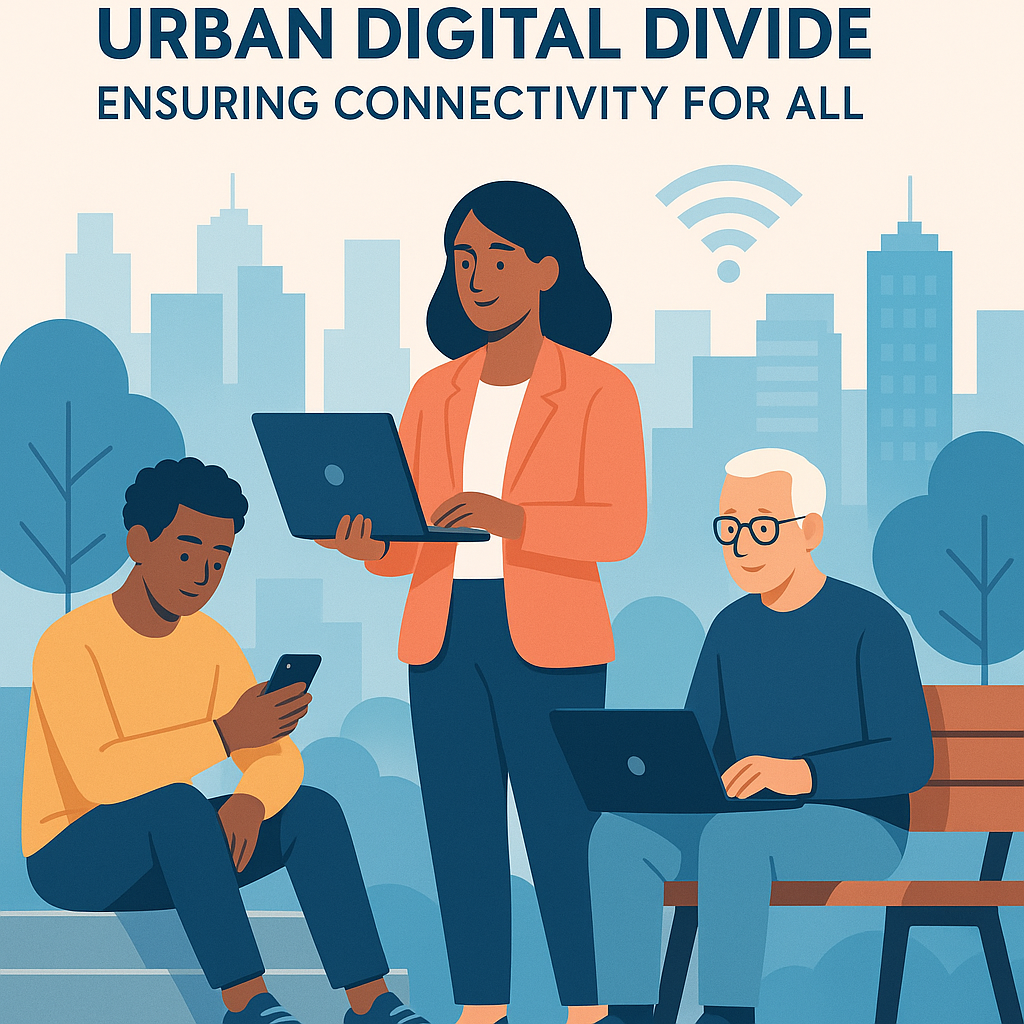
In the bustling fabric of modern cities, a new kind of inequality is emerging, one that revolves around access to digital resources—this is what we know as the “urban digital divide.” This term refers to the gap between those individuals and communities who have access to modern information and communication technologies (ICT) and those who do not, or who have restricted access. It is not just about owning a smartphone or a laptop; rather, it encompasses the availability of affordable, high-speed internet, digital literacy, and the ability to leverage digital tools for personal and professional growth. The urban digital divide matters profoundly because, in today’s hyper-connected world, unequal access to digital resources equates to unequal access to opportunities. Bridging this gap is critical for ensuring that people from all walks of life can enjoy a fair chance at success in a digitally-driven economy. As city planners and policymakers grapple with this growing issue, understanding its impact is vital for creating inclusive urban communities that are both technologically and economically thriving.
The Root Causes of the Urban Digital Divide
Understanding the root causes of the urban digital divide requires an examination of multiple socioeconomic factors. The divide is often linked to income disparities where low-income households find it challenging to afford reliable internet services. For instance, in a city like New York, research reveals that many low-income neighborhoods are still underserved by broadband providers. This lack of infrastructure can perpetuate disadvantages and hinder economic mobility. Furthermore, educational inequities play a significant role, as schools in financially disadvantaged areas may not have the resources to provide students with necessary digital literacy skills. Without these skills, individuals cannot effectively leverage the digital tools available to transcend their current circumstances. Thus, to truly comprehend the divide, one must consider the intersecting influences of income, education, and infrastructure.
Real-World Example: The Impact on Education
The effects of the urban digital divide on education are profound and far-reaching. Take, for example, Chicago, where significant discrepancies exist between well-resourced schools in affluent neighborhoods and underfunded schools in poorer areas. This educational gap became particularly evident during the COVID-19 pandemic when students transitioned to remote learning. Many students in underserved communities lacked devices and reliable internet connections, resulting in a significant loss of learning. While programs were initiated to provide laptops and Wi-Fi hotspots, the stopgap measures were insufficient to meet the demand. An analysis showed that students in these neighborhoods experienced a more substantial learning loss compared to their peers in wealthier areas, illustrating the digital divide’s direct impact on educational equity. Addressing these inequalities requires systemic changes to ensure every child has access to the tools needed to succeed in a digital classroom.
Economic Implications: A Case Study on Employment
In the context of employment, the urban digital divide can have severe implications for job acquisition and career advancement. Consider the city of Atlanta, where data indicates that many jobs require digital skills or the ability to work remotely, a trend that was further cemented during the pandemic. Individuals who lack access to the internet or the skills to use digital tools are at a distinct disadvantage in the job market. For instance, a potential job candidate without a stable internet connection will struggle to complete online job applications or participate in virtual interviews, hindering employment opportunities. Moreover, the absence of digital literacy skills can also restrict career progression, as many in-demand jobs require proficiency with specific software or platforms. This reinforces the need for comprehensive digital education programs that not only equip individuals with necessary devices but also arm them with the pertinent skills required for modern-day employment.
The Social Divide: Bridging Connectivity Gaps in Communities
The social aspects of the digital divide extend beyond individual capabilities to the community’s collective connectivity. This is vividly seen in cities like San Francisco, where specific communities remain digitally isolated, despite the city’s reputation as a tech hub. Factors such as language barriers, age, and cultural differences significantly contribute to the divide. In neighborhoods heavily populated by immigrants, language may pose a challenge in accessing and using digital tools effectively. Older community members may find themselves unable to utilize technology due to a lack of training or understanding. The result is a community that feels disconnected from broader societal interactions, leading to a sense of isolation. Community-driven initiatives, such as local tech workshops and language-specific digital literacy programs, are crucial for fostering inclusivity and ensuring that all community members are digitally connected.
- Improve infrastructure in low-income areas to provide affordable, high-speed internet access.
- Implement digital literacy programs in schools, focusing on disadvantaged communities.
- Support community-based initiatives to drive local digital inclusion efforts.
- Encourage public-private partnerships to increase digital accessibility.
Policy Solutions: Initiatives to Close the Gap
Policymakers play a pivotal role in addressing the urban digital divide by crafting strategies and policies that promote digital equity. Successful initiatives often involve collaboration between government entities, private companies, and local communities. A notable example is Los Angeles, where the city partnered with private telecom companies to expand free public Wi-Fi access across underserved neighborhoods. Additionally, the creation of digital literacy programs tailored for adults reinforces skills pertinent to current job markets. Effective policymaking also requires continuous assessment and adaptation, as technology and its role within society are continually evolving. Lawmakers must be proactive and committed to sustainable solutions that emphasize both infrastructural and educational advancements while promoting inclusivity.
Infrastructure Advancements: The Role of Urban Planning
Urban planners are instrumental in bridging the digital divide by integrating infrastructure development with technological advancements. Cities such as Philadelphia have pioneered their path with the implementation of “smart city” technologies to ensure equitable access. The “LinkPHL” program, for instance, which provides free public Wi-Fi through strategically placed kiosks around the city, strives to improve connectivity for all residents, regardless of income level. Moreover, by adopting a holistic approach that includes expanding broadband infrastructure and incentivizing private sector participation, cities can ensure more uniform internet coverage. Such developments are vital for fostering digitally inclusive environments, ultimately resulting in better connectivity outcomes for urban populations.
Working Towards a Digitally Inclusive Future
The journey towards achieving digital inclusivity requires a concerted effort from various societal sectors, including government, education, technology, and community organizers. The city of Toronto serves as an exemplary model through its “Digital Infrastructure Plan,” which outlines long-term goals to address technological diversification while fostering inclusivity. This plan emphasizes partnerships between public sectors and local communities, ensuring that every group, irrespective of socioeconomic status, can access digital resources. Schools and community centers act as pivotal agents in implementing digital literacy training, thereby preparing citizens for a digitally-driven future. Through these strategic efforts, cities can pave the way for a more equitable technology landscape, wherein every individual, community, and sector can contribute and benefit from digital advancements.
Conclusion: Bridging the Divide for a Connected Tomorrow
Bridging the urban digital divide is a crucial task that demands not only acknowledgment of the problem but actionable solutions that address its root causes. As outlined in various real-world examples and impact studies, ensuring digital inclusivity is not merely an infrastructural challenge but also an educational and social imperative. The consequences of inaction are far-reaching, affecting educational outcomes, economic opportunities, and social cohesion. By investing in infrastructure, promoting digital literacy, and fostering collaborative policy initiatives, cities can not only tackle current disparities but also safeguard against future ones. The main benefit of addressing the divide is clear: a more inclusive, connected society that thrives on the equitable distribution of digital resources. Individuals, educators, policymakers, and community leaders alike should champion this cause to ensure connectivity for all. Our call to action is straightforward: participate in local forums, support initiatives that promote digital accessibility, and advocate for policies that ensure no community is left in the digital shadows. Let us work together to build a digitally inclusive tomorrow where everyone has the opportunity to flourish.
Frequently Asked Questions
1. What is the urban digital divide, and how does it impact communities?
The urban digital divide refers to the disparity in access to information and communication technologies (ICT) among different communities in urban areas. This divide manifests as a lack of access to essential digital resources such as high-speed internet, modern devices, and the skills necessary to benefit from these technologies. The impacts of this divide are wide-ranging. Individuals and communities on the disadvantaged side often struggle with impediments to education, as online learning becomes increasingly important. They may also face challenges in accessing job opportunities, which are steadily shifting online. Access to healthcare information can also be limited, as more healthcare services offer digital solutions. Overall, the urban digital divide exacerbates socioeconomic inequalities, where those without proper digital access find themselves unable to participate fully in modern economic, educational, and social opportunities.
2. Why does the urban digital divide exist even in cities where technology is prevalent?
Cities are often perceived as hubs of technological advancement, yet the urban digital divide persists due to several factors. Firstly, the cost of ICT services and devices can be prohibitive for low-income individuals and families, making it difficult for them to have adequate access. Additionally, there might be a lack of infrastructure in certain neighborhoods, particularly in disadvantaged areas, where service providers are less inclined to invest. Education also plays a significant role; there may be communities where individuals lack the digital literacy or skills required to utilize available technologies effectively. Language barriers can further exacerbate this divide, especially for immigrant populations who may not be fluent in the primary language of the digital content available. These factors combined create a scenario where, despite the prevalence of technology, not everyone in urban areas can access or benefit from it equally.
3. What are some strategies to bridge the urban digital divide?
Bridging the urban digital divide requires a multi-faceted approach. First and foremost, affordable internet should be made available to all urban residents. This could include government-subsidized programs or partnerships with private companies to lower costs. Infrastructure development is another critical strategy—ensuring that high-speed internet access reaches under-served neighborhoods. Enhancing digital literacy through education initiatives can empower individuals to utilize technology effectively, providing workshops and training in community centers or schools. Public access to technology must also be increased through public libraries and community centers equipped with devices and internet access. Additionally, policies supporting equitable access to public resource distribution, such as grants for technology purchase, can help those at a financial disadvantage. Collaborations between governmental bodies, private sector, and non-profits are essential in creating comprehensive programs tailored to the needs of different communities.
4. How does the digital divide affect education in urban areas?
The digital divide significantly impacts education, creating unequal learning opportunities among students in urban areas. Students without reliable internet access or digital devices struggle to complete homework, participate in virtual classes, or access online learning resources, putting them at a disadvantage compared to their peers. This gap in access can lead to lower academic performance, decreased motivation, and a widening educational achievement gap. Furthermore, lack of exposure to technology can hinder skill development that is critical in today’s digital economy, affecting long-term employment prospects. Schools can play a fundamental role in addressing this divide by providing devices to students and facilitating broadband access within schools as well as partnering with community resources to ensure students have the connectivity and tools they need outside of school hours.
5. Can increased digital access truly resolve socioeconomic disparities in urban areas?
While increasing digital access is a critical step towards equity, it is not a panacea for all socioeconomic disparities. Digital access must be coupled with broader policy efforts to tackle underlying systemic issues such as income inequality, education quality, and employment opportunities. Digital access can serve as a powerful tool that opens up new pathways for education, innovation, and economic participation. For instance, access to online learning can provide individuals with valuable skills that improve their employability, while small businesses can reach wider markets through e-commerce platforms. However, without addressing the root causes of poverty and inequality, increased digital access alone will not suffice. Comprehensive strategies that integrate digital inclusion with economic and social policies are necessary for meaningful and sustained impact in reducing urban socioeconomic disparities.