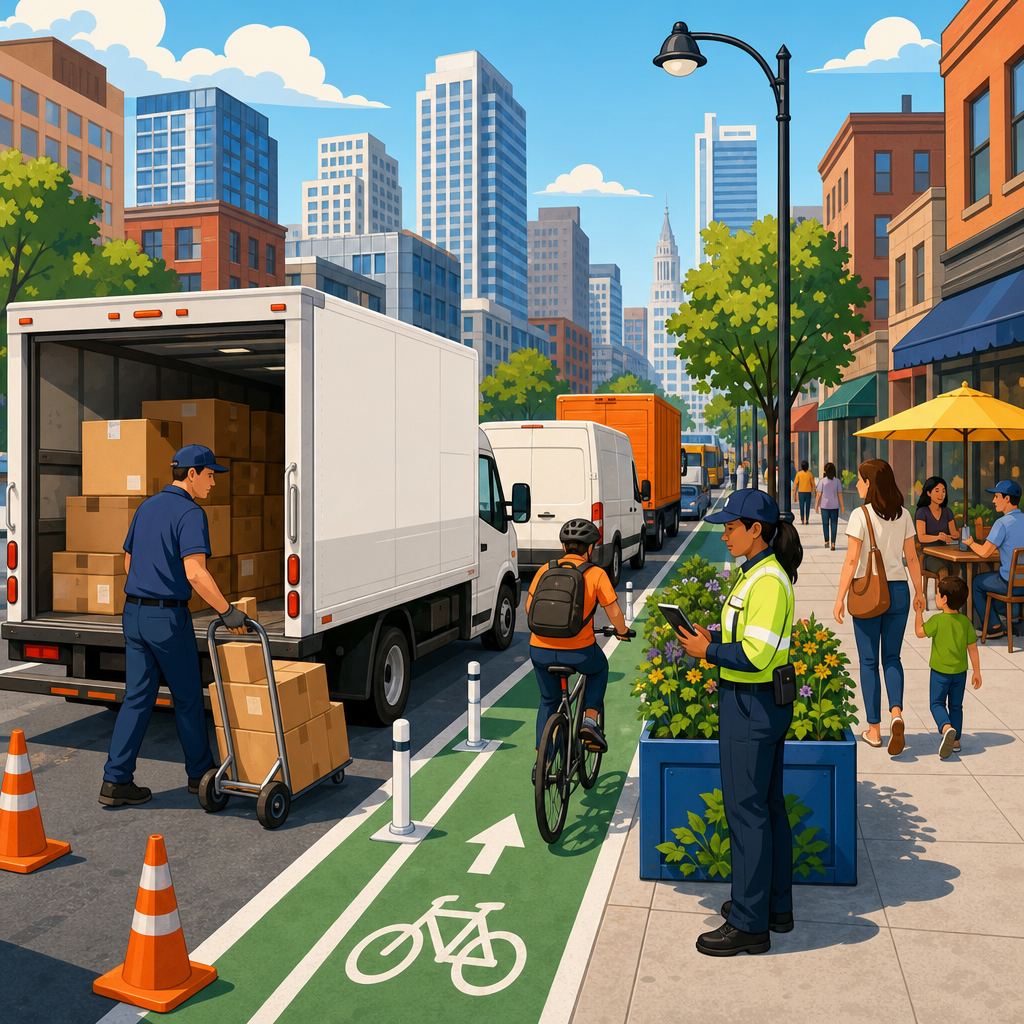
Urban freight now competes for the same few feet of curb space as buses, bike lanes, ride-hail pickups, outdoor dining, waste collection, micromobility parking, and private cars, turning the curb into one of the most contested assets in modern city governance. The urban freight curb crisis refers to the mismatch between rising delivery demand and outdated curb management systems that were designed for longer parking stays, lower parcel volumes, and less pressure from e-commerce. It matters because the curb is not a minor streetscape detail; it shapes congestion, safety, emissions, business access, and the daily reliability of urban logistics. When delivery drivers cannot find legal loading space, they circle blocks, stop in travel lanes, block bike lanes, double-park, or park far away and wheel goods through crowded sidewalks. Each workaround adds cost and risk. In practice, I have seen a single missed loading zone on a busy commercial street cascade into delayed routes, frustrated store owners, bus slowdowns, and near conflicts with cyclists within minutes. That is why cities are treating curb management as transportation policy, freight policy, climate policy, and public realm policy at the same time.
Urban freight includes parcel delivery, food and grocery distribution, construction materials, service vehicles, and business-to-business shipments. Curb management includes loading zones, parking rules, pricing, signage, permits, enforcement, and digital reservation systems that govern who can stop, where, and for how long. The crisis has intensified for three structural reasons. First, e-commerce has expanded rapidly, increasing the number of stops per route even when shipment sizes are smaller. Second, cities have reallocated street space for safety and placemaking goals, often correctly, but without giving equal attention to how goods still need to move. Third, most curb regulations remain static while freight demand is highly dynamic by hour, day, and season. The result is friction that traditional parking rules cannot solve. A city may publish loading hours on a sign, yet the real question is whether the rule matches actual delivery patterns for pharmacies, restaurants, offices, and apartment buildings on that block. Good urban freight policy starts by answering that question with data.
Why the curb crisis escalated so quickly
The main driver is the growth of urban deliveries combined with scarce street space. A mixed-use corridor that once handled a handful of daily store replenishment trips may now also receive parcel vans serving residents, app-based grocery orders, courier drop-offs, and same-day business deliveries. Freight vehicles need short dwell times close to front doors. If the nearest curb is occupied by all-day parking or passenger loading, deliveries spill into unsafe places. This is not just an inconvenience for drivers. Double-parking reduces road capacity, slows buses, increases lane-changing conflicts, and creates sightline problems at intersections. On protected bike corridors, illegal stopping in the bike lane forces riders into mixed traffic, which raises crash risk. New loading demand also clusters at predictable peaks, especially morning business deliveries and afternoon residential parcels, meaning the busiest blocks fail first.
City policy has sometimes worsened the problem unintentionally. Many downtowns reduced general traffic lanes, expanded sidewalks, added parklets, and installed bus priority corridors. Those changes often produce public benefits, but freight access was not always redesigned alongside them. In several curb audits I have worked on, loading zones remained where land use had changed years earlier, while newly dense apartment blocks had no designated delivery space at all. Static signs also fail on blocks that serve different users by time of day. A restaurant district may need produce deliveries before noon, passenger pickup in the evening, and overnight access for sanitation. If a city uses one rule for twenty-four hours, it wastes capacity. The crisis is therefore not simply a shortage of curb space; it is a shortage of managed, right-timed curb space.
What poor freight curb management costs cities
The costs show up in operations, safety, environment, and local commerce. For carriers, failed first attempts and extra circling increase labor time, fuel use, and route variability. That variability matters because urban delivery networks depend on dense stop sequencing. If one stop runs ten minutes late because no loading space is available, every downstream stop becomes harder to meet. For cities, congestion from curb friction imposes broader network delays. Transit agencies lose bus speed and schedule reliability when buses must merge around stopped vans. Emergency access can also be compromised on narrow streets where an illegally stopped truck narrows the corridor.
Safety impacts are equally significant. The Federal Highway Administration and NACTO have both emphasized that curb activity affects visibility, crossing safety, and the functioning of bike facilities. A delivery van parked near a crosswalk can hide pedestrians from turning drivers. A truck unloading from a travel lane creates abrupt maneuvers around it. Workers themselves face risks when they carry heavy goods across active traffic or wheel dollies long distances because legal curb access is unavailable. Environmental effects follow from the same pattern: more idling, more cold starts, and more circling. Even electric vans do not solve curb inefficiency because they still block lanes and waste driver time. Local businesses are affected too. Reliable loading access helps restaurants receive fresh goods on schedule, pharmacies maintain stock, and contractors keep projects moving. When freight fails, the city economy feels it quickly.
How cities are measuring freight demand and curb use
The strongest city responses begin with evidence rather than assumption. Traditional parking occupancy studies are not enough because freight needs are short-duration and highly time-sensitive. Cities now use curb inventories, manual observations, camera analytics, GPS traces from fleets, citation data, and interviews with carriers and merchants to understand actual dwell time and turnover. Seattle, New York City, and Washington, DC have all tested data-driven freight curb programs that map where loading demand is concentrated and when violations are most common. In my experience, the most useful baseline is a block-by-block inventory tied to land use and front-door conditions, then validated with field observation during peak delivery windows. That method quickly reveals where signs are obsolete, where curb length is insufficient, and where loading zones are being used by the wrong vehicles.
Good measurement also separates passenger loading from freight loading, because the two are often mixed in practice but require different dwell patterns. Passenger pickups are brief and frequent; freight stops may require ramp access, hand truck movement, or multiple building entries. Several cities now classify curb use by purpose and time period so they can redesign regulations with more precision. Dynamic curb pilots go further by testing reservations, geofenced loading areas, or variable pricing by hour. The lesson from these pilots is consistent: once a city can see actual demand, it can move from reactive enforcement to planned allocation. Data does not eliminate political tradeoffs, but it makes them explicit and defensible.
Policy tools cities are using right now
Cities are not relying on one fix. The most effective programs combine curb reallocation, pricing, enforcement, and digital management. Converting selected metered parking spaces into commercial loading zones is still the fastest intervention, especially on retail corridors with chronic double-parking. Time-of-day rules are equally important. A curb that functions as freight loading from six to eleven in the morning can switch to short-term customer parking at midday and restaurant pickup in the evening. Dynamic management increases productivity without adding asphalt. Pricing can help too. Where demand is intense, charging for premium curb access encourages turnover and funds administration, though cities must calibrate rates carefully so they do not simply push violations elsewhere.
| Tool | How it works | Best use case | Main limitation |
|---|---|---|---|
| Commercial loading zones | Reserves curb space for freight vehicles with posted time limits | Retail streets with repeated double-parking | Needs active enforcement |
| Time-of-day regulations | Changes allowed use by hour, such as freight mornings and passenger evenings | Mixed-use corridors with shifting demand | Signage can confuse users |
| Digital reservations | Lets carriers book loading windows through an app or platform | Dense downtown blocks with predictable demand | Requires technology adoption |
| Demand-based pricing | Charges for high-value curb access to improve turnover | Commercial cores with scarce space | Political resistance is common |
| Microhubs and cargo bikes | Transfers parcels to smaller vehicles near final destination | Congested centers and low-emission zones | Needs real estate and operating model |
Enforcement is the hinge that makes every other tool credible. If private cars occupy loading zones all day, carriers will not trust the system and will revert to illegal stopping. Several cities have improved compliance through license plate recognition, focused patrols, and higher penalties for blocking transit lanes or bike lanes. Some have also modernized permitting so legitimate commercial users can be identified more accurately. Yet enforcement alone cannot fix a bad design. If there are too few loading spaces or the rules do not match delivery windows, tickets simply tax failure. The best programs pair fair enforcement with realistic access.
Microhubs, cargo bikes, and off-hour delivery strategies
Where curb scarcity is severe, cities are experimenting beyond the block face. Urban consolidation centers and neighborhood microhubs allow carriers to transfer goods from larger trucks to smaller vehicles closer to the final destination. Cargo bikes are especially effective for parcels, food, and small business deliveries in dense cores because they require less space, can use narrower access points, and reduce conflicts created by large vans searching for curb. European cities have advanced these models further, but North American pilots are growing as well. New York City has tested micro-distribution concepts, while cities such as Portland and Seattle have explored cargo bike delivery for central districts. These systems work best where stop density is high and shipment size is moderate.
Off-hour delivery is another proven response. By shifting some deliveries to early morning, evening, or overnight periods, cities can reduce daytime congestion and improve route reliability. New York City’s off-hour delivery research showed that carriers and receivers can cut parking violations and travel time when deliveries are rescheduled outside peak periods, especially if buildings and businesses can accept goods securely. The tradeoff is noise. Off-hour programs must use quiet delivery practices, including low-noise equipment, driver training, and building protocols. Not every land use can support them, but for supermarkets, hotels, and some office buildings they can be highly effective. The broader point is that cities do not have to solve freight solely by redistributing daytime curb; they can also reshape when deliveries happen and how the final leg is performed.
What effective city freight curb programs have in common
The most successful responses share five traits. First, they treat freight as essential urban infrastructure rather than a nuisance to be squeezed into leftover space. Second, they use block-level data and revisit allocations regularly because land use and delivery patterns change. Third, they coordinate transportation, planning, economic development, sanitation, and enforcement instead of leaving the curb to one department. Fourth, they engage carriers, property managers, small businesses, and residents early, since each group sees different parts of the problem. Fifth, they measure outcomes clearly: reduction in double-parking, improved turnover, fewer bus delays, safer bike operations, and better delivery reliability.
Cities also need realistic expectations. There is no universal curb formula because the right design depends on street width, building type, freight mix, and local politics. A wholesale market, a hospital district, and a residential tower corridor will require different rules. Technology helps, but it is not a substitute for governance. Reservation platforms, sensors, and analytics only produce value when regulations are understandable and enforced consistently. Likewise, sustainability goals need operational grounding. Electrifying fleets is important, but if electric vans still spend ten minutes circling for space, the city has only solved part of the problem. Effective urban freight policy starts with access, then integrates emissions, safety, and public realm goals around it.
The urban freight curb crisis is ultimately a management crisis, not proof that deliveries and livable streets are incompatible. Cities can support commerce, safety, and cleaner transport at the same time when they allocate curb space based on actual use instead of historical habit. The clearest lesson from current practice is that freight needs a seat at the table whenever streets are redesigned. Loading zones, timed access, digital reservations, microhubs, cargo bikes, and off-hour delivery are not fringe ideas anymore; they are the working toolkit of modern curb policy. Used together, they reduce double-parking, improve travel reliability, and make streets function better for everyone.
For planners, transportation agencies, business groups, and property owners, the next step is straightforward: audit the curb by block, identify where freight demand actually occurs, and match regulations to that pattern. Start small if necessary, but start with evidence and measure the results. Cities that do this well will move goods more efficiently, protect vulnerable road users, and get more value from every foot of curb. That is the real opportunity in responding to the urban freight curb crisis.
Frequently Asked Questions
What is the urban freight curb crisis, and why has it become such a major issue for cities?
The urban freight curb crisis is the growing mismatch between today’s delivery demand and curb management systems that were built for a very different era. In many cities, curb space was historically regulated around private car parking, scheduled loading, and relatively predictable commercial activity. That model no longer fits current conditions. E-commerce has increased the number of parcel deliveries, on-demand services have accelerated pickup and drop-off activity, and cities have reallocated curb frontage to bus lanes, protected bike infrastructure, parklets, outdoor dining, micromobility corrals, and accessibility improvements. As a result, freight vehicles often compete for the same limited space as nearly every other transportation use.
This has become a major governance issue because the curb is not just a strip of pavement; it is one of the most intensively used pieces of public right-of-way. When deliveries cannot find legal, convenient loading space, the effects ripple outward quickly. Drivers may double-park, block bike lanes, occupy bus stops, circle the block, or stop in travel lanes. That creates congestion, safety conflicts, delayed transit service, and frustration for residents, retailers, and carriers alike. The crisis is ultimately about capacity, policy, and coordination. Demand for curb access has risen sharply, but the rules, pricing, enforcement practices, and data systems used to manage that demand often remain fragmented or outdated.
Why does limited curb space affect far more than delivery companies?
Limited curb space affects entire urban systems because freight activity is deeply connected to how cities function day to day. Deliveries supply restaurants, grocery stores, pharmacies, offices, construction sites, and homes. When freight operations become inefficient at the curb, the consequences are felt not only by logistics providers but also by businesses waiting on inventory, residents expecting packages, transit riders navigating blocked lanes, and cyclists dealing with unsafe obstructions. What looks like a simple parking problem is actually a broader issue of street operations, economic productivity, and public safety.
There is also an environmental and equity dimension. Trucks and vans searching for legal places to stop add vehicle miles traveled, fuel consumption, and emissions. Repeated cruising and idling can worsen air quality in dense neighborhoods that may already face disproportionate transportation burdens. At the same time, poorly managed curb space can undermine accessibility if loading activity blocks curb ramps, crosswalks, or paratransit zones. In practical terms, curb allocation decisions determine who gets reliable access to the street edge and when. That is why cities increasingly treat curb policy as a strategic public management issue rather than a narrow freight industry concern.
What are cities doing to respond to the urban freight curb crisis?
Cities are responding with a mix of operational, regulatory, and technology-driven strategies. One common approach is redesignating curb space so that loading zones better reflect actual demand by time of day and land use. Instead of using static rules that treat the curb the same way all day long, many cities are testing dynamic curb management, where spaces can serve freight loading during business hours, passenger pickup during peak periods, and other uses at different times. This helps maximize limited frontage without permanently favoring a single use.
Another major response is the use of data. Cities are deploying curb sensors, license plate recognition, reservation systems, digital permitting tools, and carrier partnerships to better understand dwell times, turnover, peak delivery periods, and illegal stopping patterns. With that information, transportation departments can make more precise decisions about where loading zones should be located, how long vehicles should be allowed to stay, and what prices or penalties should apply. Some cities are also piloting off-hour delivery programs, consolidation centers, microhubs, cargo bike deliveries, and dedicated commercial loading policies designed to reduce pressure on the busiest blocks. The broader shift is away from passive regulation and toward active curb management informed by real usage patterns.
How do pricing, enforcement, and delivery scheduling help improve curb management?
Pricing, enforcement, and scheduling are critical because curb scarcity is fundamentally a demand management problem. If valuable curb space is underpriced or free, it tends to be overused, misused, or occupied longer than necessary. By introducing variable pricing for commercial loading, cities can encourage turnover and direct delivery activity toward legal spaces rather than letting the strongest or fastest users dominate access. Pricing can also help match curb use to neighborhood conditions, with denser, high-demand commercial areas often requiring different rules than lower-intensity corridors.
Enforcement matters just as much. Even well-designed loading zones fail if drivers believe rules will not be enforced. Effective enforcement can reduce double-parking, bus lane blocking, and unsafe stopping behavior, but it works best when paired with realistic legal alternatives. In other words, cities cannot simply penalize freight vehicles without also providing workable loading options. Delivery scheduling adds another layer by spreading demand across time. Incentives for off-peak or off-hour deliveries can reduce conflicts during the busiest daytime periods, especially in downtowns and mixed-use districts. Together, these tools help cities move from reactive curb conflict toward a more predictable system where access is allocated intentionally rather than informally.
What does a long-term solution to the freight curb problem look like?
A long-term solution is not a single policy or pilot program. It is an integrated curb management framework that treats freight as an essential urban function while balancing safety, transit performance, accessibility, climate goals, and public realm priorities. In practice, that means cities need current curb inventories, clear governance structures, better interagency coordination, and rules that can adapt as demand changes. Freight cannot remain an afterthought in street design if cities expect reliable deliveries without worsening congestion and conflict.
Over time, the strongest approaches will likely combine physical redesign with digital management. That may include more strategically placed loading zones, flexible curb designations, commercial vehicle reservation systems, neighborhood freight microhubs, stronger integration with land-use planning, and support for lower-impact delivery modes such as cargo bikes for last-mile trips. It also requires closer collaboration with carriers, property owners, business improvement districts, and residents, because curb demand is highly local and often block specific. The long-term goal is not to eliminate competition at the curb, which is unrealistic in dense cities, but to manage that competition transparently and efficiently so the street edge serves multiple users without constant operational breakdowns.