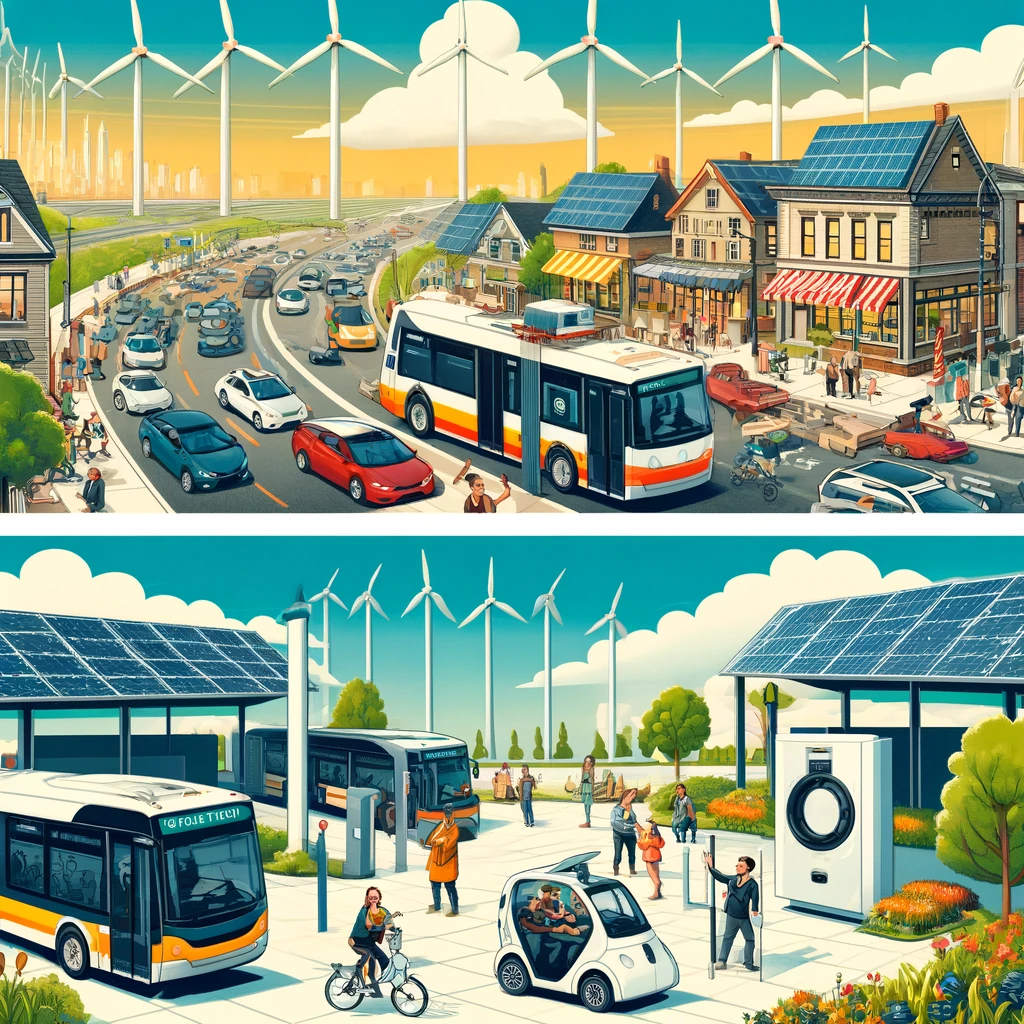
Sustainable land use scenarios give cities a practical way to test the consequences of rezoning before new rules shape housing supply, transportation demand, infrastructure costs, and environmental performance for decades. In planning practice, a scenario is not a guess. It is a structured model of how land, people, jobs, streets, utilities, and ecosystems may interact under a defined policy choice. Rezoning, meanwhile, changes the legal envelope for what can be built, where it can be built, and at what intensity. When those decisions are made without scenario testing, cities often lock in congestion, flood exposure, fiscal strain, or displacement that is expensive to reverse.
I have worked on comprehensive plans, corridor studies, and redevelopment programs where elected officials wanted to move quickly from political vision to zoning text. The most successful processes slowed down long enough to compare credible land use scenarios first. That step made debates more concrete. Instead of arguing abstractly about density or growth, staff and residents could review modeled outcomes: vehicle miles traveled, school enrollment impacts, tree canopy change, infrastructure replacement costs, stormwater runoff, affordable housing capacity, and tax yield per acre. Scenario modeling does not eliminate politics, but it gives public decisions a factual baseline.
For cities focused on sustainable urban development, this matters because zoning is one of the most powerful climate, housing, health, and budget tools local government controls directly. A land use map influences whether daily trips are short enough to walk, whether apartment buildings can be built near jobs, whether wetlands are paved over, and whether sewer extensions stretch public finances. Sustainable land use scenarios help answer a basic question before rezoning: which growth pattern produces the best long-term outcomes, and for whom?
This article serves as a hub for the full topic. It explains the main scenario types cities should model, the data needed to model them well, the metrics that separate serious analysis from symbolic planning, and the tradeoffs officials must understand before adopting new zoning. If a city wants to rezone responsibly, these are the scenarios it should test.
Why scenario modeling should happen before rezoning
Scenario modeling should precede rezoning because zoning ordinances are implementation tools, not discovery tools. Once a city writes new districts, parking standards, height limits, or use permissions into code, reversing course becomes politically and legally difficult. Modeling first allows planners to compare outcomes under multiple alternatives using common assumptions. In practice, that means asking how different zoning patterns perform against adopted goals such as greenhouse gas reduction, fair housing compliance, resilience, and fiscal health.
A credible scenario process usually starts with a baseline trend projection. This is the “business as usual” case showing what happens if current zoning, pipeline projects, demographic trends, and infrastructure plans continue unchanged. From there, cities test alternatives. One might concentrate mixed-use growth around transit stations. Another might spread lower-intensity growth across greenfield sites. A third might prioritize infill on vacant and underused parcels within existing service areas. Comparing these options reveals cause and effect.
Recognized tools support this work. ArcGIS Urban, UrbanFootprint, CommunityViz, Envision Tomorrow, and similar platforms can estimate buildout capacity, development feasibility, transportation effects, and emissions. Travel demand models, parcel databases, flood maps, utility capacity studies, and assessor records add local precision. The best results come when planning, transportation, public works, housing, and finance teams work from the same assumptions rather than modeling in silos.
Scenario modeling also improves public trust. Residents may oppose rezoning because they fear traffic, flooding, or neighborhood change. Those concerns should not be dismissed. They should be tested. When cities show side-by-side scenarios with transparent metrics and plain-language explanations, the conversation shifts from speculation to evidence. That is especially important in historically excluded neighborhoods where planning decisions have often imposed harms without clear disclosure.
Core sustainable land use scenarios every city should test
Most cities do not need dozens of scenarios. They need a disciplined set that captures the real policy choices on the table. At minimum, I recommend six.
| Scenario | What it tests | Typical indicators | Main risk if ignored |
|---|---|---|---|
| Baseline trend | Current zoning and pipeline development | Buildout, traffic, tax base, emissions | No reference point for comparison |
| Transit-oriented infill | Higher intensity near frequent transit | Ridership, mode share, parking demand | Missed low-carbon growth opportunities |
| Missing middle housing | Duplexes, fourplexes, townhomes in residential areas | Unit yield, affordability, displacement pressure | Continued housing shortage in high-opportunity areas |
| Employment cluster preservation | Protection of industrial and job-generating land | Job capacity, freight access, land value pressure | Loss of middle-wage employment space |
| Greenfield expansion | Outward growth on undeveloped land | Infrastructure cost, habitat loss, VMT | Underestimated long-term public expense |
| Resilience-first growth | Avoidance of flood, fire, heat, or subsidence risk areas | Risk exposure, insurance burden, canopy, runoff | New development in hazard-prone locations |
The transit-oriented infill scenario examines whether a city can shift a meaningful share of future growth to areas already served by buses, rail, or high-frequency corridors. In many corridor studies I have reviewed, this scenario outperforms edge expansion on emissions and infrastructure efficiency, but only if parking minimums are reduced, sidewalks are complete, and station areas allow enough height and floor area to support mixed-use projects.
The missing middle housing scenario is essential because many cities claim to support affordability while reserving large portions of residential land for detached houses only. Modeling duplexes, triplexes, courtyard apartments, and townhomes reveals how many additional homes could fit inside existing neighborhoods without relying exclusively on large apartment sites. It also helps estimate school impacts, parking demand, and redevelopment pressure parcel by parcel.
The employment cluster preservation scenario protects land that is often rezoned away too casually. Industrial districts, maker spaces, warehouse areas, and logistics corridors support regional employment and tax diversity. If housing demand pushes those areas toward residential rezoning, cities need to model the consequences: freight conflicts, job displacement, lower industrial vacancy, and loss of space for climate-supportive uses like recycling, district energy, and repair businesses.
Greenfield expansion should always be modeled even when leaders already favor it, because suburban outward growth often appears cheaper at approval stage than it is over a full asset lifecycle. New roads, pipes, pump stations, fire coverage, and school service carry long-term maintenance obligations. Strong Towns and many municipal finance analysts have shown that low-density expansion can generate insufficient tax revenue per acre to cover future liabilities.
The resilience-first growth scenario overlays future development capacity with hazard data. Federal Emergency Management Agency flood maps are a starting point, not the end. Cities should also review local stormwater models, urban heat island patterns, wildfire interfaces, sea level rise projections where relevant, and tree canopy deficits. If a rezoning increases intensity in risk-prone areas, the model should quantify people and property newly exposed.
Data and methods that make scenarios credible
Good scenarios depend on better inputs than a generalized land use map. Parcel-level data matters. Cities should inventory lot size, existing units, assessed improvement value, vacancy status, ownership patterns, building age, historic designation, slope, impervious cover, and utility availability. Market feasibility matters too. A parcel may have theoretical zoning capacity but still be unlikely to redevelop if rents, construction costs, or absorption rates do not support the product type. That is why buildout analysis and development pro formas should inform one another.
Demographic assumptions should be grounded in regional forecasts but tested locally. Household size, aging trends, student populations, and job sector shifts all influence housing and land demand. Transportation analysis should go beyond intersection level of service, which often overstates the value of vehicle speed and understates access by walking, biking, and transit. A sustainable scenario review should include vehicle miles traveled, mode share, trip length, and household transportation cost burden.
Environmental performance requires measurable indicators. Stormwater runoff can be estimated through impervious surface change and watershed modeling. Heat exposure can be mapped using land surface temperature and canopy distribution. Habitat fragmentation can be assessed with ecological corridor analysis. Public health considerations include access to parks, grocery stores, and primary care within a defined travel time. These are not decorative metrics; they reveal whether rezoning supports safer daily life.
Equity analysis should be embedded from the start. Cities should identify neighborhoods with high rent burden, low homeownership, low access to opportunity, and histories of exclusion or disinvestment. Then each scenario should estimate who gains new housing choice, who faces rising land value pressure, and where anti-displacement tools are needed. Tools may include inclusionary requirements, community land trusts, preservation funds, right-to-return policies, tenant protections, and acquisition strategies for nonprofit housing providers.
How cities should evaluate tradeoffs before choosing a scenario
No single scenario wins on every metric. Transit-oriented growth may reduce driving but increase redevelopment pressure in lower-cost neighborhoods near stations. Employment land preservation may protect jobs but constrain housing supply if industrial areas occupy central locations. Missing middle reform may expand choice gradually, yet produce fewer deeply affordable homes than a public land strategy or subsidy-backed multifamily program. The point of modeling is not to find a perfect option. It is to understand tradeoffs early enough to manage them.
In practice, cities should use a weighted evaluation framework tied to adopted goals. If the comprehensive plan prioritizes climate resilience, housing production, and fiscal stewardship, those categories should carry the most weight. Measures might include net new units, share of units in high-opportunity areas, per-capita emissions, infrastructure lifecycle cost, jobs-housing balance, and households exposed to flood risk. Decision-makers should publish the scoring method before the preferred scenario is selected.
Phasing is another critical tradeoff. A city may choose an ambitious rezoning map but still sequence infrastructure, affordability requirements, and capital improvements over ten to twenty years. That often produces better outcomes than citywide upzoning without implementation capacity. Trigger-based phasing can work well: when sewer upgrades, bus service thresholds, or park investments are delivered, higher intensity entitlements activate. This approach aligns growth with service readiness.
Monitoring should continue after adoption. Scenario modeling is not a one-time graphics exercise for a public meeting. Cities should establish indicators and review them annually or biennially. If actual permits cluster in hazard areas, if affordability targets are missed, or if industrial land conversion accelerates, zoning and incentives should be adjusted. Adaptive management is a hallmark of serious planning.
From model to policy: turning scenarios into better rezoning decisions
The final step is translating the preferred scenario into zoning, capital planning, and implementation tools that match the evidence. If modeling shows infill near transit delivers the best overall performance, the code should legalize mixed-use density there, lower parking requirements, improve frontage standards, and support small-lot assembly where appropriate. If missing middle housing expands supply in exclusionary areas, the ordinance should allow those forms by right with predictable design standards instead of discretionary review.
Rezoning should also be paired with non-zoning actions. Capital improvement plans, stormwater investments, school coordination, affordable housing funding, and land banking often determine whether a sustainable scenario succeeds. The strongest cities align their future land use map, zoning code, transportation plan, utility plan, and housing strategy so each document reinforces the others instead of sending conflicting signals.
Before any city rezones, it should model the baseline, test multiple sustainable land use scenarios, measure housing, mobility, environment, equity, and fiscal outcomes, and publish the tradeoffs clearly. That process leads to better choices and fewer unintended consequences. Sustainable urban development is not produced by aspiration alone; it is produced by disciplined scenario testing followed by honest implementation. If your city is preparing to rezone, start with the scenarios, verify the data, and make the map earn its authority.
Frequently Asked Questions
What are sustainable land use scenarios, and why should cities model them before rezoning?
Sustainable land use scenarios are structured planning models that let cities compare how different rezoning choices may affect growth, development patterns, and long-term public outcomes before any zoning map or code amendment is adopted. Rather than treating rezoning as a simple legal change, scenario modeling frames it as a systems decision with ripple effects across housing production, transportation demand, water and sewer capacity, public service costs, climate resilience, and ecological performance. A scenario can test, for example, whether allowing greater density near transit would reduce vehicle miles traveled, whether expanding mixed-use districts would support local jobs and walkability, or whether opening greenfield land to development would increase infrastructure extension costs and stormwater burdens.
Modeling these scenarios in advance helps city leaders move from assumption to evidence. Rezoning decisions can shape urban form for decades, so it is important to understand not only what could be built under new rules, but also what is likely to be built, where market demand will go, and how those choices will affect households, neighborhoods, and municipal budgets. Sustainable scenarios also make tradeoffs visible. One option may increase housing capacity quickly but require expensive roadway upgrades. Another may preserve open space and lower emissions but need stronger affordability tools to prevent displacement. By testing these outcomes before adoption, cities can rezone with clearer expectations, stronger public justification, and a more defensible link between policy goals and land use regulations.
Which land use scenarios should cities compare when evaluating a rezoning proposal?
Most cities benefit from comparing several distinct scenarios rather than a single preferred concept against the status quo. A baseline or “no change” scenario is essential because it shows what is likely to happen if existing zoning remains in place. That gives planners a realistic benchmark for housing production, land consumption, congestion, infrastructure demand, and fiscal performance. From there, cities often model an infill-focused scenario that directs new housing and jobs into already served areas, especially downtowns, commercial corridors, and neighborhoods near frequent transit. This scenario is useful for testing whether compact growth can absorb demand while limiting outward expansion and reducing per-capita service costs.
Another common option is a transit-oriented development scenario, which concentrates mixed-use intensity around major transit stations and high-frequency bus corridors. This helps evaluate ridership potential, parking demand, walkability, and the extent to which zoning can support lower-emission travel behavior. A corridor redevelopment scenario may also be valuable where aging strip commercial areas or underused arterial parcels present opportunities for housing, employment, and public realm improvements. Cities should often include a neighborhood-scale “missing middle” scenario as well, examining what happens when duplexes, fourplexes, courtyard apartments, and accessory dwelling units are allowed in select residential areas. That scenario can reveal whether modest increases in distributed density improve housing choice without large changes to neighborhood form.
In regions facing growth pressure at the urban edge, it is also important to test an expansion scenario that shows the consequences of outward development on roads, utilities, schools, wildfire exposure, habitat fragmentation, and long-term maintenance liabilities. Finally, many cities should include an equity-centered scenario that overlays anti-displacement tools, affordable housing requirements, community-serving uses, and environmental justice priorities. The most useful comparison set is one that reflects real political choices and practical development pathways, not abstract diagrams. Good scenario planning gives decision-makers a side-by-side understanding of how each rezoning approach performs against adopted goals.
What impacts should cities measure to decide whether a rezoning scenario is truly sustainable?
A sustainable rezoning scenario should be evaluated across multiple dimensions because land use success cannot be judged by unit count alone. Housing outcomes are a primary measure, including total housing capacity, likely housing production, unit diversity, affordability at different income levels, and the extent to which new supply is located near jobs, schools, and services. Transportation metrics are equally important. Cities should examine trip generation, mode share potential, vehicle miles traveled, access to frequent transit, pedestrian and bicycle connectivity, parking demand, and whether the proposed pattern supports shorter, safer, and less car-dependent daily travel.
Infrastructure and fiscal impacts are another core category. A scenario may appear attractive on paper but become unsustainable if it requires major utility upsizing, roadway widening, new pump stations, or costly public facility extensions. For that reason, cities should assess capital costs, lifecycle maintenance obligations, school and emergency service implications, and the relationship between public investment needs and expected tax base growth. Environmental indicators should include greenhouse gas emissions, energy demand, impervious surface change, stormwater runoff, flood exposure, tree canopy effects, habitat connectivity, heat island conditions, and impacts on wetlands, agricultural land, or other sensitive resources.
Social and equity measures are just as important as physical and fiscal ones. A strong analysis should identify who benefits, who bears risk, and whether rezoning may accelerate displacement in lower-income areas or communities of color. Useful indicators include tenant vulnerability, access to parks and healthy food, proximity to pollution sources, fair housing outcomes, and whether the scenario expands opportunity without concentrating burdens. When possible, cities should also test implementation realism by measuring market feasibility, phasing, and administrative complexity. A scenario is only truly sustainable if it performs well environmentally, supports inclusive growth, and can be implemented without creating hidden long-term liabilities.
How can cities use scenario modeling to balance housing growth, transportation efficiency, and environmental protection?
The most effective way to balance these priorities is to model them together instead of treating them as separate planning tracks. Housing growth decisions influence travel behavior, and both affect environmental performance. If new housing is permitted mostly in auto-oriented fringe areas, a city may increase supply but also lock in higher commuting distances, greater infrastructure expansion, and more land consumption. By contrast, if rezoning emphasizes locations near jobs, schools, commercial services, and high-quality transit, the same growth may generate fewer car trips, lower household transportation costs, and less pressure to convert open land. Scenario modeling makes these relationships visible by showing how different rezoning patterns change not just development capacity, but the spatial logic of everyday life.
Cities can also use scenario analysis to identify thresholds and tradeoffs. For instance, a compact growth scenario may reduce emissions and preserve environmentally sensitive land, but it may require targeted investments in sidewalks, transit service, utility capacity, and public open space to remain livable and equitable. A conservation-focused scenario may strongly protect watersheds or habitat corridors, yet it may need additional zoning flexibility in urbanized areas to avoid worsening housing scarcity. Good modeling does not force a false choice between housing and environmental stewardship. Instead, it helps cities find combinations of density, design standards, infrastructure investment, and conservation tools that produce better outcomes across all three areas.
In practice, this often means pairing rezoning with complementary measures such as stormwater standards, tree preservation requirements, complete streets policies, parking reform, affordable housing incentives, and anti-displacement strategies. Scenario results can guide where those tools are most needed and where they will have the greatest benefit. The goal is not simply to approve more development or to block it, but to shape growth so that new homes, transportation networks, and ecological systems function as part of one coherent urban strategy.
What makes a land use scenario credible enough to inform a real rezoning decision?
A credible land use scenario is grounded in local data, realistic assumptions, and transparent methods. It should reflect actual parcel conditions, infrastructure constraints, environmental features, market trends, demographic projections, and adopted community goals. If a scenario assumes that every parcel redevelops to maximum allowed density immediately after rezoning, it will not be persuasive because that is rarely how cities grow. Strong scenarios account for development likelihood, redevelopment timing, ownership patterns, financing realities, and the fact that some sites are constrained by flood risk, contamination, access limitations, or utility capacity. Credibility increases when the model distinguishes between theoretical zoning capacity and probable buildout.
It is also important that the evaluation criteria be clear and consistent across all scenarios. Decision-makers and the public should be able to see what metrics were used, why they matter, and how each scenario was scored or compared. This transparency builds trust and reduces the perception that the analysis was designed to justify a predetermined outcome. Involving agencies, utilities, transportation staff, housing experts, environmental specialists, and community stakeholders early in the process further strengthens the work by identifying blind spots and improving assumptions before policy choices are finalized.
Finally, a scenario becomes especially useful when it is actionable. That means it leads directly to zoning text, map changes, infrastructure priorities, mitigation strategies, and implementation steps that match the findings. A credible scenario should help answer practical questions such as where higher intensity belongs, what public investments are required, what environmental safeguards must accompany rezoning, and how equity goals will be protected. When scenario planning is technically sound and clearly tied to decision-making, it gives cities a much stronger foundation for rezoning in a way that is durable, defensible, and aligned with long-term sustainability objectives.