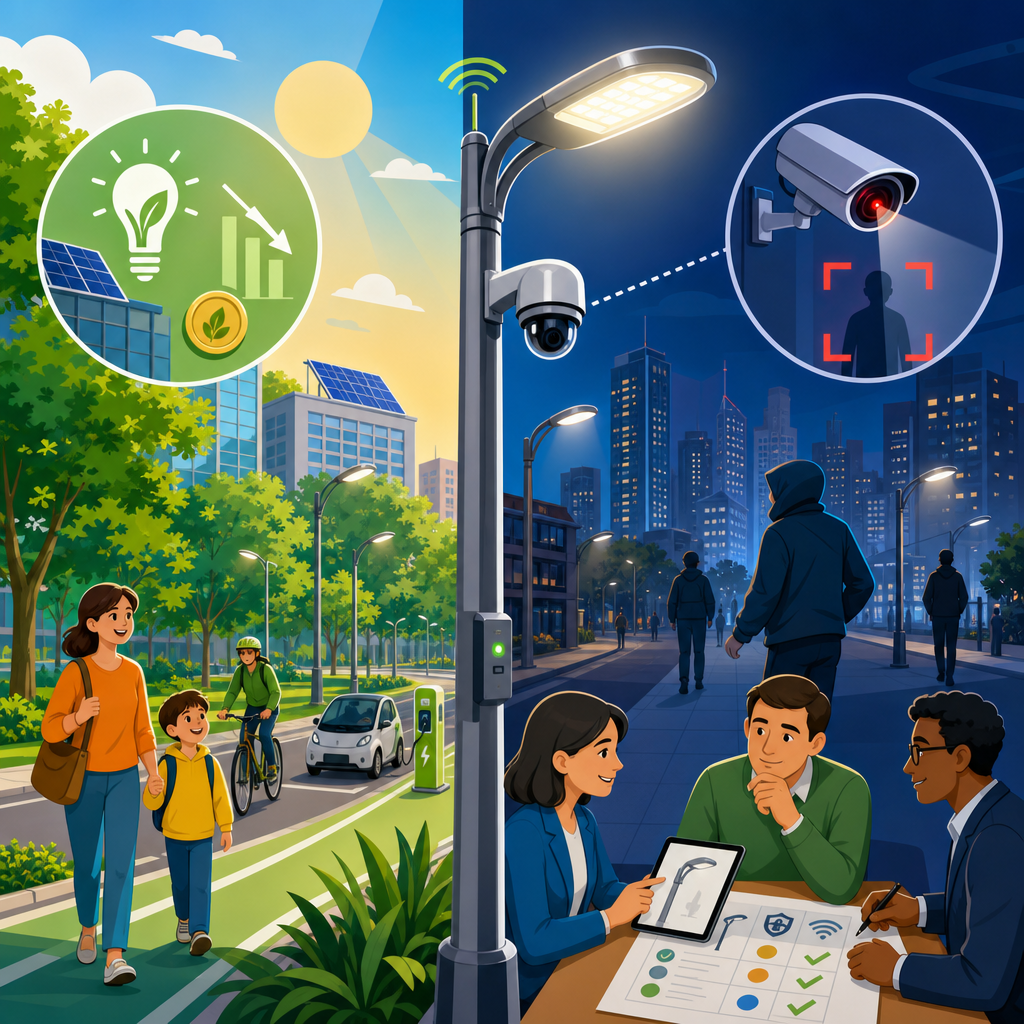
Smart streetlights are becoming one of the most visible pieces of urban infrastructure because they promise lower electricity bills, better maintenance, and a platform for connected-city services, yet they also raise hard questions about surveillance, cybersecurity, and public procurement. In practical terms, a smart streetlight is an outdoor lighting asset, usually based on LED fixtures, that includes communications, sensing, and remote management so a city or utility can monitor status, dim output, schedule operations, and sometimes collect environmental or traffic data. I have worked on municipal technology evaluations where lighting looked simple at first and then turned into a cross-department decision involving public works, police, legal counsel, finance, and residents. That is why this topic matters. Streetlighting is a large, long-lived capital asset class; the wrong procurement structure can lock in weak cybersecurity, poor interoperability, and expensive maintenance for a decade or more, while the right structure can cut energy consumption dramatically and improve service reliability without creating unnecessary privacy risk.
The strongest business case usually starts with the shift from legacy high-pressure sodium or metal halide fixtures to LEDs, which commonly reduce electricity use by roughly 40 to 70 percent before additional controls are added. Networked controls can deepen savings by enabling adaptive dimming during low-traffic periods, daylight response, and failure detection that shortens repair cycles. Utilities and city sustainability offices also value lower greenhouse gas emissions, especially where climate plans set building and infrastructure targets. But energy savings are only one part of the picture. Once luminaires carry radios, cameras, microphones, license plate systems, or air-quality sensors, a streetlight stops being just a light and becomes a data collection node. Residents may support safer streets and better maintenance while still objecting to opaque monitoring. For that reason, any serious smart streetlight strategy has to balance energy, safety, governance, and trust from the beginning rather than trying to bolt privacy safeguards on after deployment.
Why cities adopt smart streetlights
Cities adopt smart streetlights because they solve several operational problems at once. Traditional streetlighting maintenance is reactive: crews wait for complaints, inspect circuits, and replace failed lamps on periodic routes. With a connected management system, each fixture can report outages, voltage anomalies, tilt events, and power consumption. In a portfolio of tens of thousands of poles, that changes labor planning immediately. Public works teams can dispatch based on verified failures instead of windshield surveys, stock fewer spare parts, and prioritize corridors with higher risk or complaint volume. From experience, finance departments respond well to this because the savings are legible: lower kilowatt-hours, fewer truck rolls, and longer replacement cycles for LED drivers and fixtures compared with older lamps.
There is also a public realm argument. Better lighting uniformity improves visibility for drivers, pedestrians, and cyclists. LEDs provide stronger color rendering than high-pressure sodium, making objects and people easier to distinguish. Many cities pair smart controls with context-specific lighting profiles: brighter output near transit stops, schools, and commercial districts; lower levels in industrial zones after business hours; and special schedules for parks or event areas. Organizations such as the Illuminating Engineering Society publish recommended practices for roadway and pedestrian lighting, and those standards matter because “more light” is not automatically better. Overlighting wastes energy, creates glare, and can reduce visual comfort. The smarter approach is to match light levels and distribution to the task, then use controls to adjust by time and conditions.
Another driver is platform value. Vendors often pitch poles as hosts for electric vehicle chargers, 5G small cells, gunshot detection, traffic analytics, digital signage, and environmental sensors. Some of these add-ons are useful; some are speculative revenue stories. The lesson I have learned is that cities should separate the proven value of lighting modernization from optional smart-city ambitions. If the LED conversion and controls project works on its own merits, added capabilities can be evaluated later under separate privacy, legal, and financial standards. If the business case only works by assuming future advertising, telecom leases, or data monetization, the project is usually too fragile.
Where the energy savings actually come from
The largest energy savings come from fixture efficiency, not from the “smart” label alone. Replacing a 150-watt high-pressure sodium cobra head with a 60- to 90-watt LED fixture can cut electricity use substantially while still meeting target illuminance. Add lower lumen depreciation, better optical control, and scheduled dimming after midnight, and the operating reduction can become material at city scale. For example, a city operating 20,000 fixtures that saves an average of 80 watts per light for 4,100 annual hours avoids about 6.56 million kilowatt-hours each year. At $0.12 per kilowatt-hour, that is roughly $787,000 in annual electricity savings before maintenance effects are counted. In places with higher tariffs or demand charges, the value can be even greater.
Controls improve this baseline in several ways. Astronomical clocks remove the drift associated with older photocells. Group dimming lets an operator set neighborhoods or road classes to lower output during low-traffic periods. Individual node control enables more granular profiles, though it also increases system complexity and device count. The best savings models are built from asset inventories, utility rates, burn-hour assumptions, and measured lighting classes rather than vendor averages. Measurement and verification should be specified up front. Cities can compare pre- and post-conversion bills, feeder-level metering, and node-level data to validate savings. That step sounds administrative, but it prevents disputes later when budget offices ask whether promised reductions really occurred.
| Lighting scenario | Typical fixture load | Control approach | Expected energy effect | Operational notes |
|---|---|---|---|---|
| Legacy high-pressure sodium | 100–250W | Basic photocell | Highest baseline use | Frequent lamp cycling, poorer color rendering |
| LED retrofit only | 40–120W | Basic on/off | 40–70% reduction | Strong savings with simpler maintenance |
| LED with group controls | 40–120W | Scheduled dimming by circuit or zone | Additional 10–20% reduction | Lower complexity than per-node systems |
| LED with individual nodes | 40–120W | Remote monitoring and adaptive profiles | Additional 15–30% reduction in suitable corridors | Best data visibility, higher cybersecurity and integration demands |
However, not every location should be dimmed aggressively. Major intersections, high-crime hot spots, pedestrian-heavy entertainment districts, and areas with late-night transit activity may need steadier output. Snow cover, tree canopy, pavement reflectance, and pole spacing also change results. A competent audit reviews these variables before a city publishes projected savings. It also accounts for maintenance factors such as driver failure rates, surge protection, and warranty terms. In other words, the energy story is real, but it depends on design discipline rather than marketing claims.
Surveillance risks and privacy governance
The most contentious smart streetlight issue is surveillance. A connected lighting system that only monitors power, uptime, and fixture health has a very different risk profile from one that carries cameras, microphones, Wi-Fi tracking, Bluetooth beacons, or automatic license plate recognition. These functions are often bundled in procurement language under broad phrases like “public safety sensors” or “multifunction smart poles,” which can obscure what is actually being installed. Cities should define each data type, its purpose, retention period, access rules, and legal basis before deployment. If they do not, residents may discover capabilities after the fact and interpret the entire project as covert monitoring, even when the core lighting investment is sound.
Recent public controversies illustrate the governance gap. In several cities, residents and civil liberties groups challenged sensor networks after learning that acoustic, video, or mobility data could be shared across agencies without clear council approval. The problem was not only the sensors themselves; it was the absence of transparent policy. Good practice requires a published data inventory, privacy impact assessment, signage where appropriate, and a clear statement of whether data is anonymized, aggregated, or personally identifiable. It also requires hard limits. For example, if a city installs air-quality or traffic counters, contracts should prohibit later activating facial recognition or audio capture without a new public process.
Cybersecurity belongs in the same discussion. Streetlights are distributed endpoints on public rights-of-way, which makes them attractive targets. Weak authentication, default credentials, insecure firmware updates, and proprietary radios can create pathways for disruption or lateral movement into other city systems. Baseline controls should include encrypted communications, certificate-based device identity, role-based access, logging, patch management, and documented vulnerability disclosure. Procurement teams should ask vendors whether their products align with recognized controls such as NIST guidance for IoT cybersecurity and whether independent penetration testing has been performed. A city does not need perfect security to proceed, but it does need a defensible standard and contract remedies when vendors fail to meet it.
Procurement lessons that prevent expensive mistakes
Most smart streetlight failures are procurement failures before they are technology failures. Cities get into trouble when they buy a proprietary end-to-end stack without securing data rights, interoperability, service levels, and exit options. The first lesson is to start with an asset inventory and a clear statement of outcomes. How many fixtures are owned by the city versus the utility? What poles need structural upgrades? Which corridors have poor lighting performance today? What is the target payback period? Without those basics, requests for proposals drift into vague smart-city wish lists that vendors are happy to fill.
The second lesson is to specify open or at least standards-based architecture where practical. Networking and control options may involve cellular, radio frequency mesh, LoRaWAN, or other communications models, each with tradeoffs in coverage, bandwidth, and recurring cost. Cities should understand whether nodes can be replaced independently of luminaires, whether the management platform exposes APIs, and whether data can be exported in usable formats. If a contractor owns the platform and the city merely licenses access, migration later can be painful. I have seen agencies save on upfront price only to discover that adding a second vendor’s fixture or sensor was impossible without replacing the management layer.
The third lesson is to evaluate finance and delivery models carefully. Some cities use direct capital purchase; others use energy savings performance contracts, leases, public-private partnerships, or utility tariff conversions. Energy savings performance contracts can accelerate upgrades when capital is tight, but the savings guarantee, baseline assumptions, and maintenance scope must be tested rigorously. Utility-owned streetlights create another layer of negotiation because fixture selection, metering, and control rights may sit partly with the utility rather than the municipality. Good procurement documents address ownership, tariff treatment, pole attachment rights, outage response times, and decommissioning responsibilities. They also include acceptance testing, spare parts requirements, and warranty administration instead of assuming those details will sort themselves out later.
Building a defensible deployment strategy
A defensible smart streetlight program usually begins with a pilot, but not a vanity pilot. The purpose is to answer operational questions under real conditions: radio performance in dense canopy, dimming acceptance in residential blocks, work-order integration with systems such as Cityworks or Cartegraph, billing reconciliation, and resident reaction to any sensor package. Pilot metrics should include outage detection accuracy, communications uptime, actual power draw, complaint rates, and technician time per repair. If the project includes cameras or other public safety tools, the pilot should also test governance: who can access footage, how quickly records requests can be handled, and whether retention settings match policy.
Public communication matters more than many project plans admit. Residents generally notice when streetlights become brighter, cooler in color, dimmer late at night, or visibly equipped with devices. Cities that explain the project early, publish fixture specifications, and show sample dimming schedules face less resistance than those that treat the rollout as routine maintenance. Correlated color temperature is a common flashpoint. Many communities prefer 3000K LEDs over 4000K or 5000K because warmer light reduces blue-rich emissions and perceived harshness while still providing good visibility. The right answer varies by roadway type and local preference, but a city should make the choice deliberately and document why.
Finally, success depends on governance after installation. Someone must own the platform, review alerts, manage firmware updates, audit data access, and evaluate whether promised savings and service improvements are being delivered. Smart streetlights are not a one-time procurement; they are an operating program. The cities that realize the most value treat lighting, privacy, cybersecurity, and procurement as one integrated discipline rather than four separate checklists.
Smart streetlights can deliver real public value when cities approach them as critical infrastructure instead of as gadgets. The strongest projects begin with an honest lighting audit, a solid LED conversion case, and clear performance targets for energy, maintenance, and service reliability. They then add controls only where the operational gain justifies the complexity. Just as important, they draw a bright line between asset management data and surveillance functions, with published rules for any sensor that could identify, track, or profile people. That balance is what protects public trust.
The procurement lessons are equally clear. Inventory assets before issuing an RFP. Demand interoperability, data rights, cybersecurity requirements, and measurable service levels. Stress-test finance assumptions, especially where utilities, third-party platforms, or savings guarantees are involved. Run a pilot that answers practical questions, not just marketing questions. And keep residents informed about light levels, color temperature, sensors, and data governance. These steps take more effort upfront, but they are far cheaper than unwinding a bad contract or defending a poorly explained surveillance capability later.
For city managers, housing and infrastructure planners, and local officials, the main benefit of a smart streetlight strategy is not simply lower power consumption. It is the ability to modernize a visible public asset in a way that saves money, improves street performance, and respects community expectations. If your community is considering smart streetlights, start with a cross-functional review of lighting needs, privacy limits, and procurement terms before any vendor demo sets the agenda.
Frequently Asked Questions
What are smart streetlights, and how do they differ from traditional streetlights?
Smart streetlights are outdoor lighting systems that combine energy-efficient LED fixtures with networked controls, sensors, and remote management software. Unlike traditional streetlights, which usually operate on fixed schedules and require manual inspection when something fails, smart streetlights can be monitored and adjusted from a central platform. Cities and utilities can dim or brighten lights based on time of day, traffic levels, weather conditions, or neighborhood needs, and they can often detect outages, power quality problems, or component failures automatically.
That difference matters because it turns lighting from a passive asset into an active part of urban operations. A traditional lamp mostly provides illumination. A smart streetlight can also support maintenance planning, fault alerts, adaptive dimming, and in some cases connected-city applications such as traffic monitoring, air-quality sensing, parking systems, or emergency response support. In short, the core upgrade is not just the bulb; it is the addition of communications, sensing, and software that allow the lighting network to be managed in real time rather than treated as a static piece of infrastructure.
How much energy and cost savings can cities realistically expect from smart streetlights?
The biggest and most immediate savings usually come from switching older high-pressure sodium or metal halide fixtures to LEDs. That upgrade alone can significantly reduce electricity use because LEDs are more efficient and have longer useful lives. When networked controls are added, additional savings often come from dimming during low-traffic hours, using schedules tailored to local conditions, and improving maintenance efficiency by identifying failures remotely instead of relying on night patrols or resident complaints.
That said, realistic savings depend on the baseline. A city replacing very old fixtures may see dramatic reductions in energy consumption, while a city that already has relatively efficient lighting may see more modest gains from the “smart” layer itself. Total financial results also depend on installation costs, software subscriptions, communications fees, maintenance contracts, and the life-cycle performance of the equipment. The most credible procurement teams look beyond headline percentages and ask for a full cost-of-ownership model covering energy, labor, replacements, software, warranties, and expected service life. Smart streetlights can absolutely deliver strong returns, but the best analysis is grounded in local operating conditions rather than generic vendor claims.
Why do smart streetlights raise surveillance and privacy concerns?
Privacy concerns arise because smart streetlights can serve as mounting points for sensors, cameras, microphones, wireless equipment, or analytical tools that extend well beyond lighting. Even when a project begins as an energy-efficiency initiative, residents may worry that the infrastructure could later be used to collect data about movement, vehicles, devices, or public activity without meaningful consent or oversight. The concern is not only what is installed on day one, but what the platform makes possible in the future.
These concerns become more serious when cities do not clearly disclose what data is being collected, how long it is retained, who can access it, whether it is shared with law enforcement or third parties, and what rules govern expansion of system capabilities. Public trust can erode quickly if a lighting upgrade is perceived as a backdoor surveillance network. That is why strong governance matters as much as technical design. Best practice includes publishing clear use policies, minimizing data collection, separating lighting operations from unrelated surveillance functions, requiring public approval for new sensor deployments, and conducting privacy impact assessments before implementation. The central issue is not whether smart streetlights are inherently invasive, but whether the program is designed with strict limits, transparency, and accountability from the start.
What cybersecurity risks do smart streetlight systems introduce?
Because smart streetlights are connected devices, they expand the digital attack surface of a city or utility. Risks can include unauthorized access to management platforms, insecure communications between nodes and controllers, weak authentication, unpatched firmware, vulnerable vendor software, and poor segmentation between the lighting network and other municipal systems. In the worst case, attackers could disrupt lighting operations, manipulate dimming schedules, use compromised devices as entry points into broader networks, or exploit exposed data from sensors and management systems.
Cybersecurity should therefore be treated as a procurement and governance issue, not just an IT checkbox after deployment. Cities should ask vendors about encryption, identity and access controls, software update processes, incident response responsibilities, vulnerability disclosure practices, logging, third-party testing, and long-term support for patches. It is also important to define who owns the data, who administers the system, and what happens if the vendor is acquired, goes out of business, or discontinues a platform. A secure smart streetlight program depends on secure-by-design hardware and software, but also on contractual protections, regular audits, network segmentation, and operational discipline over the full life of the system.
What procurement lessons should cities learn before buying smart streetlights?
The most important lesson is to procure outcomes, not just hardware. Cities often focus heavily on fixture specifications and unit pricing, but a smart streetlight program is really a long-term service and data-management decision. Procurement teams should define what they want to achieve first: energy savings, reduced maintenance, improved outage visibility, adaptive lighting, support for future sensors, or all of the above. Once those goals are clear, they can evaluate whether the proposed architecture, communications model, software platform, and contract terms actually support them.
Another key lesson is to avoid lock-in wherever possible. Proprietary platforms can limit future flexibility, raise operating costs, and make upgrades harder. Cities should examine interoperability, standards support, data portability, API access, warranty terms, service-level agreements, spare parts availability, and the cost of adding or replacing components later. Pilot projects can be valuable, but only if they are structured to test real operational performance rather than serve as vendor demonstrations. Strong procurement also requires internal coordination among public works, IT, legal, procurement, finance, privacy officers, and community stakeholders. The smartest buyers build requirements around life-cycle cost, cybersecurity, privacy, performance verification, and governance, not just initial capital expense. In practice, the success of a smart streetlight project often depends less on the fixture itself than on the quality of the contract, the clarity of the rules, and the city’s ability to manage the system over time.