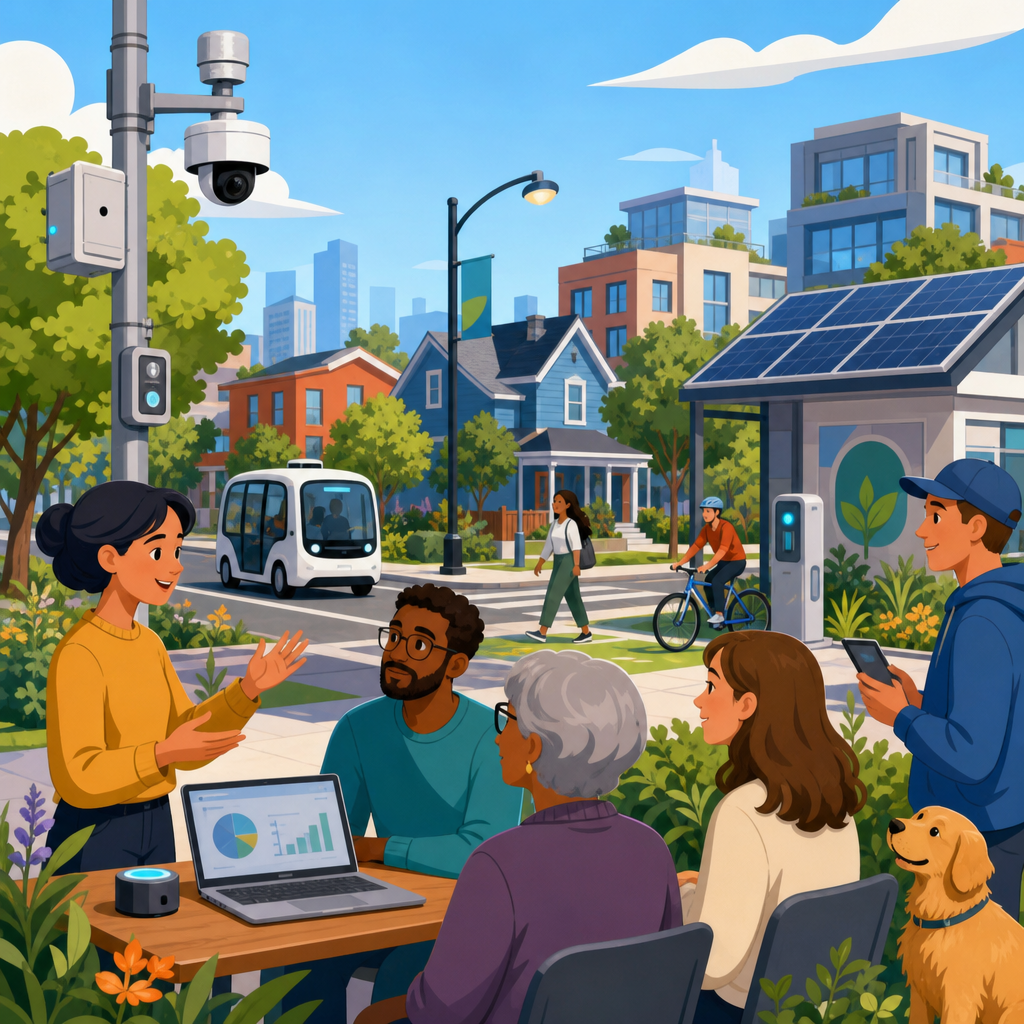
Smart neighborhood pilots let cities, housing providers, and utilities test new technology in a real place with real residents before making expensive, permanent decisions. In practice, a pilot might include curbside sensors, connected streetlights, leak-detection meters, shared battery storage, adaptive traffic signals, public Wi-Fi, or building energy dashboards across a few blocks or a single housing development. The goal is simple: learn what works, what fails, what residents actually value, and what risks appear when technology meets daily life. I have worked on pilot planning and post-launch reviews, and the consistent lesson is that technical performance alone never determines success. Public trust does.
Public trust matters because neighborhood technology changes how people move, park, heat their homes, access services, and share data. If residents believe a pilot is imposed on them, hides surveillance, or shifts costs unfairly, the project can stall even when the hardware works perfectly. If they understand the purpose, consent process, safeguards, and benefits, participation rises and the evidence becomes stronger. That evidence influences housing market trends, because buyers, renters, lenders, insurers, and local officials increasingly look at resilience, operating costs, broadband quality, safety, and climate readiness when judging neighborhood value.
A smart neighborhood pilot is not a marketing demo. It is a time-bound, measurable experiment in a defined geography with clear hypotheses, a governance model, and a plan for scaling or stopping. Key terms matter. A pilot is small enough to manage risk. A trial measures outcomes against a baseline. Governance defines who makes decisions, who owns the data, and who is accountable when something goes wrong. Public trust means residents can see the rules, challenge them, and believe the process respects their interests. Without these basics, pilots create headlines but not durable results.
For housing leaders, this topic matters now because neighborhoods are under pressure from rising utility costs, aging infrastructure, climate threats, insurance volatility, and demand for better connectivity. Technology can help, but only if testing is disciplined. The strongest pilot programs align technical design with procurement rules, privacy law, equity commitments, and maintenance budgets from day one. They ask practical questions early: What resident problem are we solving? What data is collected? How long is it kept? Who can access it? What happens if the vendor fails? Those questions are not barriers to innovation; they are the conditions that make innovation acceptable.
Start with a public problem, not a gadget
The most credible smart neighborhood pilots begin with a specific public problem residents already recognize. Examples include repeated basement flooding, high common-area energy bills, dangerous intersections near schools, package theft in multifamily buildings, or unreliable bus arrival information. When the problem is visible, residents can judge whether the pilot is worth the inconvenience. When the project is framed around a gadget, skepticism rises because people assume the outcome was predetermined. I have seen sensor proposals gain support only after teams translated them into plain language: fewer water shutoffs, faster repairs, lower lighting costs, safer crossings, and better emergency response.
Good pilot design uses a written problem statement, a baseline, and measurable outcomes. If a housing authority installs smart leak detectors, the baseline should include historical water loss, average time to identify leaks, repair times, and tenant disruption. If a city tests adaptive streetlights, it should define expected changes in electricity use, maintenance visits, light levels, and resident complaints. The pilot should also define what success does not mean. For example, reduced energy consumption is not success if it causes darker walkways or accessibility problems. Clear tradeoffs build credibility because they show decision-makers are not hiding the costs.
Scope discipline is equally important. A pilot should be large enough to produce statistically useful information but small enough to reverse. That usually means selecting one corridor, one public housing complex, or a limited service area rather than an entire district. Time limits matter too. Six to twelve months is common because it captures seasonality without creating indefinite temporary programs. The charter should name the sponsor, implementation partners, resident advisory group, evaluation method, and exit criteria. If those elements are absent, residents cannot tell whether they are participating in a controlled test or being enrolled in a permanent change without consent.
Build trust through governance, privacy, and resident control
Trust is created less by slogans than by governance documents residents can inspect. Every smart neighborhood pilot needs a data inventory, privacy impact assessment, cybersecurity plan, and public-facing rules for access and retention. Recognized frameworks help. The NIST Privacy Framework gives teams a practical way to identify data processing risks, while the NIST Cybersecurity Framework supports basic controls around asset management, detection, incident response, and recovery. For public agencies, procurement language should require encryption in transit and at rest, role-based access control, software patching timelines, audit logs, and breach notification terms. These are standard protections, not optional extras.
Residents also need meaningful control. That starts with plain-language notice describing what is collected, why, how long it is retained, and whether data is shared with third parties such as vendors, law enforcement, insurers, or researchers. Consent should match the technology. An opt-in model is often appropriate for in-home devices, tenant apps, and individualized dashboards. Public-space systems may rely on notice and policy controls, but they still need minimization. For example, a curb occupancy pilot can often use computer vision that converts video into anonymous counts at the edge rather than storing identifiable footage. Designing for less data is the strongest privacy practice.
Independent oversight strengthens confidence. A resident advisory panel, privacy officer, or university evaluation partner can review metrics, complaints, and change requests throughout the pilot. Publishing meeting notes and monthly dashboards matters because trust erodes when residents hear about changes after deployment. Clear accountability is crucial when incidents happen. If a smart access control system locks tenants out, the operator should have a documented manual override, hotline response standard, and compensation policy where appropriate. Technology does fail. Trust survives when institutions show they anticipated failure and protected residents before asking for participation.
Design pilots that improve housing outcomes, not just infrastructure metrics
As a housing market trends hub, this topic connects directly to how neighborhoods perform for residents and how markets price that performance. Buyers and renters do not care about sensor density for its own sake. They care about bills, comfort, safety, convenience, reliability, and resilience. That means a strong smart neighborhood pilot should connect operational metrics to housing outcomes. A building electrification dashboard should be evaluated not only for kilowatt-hours but also for peak-demand charges, indoor temperature stability, and maintenance call volume. A public Wi-Fi pilot should track sign-ups, uptime, device access, and whether residents can actually complete school, job, or telehealth tasks.
Real-world examples show why this framing matters. Chattanooga’s smart grid investments, while broader than a single neighborhood pilot, are widely cited because they improved outage management and reduced interruption durations, producing visible service value. In housing, remote water monitoring in multifamily buildings has helped operators detect leaks early, preventing mold, repair costs, and tenant displacement. Smart thermostats in affordable housing can lower consumption, but only when installation quality, resident education, and override options are handled properly. Without those pieces, residents may feel they lost control of comfort for savings they cannot verify.
| Pilot type | Main resident benefit | Core metric | Key trust safeguard |
|---|---|---|---|
| Leak detection | Fewer repairs and disruptions | Time from leak start to fix | Opt-in for unit-level alerts |
| Smart lighting | Lower costs and better safety | Energy use and complaint rate | Published illumination standards |
| Public Wi-Fi | Reliable connectivity | Uptime and household usage | No sale of browsing data |
| Curb sensors | Easier parking and deliveries | Turnover and violation reduction | Anonymous counting, short retention |
| Air quality monitoring | Health and ventilation insight | PM2.5 and CO2 trends | No individual health profiling |
When teams report results, they should distinguish outputs from outcomes. Installing one hundred sensors is an output. Cutting leak-related work orders by 35 percent is an outcome. Residents notice that difference immediately. So do asset managers, lenders, and insurers. In my experience, the fastest way to lose confidence is to celebrate deployment counts while residents still face the same service failures. The best pilot reports therefore include before-and-after comparisons, resident satisfaction findings, maintenance records, and a realistic estimate of total cost of ownership over five to ten years, not just the first-year subscription price.
Use procurement and vendor management to prevent future backlash
Many public trust failures begin long before launch, inside procurement documents and vendor negotiations. A pilot contract should specify data ownership, interoperability, service-level agreements, uptime targets, training obligations, and the right to export data in nonproprietary formats. Open standards matter because neighborhoods should not be trapped in a single vendor ecosystem after a short pilot. For building and energy systems, protocols such as BACnet, MQTT, and OpenADR can reduce lock-in when used appropriately. If the vendor controls the only workable dashboard, analytics model, or maintenance key, the pilot may create dependency instead of learning.
Procurement also needs a fair approach to claims about artificial intelligence. Vendors often promise predictive maintenance, safety analytics, or occupancy forecasting, but those claims need validation criteria. Agencies should ask what data trained the model, how local calibration works, what error rates are acceptable, and who is responsible for false positives. A parking enforcement model that misreads delivery zones can harm local businesses. A water anomaly model that triggers repeated false alerts can cause residents to ignore real warnings. Testing should include bias checks, manual review procedures, and a requirement to explain decisions in terms nontechnical stakeholders can understand.
Maintenance planning is another trust issue often overlooked. A pilot that works only while vendor engineers are on site is not a successful pilot. Local staff must be able to operate, troubleshoot, and replace components without heroic effort. Spare parts availability, battery life, calibration schedules, and software support windows should be documented before installation. Public agencies should also budget for decommissioning if the pilot ends. Residents notice abandoned kiosks, dead sensors, and unreadable QR codes, and those visible failures shape attitudes toward the next proposal. Competent vendor management protects both the technology investment and the institution’s credibility.
Measure what residents experience and publish the evidence
The evaluation phase is where public trust is either earned or lost. A pilot should use mixed methods: operational data, cost analysis, resident surveys, complaint logs, and field observation. If the project affects mobility, include walking audits and travel-time checks. If it affects housing operations, include work-order trends, unit downtime, and utility billing changes. Evaluation should compare against a baseline and, where possible, a control area. Randomized trials are rare in neighborhood settings, but matched comparisons can still improve confidence. The point is not academic perfection. The point is to produce evidence strong enough for residents and decision-makers to believe the conclusions.
Transparency must continue after the ribbon-cutting. Publish a dashboard with simple definitions, update frequency, incident reports, and contact information for questions. Include what is not yet known. If an air quality pilot shows elevated indoor CO2 in common rooms, say whether ventilation improvements are planned or whether more monitoring is needed. If a smart curb program reduced double parking but increased app confusion for older residents, report both findings. Balanced reporting is persuasive because it mirrors lived experience. Residents know no pilot is perfect. They want proof that officials are seeing the same problems they see and responding honestly.
Finally, decide and communicate the next step. Every pilot should end with one of three outcomes: scale, redesign, or stop. Scaling requires a funding plan, procurement pathway, and updated safeguards informed by the test. Redesigning may mean narrowing the use case, changing the consent model, or replacing a vendor. Stopping is sometimes the right result, and saying so can increase trust if the evaluation is candid. Smart neighborhood pilots succeed when they solve a public problem, protect resident rights, and generate evidence that supports better housing decisions. If you are planning one, start small, write the rules clearly, measure outcomes residents can feel, and publish what you learn.
Frequently Asked Questions
What is a smart neighborhood pilot, and why not just deploy the technology citywide right away?
A smart neighborhood pilot is a limited, real-world test of connected infrastructure or digital services in a defined area, such as a few blocks, a corridor, or a housing development. Instead of committing major public funds to a full rollout based on vendor promises or lab results, cities, housing providers, and utilities use pilots to see how technology performs under everyday conditions with actual residents, buildings, streets, and maintenance teams. A pilot might include connected streetlights, curbside sensors, adaptive traffic signals, leak-detection devices, public Wi-Fi, shared battery systems, or building energy dashboards. The point is not to showcase innovation for its own sake. It is to answer practical questions: Does it solve a real problem? Is it reliable? Can staff maintain it? Do residents find it useful, intrusive, confusing, or unnecessary? Does it save money, improve safety, reduce emissions, or increase access in measurable ways?
Skipping the pilot stage can be expensive and politically risky. Technologies that look impressive in a demo often behave differently once they meet local weather, aging infrastructure, uneven connectivity, procurement constraints, and community expectations. A citywide deployment also magnifies mistakes. If privacy protections are weak, if the interface is hard to use, if sensors generate bad data, or if the technology creates unequal benefits across neighborhoods, those problems become harder and more costly to fix at scale. A well-designed pilot gives decision-makers evidence before they lock in long-term contracts, install permanent hardware, or ask the public to accept new forms of data collection. In short, pilots reduce uncertainty, improve purchasing decisions, and create a structured opportunity to learn before making commitments that affect residents for years.
How can cities test smart technology without losing public trust?
Public trust is usually won or lost long before the first device is installed. The strongest pilots start with clear communication about the problem being addressed, the reason this neighborhood was selected, what technology is being tested, what data will be collected, how long the pilot will last, who has access to the information, and what success or failure will look like. Residents are far more likely to support a pilot when they understand the purpose and can see that the test is limited, accountable, and reversible. Trust grows when officials explain not only the possible benefits, but also the uncertainties, trade-offs, and safeguards. People do not expect perfection; they do expect honesty.
Meaningful participation matters just as much as transparency. Public trust weakens when communities feel like they are being used as a laboratory without influence over the process. Strong programs involve residents early through meetings, tenant associations, neighborhood groups, multilingual materials, office hours, and feedback channels that are easy to use online and offline. That input should affect design decisions, not simply be collected after plans are final. If residents are worried about surveillance, accessibility, billing impacts, maintenance, or unequal benefits, those concerns should shape the pilot’s scope and rules. Trust also depends on visible accountability: published timelines, named project leads, independent evaluation where appropriate, plain-language reporting, and a commitment to remove or revise technology that does not perform as promised. The core principle is simple: a pilot should be done with a community, not to a community.
What privacy and data governance rules should be in place before a pilot begins?
Before any smart neighborhood pilot launches, organizers should establish a plain-language data governance framework that is specific, public, and enforceable. At minimum, that framework should explain what data is being collected, why it is necessary, how often it is gathered, whether it is personally identifiable, how long it will be retained, where it will be stored, who can access it, and whether it will be shared with vendors, law enforcement, researchers, or third parties. One of the most important trust-building steps is data minimization: collect only what is needed to answer the pilot’s questions. If aggregate traffic flow is the goal, for example, there may be no reason to store identifiable video. If building energy use is being studied, there should be clear protections around tenant-level information and no vague permission for future unrelated uses.
Strong governance also means setting clear boundaries before the technology goes live. Contracts should define ownership of data, prohibit unauthorized resale or secondary use, require cybersecurity standards, and specify deletion requirements when the pilot ends. Residents should know whether consent is required, what choices they have, and how complaints will be handled. In sensitive contexts, such as affordable housing or neighborhoods with a history of over-policing, these protections become even more important because power imbalances can make residents feel they have no real ability to object. Cities and housing providers should also publish impact assessments where appropriate, especially when technologies could affect privacy, mobility, safety, or access to services. When people can see that rules are in place, limited in scope, and tied to a defined public purpose, concerns about surveillance and misuse become easier to address in a credible way.
How do you measure whether a smart neighborhood pilot actually worked?
A smart neighborhood pilot should be judged against clear success metrics established before deployment, not after the fact. Those metrics need to connect directly to the public problem the pilot is trying to solve. If the goal is water conservation, useful measures might include leak detection speed, gallons saved, maintenance response times, and cost per repair avoided. If the goal is safer streets, metrics could include collision rates, near-miss patterns, pedestrian crossing times, lighting reliability, and resident perceptions of safety. If the pilot involves public Wi-Fi or digital building dashboards, evaluation should look beyond technical uptime to include adoption rates, ease of use, accessibility, and whether the tool helps residents achieve meaningful outcomes such as lower bills, better connectivity, or easier access to services.
The best evaluations combine quantitative and qualitative evidence. Sensor data, operating costs, and service metrics are important, but so are resident interviews, surveys, staff feedback, complaint logs, and observations about how people actually use or avoid the technology. A pilot can appear successful on paper while failing in practice because interfaces are confusing, repairs take too long, or benefits are concentrated among already well-connected users. Equity should therefore be part of the evaluation from the start. Who benefits? Who bears the burden? Are some residents excluded because of language, disability, device access, or housing status? Organizers should also compare results to a baseline and publish findings in plain language, including what did not work. A pilot is successful not only when it confirms a good idea, but also when it prevents a bad or premature investment by revealing limits early.
What happens after the pilot ends, and how should cities decide whether to expand, change, or stop it?
The end of a pilot should never feel like a mystery to residents. From the beginning, organizers should explain that the test has a defined timeline and that a formal review will determine the next step. Once the pilot period ends, decision-makers should assess performance against the original goals, total costs, maintenance demands, privacy safeguards, procurement implications, and resident feedback. The main options are usually to scale the technology, modify it and continue testing, keep only certain components, or end the project entirely. Expansion should happen only when the evidence shows that the pilot delivered meaningful public value and can be supported operationally and financially over the long term. In many cases, the right answer is not a simple yes or no, but a redesign based on what the community and project staff learned.
Just as important, cities and housing providers should treat the post-pilot phase as a public accountability moment. They should share the results openly, explain the decision, and document lessons for future projects. If the technology is removed, residents deserve to know why. If it is expanded, they deserve to know what changes are being made based on their feedback. This is where trust can deepen: when officials show they are willing to admit shortcomings, reject tools that do not perform, and avoid scaling something just because money has already been spent. Smart neighborhood pilots are most credible when they are framed as a disciplined learning process rather than a predetermined path to deployment. The goal is not to prove that every technology belongs everywhere. It is to make better, more democratic decisions about what should be adopted, where, and under what rules.