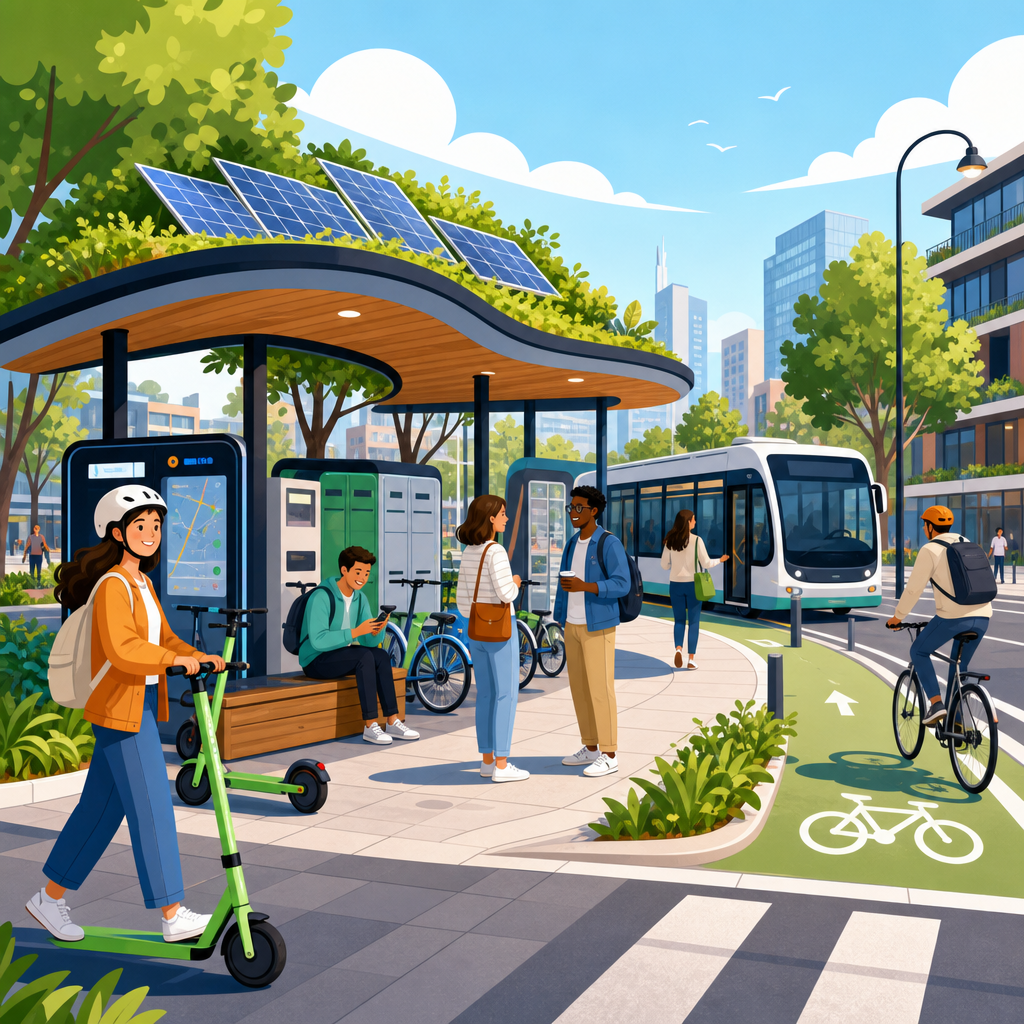
Smart mobility hubs promise cleaner trips, shorter transfers, and better access to jobs, schools, and services, but the difference between an appealing rendering and a useful public asset comes down to operations, governance, land use, and daily user experience. A smart mobility hub is a place where multiple transport modes meet—typically rail, bus, bike share, scooters, ride-hail, walking routes, parking, parcel lockers, and real-time passenger information—designed to make transfers easy and efficient. In practice, I have seen the strongest hubs succeed not because they look futuristic, but because they solve ordinary friction points: missed connections, unsafe crossings, confusing wayfinding, inaccessible platforms, and poorly managed curb space. That matters for housing market trends because mobility hubs shape where people can reasonably live without depending on a private car, which directly affects household costs, development patterns, rental demand, and neighborhood desirability. When a hub works, it expands effective access to a city; when it fails, nearby housing may still be built, but residents inherit delay, congestion, and a weaker quality of life.
For developers, planners, lenders, and local residents, smart mobility hubs sit at the intersection of transportation planning and real estate economics. Their performance influences transit-oriented development, parking ratios, retail viability, and the pricing power of nearby apartments or mixed-use projects. Key terms matter here. First-mile and last-mile connections describe how people get from home to the hub and from the hub to their final destination. Intermodality means switching smoothly between modes. Dwell time refers to how long a vehicle remains stopped, while transfer penalty describes the time and inconvenience users feel when changing modes. A hub that lowers transfer penalty can outperform one with flashier architecture. The strongest examples, from Utrecht Centraal to London’s King’s Cross and Seoul Station precinct upgrades, combine legible design, integrated fares, frequent service, and active ground-floor uses. Smart mobility hubs work beyond the renderings when they are planned as operating systems for movement and neighborhood value, not as isolated buildings or branding exercises.
The Core Ingredients of a High-Performing Hub
A smart mobility hub works when it performs six functions consistently: it connects modes, reduces uncertainty, protects safety, supports accessibility, manages curb demand, and fits surrounding land use. In projects I have reviewed, the first warning sign of trouble is overemphasis on iconography instead of circulation. Beautiful canopies and digital screens do not compensate for a two-minute scramble across traffic or a bus stop hidden behind parking access. The best hubs create direct, weather-protected transfer paths with clear sightlines, minimal level changes, and predictable distances between modes. If a commuter steps off a train and reaches the correct bus bay in under three minutes without asking for help, the hub is doing its job.
Reliable information is the second ingredient. Real-time passenger information, dynamic bay assignment, and integrated journey planning reduce anxiety and missed trips. Standard tools such as GTFS and GTFS Realtime allow agencies and trip-planning apps to publish accurate departure and disruption data. That sounds technical, but the user benefit is simple: fewer surprises. Strong hubs also respect universal design. Elevators with redundancy, tactile paving, ramp grades compliant with ADA standards, audible announcements, seating at intervals, and safe lighting are not extras. They determine whether older adults, parents with strollers, and riders with disabilities can use the system independently. Finally, hubs must match the local urban fabric. A suburban park-and-ride node operates differently from a dense urban interchange. Success depends on aligning mode mix, pedestrian priority, and curb regulations with actual demand rather than a generic template.
Operations Matter More Than Architecture
Renderings usually highlight structure, landscaping, and signature materials, but daily operations decide whether a mobility hub earns repeat use. Frequency is the foundation. A transfer hub served by trains every fifteen minutes and buses every ten minutes is fundamentally different from one with hourly service, even if both have premium finishes. Riders experience service span, reliability, and coordinated schedules more intensely than architecture. Agencies often underestimate this because capital budgets are easier to celebrate publicly than operating budgets, yet a clean station with infrequent buses will still feel inconvenient. In several metropolitan station areas, I have watched ridership lag until agencies adjusted layover space, signal priority, and dispatching practices. The physical hub had not changed much; the operating plan had.
Staffing also matters. Security presence, maintenance crews, customer ambassadors, and incident response protocols shape whether users feel safe and informed. A mobility hub with broken ticket validators, inconsistent enforcement, overflowing bins, or scooters blocking pathways quickly loses credibility. The same applies to curb management. Ride-hail pickups, taxis, delivery vans, private drop-offs, microtransit vehicles, and paratransit all compete for finite space. Without time-based rules, geofenced pickup zones, and active enforcement, curb chaos spills into bus lanes and crosswalks. Leading cities increasingly use digital curb management platforms and camera-based monitoring to allocate loading time by use case. That is less glamorous than a landmark roofline, but it directly improves throughput, safety, and user trust.
Why Housing Markets Respond to Mobility Hubs
Housing markets respond to accessibility, not just distance. A well-run mobility hub increases the number of jobs, schools, clinics, and cultural destinations reachable within a reasonable travel time, and buyers or renters consistently price that access into location decisions. Research across major metros has shown that proximity to high-frequency transit can support stronger rent growth and lower vacancy, especially when service is dependable and the station area offers walkable amenities. The logic is straightforward. If a household can reduce car ownership from two vehicles to one, or from one to none, it can redirect thousands of dollars per year toward rent, savings, or other spending. According to AAA estimates in recent years, the annual cost of owning and operating a new vehicle can exceed $10,000 when fuel, depreciation, maintenance, insurance, and financing are included. Mobility access changes housing affordability in practical terms.
However, not every transit-adjacent project captures this benefit equally. The premium tends to be strongest when the hub is safe, frequent, and integrated into an active district. A station surrounded by blank walls, hostile arterials, and disconnected sidewalks may underperform despite being geographically close. Conversely, a smaller hub with excellent bus reliability, protected bike routes, and grocery access can raise neighborhood appeal substantially. Developers often focus on the rail map, but residents evaluate the full trip chain: how long it takes to leave the building, cross the street, enter the station, pay, wait, transfer, and arrive. In underwriting and market analysis, that means transportation quality should be assessed through door-to-door travel times, mode redundancy, and public realm quality, not just a radius drawn around a station.
Designing the Transfer Experience for Real People
The transfer experience should be designed around seconds, meters, and decisions. Long detours, blind corners, inconsistent signage, and stairs without alternatives all create friction that compounds over time. Wayfinding must begin before a user enters the hub, with visible entrances, street-level maps, and legible naming conventions. Inside, signs should prioritize destinations and modes over internal jargon. I have seen hubs improve dramatically after replacing agency-centric labels with directional language people actually use, such as “Downtown buses” or “Airport train,” supported by color coding and universal symbols. Digital tools help, but physical clarity remains essential because not every rider has full battery, mobile data, local language fluency, or visual acuity.
Comfort influences use more than many project teams expect. Weather protection, indoor waiting zones, clean restrooms, drinking water, seating, and acoustics affect whether people tolerate transfers during peak heat, cold, or rain. Retail should support dwell time without obstructing circulation. A coffee kiosk placed in the desire line can create congestion; the same kiosk positioned beside waiting space can add value. Safety depends on visibility and activity. Active frontages, transparent materials, and consistent lighting reduce perceived risk better than isolated corners and overscaled empty halls. These details are measurable. Agencies can track transfer times, escalator uptime, elevator availability, queue lengths, and platform crowding. If those indicators worsen, the hub is not working, regardless of how persuasive the original rendering looked.
Governance, Funding, and Accountability
Many mobility hubs underperform because no single entity controls the whole user journey. Rail agencies manage platforms, cities control sidewalks and signals, private owners govern adjacent parcels, and operators ranging from bus contractors to bike-share vendors each optimize their own piece. Without a shared governance model, gaps appear at the seams. The strongest hubs establish clear responsibility for operations, maintenance, data standards, and customer communications. Sometimes that is a formal joint powers arrangement; sometimes it is a station-area management entity with agreed service levels and performance reporting. The principle is the same: one integrated place needs integrated accountability.
Funding must also extend beyond construction. Capital grants can pay for canopies, plazas, charging points, and screens, but recurring costs cover cleaning, software subscriptions, security, repairs, and staffing. A useful planning test is whether the hub still functions well three years after ribbon cutting. If the answer depends on one-time launch funding, the business model is weak. Revenue can come from retail leases, advertising, parking, value capture, special assessment districts, or development agreements, but these should support, not distort, the mobility function. The table below summarizes what strong teams measure when moving from concept to operations.
| Component | What good looks like | Common failure | Useful metric |
|---|---|---|---|
| Service integration | Coordinated schedules and fares | Independent timetables | Average transfer wait |
| Passenger information | Accurate real-time updates | Static or inconsistent displays | Data accuracy rate |
| Accessibility | Step-free routes with redundancy | Single elevator dependency | Elevator uptime |
| Curb management | Signed, enforced pickup zones | Blocked bus bays | Curb turnover time |
| Public realm | Safe crossings and active edges | Dead frontages, long detours | Pedestrian delay |
| Financial durability | Funded operations plan | Capital-only budgeting | Operating cost coverage |
Data, Technology, and the Limits of “Smart”
Technology helps mobility hubs perform, but only when it supports a clear operational need. Open payments, fare capping, occupancy sensors, license plate recognition for curb enforcement, and integrated mobility-as-a-service apps can reduce friction and expand user choice. In cities with fragmented agencies, account-based ticketing is especially valuable because it lets riders use one credential across modes and receive the best fare automatically. Real-time occupancy data can spread demand across entrances or vehicles, while predictive maintenance can identify failing escalators before outages cascade into crowding. These are tangible gains.
Still, “smart” should never be confused with gadget-heavy. If sensors are installed without maintenance plans, APIs are closed, or digital interfaces exclude unbanked riders, older adults, or visitors, the result is a more brittle system. Privacy is another concern. Camera analytics and mobility data can improve safety and planning, but agencies should define retention limits, procurement standards, and public reporting to maintain trust. Low-tech interventions often deliver outsized returns: repainting crosswalks to shorten pedestrian crossings, retiming signals for bus priority, relocating a bike dock closer to the station entrance, or simplifying bay assignments. A mobility hub is smart when technology supports reliability, accessibility, and legibility. It is not smart merely because a rendering shows glowing screens and autonomous shuttles.
What Decision-Makers Should Evaluate Before Backing a Hub
Before approving a mobility hub, decision-makers should test whether it improves real travel outcomes and neighborhood value. Start with demand: who will use it, at what times, and for which trip purposes? Commuter peaks, school trips, airport access, hospital visits, and nightlife produce different mode mixes and staffing needs. Then evaluate the transfer chain. Can users move between the highest-demand modes with minimal walking, low conflict, and weather protection? Are there safe, direct pedestrian and cycling approaches from nearby housing? Does zoning permit the density and mix of uses needed to support an active station area? If the land around the hub remains dominated by drive aisles, single-use parcels, or mandatory parking, the project will struggle to reach its potential.
Decision-makers should also insist on measurable outcomes: transfer time targets, accessibility uptime, safety benchmarks, curb compliance rates, customer satisfaction, and operating funding commitments. In housing market terms, the most valuable hubs are those that make daily life simpler and less expensive for residents while supporting durable local commerce. They widen choice. A renter can live farther from a central business district without losing practical access. A family can consider one-car living. An older resident can remain independent longer. That is the real promise of smart mobility hubs. If you are evaluating projects in a growing housing market, look past the renderings and ask how the hub will operate on a wet Tuesday at 7:45 a.m. If the answer is clear, funded, and user-centered, the project deserves serious consideration.
Frequently Asked Questions
What is a smart mobility hub, and what separates a successful one from a visually impressive concept?
A smart mobility hub is more than a station with attractive architecture and a cluster of transport options. At its core, it is a place where multiple modes—such as rail, bus, bike share, scooters, walking routes, ride-hail, parking, parcel pickup, and passenger information systems—are organized to make transfers faster, safer, and more predictable. What makes a hub successful is not the rendering, but the quality of everyday performance. That means coordinated schedules, intuitive wayfinding, reliable real-time information, accessible design, safe pedestrian connections, and enough staff or management attention to keep the space working smoothly throughout the day.
In practice, the best hubs reduce friction. A rider should be able to arrive by train, locate the bus bay immediately, understand departure times without guesswork, cross the site without dodging traffic, and complete the transfer in a few minutes. If bike parking is hidden, curbside pickup is chaotic, lighting feels unsafe, or digital information is unreliable, the hub may look advanced on paper but fail real users. Successful hubs are designed around operations and human behavior, not just infrastructure. They anticipate peak crowds, weather, maintenance needs, conflicting vehicle movements, and the fact that people often make decisions under time pressure.
Another critical difference is whether the hub functions as part of a broader place, not just a transport node. Hubs that work well often connect to surrounding land uses such as housing, offices, schools, clinics, retail, and public services. This helps spread activity across the day, improves safety through continuous use, and makes the hub genuinely useful to the neighborhood. In other words, the strongest mobility hubs are operational systems, public spaces, and local access points all at once. Their value comes from convenience and reliability, not from visual ambition alone.
Why are operations and governance so important in making a mobility hub work beyond opening day?
Operations and governance are often the hidden factors that determine whether a mobility hub succeeds over time. A hub can include every desirable feature on a planning checklist, but if no one clearly manages who controls the curb, who maintains signage, who updates passenger information, who responds to incidents, and how service changes are communicated, the user experience quickly degrades. Mobility hubs typically involve multiple public agencies, private operators, micromobility providers, property owners, and municipal departments. Without a clear governance model, responsibilities become fragmented, and basic issues such as cleaning, enforcement, and coordination can fall between institutions.
Strong governance usually means one thing above all: clarity. There should be defined authority for day-to-day management, documented service standards, funding for routine operations, and agreements that spell out roles for each partner. For example, if a bus operator changes bay assignments, the digital displays, physical signs, and mobile apps should all reflect that change quickly. If ride-hail vehicles are blocking buses or creating unsafe crossings, there must be an enforcement and curb management strategy in place. Good governance also includes performance monitoring, so operators can track dwell times, transfer reliability, safety incidents, space utilization, and user feedback, then make adjustments.
Opening day is rarely the hardest part. The real test comes six months or two years later, when equipment needs maintenance, travel patterns shift, and competing demands for space increase. Successful hubs are run as living systems. They require budgets for staffing, cleaning, repairs, technology updates, security, and customer service. They also need mechanisms for coordination between transportation and land-use decision-makers, because the surrounding neighborhood will shape travel demand. When governance is weak, even a high-profile hub can become confusing, underused, or conflict-prone. When governance is strong, the hub can adapt, improve, and remain useful long after the ribbon cutting.
How does land use around a smart mobility hub affect whether people actually use it?
Land use is one of the biggest predictors of whether a mobility hub becomes an active daily asset or an isolated piece of infrastructure. A hub performs best when it sits within a walkable district that includes destinations people need and use frequently: homes, jobs, schools, healthcare, shops, public services, and community spaces. If the surrounding area is dominated by blank walls, oversized parking lots, low-density single-purpose development, or dangerous road crossings, even excellent transit connections may be harder to access than they appear in planning diagrams. In those cases, the hub can function more like an island than a connector.
Good surrounding land use increases both utility and resilience. Residents living nearby can access multiple modes without driving first. Workers can use the hub at different times of day, which supports retail and improves passive surveillance. Students and families benefit when schools, libraries, childcare, and health services are integrated into the wider district. Mixed-use development also helps distribute demand across more than just peak commuting hours, making the hub feel active and safer throughout the day. This is especially important for smaller cities or suburban areas trying to shift from auto-oriented travel patterns toward more multimodal behavior.
Equally important is affordability and inclusion. If rising land values around a hub displace lower-income households or local businesses, the project can undermine one of its core promises: better access to opportunity. That is why many practitioners emphasize transit-oriented development policies that include affordable housing, public amenities, and pedestrian-first street design. A mobility hub should not only move people through an area; it should improve access for the people who live there. The most effective hubs are embedded in complete neighborhoods where transportation, land use, and public realm design support one another rather than operating as separate agendas.
What features most improve the daily user experience at a smart mobility hub?
The daily user experience depends on how easily people can understand, navigate, and trust the hub under real conditions. Some of the most important features are surprisingly basic: short walking distances between modes, weather protection, clear signs, seating, lighting, accessible paths, visible staff or help points, and accurate real-time information. People judge a hub less by how many modes are present and more by how much effort it takes to make a transfer. If the bus stop is difficult to find, elevators are unreliable, crosswalks are indirect, or pickup zones are chaotic, users experience stress even if the physical site appears modern.
Wayfinding is especially critical. A well-designed hub tells people where to go almost instantly through layout, sightlines, maps, consistent naming, and digital displays. This matters for commuters, but it matters even more for visitors, occasional riders, older adults, people with disabilities, and anyone traveling with children or luggage. Universal design should be a baseline, not an afterthought. Step-free routes, tactile guidance, audible announcements, clear curb ramps, generous waiting areas, and readable information all contribute to a system that works for the broadest range of users. Safety also shapes the experience profoundly, including visibility, lighting, traffic calming, and secure spaces for waiting or parking bikes.
Another major factor is reliability across modes. Real-time passenger information should reflect actual conditions, not just scheduled times. Payment systems should be as integrated and low-friction as possible. Pickup and drop-off areas should be organized to prevent conflicts between buses, pedestrians, delivery vehicles, and ride-hail drivers. Amenities such as parcel lockers, charging points, public restrooms, and small retail can add value, but only if the fundamentals are already working. The best mobility hubs feel legible, calm, and dependable. They save time, reduce uncertainty, and make multimodal travel feel normal rather than complicated.
How should cities measure whether a smart mobility hub is delivering real public value?
Cities should evaluate mobility hubs using performance measures that reflect real user outcomes, not just construction milestones or visual quality. A meaningful assessment starts with transfer time, service reliability, accessibility, and safety. How long does it actually take to move from one mode to another? How often do people miss connections because of poor coordination or confusing layouts? Are routes fully accessible for wheelchair users, people with strollers, and travelers carrying bags? Have pedestrian or curbside conflicts decreased? These metrics reveal whether the hub is functioning as intended in everyday use.
Ridership and mode shift also matter, but they should be interpreted carefully. A hub may increase transit boardings, walking access, or bike usage, but the broader goal is often improved access to jobs, education, healthcare, and services. Cities should therefore measure connectivity and opportunity, not just passenger counts. That can include the number of key destinations reachable within a certain travel time, changes in first-mile and last-mile travel behavior, and whether the hub improves access for historically underserved communities. Customer satisfaction surveys, observed movement patterns, and anonymized utilization data can help identify what is working and where friction remains.
Longer-term public value includes economic and place-based outcomes. Cities should look at whether the hub supports healthier surrounding development, stronger street activity, lower household transportation costs, and better integration between transportation and land use. They should also measure operational durability: maintenance response times, uptime for digital systems, cleanliness, security incidents, and compliance with service standards. The most useful question is not whether the hub was built as planned, but whether it delivers dependable, inclusive, and efficient mobility over time. A successful smart mobility hub creates measurable improvements in access and daily life, not just a compelling image for presentations.