Residential PropTech is changing how apartment communities are built, leased, managed, and experienced, and the shifts now underway could materially reshape multifamily operations over the next several years. In practical terms, Residential PropTech refers to digital tools, connected devices, software platforms, and data systems used across the housing lifecycle, from marketing and leasing to maintenance, energy management, payments, and resident engagement. Multifamily operations cover the daily and strategic work required to run apartment portfolios: occupancy management, revenue optimization, work orders, staffing, compliance, utility control, capital planning, and retention. I have worked with operators evaluating these systems, and the pattern is consistent: the most valuable technologies are not gimmicks. They solve stubborn operational problems, reduce friction for residents, and give site teams clearer visibility into performance.
This matters because multifamily owners and managers are under pressure from multiple directions at once. Insurance costs have climbed in many markets, labor remains tight, interest rates have changed deal math, and residents expect digital convenience comparable to banking, retail, and travel. At the same time, regulators are paying closer attention to data privacy, fee transparency, screening practices, and fair housing compliance. A fragmented tech stack can amplify these pressures rather than relieve them. A well-designed operating model, supported by the right property technology, can reduce delinquency, shorten vacancy loss, improve maintenance response times, and support better net operating income. That is why Residential PropTech trends deserve close attention from asset managers, property managers, regional leaders, and investors.
As a hub article within Housing Market Trends, this page maps the key technology currents shaping multifamily operations now: connected building systems, centralized leasing, artificial intelligence, resident experience platforms, fraud prevention, data interoperability, and sustainability technology. The goal is not to chase every product category. It is to understand which trends have operational substance, where they fit in the apartment lifecycle, and what tradeoffs come with adoption. For operators, the central question is straightforward: which PropTech investments will create measurable gains in efficiency, service quality, compliance, and asset performance? The answer increasingly depends on integration, governance, and disciplined implementation as much as on the software itself.
Centralized operations and AI-assisted workflows
One of the clearest Residential PropTech trends in multifamily is the move from heavily site-based administration toward centralized operations supported by automation. Leasing teams once handled every inquiry, tour, application follow-up, and renewal outreach manually. Today, many operators are consolidating these tasks into shared service models, then using customer relationship management systems, conversational AI, and workflow automation to route work. Platforms such as RealPage, Yardi, Entrata, Funnel, and EliseAI are often part of this shift, though the exact stack varies by portfolio size and operating strategy.
The operational logic is strong. Internet leads arrive outside business hours, prospects expect instant responses, and site teams are frequently pulled into resident issues. AI leasing assistants can answer common questions, schedule tours, send reminders, and maintain communication continuity when on-site staff are busy. In practice, this does not eliminate the need for people. It changes where human effort adds the most value. Experienced associates can spend more time on complex objections, in-person conversion, and resident relationship management, while routine touchpoints are handled at scale. Operators that centralize effectively usually standardize lead stages, response time rules, and handoff protocols before deploying automation. Without that groundwork, response volume may improve while actual conversion stagnates.
Centralization also reaches collections, renewals, vendor coordination, and after-hours resident communication. I have seen portfolios improve consistency simply by reducing the number of ad hoc processes happening at individual properties. However, there are important limits. A shared model can feel impersonal if escalations are slow or if local market knowledge is missing. AI-generated communication must be monitored for accuracy, tone, and fair housing risk. The real trend is not replacing property teams with bots; it is redesigning workflows so repetitive administrative work no longer dominates the day.
Smart access, self-guided touring, and connected units
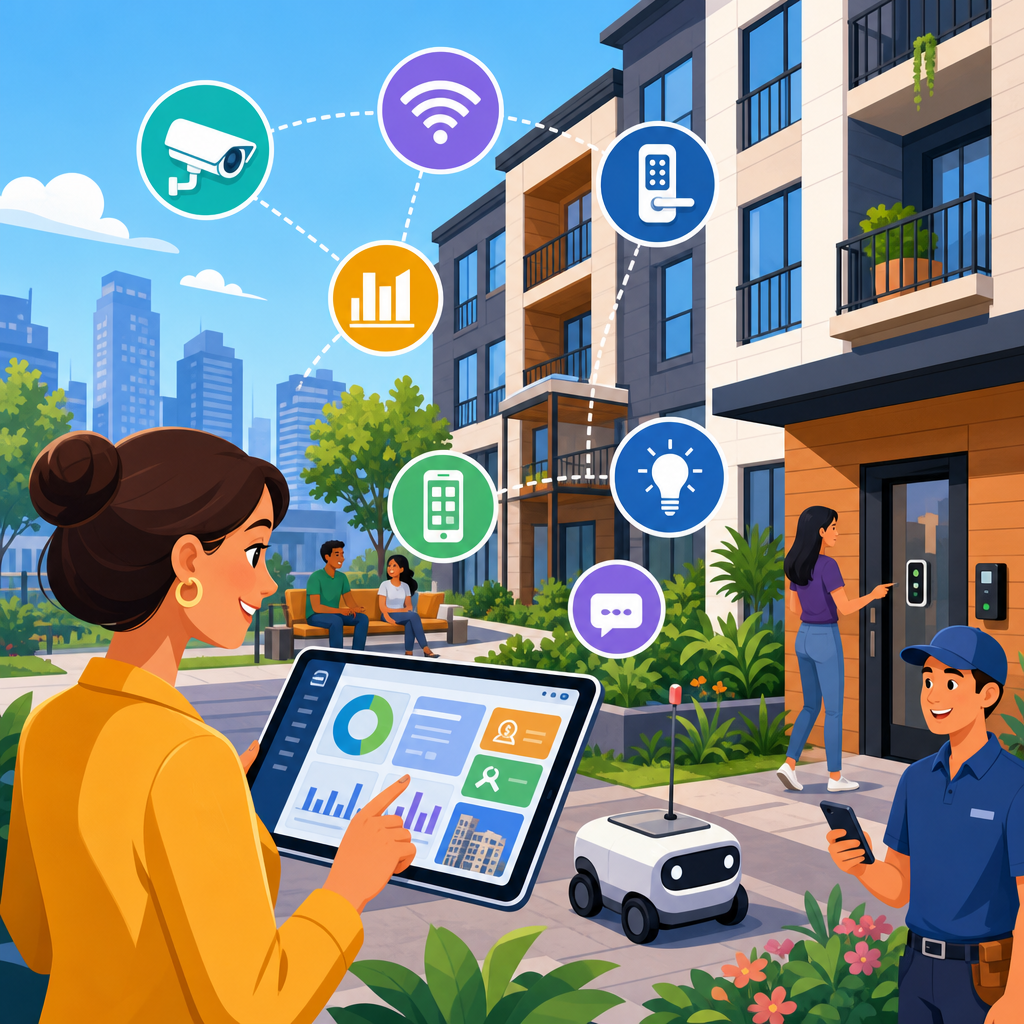
Smart access technology has moved from novelty to a serious operational tool. Self-guided tours, mobile credentials, video intercoms, smart locks, and unit-level sensors can reshape staffing patterns, prospect convenience, and security procedures. For multifamily operators, these systems promise fewer key management headaches, easier vendor access, faster turns, and broader touring windows. Products from Latch, ButterflyMX, Schlage, Yale, and Assa Abloy frequently appear in deployment plans, often paired with property management software and identity verification tools.
The biggest operational gain is flexibility. Prospects can tour outside traditional leasing hours, reducing friction in high-volume periods. Maintenance teams can receive time-bound digital access rather than physical keys. Move-ins and common-area permissions can be managed centrally. In scattered-site or lean-staffed portfolios, that control matters. Smart thermostats and leak sensors add another layer by helping operators monitor vacant units, detect water events early, and manage energy consumption across common areas and apartments. A single avoided leak can justify a substantial portion of sensor deployment costs, especially in markets where insurance deductibles and water damage claims have become painful.
Still, connected hardware is only as good as the operating process around it. Device battery replacement, credential lifecycle management, Wi-Fi or hub reliability, and resident support cannot be afterthoughts. A self-guided touring program fails quickly if access codes malfunction or if identity checks are weak. Security and privacy also matter. Operators need documented policies on who can issue credentials, how access logs are retained, and what happens during outages. The trend with staying power is not merely installing smart devices. It is using connected infrastructure to tighten controls, create convenience, and reduce avoidable operational loss.
Fraud prevention, screening modernization, and digital trust
Application fraud has become a major operational concern in multifamily, particularly as more leasing activity moved online. Synthetic identities, manipulated pay stubs, fake bank statements, and coordinated occupancy fraud can undermine occupancy quality and create expensive eviction or delinquency problems later. As a result, a defining Residential PropTech trend is the modernization of screening and identity verification. Operators are adding document analysis, bank-account verification, fraud scoring, device intelligence, and cross-checks against known risk signals to traditional credit and background screening.
What has changed is not only the technology, but the risk tolerance. Teams that once prioritized application speed above all else are now balancing speed with defensibility. Solutions from TransUnion, Equifax, Experian, Plaid, Snappt, and other verification vendors are being layered into leasing workflows to assess authenticity before approval. In day-to-day operations, this means fewer manual document reviews and more structured exception handling. It also means leasing associates need training on adverse action requirements, consistency standards, and escalation paths. Screening cannot become opaque or arbitrary. Fair housing compliance requires applied criteria to be objective, documented, and consistently administered.
Digital trust extends beyond initial applications. Payment platforms with stronger authentication, resident portals with secure account management, and fraud monitoring on concessions or referrals are increasingly relevant. The tradeoff is that every added checkpoint can create drop-off if the user experience becomes cumbersome. The best systems minimize friction for legitimate applicants while flagging anomalies early. For multifamily operators, the takeaway is simple: fraud prevention is no longer a back-office concern. It is now core to leasing operations, revenue protection, and compliance management.
Data interoperability and platform consolidation
Many multifamily technology headaches come from disconnected systems rather than weak individual tools. Leasing data lives in one platform, maintenance in another, access control in a third, utilities in a fourth, and business intelligence in separate spreadsheets. This fragmentation slows reporting, creates duplicate work, and makes root-cause analysis harder. That is why data interoperability and platform consolidation are among the most important PropTech trends shaping operations. Operators increasingly want open APIs, reliable integrations, consistent resident records, and fewer manual exports.
In practice, consolidation does not always mean moving to one vendor for everything. It means deciding which system is the system of record for prospects, residents, units, and financial data, then ensuring adjacent tools sync cleanly. Mature operators map their critical data flows before buying software. They ask basic but essential questions: Will guest cards sync in real time? Can work-order completion trigger resident communication automatically? Will smart lock events connect to unit status? Can invoice data flow into accounting without rekeying? These details determine whether technology reduces workload or multiplies it.
| Operational area | Common legacy problem | PropTech improvement | Expected impact |
|---|---|---|---|
| Leasing | Leads lost between channels | Unified CRM and automated follow-up | Faster response and higher conversion |
| Maintenance | Manual scheduling and poor visibility | Mobile work-order platform with status updates | Shorter completion times and better resident communication |
| Access control | Physical key tracking | Smart credentials with audit logs | Stronger security and easier vendor access |
| Payments | Fragmented rent collection methods | Integrated digital payments and reminders | Lower delinquency and fewer exceptions |
| Utilities | Limited consumption insight | Metering and leak detection integrations | Reduced waste and earlier loss prevention |
Interoperability also affects reporting quality at the portfolio level. Revenue managers, asset managers, and operations leaders need trusted definitions for occupancy, renewals, work-order aging, lead-to-lease conversion, and delinquency. If every property interprets fields differently, dashboards become decorative instead of actionable. The portfolios making real progress are standardizing data governance alongside software deployment. Technology selection should follow operating design, not replace it.
Resident experience, payments, and retention technology
Resident experience technology now sits at the center of multifamily operations because retention is often cheaper than replacing a move-out. Portals, mobile apps, digital payments, package management, community messaging, maintenance tracking, and renewal workflows all affect whether living in a community feels simple or frustrating. The strongest systems do not just offer features; they reduce ambiguity. Residents want to know when rent is due, how to submit a request, when a technician will arrive, where a package is stored, and how to renew without chasing the office.
Payment innovation is especially influential. Autopay, flexible payment schedules, wallet options, and clearer ledger visibility can improve collection rates when implemented responsibly. Some operators use cash-pay networks for underbanked households; others offer split-payment tools timed to payroll cycles. These options can support on-time payment, but they must be structured carefully to avoid confusing fee structures or resident dissatisfaction. Transparency matters. Residents quickly lose trust when convenience tools appear to increase costs without delivering value.
Retention technology is also becoming more predictive. Operators are analyzing service request history, payment patterns, engagement signals, and renewal response behavior to identify residents at risk of moving. Used well, this can help teams intervene with service recovery, targeted communication, or renewal options before dissatisfaction hardens. Used poorly, it becomes noise. The key is connecting signals to operational action. A dashboard alone does not improve retention. Clear outreach playbooks, empowered site teams, and measurable service standards do.
Sustainability, maintenance intelligence, and the next operating model
Another major trend is the merger of sustainability goals with practical operations. In multifamily, energy management, water conservation, preventive maintenance, and capital planning increasingly rely on sensors, analytics, and remote monitoring. This is not just about environmental branding. Utility costs directly affect operating margins, and local building performance standards are becoming more common in major cities. Smart thermostats in common areas, submetering, leak detection, HVAC monitoring, and analytics platforms can help operators identify waste and prioritize repairs before resident comfort suffers.
Predictive maintenance is particularly promising because traditional reactive models are expensive. If a fan motor, water heater, or HVAC component shows early signs of failure, maintenance teams can schedule service before an emergency call, resident complaint, or larger asset loss occurs. The savings come from avoided downtime, lower overtime, fewer make-ready disruptions, and better parts planning. However, predictive claims should be evaluated carefully. The data model is only useful if devices are calibrated, alerts are actionable, and teams have capacity to respond. Too many notifications simply create alert fatigue.
Looking ahead, the multifamily operating model is likely to become more centralized, more data-driven, and more resident-facing at the same time. On-site roles will not disappear, but they will continue shifting toward hospitality, exception handling, inspections, and high-value interactions while software manages repetitive transactions in the background. The winners will be operators that treat PropTech as operating infrastructure rather than a collection of apps. Start with process design, select tools with strong integrations, define governance, train teams thoroughly, and measure outcomes such as conversion, turn time, work-order completion, delinquency, retention, and utility variance. Residential PropTech trends can reshape multifamily operations, but only when technology is matched with disciplined execution. For teams building their housing market strategy, now is the time to audit the stack, identify friction points, and prioritize investments that produce measurable operational gains.
Frequently Asked Questions
1. What is Residential PropTech, and why does it matter so much for multifamily operations?
Residential PropTech refers to the growing ecosystem of software platforms, connected devices, automation tools, and data systems used to improve how apartment communities are marketed, leased, operated, maintained, and experienced. In a multifamily setting, that can include everything from AI-powered leasing assistants and self-guided tour technology to smart locks, digital payment systems, maintenance workflow platforms, resident apps, utility monitoring, and energy management tools. What makes PropTech so important is that multifamily operations are complex, repetitive, and highly dependent on coordination across people, processes, and physical assets. Even small improvements in efficiency can have an outsized impact when they are applied across dozens, hundreds, or thousands of units.
Over the next several years, Residential PropTech is likely to reshape multifamily operations because owners and operators are under pressure from multiple directions at once. They need to control operating costs, meet rising resident expectations, improve staff productivity, reduce vacancy loss, respond faster to service issues, and make better use of operational data. Traditional property management methods often rely on disconnected systems, manual follow-up, and reactive decision-making. PropTech helps move operations toward more integrated, real-time, and measurable workflows. Instead of treating leasing, maintenance, payments, access control, and resident communication as separate silos, modern platforms increasingly connect them into a single operational environment.
That matters strategically, not just tactically. A property that can lease units faster, reduce delinquency, streamline service requests, improve communication, and lower energy waste may gain a meaningful advantage in net operating income and resident retention. In that sense, Residential PropTech is no longer just a convenience layer. It is becoming part of the operating model for competitive multifamily communities.
2. Which Residential PropTech trends are most likely to have the biggest impact on apartment communities?
Several trends stand out because they directly affect the daily realities of multifamily operations. One of the biggest is leasing automation. This includes AI chat tools, centralized leasing platforms, self-scheduling tours, digital applications, identity verification, and online screening workflows. These tools help properties respond faster to prospects, reduce friction in the leasing journey, and support more consistent conversion even when onsite teams are stretched thin. In competitive rental markets, speed and responsiveness can materially influence occupancy performance.
Another major trend is the expansion of smart building and smart unit technology. Connected locks, thermostats, leak sensors, water monitoring systems, and access control platforms are moving beyond novelty and becoming operational tools. For operators, these systems can reduce unit turn delays, support remote access management, detect maintenance issues earlier, and improve energy performance. Leak detection alone can potentially prevent expensive damage and resident disruption, while smart thermostats and building controls can support lower utility costs and more efficient climate management.
Data integration and analytics are also becoming more influential. Many multifamily organizations have historically collected large amounts of information without being able to use it effectively. Newer PropTech platforms aim to centralize data from leasing, CRM, maintenance, accounting, utility systems, and resident engagement tools so operators can identify trends, benchmark property performance, and make better decisions. This can help with everything from staffing models to pricing strategies to preventative maintenance planning.
A fourth trend is resident experience technology. Mobile resident portals, digital communication platforms, package management systems, online rent payments, amenity reservations, and community engagement features are helping properties meet modern expectations for convenience and transparency. Residents increasingly expect apartment living to offer the same digital ease they encounter in banking, retail, and travel. Properties that fail to provide that level of convenience may struggle with satisfaction and retention.
Finally, there is growing momentum behind PropTech tied to sustainability and operational resilience. Tools that track energy use, monitor water consumption, automate lighting, support ESG reporting, and identify inefficiencies are becoming more relevant as utilities remain volatile and regulatory scrutiny increases. For multifamily operators, this trend is less about marketing language and more about practical cost control, risk management, and future readiness.
3. How can PropTech improve leasing, maintenance, and resident satisfaction in multifamily properties?
PropTech improves leasing by reducing friction and increasing responsiveness across the renter journey. Prospective residents often choose the property that answers first, provides clear information, and makes next steps easy. AI leasing assistants, automated follow-up tools, virtual tours, online applications, and digital document workflows help maintain momentum from first inquiry to signed lease. This is especially valuable after hours or during peak lead periods, when onsite teams may not be able to respond immediately. Better leasing technology can also help standardize communication, reduce administrative errors, and give managers clearer visibility into lead sources and conversion bottlenecks.
On the maintenance side, PropTech can create major operational gains because service workflows affect both resident satisfaction and asset performance. Digital maintenance platforms allow residents to submit requests easily, attach photos, receive status updates, and communicate with staff without repeated phone calls or office visits. For teams, these systems help with prioritization, routing, technician accountability, completion tracking, and historical documentation. Predictive and preventative maintenance tools add another layer of value by identifying issues before they become emergencies. Smart sensors that detect leaks, humidity changes, HVAC irregularities, or equipment anomalies can reduce costly repairs, protect units, and limit disruption for residents.
Resident satisfaction improves when technology removes common pain points from everyday living. Online payment systems simplify rent collection and reduce inconvenience. Mobile apps make it easier to contact management, reserve amenities, receive announcements, and track service requests. Smart access systems can improve convenience and security for residents, staff, and vendors. Package management tools help address one of the most persistent challenges in modern apartment communities. The broader pattern is simple: when operations become more transparent, responsive, and convenient, residents tend to perceive the community as more professionally managed.
That said, the biggest gains usually come when technology supports people rather than replacing the human experience entirely. Residents still value empathy, professionalism, and trust. The most effective multifamily operators use PropTech to free staff from repetitive administrative tasks so they can spend more time on high-value resident interactions, problem-solving, and community management.
4. What challenges should owners and operators expect when adopting new PropTech solutions?
While the upside can be significant, PropTech adoption is rarely as simple as installing a new app or device. One of the most common challenges is integration. Many multifamily portfolios already rely on a mix of property management software, accounting systems, CRM tools, access platforms, payment processors, and maintenance applications. If a new PropTech solution does not connect well with existing systems, it can create more fragmentation rather than less. Data silos, duplicate entry, inconsistent reporting, and staff confusion can undermine the benefits operators were hoping to achieve.
Another challenge is implementation discipline. A promising technology can underperform if the rollout is rushed, poorly communicated, or unsupported by training. Onsite teams need to understand not only how to use a tool, but why it matters and how it fits into daily workflows. Residents may also need education and support, particularly when a property introduces new access systems, mobile apps, or digital communication channels. Change management often determines whether PropTech becomes a real operational improvement or just another underused platform.
Cost and return on investment are also important considerations. Some tools deliver obvious savings or revenue benefits, while others create softer advantages that take longer to measure. Operators should evaluate not just license fees or hardware costs, but also implementation time, maintenance requirements, training needs, cybersecurity implications, and the operational burden of managing multiple vendors. The best buying decisions usually come from identifying a specific business problem first, then selecting technology that solves it, rather than adopting tools simply because they are new or heavily marketed.
Security, privacy, and reliability should not be overlooked either. Connected devices and cloud platforms can create exposure if they are not properly vetted. Multifamily operators need confidence that resident data, payment information, access credentials, and building systems are protected by strong security practices. They also need contingency plans for outages, device failures, and vendor disruptions. In a business that affects people’s homes, technology reliability is not just an IT issue; it is an operational and reputational issue as well.
5. How should multifamily companies evaluate which PropTech investments are worth making now?
The smartest approach is to begin with operational priorities, not product categories. Owners and operators should first ask where they are losing the most time, money, or resident goodwill. Is leasing response too slow? Are maintenance backlogs creating complaints? Are utility expenses rising? Is delinquency difficult to manage? Are teams spending too much time on repetitive administrative tasks? Once the real pain points are defined, it becomes easier to evaluate which PropTech solutions can produce meaningful improvements. This problem-first approach helps prevent technology sprawl and keeps investment decisions tied to measurable business outcomes.
From there, companies should evaluate tools based on practical criteria: ease of integration, usability for onsite teams, resident adoption potential, reporting quality, vendor support, implementation requirements, and total cost of ownership. It is also important to look at scalability. A tool that works well at one property may not be suitable across a regional or national portfolio if it lacks standardized workflows, centralized reporting, or enterprise support. Multifamily operators should think beyond short-term convenience and ask whether a platform can support the organization’s future operating model.
Measurement is critical.