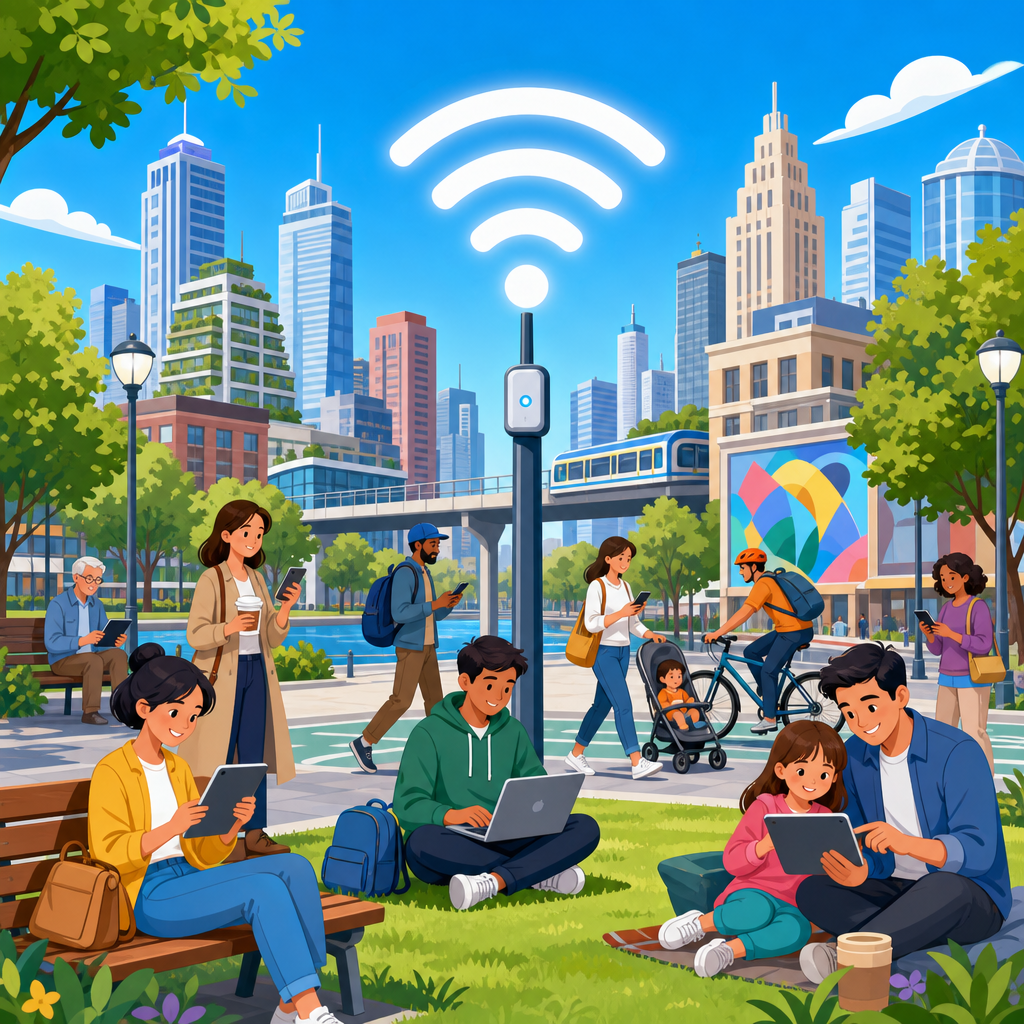
Public Wi-Fi has evolved from a convenience in cafés and airports into a practical layer of urban infrastructure, shaping how residents find housing, apply for services, search for jobs, and participate in civic life. In city planning terms, public Wi-Fi means internet access made available in shared spaces such as libraries, parks, transit stations, public housing common areas, downtown corridors, and municipal buildings, usually funded or coordinated by local government, utilities, private partners, or anchor institutions. Essential infrastructure refers to systems a city depends on for daily function and long-term resilience, alongside transportation, water, power, and communications. Treating connectivity as essential matters because modern urban life now assumes reliable internet access for tasks as basic as paying rent, attending telehealth appointments, completing schoolwork, receiving emergency alerts, and comparing housing options in competitive markets.
I have worked on digital access planning with housing, broadband, and municipal operations teams, and the pattern is consistent: when internet access is absent or unaffordable, people are cut off from opportunities that cities say they want to expand. The issue is not only speed. It is proximity, affordability, device access, digital literacy, network reliability, and whether service is available where life actually happens. A household may technically have broadband in a census tract yet still rely on a phone data cap or a weak signal from a parking lot. Public Wi-Fi helps close that practical gap. It offers a low-barrier on-ramp that supports residents who are priced out of home broadband, temporarily disconnected, unhoused, newly arrived, or simply mobile throughout the day.
For housing markets, the connection is direct. Renters and buyers use online listings, application portals, digital document signing, background screening, and payment systems. Property managers increasingly communicate by app or email. Waiting lists for subsidized housing are posted online. Tenant rights resources, utility assistance, zoning updates, and neighborhood plans are commonly digital first. In this environment, citywide public Wi-Fi supports housing access, neighborhood stability, and economic mobility. It also creates a platform for smarter public services, from transit information to park management. Cities that understand public Wi-Fi as essential infrastructure are not adding a nice amenity. They are strengthening the basic operating system of urban life.
Why cities now treat public Wi-Fi as core infrastructure
The case for public Wi-Fi starts with a simple fact: internet access functions like a utility for social and economic participation. The Federal Communications Commission has repeatedly framed broadband as critical communications infrastructure, and the National Telecommunications and Information Administration has tied access to workforce participation, education, healthcare, and civic engagement. In practice, public Wi-Fi complements home broadband rather than replacing it. A resident may use fiber at home when available, but still depend on a free network at a bus hub, library, workforce center, or courthouse during the day. That layered access model is how cities build resilience.
Municipal leaders also care about cost efficiency. Extending public Wi-Fi through existing assets such as streetlight poles, transit shelters, library branches, and public buildings can be more affordable than building entirely new structures. A city may backhaul traffic through municipal fiber, a school district network, or dark fiber leased from a utility. Wireless access points then serve targeted high-need areas. New York City’s LinkNYC kiosks, for example, repurposed old payphone sites into public connectivity points with advertising-supported operations. Charlotte, Philadelphia, and San Jose have all used combinations of public-private partnership, philanthropic support, and municipal assets to expand access where the market alone was not meeting need.
There is also a resilience argument. During storms, power outages, heat emergencies, or wildfire smoke events, people need reliable ways to receive alerts, locate cooling centers, contact family, and complete emergency forms. Public Wi-Fi in hardened facilities such as libraries, recreation centers, and public housing community rooms can act as a continuity layer when private options fail. The COVID-19 period made this visible. Cities parked Wi-Fi buses near neighborhoods, opened school parking lots for connectivity, and accelerated outdoor hotspot deployments because work, school, housing, and healthcare had all shifted online at once. What looked temporary revealed a permanent need.
How public Wi-Fi supports housing access and neighborhood stability
Public Wi-Fi is especially important in housing because digital access now sits inside nearly every step of the housing journey. A renter searching for an apartment compares listings, maps commute times, verifies school boundaries, requests tours, submits applications, uploads pay stubs, pays screening fees, and signs leases online. Homebuyers research mortgage rates, inspection checklists, neighborhood sales, tax records, flood maps, and closing documents through digital tools. If access is inconsistent, households lose time and bargaining power in a market where the best listings often move quickly. In tight rental markets, a delay of even a few hours can mean missing a unit entirely.
For lower-income residents, public Wi-Fi can reduce hidden transaction costs. Instead of paying for repeated trips to print and submit paperwork, applicants can complete forms from a library, housing resource center, or public plaza. Residents in public or subsidized housing can use common-area Wi-Fi to renew benefits, communicate with case managers, and access maintenance portals. This matters because housing instability often overlaps with unstable employment, caregiving burdens, and transportation limits. Connectivity in the places people already visit reduces friction. It is not a cure for housing affordability, but it removes avoidable barriers from an already difficult process.
Neighborhood stability also improves when residents can stay connected to local information. Cities increasingly post zoning hearings, code enforcement notices, redevelopment plans, tenant protection resources, and emergency repair updates online first. Public Wi-Fi helps residents participate in those processes instead of hearing about them after decisions are made. Community organizations can hold workshops in connected public spaces, helping tenants understand leases, eviction diversion programs, weatherization grants, or first-time homebuyer assistance. In my experience, the strongest results come when connectivity is paired with trusted intermediaries such as libraries, housing nonprofits, and neighborhood associations, because access alone does not guarantee people know which information matters.
What makes a successful municipal public Wi-Fi network
Effective public Wi-Fi is not defined by how many hotspots a city can announce. It is defined by whether the network solves real problems in the places residents need it most. Planning should begin with demand mapping: libraries with parking lot use after hours, transit transfer points, public housing campuses, main streets with small business activity, shelters, parks in dense neighborhoods, and service hubs such as clinics or workforce centers. Cities should compare local data on broadband adoption, poverty, language access, student need, and device ownership, then align deployments to those patterns.
Technical design matters. Outdoor access points need appropriate ingress protection, power, and backhaul capacity. Network teams should account for concurrent users, not just advertised speed. A site serving fifty people waiting for buses has different requirements than a quiet plaza. Authentication should be simple, with captive portals minimized or carefully designed for accessibility. Content filtering must be legally and ethically considered, especially in libraries and youth-serving spaces. Strong encryption, segmented networks, routine patching, and clear privacy policies are essential. People will not trust public Wi-Fi if they fear surveillance or credential theft.
Operations often determine success more than ribbon cuttings. Networks need uptime targets, help desk procedures, hardware replacement cycles, and analytics that go beyond vanity metrics. Useful measures include unique users, repeat sessions, average throughput, peak demand periods, service tickets, and whether residents can complete common tasks such as housing applications or telehealth visits without interruption. Cities that perform well usually set clear service standards and assign ownership across information technology, economic development, housing, libraries, and emergency management rather than leaving the network in an organizational silo.
| Planning Area | Key Decision | What Good Practice Looks Like |
|---|---|---|
| Site selection | Where to deploy first | Prioritize libraries, transit hubs, public housing, service centers, and parks in low-adoption neighborhoods |
| Backhaul | How to connect access points | Use municipal fiber, utility fiber, or high-capacity leased lines with room for peak demand |
| User experience | How people join the network | Simple sign-on, multilingual instructions, ADA-conscious design, minimal data collection |
| Security | How to protect users and systems | WPA3 where possible, network segmentation, regular firmware updates, clear privacy notices |
| Operations | How to sustain performance | Monitor uptime, replace aging equipment, track repeat use, and publish service metrics |
Funding models, governance, and public accountability
No single funding model fits every city. Some networks are fully municipal, supported through general funds, capital budgets, or utility revenues. Others rely on private internet service providers under franchise or service agreements. Advertising-supported models can offset cost in high-footfall areas, though they raise questions about data collection and the distribution of service beyond commercially attractive districts. Federal and state funding has also become important. The American Rescue Plan Act helped many local governments invest in connectivity, while programs associated with the Infrastructure Investment and Jobs Act and state broadband offices have expanded planning and capital options.
Governance deserves equal attention. A city should define who owns the assets, who manages the user relationship, who handles cybersecurity incidents, and what public reporting is required. Procurement documents should set standards for uptime, maintenance response, accessibility, privacy, and data retention. If a private operator monetizes screens or anonymized analytics, those terms should be explicit and reviewable. Public Wi-Fi can generate public value, but only if accountability keeps pace with technology. Hidden fees, vague privacy language, or deployments concentrated only in tourist zones will undermine trust quickly.
Libraries offer a strong governance model because they combine mission alignment, public trust, and experience with privacy standards. Many city systems extend library connectivity outdoors so residents can connect from plazas, sidewalks, and parking areas even after buildings close. Housing authorities can play a similar role in residential settings by integrating common-area Wi-Fi with resident services while preserving tenant rights. The most credible city programs build advisory input from residents, digital inclusion groups, school systems, and small business organizations from the beginning, not after procurement decisions have already narrowed the options.
Limits, risks, and what public Wi-Fi cannot do alone
Public Wi-Fi is essential infrastructure, but it is not a substitute for affordable home broadband, quality devices, or digital skills. A student cannot comfortably complete all schoolwork on a bench outside a library. A tenant dealing with eviction should not have to upload legal documents over a crowded signal in a plaza. Cities need a layered strategy that includes home internet affordability, device distribution, digital navigation, and tenant-facing service design. The Affordable Connectivity Program showed how much demand exists for lower household broadband costs, and its funding instability showed why local governments cannot assume federal affordability support will always fill the gap.
There are also real operational risks. Open or poorly secured networks can expose users to spoofed portals, phishing, or traffic interception. Outdoor equipment can be vandalized, damaged by weather, or rendered obsolete by changing standards. Usage can exceed expectations if planners underestimate demand in dense areas. Equity risks matter too. If a city installs polished Wi-Fi in downtown entertainment districts while underserved neighborhoods remain disconnected, the program can widen the perception that public investment follows visitors more than residents. Good planning requires acknowledging these tradeoffs directly.
The strongest approach is practical and balanced. Cities should treat public Wi-Fi as one tier in a broader digital infrastructure strategy, then measure outcomes that matter to residents. Are more people completing housing applications successfully? Are public housing residents reporting fewer connectivity disruptions? Are small businesses on commercial corridors seeing better foot traffic and payment reliability? Are emergency alerts reaching people in public spaces? When those answers improve, public Wi-Fi is doing the job infrastructure is supposed to do: making the city more functional, more inclusive, and more resilient for everyone.
Public Wi-Fi belongs in the same conversation as streets, transit, water, and power because it now underpins access to housing, work, education, healthcare, and civic participation. Cities that plan it well do more than provide free internet in a park. They build a reliable access layer across libraries, transit nodes, public housing, service centers, and commercial corridors so residents can complete essential tasks where daily life actually unfolds. The practical benefits are clear: faster access to housing information, fewer barriers to public services, stronger emergency communication, and better support for residents who cannot depend on private broadband alone.
The most effective municipal public Wi-Fi networks share a few traits. They target real coverage gaps instead of chasing headlines, use durable technical design, protect privacy, publish performance metrics, and connect connectivity investments to broader goals such as housing stability and neighborhood equity. They also recognize the limits of hotspot access and pair public networks with home broadband affordability efforts, devices, and digital support. That balanced approach is what turns a visible amenity into durable urban infrastructure.
For city leaders, housing organizations, and community institutions, the next step is straightforward: map where connectivity barriers disrupt housing access and daily services, then build a public Wi-Fi strategy around those locations first. When cities treat internet access as infrastructure, residents gain a stronger foothold in the housing market and in urban life overall.
Frequently Asked Questions
Why is public Wi-Fi now considered essential infrastructure for cities?
Public Wi-Fi is increasingly viewed as essential infrastructure because internet access is no longer a luxury or a purely commercial amenity. It supports daily life in the same way transportation, lighting, and public utilities do. Residents rely on connectivity to search for housing, complete job applications, access telehealth services, communicate with schools, use transit apps, file government forms, and stay informed during emergencies. When cities provide internet access in shared public spaces such as libraries, parks, transit hubs, municipal buildings, and public housing common areas, they help ensure that people can participate in economic, civic, and social life even if they cannot afford reliable home broadband or generous mobile data plans. In practical terms, public Wi-Fi strengthens inclusion, improves access to services, and helps local governments deliver digital tools more effectively. That is why many city leaders now treat it as part of the basic framework that supports modern urban life.
How does public Wi-Fi help close the digital divide in urban communities?
Public Wi-Fi helps close the digital divide by creating reliable connection points for people who might otherwise face barriers to getting online. Those barriers often include cost, lack of home service, unstable housing, limited mobile data, or inadequate device access. In many cities, the people most affected are also the ones who need connectivity the most: job seekers, students, seniors, immigrants, low-income families, and residents navigating public benefits systems. A well-designed public Wi-Fi network can give these groups practical access to essential online tasks, from submitting applications and attending virtual appointments to checking school assignments and using city service portals. While public Wi-Fi does not replace the need for affordable home broadband, it serves as an important bridge and backup. It expands digital opportunity in the places where people already gather and move through the city, making access more consistent, visible, and equitable. When combined with digital literacy support, device programs, and inclusive planning, public Wi-Fi becomes a meaningful tool for reducing disparities rather than simply adding another convenience for already connected residents.
Where should cities prioritize public Wi-Fi deployment for the greatest community impact?
Cities typically see the greatest impact when public Wi-Fi is deployed in locations tied to everyday needs and high public use. Libraries are a natural priority because they already function as trusted access points for education, research, and public services. Transit stations and bus corridors are also valuable because they connect riders to trip planning, work communications, and time-sensitive information while reducing dead zones in daily commutes. Parks and plazas can extend access into neighborhoods that may lack indoor public facilities, while downtown corridors support residents, visitors, and small businesses. Municipal buildings, community centers, and public housing common areas are especially important because they place connectivity close to people seeking services or living in areas with affordability challenges. The strongest deployment strategies are driven by local data rather than assumptions. Cities should look at neighborhood broadband gaps, service demand, foot traffic, income patterns, and community feedback to decide where public Wi-Fi can solve real problems. Prioritization works best when equity is the guiding principle, ensuring that investment reaches underserved areas first rather than only high-visibility commercial districts.
What should cities consider when building and managing a public Wi-Fi network?
Building and managing public Wi-Fi requires more than installing access points. Cities need a clear strategy for funding, governance, reliability, security, maintenance, and long-term accountability. One of the first considerations is the operating model: some networks are fully municipal, while others are developed through partnerships with utilities, internet providers, nonprofit organizations, or private vendors. Each model has tradeoffs involving cost, control, and service quality. Cities also need to think carefully about network capacity, coverage design, uptime expectations, and technical support so the service is actually usable at busy times and in challenging outdoor or transit environments. Security and privacy are equally important. Residents should be able to connect through a network that uses modern safeguards and has transparent policies about data collection, retention, and acceptable use. Accessibility matters as well, including multilingual login experiences and designs that are easy to use for people with disabilities. Finally, cities should define what success looks like. That means tracking metrics such as usage, reliability, neighborhood reach, and service outcomes, while also listening to community feedback. Public Wi-Fi works best when it is managed as an ongoing public service, not a one-time technology project.
Can public Wi-Fi support economic development and civic participation at the same time?
Yes, and that dual benefit is one of the strongest arguments for treating public Wi-Fi as urban infrastructure. On the economic side, connectivity supports workers, entrepreneurs, and local businesses by making it easier to search for jobs, conduct digital transactions, communicate with customers, and use online platforms that are now central to commerce. Commercial districts with reliable public internet can also become more welcoming and functional spaces for visitors and small business activity. At the same time, public Wi-Fi strengthens civic participation by helping residents access city meetings, digital service portals, public notices, emergency alerts, and community resources. It lowers the friction involved in interacting with local government and can make public institutions more reachable to people who have limited connectivity at home. During emergencies or service disruptions, public internet access can also serve as a critical communication layer. In this sense, public Wi-Fi supports both the economic engine of a city and the democratic life of its communities. When planned well, it does not force a choice between growth and inclusion; it helps cities advance both goals together.