Designing ground floors that activate streets without over-retailing is one of the most practical challenges in sustainable urban development because the wrong frontage can leave a block dead, expensive, and difficult to adapt, while the right mix creates safety, foot traffic, and long-term resilience. In planning meetings, I have seen teams default to “put shops everywhere” as if retail alone guarantees vitality. It does not. Street activation means creating visible, accessible, human-scaled edges where people can enter, wait, work, socialize, and observe public life. Over-retailing happens when a project delivers more storefront space than local demand can support, producing vacancies, high tenant turnover, and blank windows disguised as future opportunity.
Ground floor design matters because it shapes how a neighborhood feels at walking speed. People decide whether a street is interesting, safe, and worth returning to based largely on the first 15 feet of building frontage. Jane Jacobs described the social value of active sidewalks decades ago, and current practice still confirms her core point: streets work best when buildings support continuous human presence. Yet activation is broader than commerce. Lobbies, workshops, daycare centers, clinics, maker spaces, libraries, residential stoops, small offices, and community rooms can all animate the public realm if they are transparent, permeable, and well-managed.
This hub article explains how to design active ground floors using demand-based planning rather than retail quotas. It defines the key components of a successful frontage, shows where retail is necessary and where it is not, and outlines the operational decisions that often matter more than tenant type. It also connects physical design to leasing strategy, zoning, mobility, and climate goals. For developers, planners, and designers, the central lesson is clear: successful streets are built from flexible edges calibrated to context, not from an oversupply of shops. When ground floors match local demand and daily patterns, they support both urban life and project performance.
What Street Activation Actually Means
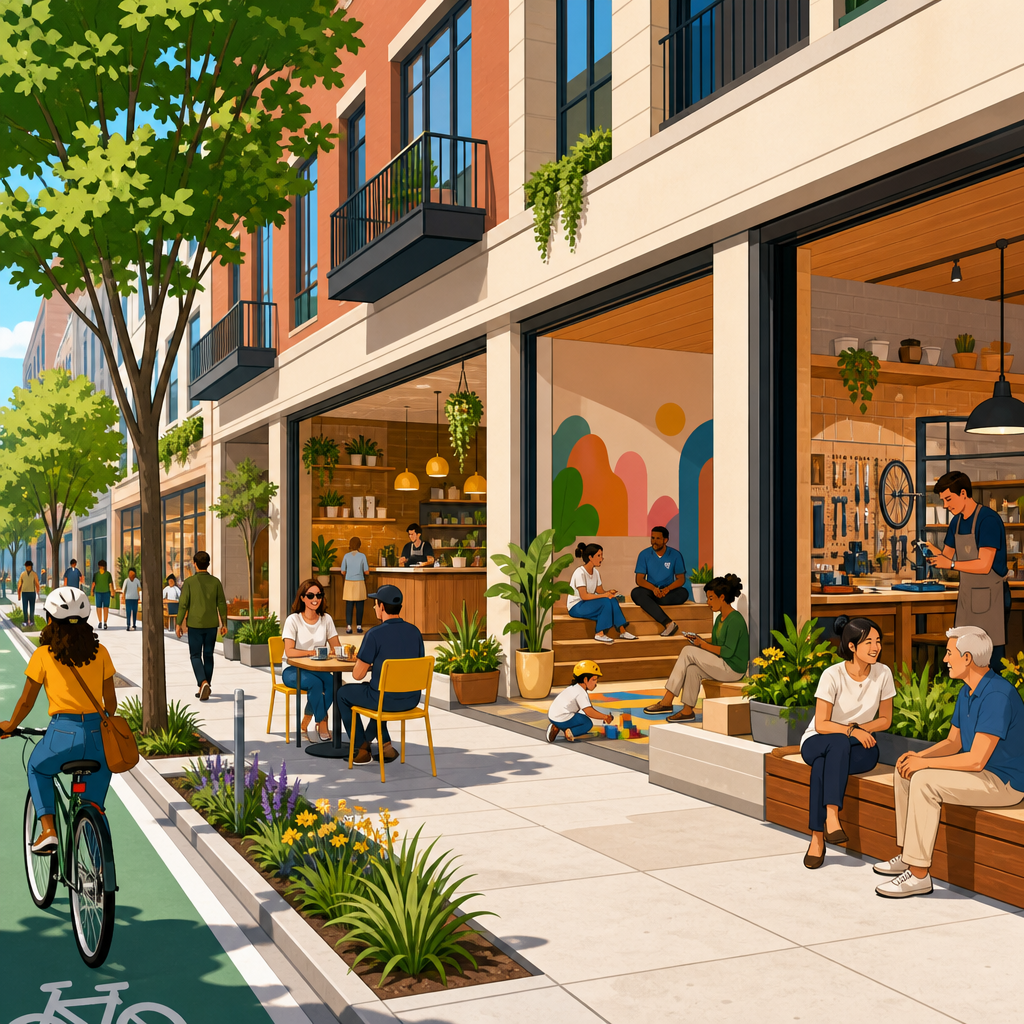
Street activation is the consistent generation of visible human activity along a sidewalk through building design, tenant mix, access points, and programming. The goal is not simply sales per square foot. The goal is a public realm that feels safe, useful, and socially legible throughout the day and week. In practice, that means frequent doors, transparent glazing, short frontage modules, weather protection, lighting, seating opportunities, and interior uses that create movement and observation. A pharmacy with long opaque shelving at the window may contribute less to street life than a co-working lounge, a daycare drop-off zone, or a residential common room with active glazing.
Design teams often ask a straightforward question: what counts as an active use? The answer is any use that puts people in visual relationship with the street and supports regular entry, exit, or occupancy near the frontage. Cafes do this well, but so do outpatient clinics, fitness studios, galleries, food halls, small-format production spaces, university facilities, and local services such as repair shops or postal counters. Even non-commercial uses can perform strongly if they are designed with transparency and direct street access. I have seen affordable housing projects activate corners with community kitchens and nonprofit offices far more effectively than speculative retail bays that sat empty for years.
Another common misunderstanding is equating activation with constant intensity. A good street does not need every frontage to be loud or transaction-based. It needs rhythm, variation, and enough reasons for people to move along the block. A sequence of entries every 20 to 40 feet generally performs better than a single large tenant with few doors. Likewise, active residential frontages can work on secondary streets where the demand for shops is weak. The best ground floors create a fine grain of engagement and can adapt over time without expensive reconstruction.
Why Over-Retailing Hurts Urban Districts
Over-retailing occurs when a plan requires more shop space than the trade area, footfall, spending power, and tenant pipeline can sustain. This problem is common in master-planned districts, mixed-use rezonings, and podium apartment projects where retail is treated as a symbolic marker of urbanity. The result is predictable: vacant bays, dark glass, temporary banners, rent concessions, and operators with thin margins who fail quickly. A street with 30 percent vacancy often feels less active than a street with fewer retail units but stronger occupancy and more diverse frontage types.
There are several reasons over-retailing is damaging. First, deep retail bays and high fit-out costs narrow the tenant pool. Second, asking neighborhood-serving businesses to pay rents justified by residential land values usually does not pencil out. Third, too much retail can cannibalize existing main streets instead of strengthening them. Fourth, dead frontage undermines walkability, making residents more likely to drive elsewhere. In sustainability terms, that means more vehicle trips, weaker local economies, and wasted embodied carbon in spaces repeatedly retrofitted for failed uses.
Experienced practitioners test demand early. They study pedestrian counts, daytime population, transit exits, household spending, vacancy rates, business churn, and the capture potential from nearby institutions. They also separate convenience retail from destination retail. A new district may support a corner grocer, cafe, childcare center, and neighborhood services long before it can support fashion, gift, or specialty food clusters. Getting this wrong is expensive because shell dimensions, servicing, grease exhaust, and code requirements are hard to undo after construction.
Match Ground Floor Uses to Street Type and Demand
Not every frontage should perform the same job. Successful plans assign uses according to street hierarchy, transit exposure, block depth, and local demand. Primary corridors near stations, bus interchanges, schools, or civic anchors can absorb the strongest commercial concentration because they already have footfall and visibility. Secondary streets often work better with hybrid uses: clinics, studios, small offices, fitness, learning spaces, or residential amenities that still create activity. Tertiary streets may be best served by stoops, townhome units, live-work spaces, or building amenities with windows and frequent entries.
A simple calibration approach helps. Start with the daily pedestrian base. If a frontage lacks reliable foot traffic from commuters, students, workers, or residents from several surrounding blocks, conventional retail is risky. Next, assess dwell time. Places where people linger near transit stops, plazas, parks, or schools can support food and service uses better than pure pass-through corridors. Then check spending patterns and competition. If a historic main street one block away already offers abundant restaurants and boutiques, a new project should not duplicate that mix. It should fill unmet needs and support the wider district ecosystem.
| Street condition | Best ground-floor pattern | Common mistake |
|---|---|---|
| Transit corridor with heavy footfall | Frequent small retail bays, food, services, visible lobbies | Single large tenant with blank side walls |
| Residential side street | Stoops, live-work units, amenity rooms, small studios | Continuous speculative retail with no demand |
| Edge facing park or school | Daycare, cafe, community uses, recreation, flexible rooms | Back-of-house functions at the public edge |
| Employment district block | Convenience retail, clinics, coworking, fitness, grab-and-go food | Too many evening-focused uses with no daytime base |
When this matching process is done well, the ground floor becomes a network of complementary uses rather than a repetitive row of fragile shops. That improves occupancy, creates more even activity across the day, and reduces leasing risk. It also leaves room for future change as a district matures and stronger retail demand emerges.
Design Principles That Create Active Edges
Use matters, but physical design determines whether the use actually contributes to the sidewalk. The strongest ground floors share several traits. First is transparency at eye level. Clear glazing between roughly 2 and 8 feet above grade allows people to see activity inside and provides passive surveillance. Second is permeability, meaning frequent entrances and a fine-grained frontage pattern. Third is floor-to-floor height. A clear height of at least 14 feet in many mixed-use settings improves adaptability because a space can shift from retail to community use, office, or food service without feeling compromised.
Depth and servicing also matter. Many neighborhood uses work best in shallower bays than developers assume. Oversized depths can push activity away from the window line and increase fit-out costs. Utility placement should preserve flexibility. Put risers, vents, and structural elements where multiple future layouts remain possible. Weather protection, especially canopies or arcades, increases comfort and supports walking in rain or heat. Lighting should make the frontage legible at night without producing glare. Exterior seating, ledges, and thresholds can extend activity into the public realm when carefully coordinated with accessibility and pedestrian clear zones.
One lesson from built projects is that back-of-house creep kills activation. Loading rooms, parking vents, electrical closets, refuse areas, and blank fire stairs often migrate to the easiest frontage unless teams discipline the plan. On constrained sites, wrap these functions with occupiable liner spaces or place them on minor frontages. If parking is unavoidable, conceal it behind active uses or residential units. A supposedly active street can fail because 80 feet of dead wall interrupts the walking experience more than planners anticipated.
Flexible Uses Beyond Traditional Retail
The most resilient ground floors treat activation as a performance requirement, not a retail mandate. This opens a broader menu of occupiers. Health uses are especially valuable because they generate repeat visits and daytime foot traffic: dentists, primary care clinics, physical therapy, and diagnostics all work well in urban neighborhoods. Education and childcare uses create dependable peaks at drop-off and pick-up times. Small-scale production, including bakeries, craft manufacturing, bike repair, and maker labs, can animate streets while supporting local employment. Public or nonprofit uses such as libraries, legal aid offices, and community hubs often stabilize blocks where market rents are too high for independent merchants.
Live-work units deserve more attention than they receive. In districts transitioning from industrial or low-density patterns, these units can provide an intermediate step between residential frontage and full commercial tenancy. The key is a layout that permits direct street access, higher ceilings, acoustic separation, and utility capacity for office or studio use. Similarly, residential amenities should not be hidden. Shared lounges, fitness rooms, mail areas, and co-working spaces can contribute to the street if they face outward and maintain visible activity. The difference between an active frontage and a private dead zone often comes down to window treatment and door placement.
Temporary uses are another practical tool. Pop-ups, exhibitions, seasonal markets, and short-term leases can test demand before a permanent tenant commits. This is particularly effective in newly built districts where occupancy grows in phases. However, temporary activation works only when the shell is designed for easy turnover, with accessible utilities, durable finishes, and simple signage rules. Otherwise, the cost of adaptation wipes out the benefit.
Operations, Leasing, and Policy Decisions That Make or Break Success
Ground floors succeed or fail as much through operations as through architecture. I have worked on projects where excellent frontage design was undermined by leasing strategy that chased national chains, oversized units, and unrealistic rents. Smaller bays usually broaden the tenant pool and support local businesses, though they require more management. Percentage rent, stepped rent, and fit-out assistance can help early-stage operators survive the first years of a district. Curated tenanting matters too. The right mix balances daily needs, destination uses, and services that extend activity beyond lunch hour.
Public policy has a large role. Zoning should permit a wide range of active uses instead of narrowly defining ground-floor retail. Performance-based frontage standards are often more effective than use mandates. Requiring transparency, minimum entrance frequency, active depth near the frontage, and limits on blank walls gives flexibility while protecting the street experience. Some cities also allow reduced parking or expedited approvals when projects provide community-serving uses at grade. Business improvement districts, façade grants, and technical assistance programs can improve tenant retention after opening.
Measurement should continue after occupancy. Track vacancy duration, pedestrian counts, sales where available, tenant turnover, and hourly activity patterns. If a frontage underperforms, diagnose why before assuming the concept is wrong. Sometimes the issue is poor signage, weak lighting, a hidden entrance, or lease terms that prevent suitable tenants from entering. In other cases, the district simply needs a different use category. Ground floors are not static assets. The best streets stay alive because owners, managers, and cities adapt them over time.
Designing ground floors that activate streets without over-retailing requires a shift from symbolic urbanism to evidence-based frontage planning. Active streets are created by visible human use, not by retail labels alone. The strongest projects match uses to street type, calibrate supply to real demand, and design shells that can evolve as neighborhoods change. Transparent edges, frequent doors, flexible bay sizes, protected walking conditions, and disciplined placement of back-of-house functions all contribute directly to a better sidewalk experience. Equally important, leasing strategy and local policy must support a diverse tenant mix rather than forcing speculative storefronts that sit empty.
For sustainable urban development, this approach has clear benefits. It reduces vacancy, supports walkability, lowers wasted fit-out cycles, and strengthens local services without undermining existing commercial streets. It also gives communities more useful ground-floor choices, from childcare and clinics to workshops and civic rooms. If you are planning a mixed-use building, corridor plan, or district framework, start by asking what kind of activity each street can truly sustain. Then design for flexibility, not fantasy. That is how ground floors become durable assets that keep streets lively for years.
Frequently Asked Questions
What does it actually mean to “activate” a street if the ground floor is not mostly retail?
Street activation is often misunderstood as a synonym for storefront shopping, but in practice it means creating a ground-floor edge that feels visible, welcoming, occupied, and useful throughout the day. A street is active when people can see signs of life at eye level, when entrances are frequent and legible, when interior spaces connect visually to the public realm, and when the building contributes to safety and comfort rather than blankness or confusion. Retail can do that, but so can many other uses. Lobbies, small workspaces, community rooms, maker spaces, cafes, clinics, child-care facilities, residential amenities, flexible studios, and even well-designed live-work units can all support an active street if they are transparent, accessible, and designed around human-scale interaction.
The key distinction is that activation is about how the ground floor performs in relation to pedestrians, not just what lease category occupies it. A fully glazed shop that sits empty for years does not activate a street. By contrast, a modest shared workspace with regular hours, visible activity, outdoor seating, and a well-detailed entrance may contribute far more to daily street life. Designers and developers should therefore focus less on forcing a retail program everywhere and more on frontage quality: transparent facades, generous windows, multiple doors, weather protection, lighting, seating, fine-grained bays, and spaces that can evolve over time. That is what creates a street people want to walk along.
Why can too much retail at the ground floor be a problem for urban neighborhoods?
Over-retailing creates both economic and urban design problems. Economically, not every block has the foot traffic, local spending power, destination pull, or tenant demand needed to support continuous retail frontage. When plans assume more shops than the market can absorb, the result is often prolonged vacancy, low-quality tenants with rapid turnover, deeply discounted leases, or windows covered from the inside. That weakens the street more than a well-occupied non-retail use would. Empty retail is expensive for owners, discouraging for neighboring businesses, and damaging to public perception because people read vacancy as instability.
From an urban design perspective, a street does not become lively simply because the zoning map says “active commercial frontage.” It becomes lively when the uses match local rhythms. A residential side street, a school edge, a transit corridor, and a mixed-use main street may each need a different ground-floor strategy. Forcing retail where there is insufficient demand can produce repetitive and generic frontage that ignores how people actually use the area. It can also reduce adaptability, because highly specialized retail bays may be harder to repurpose than flexible units designed for a range of small-scale commercial, civic, or hybrid uses.
There is also a social dimension. When every frontage is optimized for lease revenue from retail alone, cities can unintentionally crowd out lower-margin but socially valuable uses such as community services, health providers, repair businesses, artist studios, educational spaces, or nonprofit programs. A more balanced approach recognizes that resilient neighborhoods need a mix of uses, not a monoculture of shops. The best ground floors support local demand, can change over time, and keep the street engaged even when consumer spending cycles shift.
What are the most effective design strategies for creating active ground floors without relying on shops everywhere?
The strongest strategy is to design for permeability, visibility, and flexibility first, then assign uses that fit those physical conditions. Permeability means frequent entrances, minimal blank walls, and a clear relationship between indoor activity and the sidewalk. Visibility means transparent glazing at pedestrian eye level, lighting that reveals interior use after dark, and layouts that place active rooms along the street rather than storage, back-of-house functions, or parking. Flexibility means units with workable ceiling heights, regular structural grids, durable services, and dimensions that allow future conversion among retail, office, civic, wellness, food, studio, or residential-adjacent uses.
Fine-grained frontage is especially important. A long ground floor should be broken into smaller bays or modules so the building reads as varied and approachable rather than monolithic. Multiple smaller spaces are usually more adaptable and can attract a broader mix of tenants and programs. Designers should also pay close attention to thresholds. Recessed entries, stoops, patios, forecourts, operable windows, canopies, and spill-out zones all help blur the transition between public and private space. That edge condition is where street life often happens.
Another effective approach is to match the use mix to time-of-day patterns. For example, a block near offices may need morning food service, midday seating, and evening community uses. A residential corridor may benefit more from child-care drop-off, fitness, co-working, local services, and shared amenity rooms than from several speculative boutiques. A transit stop may support convenience retail in one bay, a clinic in another, and a mobility hub or waiting area in a third. The point is not to avoid retail, but to use it selectively where it can thrive and pair it with other frontages that maintain continuity and occupation across the day and week.
How can planners and developers decide where retail belongs and where other active uses make more sense?
The best decisions start with evidence rather than assumptions. Teams should study pedestrian counts, transit access, nearby anchors, neighborhood demographics, existing business performance, daytime and nighttime population, and the competitive landscape within walking distance. They should also consider block-by-block differences. A corner near transit or an intersection with strong footfall may justify true retail frontage, while the middle of the same block may be better suited to flexible workspace, community-serving uses, or residential common areas designed to engage the street. Not every linear foot of frontage has equal commercial potential.
It is also important to understand local demand in qualitative terms. Conversations with residents, small business owners, brokers, institutions, and community organizations often reveal unmet needs that standard retail formulas miss. In many neighborhoods, the most valuable ground-floor uses are not fashion or restaurant tenants but practical daily services: clinics, repair shops, tutoring spaces, neighborhood food concepts, cultural organizations, elder services, or publicly accessible lobbies and meeting rooms. These uses may generate steadier occupancy and stronger local loyalty than speculative retail categories aimed at an imagined future market.
Developers should think in terms of a frontage hierarchy. Reserve the highest-exposure locations for uses that truly depend on visibility and walk-in trade. Place adaptable, lower-rent, or hybrid spaces where they can still contribute activity without bearing unrealistic sales expectations. Build in the ability to subdivide or combine units over time. And when local market depth is uncertain, it is often smarter to deliver less retail, but make it better positioned and more leasable, than to flood a project with underperforming shop space. The long-term success of the street usually depends on calibration, not maximum commercial frontage.
What role do adaptability and long-term resilience play in successful ground-floor design?
Adaptability is central because neighborhoods change faster than buildings do. Consumer behavior shifts, rents fluctuate, mobility patterns evolve, and community needs expand or contract over time. A ground floor that only works for one narrow use type is fragile. A ground floor that can accommodate different programs over its life is resilient. That resilience protects both the street and the project’s economics. When one use weakens, another can take its place without requiring major reconstruction or leaving the frontage dead for years.
In practical terms, resilient ground floors usually have generous floor-to-floor heights, straightforward servicing, durable materials, flexible entry placement, and facade systems that can support reconfiguration. They avoid putting nonactive functions such as parking ramps, long loading zones, or deep blank utility rooms in the most visible pedestrian locations whenever possible. They also allow for phased occupation. A space might begin as a gallery, pop-up, leasing lounge, shared workspace, or community room and later convert to retail or another commercial use when demand matures. That kind of incremental activation is often more realistic than expecting full retail absorption on day one.
Long-term resilience also depends on designing for local stewardship. Ground floors that can support smaller tenants, mission-driven organizations, and neighborhood-serving operators tend to remain relevant because they are tied to everyday life rather than a single trend cycle. When designers create spaces that are easy to occupy, easy to adapt, and pleasant to use from the sidewalk, they give the street a better chance of staying lively through market shifts. That is the real goal: not a perfect leasing plan at opening, but a durable urban edge that continues to support safety, sociability, and economic life over time.