
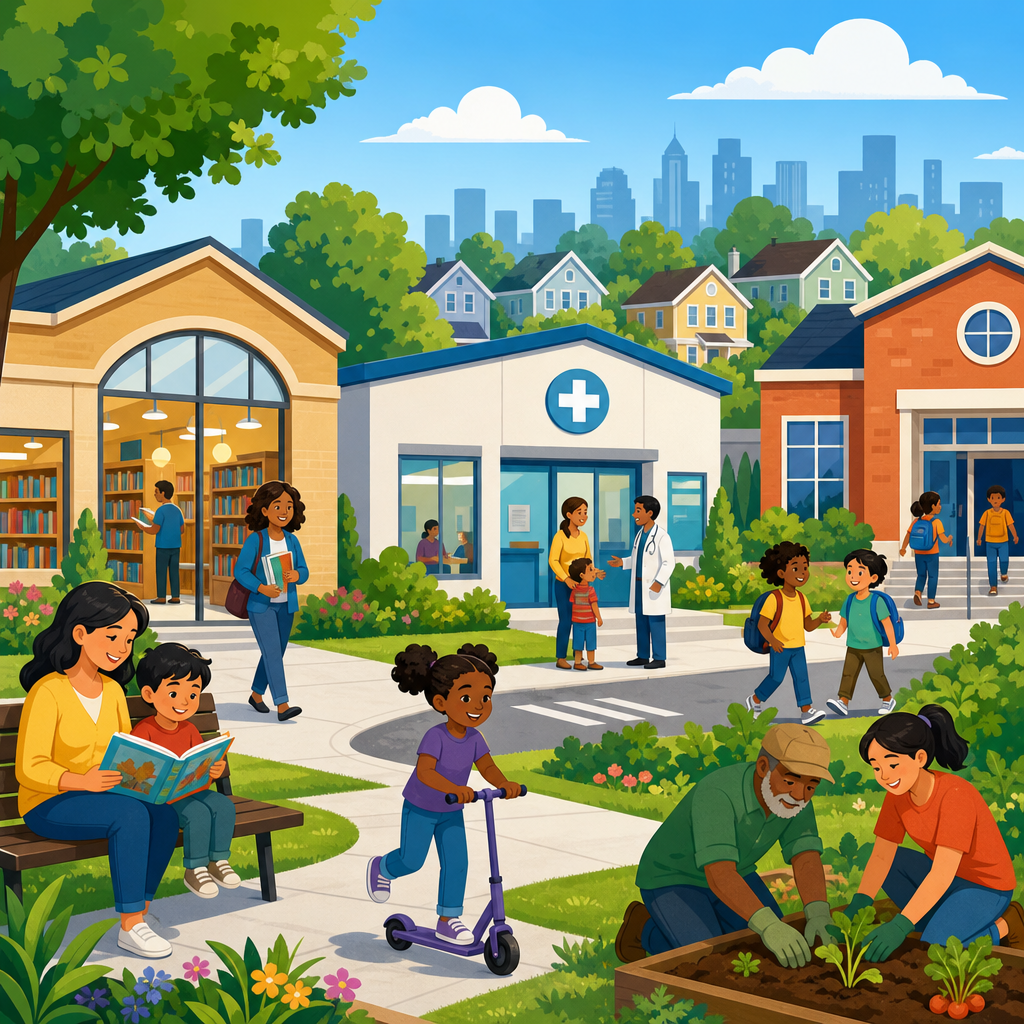
Building social infrastructure means investing in the everyday places that help people meet basic needs, build trust, and stay rooted in a neighborhood. In affordable housing work, I have seen projects succeed or fail not only because of rent levels or financing terms, but because residents could or could not reach a library, enroll a child in a good school, or get timely care at a nearby clinic. Social infrastructure refers to public and nonprofit institutions that support daily life, including libraries, schools, health centers, parks, transit-linked community spaces, and recreation facilities. Among these, libraries, clinics, and schools are especially important because they combine practical services with social connection. They matter for neighborhood stability because stable neighborhoods depend on more than buildings. They depend on access, trust, opportunity, and a shared sense that people can remain, participate, and plan for the future.
When these institutions are strong, residents gain what housing policy alone cannot deliver: reliable information, preventive health support, child development, adult learning, civic participation, and social ties that reduce isolation. When they are weak or absent, even well-designed affordable housing can feel precarious. A family may find an apartment within budget, yet still struggle if the nearest pediatric clinic is two bus rides away, the local school loses teachers every year, or there is no public place to use a computer, print forms, or attend programs. Neighborhood stability is the capacity of a community to retain residents, absorb shocks, and improve without displacement or decline. Libraries, clinics, and schools anchor that capacity by lowering daily friction and increasing collective resilience.
What social infrastructure does that housing alone cannot
Affordable housing is essential, but it is not self-sufficient. In practice, residents evaluate a neighborhood through a bundle of conditions: safety, transportation, education quality, healthcare access, digital connectivity, and the availability of trusted institutions. Social infrastructure turns a housing unit into a livable community. A library helps a job seeker complete applications, a teenager find study space, a new immigrant access language classes, and an older adult learn digital tools. A clinic manages chronic illness before it becomes an emergency, provides prenatal care, and connects families to behavioral health services. A school offers instruction, meals, after-school care, counseling, and a stable routine that organizes family life.
These functions reinforce one another. I have worked on housing developments where the opening of a nearby federally qualified health center immediately reduced barriers for residents with diabetes, asthma, and depression. The same developments saw stronger lease compliance and fewer crises because people were healthier and more connected to case managers. Similarly, library branches often operate as quiet but powerful service hubs. Many now offer Wi-Fi hotspots, workforce coaching, tax preparation support, makerspaces, early literacy programming, and public meeting rooms. Schools do something even broader. They create place-based continuity. Families often choose whether to stay or move based on confidence in a school’s leadership, teacher retention, extracurricular offerings, and special education capacity.
For neighborhood stability, this matters in measurable ways. Access to primary care is associated with better health outcomes and lower preventable hospitalization. High-quality early education and K-12 stability are linked to higher graduation rates and long-term earnings. Public libraries are associated with literacy gains, job search support, and digital inclusion, especially for households without reliable home broadband. None of these effects are abstract. They influence whether residents can keep working, whether children thrive, whether elders can age in place, and whether a neighborhood feels dependable rather than fragile.
Libraries as low-barrier anchors of trust and mobility
Libraries are often undervalued in neighborhood planning because they do not look like traditional economic development projects. Yet they are among the most accessible institutions a community can have. A library does not require an appointment, insurance card, tuition payment, or formal referral. That low barrier matters. In neighborhoods facing housing cost pressure, residents need places where they can get help without navigating bureaucracy first. Modern libraries provide internet access, device lending, homework help, legal information clinics, resume workshops, story time, English language learning, citizenship preparation, and small business support. In many cities, they also serve as cooling centers during heat waves and trusted information sites during emergencies.
I have seen library branches function as neighborhood stabilizers during redevelopment. When rents rise and longtime residents worry about losing their place, libraries remain one of the few spaces where old and new residents mix without a transaction. That mixing builds weak ties, the kind of everyday social connection urban sociologists have long linked to resilience and opportunity. Libraries also support household budgets indirectly. Free internet, printing, educational materials, and youth programming reduce costs for families already stretched by rent and transportation. For job seekers, access to a computer and a librarian who understands workforce resources can be the difference between missing and meeting an application deadline.
Libraries are also critical for children in housing-insecure households. Students who move frequently often lose continuity in study routines and digital access. A dependable library can offset some of that instability by providing predictable space, tutoring, and literacy programming. Strong library systems increasingly coordinate with schools, housing authorities, and health providers, making the branch a connector rather than an isolated amenity. That role is especially valuable in neighborhoods where residents may distrust formal agencies but trust familiar frontline staff.
Clinics as prevention systems that protect households from crisis
Neighborhood clinics matter because health shocks quickly become housing shocks. A missed diagnosis, unmanaged chronic illness, untreated anxiety, or lack of prenatal care can trigger lost wages, school absences, caregiver strain, and medical debt. In affordable housing portfolios, I have repeatedly seen that the households most at risk of eviction are not simply those with low incomes, but those experiencing multiple disruptions at once. Accessible clinics help interrupt that spiral early. The most effective are primary care sites integrated with behavioral health, dental care, pharmacy access, and referral pathways for food assistance, benefits enrollment, and specialty care.
Federally qualified health centers illustrate why place-based care works. They are designed to serve medically underserved areas, offer sliding-fee scales, and often provide enabling services such as translation, care coordination, and transportation support. For neighborhoods with large immigrant populations, these features are not optional extras. They determine whether people seek care before a condition worsens. School-based health centers offer another powerful model. By locating services where children already are, they reduce missed class time and make preventive care easier for working parents. Community clinics can also anchor trust during public health emergencies, when clear local communication matters as much as treatment capacity.
The housing link is direct. Preventive care reduces emergency room reliance, and lower emergency spending can improve household financial stability. Behavioral health access can reduce crises that jeopardize employment or tenancy. Maternal and pediatric care influence school readiness and long-term development. Neighborhoods with reliable clinics are better positioned to support aging residents, people with disabilities, and families balancing work with caregiving responsibilities. In short, clinics are not separate from housing outcomes. They are one of the systems that make stable tenancy realistic.
Schools as long-term neighborhood anchors
Schools shape neighborhood stability more than almost any other institution because they affect both present quality of life and future opportunity. Families routinely pay attention to attendance boundaries, school ratings, teacher turnover, and specialized programs when deciding whether to rent, buy, stay, or leave. But the stabilizing role of schools goes beyond reputation. Strong schools create routines, relationships, and expectations that support entire households. They provide meals, counseling, sports, arts, family engagement, and access to social workers. In community school models, they also host health services, adult education, and partnerships with local nonprofits.
In my experience, school stability is one of the clearest signals residents use to judge whether a neighborhood is improving in a way that includes them. A renovated apartment building means less if the local school cycles through principals, loses experienced teachers, or lacks safe walking routes. Conversely, even modest neighborhoods can retain families when schools are predictable, welcoming, and academically credible. Research on student mobility consistently shows that frequent school changes harm academic performance, attendance, and social adjustment. That means neighborhood instability and school instability reinforce each other. Keeping families housed helps schools; strong schools help families remain housed.
Schools also contribute to social cohesion. Parent associations, performances, sports events, and family nights create repeated interaction among neighbors who might otherwise remain strangers. Those interactions build the trust needed for collective problem-solving, from traffic safety campaigns to advocacy for cleaner parks or better transit service. This is one reason school closures can be so destabilizing. The loss is not just educational. It removes a familiar gathering place and weakens local identity.
How these institutions work together in stable neighborhoods
The strongest neighborhoods do not rely on a single anchor. They function as ecosystems in which libraries, clinics, schools, housing providers, and transit agencies reinforce one another. A parent learns about rental assistance at school pickup, uses the library to upload documents, visits a clinic for a child’s asthma follow-up, and attends a community meeting in a library room to discuss traffic calming near the school. Each institution lowers one barrier and connects the resident to the next resource. That is how social infrastructure produces stability: through repeated, practical interactions that make daily life manageable.
Planners and housing developers should evaluate these systems together rather than as separate line items. The most useful questions are concrete: Can residents reach a primary care provider within a reasonable travel time? Is there a library branch with evening hours and broadband access? Does the school have stable leadership, after-school programming, and safe pedestrian access? Are services culturally and linguistically competent? If the answer is no, a neighborhood may still absorb housing investment, but it will struggle to convert that investment into durable well-being.
| Institution | Core neighborhood function | Examples of stabilizing effects |
|---|---|---|
| Library | Free access to information, digital tools, public space | Job applications completed, students supported after school, residents connected to benefits and emergency information |
| Clinic | Preventive care, chronic disease management, behavioral health | Fewer health crises, lower missed work, better maternal and child health, reduced financial stress from avoidable emergencies |
| School | Education, routine, family engagement, youth development | Higher retention of families, stronger social ties, improved child outcomes, more confidence in staying long term |
Good policy follows this integrated logic. Joint-use agreements can open school facilities for community programs. Colocation can place clinics near schools or within mixed-use developments. Capital planning can prioritize library modernization in neighborhoods facing displacement pressure. Transit planning can ensure that these destinations are reachable without a car. None of this is symbolic. It changes whether people can remain connected to opportunity as neighborhoods change.
What local leaders should measure and protect
If a city wants neighborhood stability, it should track social infrastructure with the same seriousness it tracks housing production. Useful measures include travel time to primary care, library card usage, broadband access, school enrollment stability, chronic absenteeism, teacher retention, and participation in after-school or early literacy programs. Public agencies should also look at whether residents feel welcome using these institutions. A building can exist on paper and still fail in practice if hours are limited, language access is poor, staff turnover is high, or safety concerns deter use.
Protection matters as much as expansion. In many markets, neighborhoods begin to attract new investment only after years of community institutions holding them together through disinvestment. Then land values rise, and the very institutions that sustained residents face budget cuts, overcrowding, or redevelopment pressure. Local governments should treat libraries, clinics, and schools as essential infrastructure, not optional amenities. That means stable operating funds, deferred maintenance prevention, strong partnerships, and planning rules that preserve civic sites in growing neighborhoods. Housing policy works best when paired with this civic backbone.
The practical takeaway is simple. Affordable housing creates the foundation for stability, but social infrastructure determines whether that foundation can support real life over time. Libraries give residents access to information, dignity, and connection without barriers. Clinics prevent health problems from becoming housing crises. Schools provide continuity, opportunity, and a durable reason for families to stay invested in place. When all three are present and functioning well, neighborhoods are better able to keep residents healthy, connected, and rooted through economic change.
For anyone working in affordable housing, neighborhood planning, or local government, the next step is to evaluate every housing strategy through this wider lens. Map the libraries, clinics, and schools near current and proposed homes. Identify the service gaps residents experience every week. Then invest accordingly. Stable neighborhoods are built not only with housing units, but with trusted institutions that help people remain, belong, and thrive together.
Frequently Asked Questions
What does “social infrastructure” mean in the context of neighborhood stability?
Social infrastructure refers to the public, nonprofit, and community-based places that make everyday life workable and connected. In practical terms, that includes libraries, schools, clinics, parks, childcare centers, recreation facilities, senior centers, and other institutions that help residents meet daily needs while building relationships with one another. These places do more than deliver services. They create routine, trust, and a sense of belonging, all of which are essential to neighborhood stability.
When social infrastructure is strong, people can access education, healthcare, information, and support close to home. Parents can enroll children in schools they trust, older adults can reach services without long trips, and families can solve problems before they become crises. These institutions also act as anchors. They encourage residents to stay in place because the neighborhood supports their lives in practical ways. In affordable housing and community development, this matters enormously. A well-designed housing project may look strong on paper, but if residents cannot easily get medical care, use a library, or rely on nearby schools, long-term stability becomes much harder to achieve.
Why do libraries, clinics, and schools matter so much for affordable housing success?
Affordable housing works best when it is connected to the systems that help people thrive. Libraries, clinics, and schools are among the most important because they serve needs that arise constantly, not occasionally. A library offers internet access, job search support, literacy programs, after-school learning, meeting space, and a safe public environment. A clinic provides preventive care, treatment, mental health support, vaccinations, and continuity of care that can keep a minor issue from becoming a medical emergency. A school influences family decisions about where to live, how long to stay, and whether children have a fair opportunity to succeed.
These institutions also reduce the hidden costs of poverty. If a parent must travel across town for pediatric care, or if a student has no reliable nearby place to study and use a computer, the burden on the household grows quickly. Time, transportation money, missed work, and stress all add up. By contrast, when these services are nearby and dependable, residents are better able to maintain employment, care for family members, and participate in community life. That is why housing developers, planners, and local governments increasingly view social infrastructure as a core part of housing strategy rather than a separate issue. Stable neighborhoods are not created by housing units alone. They are created by housing plus the institutions that make daily life functional.
How do libraries specifically strengthen trust and connection in a neighborhood?
Libraries are one of the clearest examples of social infrastructure because they combine access, openness, and consistency. They are often among the few places where people can gather without being expected to spend money. That matters in neighborhoods where families may have limited disposable income or few safe, welcoming public spaces. A library can serve children, job seekers, immigrants, seniors, students, and people experiencing temporary hardship all under one roof. It is both a service hub and a civic commons.
Beyond books, libraries provide digital access, homework help, workforce training, language learning, cultural programming, public information, and referrals to other services. They also help residents build familiarity with one another and with local institutions. Repeated low-pressure interactions in a trusted space can increase social cohesion over time. People begin to know where to go for information, whom to ask for help, and how to participate in neighborhood life. In times of disruption, libraries often become even more important by offering cooling centers, emergency information, or internet access for people navigating school, benefits, or employment systems. That combination of everyday usefulness and community trust is exactly why libraries play such an important role in neighborhood resilience and long-term stability.
What is the relationship between nearby healthcare access and residents staying rooted in a community?
Nearby healthcare access can be the difference between a stable household and one pushed into repeated crisis. When residents have a trusted clinic close to home, they are more likely to receive preventive care, manage chronic conditions, attend follow-up appointments, and seek help early. That improves health outcomes, but it also supports economic and housing stability. Missed appointments, untreated illness, emergency room dependence, and unmanaged mental health needs can all interfere with work, school attendance, caregiving, and rent payment.
For families with children, seniors, and people with disabilities, distance to care is especially significant. Long travel times, unreliable transit, and complicated appointment logistics can make even basic healthcare difficult to maintain. A neighborhood with accessible clinics creates a stronger foundation for everyday life. It allows residents to stay healthier, spend less time and money traveling for care, and build trusted relationships with providers who understand local needs. In community development terms, healthcare access helps reduce avoidable instability. It strengthens a neighborhood not just medically, but socially and economically, because healthier residents are better positioned to remain engaged, employed, and rooted in place.
How can cities and developers invest in social infrastructure without treating it as an afterthought?
The first step is to plan for social infrastructure at the same time as housing, transportation, and economic development, rather than assuming services will appear later. Cities and developers should ask early in the process whether future residents will have realistic access to schools, clinics, libraries, childcare, parks, and other essential institutions. That means looking beyond maps and considering actual use: travel time, transit reliability, quality of services, capacity, safety, language access, and affordability. A clinic that is technically nearby but overbooked, or a school that families do not trust, does not provide the stabilizing effect a neighborhood needs.
Strong investment strategies may include funding public facilities, partnering with school districts and health providers, co-locating services within mixed-use or housing developments, preserving community institutions at risk of displacement, and aligning capital budgets with neighborhood growth. Community engagement is also critical. Residents usually know which institutions are missing, overstretched, or essential to daily life. Their input can help decision-makers prioritize investments that genuinely improve stability instead of checking a planning box. The most effective approach treats social infrastructure as foundational civic investment. When libraries, clinics, and schools are built, improved, and protected alongside housing, neighborhoods are more likely to remain healthy, connected, and resilient over the long term.


