
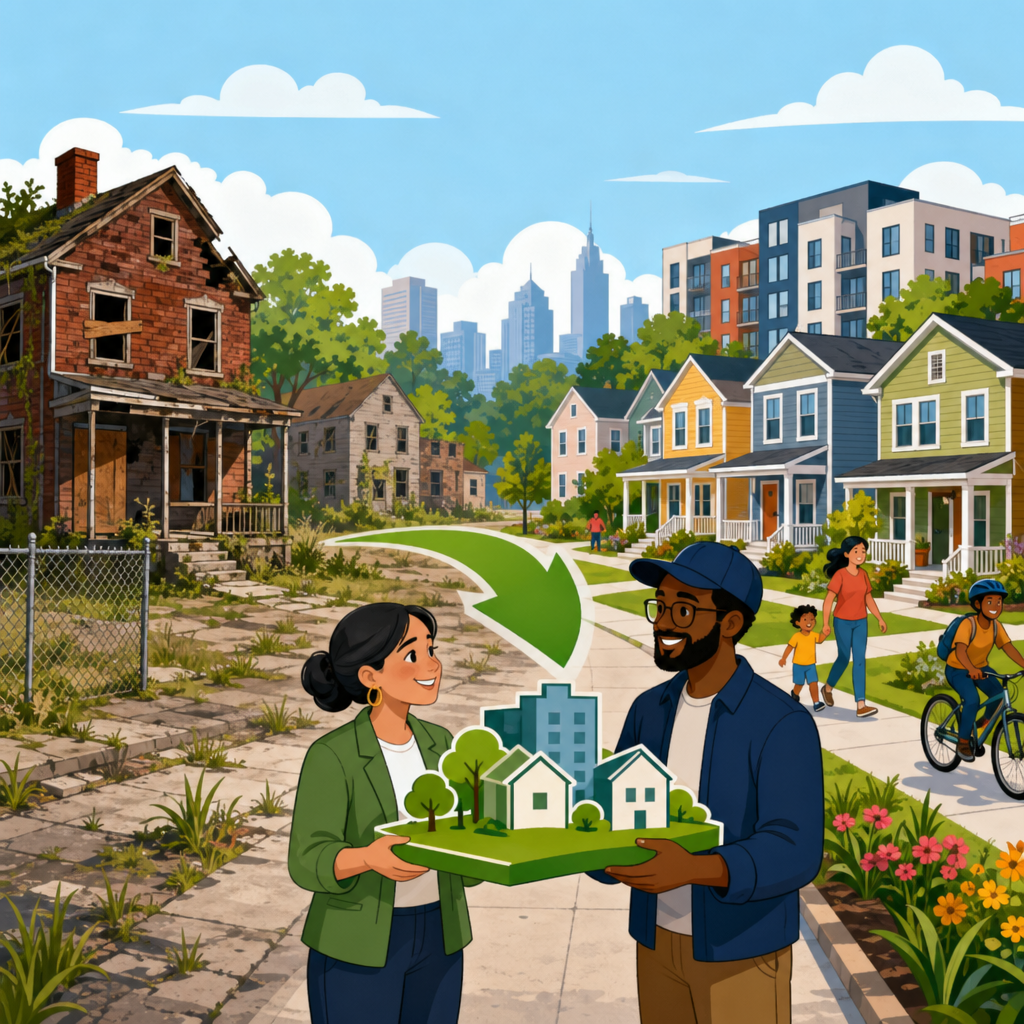
Land banks and affordable housing are closely linked because vacant, tax-delinquent, and abandoned properties can become buildable sites for homes that lower-income households can actually afford. A land bank is a public or nonprofit entity created to acquire, hold, manage, and dispose of problem properties in a strategic way. Affordable housing generally means housing costs that do not exceed 30 percent of gross household income, a standard used by the U.S. Department of Housing and Urban Development. I have worked with redevelopment teams evaluating scattered-site inventories, and the lesson is consistent: vacancy is not simply blight to be contained; it is dormant supply that can be assembled, cleaned up, and redirected toward community goals. This matters because rising land costs, construction inflation, and underproduction have made site control one of the hardest parts of housing delivery. When a city can move abandoned parcels from legal limbo into a transparent pipeline, it creates the foundation for homes, mixed-income projects, side-lot stabilization, and community facilities.
In practical terms, land banks solve a market failure. Many distressed parcels sit in ownership situations that private buyers cannot easily unwind: unpaid taxes, title defects, probate complications, environmental issues, code liens, or absentee ownership. Left alone, these properties depress neighboring values, attract dumping, and increase local service costs. A capable land bank clears title, extinguishes certain back taxes where state law allows, bundles parcels into viable development sites, and sets disposition rules that reward public benefit instead of speculation. For affordable housing practitioners, that process is essential. It creates predictability around acquisition, lowers carry risk, and can reduce the amount of subsidy needed per unit. The hub of this topic is therefore not just about acquiring land cheaply. It is about using an intentional public tool to convert fragmented vacancy into housing supply that aligns with neighborhood plans, anti-displacement goals, and long-term stewardship.
How land banks work and why they fit affordable housing
Most land banks are enabled by state statute or local ordinance and operate with powers that ordinary municipal departments do not have. Common authorities include acquiring property through tax foreclosure, accepting donations, negotiating purchases, maintaining sites, demolishing unsafe structures, and disposing of land under policy-based criteria. The strongest land banks are not passive warehouses for unwanted property. They are inventory managers with a redevelopment strategy, a parcel database, maintenance protocols, and clear disposition pathways. In Genesee County, Michigan, one of the most studied examples, the land bank used coordinated tax foreclosure, demolition, side-lot transfers, and development partnerships to stabilize neighborhoods that had suffered severe disinvestment. Other cities, including Cleveland, St. Louis, Atlanta, and Louisville, have adapted the model to local legal and market conditions.
For affordable housing, the fit is straightforward. Housing developers need sites they can control with clean title, known constraints, and enough scale to support financing. Land banks can provide all three. They often assemble adjacent lots into a development-ready package, reducing the transaction costs that stall small infill projects. They can prioritize mission-driven buyers, such as community development corporations, community land trusts, and nonprofit or mixed-income developers. They can also attach affordability covenants, construction deadlines, and reversion clauses so public land does not simply become private gain. In neighborhoods with weak markets, low-cost land can make deeply affordable projects financially possible. In stronger markets, strategic disposition can preserve affordability before speculative pressure fully resets land values. The core benefit is control: public-purpose control over land, timing, and end use.
From vacancy to homes: the redevelopment pipeline
Turning a vacant parcel into affordable housing follows a sequence, and each step affects cost, speed, and community trust. First comes identification. Land banks map tax-delinquent, abandoned, or publicly owned parcels, then sort them by condition, location, zoning, flood risk, infrastructure access, and market strength. Second is acquisition and title work. A parcel is only useful if legal claims can be resolved. Third is stabilization, which may include mowing, boarding, environmental review, or demolition. Fourth is planning and community engagement, where the land bank aligns inventory with neighborhood plans, school access, transit, and local preferences. Fifth is disposition, usually through a request for proposals, negotiated sale, or side-lot program. Last comes compliance monitoring to ensure the buyer builds what was promised and maintains affordability where required.
That sequence sounds administrative, but in practice it determines whether housing gets built. I have seen developers walk away from inexpensive land because utility connections were uncertain or because a tiny title defect threatened lender closing. Conversely, a land bank that delivers a complete due-diligence package can make a scattered-site deal financeable. Good pipeline management also prevents a common mistake: disposing of land one parcel at a time without considering block-level outcomes. Affordable housing works better when parcels support coherent design, stormwater management, parking solutions where needed, and access to schools, jobs, and services. The most effective land banks therefore act less like auctioneers and more like predevelopment partners. They reduce friction before the project reaches the developer’s balance sheet.
Key models for creating affordable housing with land bank inventory
There is no single production model. The right approach depends on neighborhood market conditions, parcel size, local subsidy sources, and who will own the homes over time. In weak markets, scattered-site single-family rehabilitation or infill can remove blight while adding ownership opportunities. In middle markets, assembled parcels can support townhomes, small multifamily buildings, or mixed-income projects that cross-subsidize affordable units. Near transit corridors or commercial nodes, larger assemblies can support layered financing with Low-Income Housing Tax Credits, HOME funds, Community Development Block Grant resources, state housing trust funds, and local gap financing. Land banks can also seed permanent affordability by transferring sites to community land trusts, which separate land ownership from the house itself and limit resale prices to keep homes affordable for future buyers.
| Model | Best Use Case | Main Advantage | Primary Limitation |
|---|---|---|---|
| Scattered-site infill | Blocks with many small vacant lots | Uses existing streets and utilities | Higher per-unit management complexity |
| Assembled multifamily site | Transit corridors and neighborhood nodes | More units on fewer parcels | Needs more subsidy and approvals |
| Rehab of tax-foreclosed homes | Structurally salvageable housing stock | Preserves neighborhood character | Hidden repair costs can be severe |
| Transfer to community land trust | Areas facing future price escalation | Keeps affordability in place long term | Requires ongoing stewardship capacity |
Each model has different implications for affordability. A small infill home on land acquired at nominal cost may be affordable to a moderate-income first-time buyer with down payment help, but not to an extremely low-income household without rental subsidy. A larger multifamily project can reach lower incomes if paired with operating support or project-based vouchers. Preservation rehabs can be cost-effective when structures are sound, yet they become expensive when lead, asbestos, roof failure, and outdated mechanical systems pile up. This is why serious land banks maintain parcel-level data and market segmentation. They do not assume every lot should hold the same product. They match the site to the subsidy stack and the neighborhood need.
Financing, subsidy layering, and the real economics of site control
Land is rarely the largest line item in affordable housing, but site control strongly shapes every other cost. If a land bank can convey property at below-market value, waive delinquent taxes, and provide clean title, the developer reduces carrying costs, legal uncertainty, and predevelopment spending. That matters because affordable housing deals are highly sensitive to delays. Interest rates, contractor pricing, and tax credit assumptions can move quickly. Common funding layers include LIHTC equity, tax-exempt bonds, HOME, CDBG, Federal Home Loan Bank Affordable Housing Program grants, state and local housing trust funds, philanthropic program-related investments, and conventional debt. In for-sale projects, developers may combine subsidy with soft second mortgages, shared-equity structures, or local down payment assistance.
Still, low-cost land does not automatically produce low-cost housing. Infrastructure upgrades, utility extensions, contaminated soil, demolition, and modern code requirements can erase the value of a cheap acquisition. I have seen projects where the nominal purchase price was one dollar, but the all-in site preparation exceeded what a private builder would pay for a clean suburban parcel. This is why disciplined underwriting matters. A land bank should publish as much due diligence as possible: phase one environmental reports where needed, survey information, demolition history, utility status, and zoning constraints. Developers need realistic assumptions before submitting proposals. Municipal partners also need to understand that discounting land is only one piece of the capital stack. Durable affordability usually requires direct subsidy, patient capital, or both.
Governance, community trust, and anti-displacement safeguards
Land banking works best when governance is transparent and community-facing. Residents are rightly skeptical if public entities acquire large inventories without clear plans, especially in neighborhoods with histories of redlining, urban renewal displacement, or predatory speculation. Trust improves when the land bank publishes inventories, board agendas, disposition criteria, and compliance outcomes. Public scoring systems help. So do resident advisory structures and neighborhood-based planning processes that identify where housing, green space, side-lot expansion, and commercial reuse each make sense. In stronger markets, safeguards should explicitly address displacement risk. Acquiring land early can preserve future affordability, but only if disposition policy includes resale controls, affordability periods, local preference where lawful, and protections against flipping.
Not every parcel should become housing. Some blocks need stormwater lots, urban agriculture, play space, or side-yard expansions to stabilize occupancy patterns. A mature land bank acknowledges those tradeoffs rather than forcing unit production everywhere. It also coordinates with code enforcement, housing departments, school districts, and transit agencies so redevelopment supports daily life, not just ribbon cuttings. The most credible programs measure outcomes beyond units built: vacancy reduction, tax base recovery, reduced nuisance calls, affordability duration, and neighborhood satisfaction. When those metrics are tracked over several years, land banking shifts from a tactical cleanup program to a strategic housing system. That is the real promise of converting vacancy into supply.
Best practices for cities and housing partners
Cities that want stronger results from land banks should start with inventory discipline and policy clarity. Build a parcel database that integrates tax status, code history, ownership, demolition records, assessed value, zoning, and utility information. Classify parcels by likely reuse, then connect each category to a disposition pathway and timeline. Write development agreements that require milestones, design standards, affordability terms, and reversion if projects stall. Coordinate legal, planning, housing, and public works functions so site readiness is not delayed by internal silos. For developers and nonprofit partners, the best approach is early engagement. Ask for pipeline visibility, not just one-off acquisitions. Understand local foreclosure law, environmental review triggers, and neighborhood priorities before underwriting a deal. And if long-term affordability is the goal, pair land disposition with stewardship mechanisms instead of relying on one-time promises.
Land banks are not a silver bullet, but they are one of the most practical ways to turn neglected property into affordable housing opportunity. They clear title, organize fragmented land, reduce speculation, and create a public-interest path from abandonment to occupancy. The main takeaway is simple: when cities treat vacant property as strategic inventory rather than leftover debris, they unlock new supply and strengthen neighborhoods at the same time. The best programs combine careful governance, realistic finance, and community-centered planning. If you are building an affordable housing strategy, start by examining your vacant land pipeline, your legal tools, and your disposition rules. That is where many housing solutions begin.
Frequently Asked Questions
What is a land bank, and how does it help create affordable housing?
A land bank is a public or nonprofit entity that acquires, holds, manages, and transfers vacant, abandoned, tax-delinquent, or otherwise distressed properties so they can be put back to productive use. In the affordable housing context, land banks play a critical role because they help solve one of the biggest barriers to new housing supply: access to buildable land at a price that makes lower-cost housing financially possible. When scattered vacant lots or deteriorated properties sit tied up in tax foreclosure, unclear title, or absentee ownership, they are often too complicated or risky for private buyers to assemble and redevelop on their own. A land bank steps in to clear title problems, address liens when allowed by law, maintain sites, and package properties for reuse in a way that supports community goals.
This matters for affordable housing because the cost of land can make or break a project. By acquiring properties at low cost and transferring them strategically rather than simply selling to the highest bidder, land banks can reduce development costs and create opportunities for homes that are affordable to lower-income households. Affordable housing generally refers to housing costs that do not exceed 30 percent of a household’s gross income, a standard commonly used by the U.S. Department of Housing and Urban Development. If a land bank can provide a lot below market price, require affordability in the redevelopment agreement, and coordinate with local governments or nonprofit developers, it can help turn vacancy into homes that meet that affordability benchmark. In short, land banks convert neglected properties from neighborhood liabilities into part of the housing supply solution.
Why are vacant and tax-delinquent properties so important in affordable housing strategies?
Vacant, abandoned, and tax-delinquent properties are important because they often represent hidden housing potential in places where land is already served by streets, water, sewer, transit, schools, and other public infrastructure. Instead of pushing development farther outward, communities can use these underutilized properties to add homes in existing neighborhoods. That can be especially valuable in cities and towns where rising land costs make it difficult to build housing that lower-income families, seniors, and working households can afford. Properties that have fallen out of productive use may not look like assets at first, but once legal and physical barriers are addressed, they can become infill sites for single-family homes, duplexes, small multifamily buildings, accessory dwelling units, or mixed-income developments.
These properties are also central to affordability strategies because they can often be acquired at a lower cost than fully market-ready parcels. A land bank can consolidate scattered lots, clear ownership complications, demolish unsafe structures when rehabilitation is not feasible, and prepare parcels for redevelopment. That process lowers uncertainty for builders and nonprofit housing organizations. Just as important, it allows public agencies to shape outcomes. Rather than waiting for speculative investors to sit on land or redevelop it without affordability requirements, a land bank can prioritize projects that serve local residents, align with neighborhood plans, and preserve long-term affordability. This strategic control over problem properties is what makes vacancy not just a symptom of disinvestment, but also a potential source of new housing supply.
How do land banks decide whether a property should be rehabilitated or redeveloped for new construction?
Land banks typically evaluate each property based on a mix of physical condition, market context, development feasibility, neighborhood needs, and policy goals. If an existing structure is sound enough to be repaired at a reasonable cost, rehabilitation may be the better option. Rehab can preserve neighborhood character, reduce demolition waste, and sometimes return housing to the market more quickly. It may also be the best path when the property has historic value or when the surrounding area would benefit from stabilizing occupied homes rather than waiting for ground-up construction. In affordable housing, rehabilitation can be particularly effective when paired with subsidies, weatherization funds, or partnerships with mission-driven developers that can keep rents or sale prices within reach of lower-income households.
On the other hand, some properties are so deteriorated, unsafe, or functionally obsolete that new construction makes more sense. A land bank may choose redevelopment if the existing building cannot be saved economically, if the lot is better suited to a different housing type, or if assembling multiple parcels creates an opportunity for a larger affordable housing project. For example, several side-by-side vacant lots might support townhomes or a small apartment building where a single distressed house once stood. The decision is rarely just about bricks and mortar. It also involves zoning, environmental conditions, infrastructure capacity, expected development costs, and the community’s housing priorities. The strongest land bank programs make these decisions strategically, balancing preservation where possible with new supply where necessary to achieve lasting affordability and neighborhood improvement.
How do land banks keep affordable housing affordable over time?
Creating affordable housing is only part of the challenge; preserving affordability is just as important. Land banks can support long-term affordability by attaching conditions to the sale or transfer of properties. These conditions may require homes to be sold or rented to income-qualified households, limit resale prices for a period of years, mandate affordability covenants, or require developers to comply with local subsidy rules. In some cases, the land bank works with nonprofit housing developers, community development corporations, or community land trusts that have a mission to maintain affordability beyond the first occupant. This helps prevent publicly supported land from simply becoming market-rate housing after a short compliance period.
Another way land banks preserve affordability is through careful partner selection and development agreements. Instead of disposing of land solely based on the highest offer, they can evaluate proposals based on affordability levels, duration of restrictions, design quality, community benefit, and developer capacity. Some land banks also use deed restrictions, reversion clauses, performance deadlines, and monitoring requirements to make sure promised projects are actually completed and remain aligned with public goals. This approach is especially important in neighborhoods where reinvestment may eventually drive up land values. By locking in affordability terms before redevelopment happens, land banks can help ensure that the households most affected by housing shortages are able to benefit from revitalization rather than being priced out by it.
What are the biggest challenges land banks face when turning vacant properties into affordable homes?
Land banks can be powerful tools, but they face several real-world challenges. Funding is one of the biggest. Acquiring properties may be inexpensive in some cases, but holding costs, maintenance, insurance, demolition, environmental cleanup, title work, and site preparation all require money. Even after land is assembled, affordable housing projects often need layered financing, such as tax credits, grants, soft loans, local subsidies, or philanthropic support, because reduced land cost alone is usually not enough to make deeply affordable housing financially viable. Staff capacity also matters. Effective land banking requires expertise in real estate, code enforcement, community engagement, development finance, and legal processes, and not every jurisdiction has those resources readily available.
There are also policy and market challenges. Zoning rules may limit density or prohibit the housing types that would make redevelopment feasible. Construction costs may be too high for small infill projects. In weaker markets, developers may be reluctant to build even with discounted land, while in stronger markets there may be pressure to dispose of properties at the highest price rather than prioritize affordability. Community trust is another key issue. Residents may worry about demolition, displacement, poor-quality development, or decisions being made without local input. The most successful land banks address these concerns by operating transparently, aligning property disposition with adopted neighborhood plans, and partnering with organizations that have a track record of responsible, community-centered development. When these pieces come together, land banks can turn vacancy into new housing supply in a way that is both practical and equitable.


