
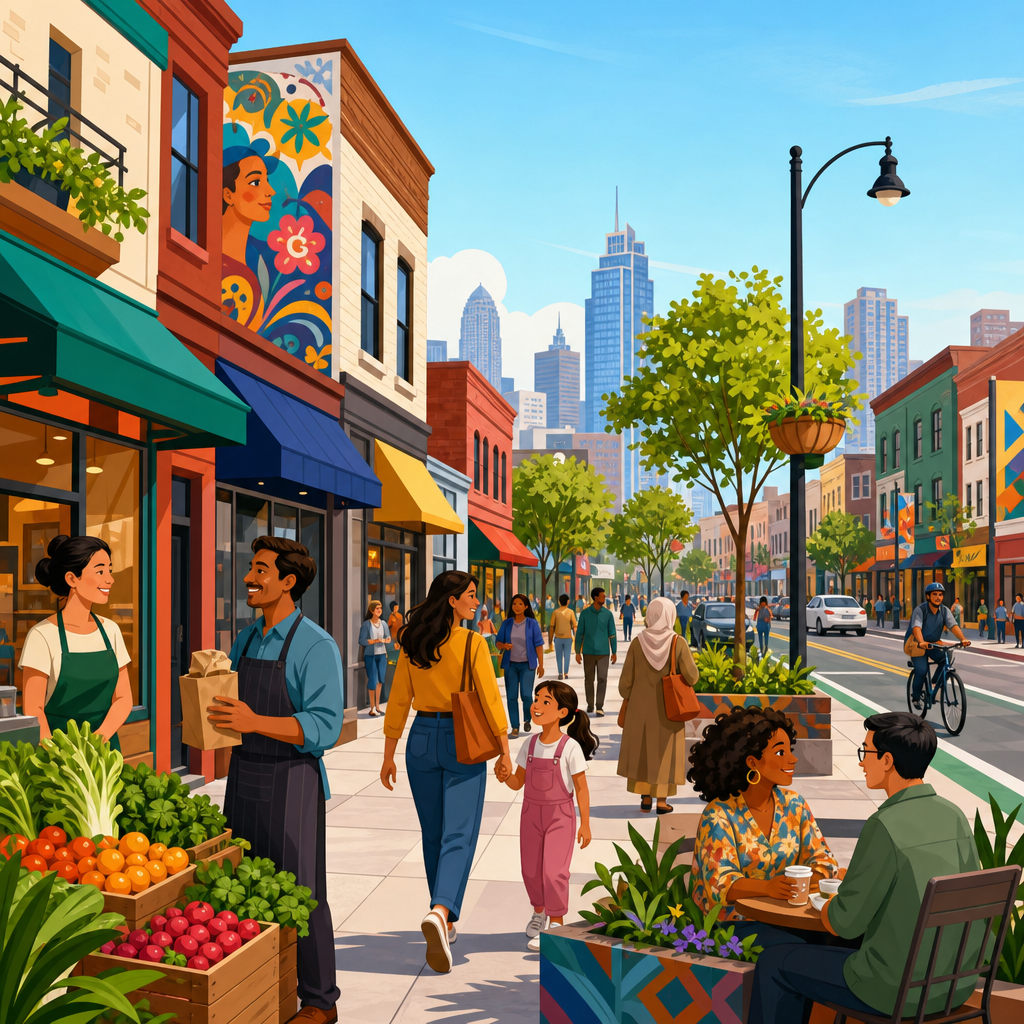
Immigrant business corridors are among the most effective yet underestimated engines of commercial district revitalization in American cities. The term refers to streets, plazas, and neighborhood retail clusters where immigrant entrepreneurs, workers, property owners, and community institutions create dense networks of shops, services, food businesses, professional offices, and cultural venues. In practice, these corridors often emerge in places written off as declining: aging main streets, underleased strip centers, transit-adjacent arterials, and legacy storefront districts facing disinvestment. I have worked with corridor plans, small business retention strategies, and mixed-use redevelopment efforts, and the pattern is consistent: where immigrant entrepreneurs gain stable footholds, commercial vacancy falls, pedestrian traffic rises, and districts regain identity faster than many subsidy-driven revitalization programs achieve on their own.
This matters directly to affordable housing because commercial district health and housing stability are tightly linked. A corridor with active storefronts supports local jobs, daily needs, social networks, and municipal tax revenue, all of which influence whether surrounding neighborhoods remain livable for working households. When revitalization is handled poorly, however, rising rents can displace the very businesses and residents who made recovery possible. The future of commercial district revitalization therefore depends on understanding immigrant business corridors not as a niche ethnic economy, but as critical urban infrastructure. They are platforms for entrepreneurship, immigrant integration, neighborhood safety through activity, and place-based wealth creation. A serious strategy must define what makes these corridors work, measure their impact accurately, and protect them from speculative redevelopment that extracts value without preserving local ownership or affordability.
What makes immigrant business corridors economically powerful
Immigrant business corridors succeed because they combine low-barrier entrepreneurship with dense customer ecosystems. Many entrepreneurs start with family labor, pooled savings, rotating credit associations, or community lending circles before qualifying for traditional financing. That allows businesses to occupy spaces that larger chains consider too small, too old, or too operationally complex. A 900-square-foot storefront on a secondary avenue may not attract institutional tenants, but it can support a halal butcher, travel agency, tax preparer, bakery, seamstress, or phone repair shop. Together, these uses create what urban economists call agglomeration effects: each business benefits from the foot traffic and destination value generated by neighboring firms. A customer visiting a grocer also buys lunch, sends money abroad, gets a haircut, and picks up household goods. That stacked demand keeps money circulating locally.
These corridors also extend commercial hours and diversify demand. In many cities, immigrant-owned corridors remain active from early morning produce deliveries through late evening restaurant service, increasing perceived safety and sidewalk vitality. The tenant mix is usually necessity-driven rather than trend-driven, which makes it more resilient during downturns. During periods when discretionary retail struggled, neighborhood groceries, pharmacies, remittance services, childcare providers, and carryout restaurants often continued operating because they served routine household needs. That resilience is one reason planners should stop evaluating corridors solely by facade aesthetics or national-brand recruitment. A corridor with modest storefront improvements but strong merchant turnover resistance is economically healthier than a polished district with fragile tenancy and high churn.
Language access, trust, and cultural competence are central to this power. Businesses become informal service hubs where customers receive not just goods but translation help, employment leads, housing referrals, school information, and navigation support for public systems. Those functions rarely appear in conventional retail leakage analyses, yet they are essential to why these districts endure. They reduce transaction friction for communities that mainstream institutions often underserve. In corridor after corridor, I have seen a grocery owner explain utility bills to customers, a money transfer operator connect recent arrivals to employers, or a salon owner direct a family to a nearby clinic. That embedded social infrastructure is not incidental; it is a competitive advantage and a revitalization asset.
How these corridors revive struggling districts
Commercial district revitalization usually fails when it starts with physical upgrades alone. Streetscape improvements matter, but they do not create demand by themselves. Immigrant business corridors revive struggling districts by repopulating vacant space quickly, restoring a sense of destination, and proving market viability before major capital arrives. In older urban neighborhoods, this often begins with entrepreneurial pioneers leasing inexpensive units in buildings with deferred maintenance. As storefront lights return and word-of-mouth spreads across regional immigrant networks, nearby spaces fill. Landlords who had accepted chronic vacancy suddenly find consistent tenants. Informal clustering then becomes formal district identity.
Examples across the United States illustrate the pattern. In Queens, Houston, Los Angeles, Chicago, and the Washington region, corridors anchored by immigrant-owned groceries, restaurants, clinics, and retail specialists have transformed underperforming blocks into regional destinations. These districts attract both co-ethnic and general-market customers because authenticity, price competitiveness, and specialized products create strong draw. A corridor may begin by serving one language community, then broaden into a multiethnic marketplace as neighboring entrepreneurs observe demand and enter. That layering effect is especially important in second-ring suburbs, where declining shopping centers can be repositioned through smaller-format leases, flexible subdivision of space, and culturally responsive merchandising rather than demolition.
Municipal leaders should recognize that this form of revitalization often precedes official recognition. By the time banners, branding campaigns, or business improvement district discussions begin, merchants have already done the riskiest work. The public sector’s role is to remove friction: simplify permitting, stabilize rents where possible, improve sanitation and lighting, support code compliance without punitive overreach, and ensure transit, loading, and parking policies reflect actual business operations. Revitalization should be measured in occupancy, business survival, sales growth, worker retention, and customer frequency, not just facade grants awarded or social media impressions generated.
Why the housing connection cannot be separated from corridor strategy
Affordable housing and immigrant business corridors rise or fall together because workers, entrepreneurs, and customers need geographic proximity. Many small businesses rely on owners and employees living nearby, often without long commutes or car dependence. When housing costs escalate rapidly around a successful corridor, labor becomes unstable, family networks disperse, and the district loses the density of everyday users that sustains small-format retail. Conversely, when neighborhoods face concentrated housing distress, commercial tenants lose purchasing power and storefront instability grows. A corridor strategy that ignores housing treats symptoms while neglecting the operating system.
The strongest revitalization plans coordinate commercial preservation with anti-displacement housing tools. These include naturally occurring affordable housing preservation, community land trusts, limited-equity cooperatives, accessory dwelling unit legalization where appropriate, and acquisition funds that help mission-aligned groups purchase mixed-use buildings before speculative investors do. Small sites matter. A two-story building with apartments over shops can be more important to neighborhood stability than a marquee redevelopment parcel because it preserves both low-cost retail space and modest rental housing. In practice, some of the best outcomes come from assembling capital stacks that combine local housing trust funds, community development financial institution lending, historic tax credits, and technical assistance for immigrant owners who have strong operating businesses but limited familiarity with public programs.
Public agencies also need better data discipline. If a district shows rising sales but falling resident retention, or increasing foot traffic alongside eviction pressure, the corridor is not simply revitalizing; it may be entering a displacement cycle. The right response is not to halt investment, but to shape it. Ground-floor affordability covenants, small business lease support, right-to-return policies in major redevelopment zones, and property tax relief mechanisms for legacy owners can preserve the business ecosystem that made the district valuable in the first place.
Policy tools that actually strengthen immigrant commercial districts
Effective policy begins with operational reality. Many immigrant-owned businesses face barriers that have little to do with demand and everything to do with system design: complicated licensing, limited translation, weak credit files despite strong cash flow, and commercial leases with renewal uncertainty. Cities serious about commercial district revitalization should focus on practical tools that improve business survivability and reduce avoidable costs.
| Policy tool | What it does | Why it works in immigrant corridors |
|---|---|---|
| Commercial rent stabilization pilots or lease mediation | Reduces abrupt rent shocks and improves renewal terms | Protects viable firms in fast-changing markets where landlords capitalize on corridor success |
| Multilingual permit navigation | Guides owners through inspections, licenses, signage, and health rules | Improves compliance rates and lowers costly delays caused by language barriers |
| Flexible small-space financing | Provides microloans, working capital, and tenant improvement funds | Matches the scale of corridor businesses that may need $15,000 to $150,000, not multimillion-dollar packages |
| Mixed-use acquisition funds | Helps nonprofits or local buyers purchase strategic buildings | Preserves affordable storefronts and upper-floor housing before speculative resale |
| Shared infrastructure investments | Upgrades lighting, waste management, loading zones, and broadband | Addresses daily pain points that directly affect sales, sanitation, and safety |
Standards matter here. The Main Street approach remains useful for organization, design, promotion, and economic vitality, but it must be adapted to multilingual, high-turnover, cash-sensitive districts. Community development financial institutions such as Accion Opportunity Fund, local loan funds, and minority business lenders often outperform conventional banks in these environments because underwriting can incorporate character, trading history, and technical assistance. Likewise, corridor management should include merchant ambassadors or navigators who understand cultural norms and can build trust quickly. Generic outreach rarely reaches the owners most at risk.
There are tradeoffs. Formalization can increase compliance costs, and branding success can invite speculative rent escalation. That is why policy should prioritize ownership pathways as much as tenant support. Helping immigrant entrepreneurs purchase condos, cooperatives, or whole mixed-use buildings can lock in local control better than recurring grant programs alone.
What the next generation of revitalization should look like
The future of commercial district revitalization will favor districts that treat immigrant entrepreneurship as a long-term development strategy rather than a temporary activation tactic. That means planning for succession, intergenerational ownership, and modernization without erasing identity. Many first-generation businesses are operationally strong but digitally behind. The next phase is not replacing them with trendier tenants; it is helping them adopt point-of-sale systems, e-commerce, delivery logistics, bookkeeping software, energy upgrades, and compliant lease structures so they can compete on stronger terms.
Districts also need governance models that share power with merchants. Advisory boards should include small landlords, tenant associations, street vendors where legal frameworks allow, and business owners from multiple language groups. Universities, hospitals, and anchor institutions can support procurement pipelines, but contracts must be structured at sizes local firms can actually fulfill. Workforce development should connect corridor businesses to bilingual employees and pathways for advancement, not treat these firms as peripheral to the formal economy.
Climate resilience will shape outcomes as well. Many immigrant corridors are located on heat-exposed arterials or in flood-prone neighborhoods with aging buildings. Investments in shade, stormwater management, backup power, refrigeration reliability, and building envelope improvements protect both commerce and food access. Revitalization in the coming decade will belong to places that align small business support, affordable housing preservation, and infrastructure adaptation into one neighborhood strategy.
Immigrant business corridors offer a proven model for rebuilding commercial districts from the ground up: start with real demand, support local operators, preserve affordability, and invest in the public realm without displacing the communities creating value. For city leaders, lenders, planners, and community developers, the lesson is clear. Stop treating these corridors as informal stopgaps and recognize them as durable economic systems. Map them, measure them, finance them, and protect them. If you are shaping an affordable housing or neighborhood revitalization agenda, begin with the corridor already working and build policy around its strengths.
Frequently Asked Questions
What are immigrant business corridors, and why do they matter for commercial district revitalization?
Immigrant business corridors are concentrated retail and service districts where immigrant entrepreneurs, employees, property owners, and community organizations create a dense local economy. These corridors can include restaurants, grocery stores, salons, repair shops, medical and legal offices, clothing retailers, faith institutions, cultural venues, and specialized service businesses that meet the needs of both immigrant households and the wider public. What makes them especially important is that they often take root in commercial areas that had previously lost investment, foot traffic, and business diversity. In many American cities, these corridors emerge along aging main streets, older strip centers, and neighborhood shopping districts that larger investors had overlooked.
They matter because revitalization is not only about new buildings or public branding campaigns; it is about restoring economic activity, daily use, and local confidence. Immigrant business corridors do exactly that. They fill vacant storefronts, extend business hours, increase pedestrian traffic, and create a destination identity that attracts customers from well beyond the immediate neighborhood. Just as important, they tend to produce a highly resilient ecosystem of small businesses that support one another through shared suppliers, family labor networks, informal mentoring, and close customer relationships. In practical terms, that means these districts can generate commercial momentum from the ground up, often with modest capital and without waiting for large-scale redevelopment to arrive first.
From a city-building perspective, immigrant business corridors also demonstrate that revitalization can be incremental, distributed, and culturally rooted. Instead of depending entirely on a single anchor project, they grow through dozens or hundreds of small investments made over time. That pattern can stabilize neighborhoods, broaden the local tax base, preserve affordable commercial opportunities, and strengthen a district’s social identity. For planners, civic leaders, and property owners, the lesson is clear: immigrant business corridors are not side stories in urban redevelopment. They are often among the most effective and durable models for bringing commercial districts back to life.
How do immigrant entrepreneurs help revive streets and retail districts that were considered declining or underused?
Immigrant entrepreneurs often revive struggling commercial districts by seeing value where others see risk. They are frequently willing to lease smaller spaces, adapt older buildings, and serve market niches that conventional investors or chain retailers may ignore. In a district with rising vacancies, deferred maintenance, and weak consumer confidence, that willingness matters enormously. A single business opening in a long-empty storefront can improve perceptions of safety and activity. When multiple businesses do the same in a short period, the district begins to feel viable again.
The revitalization process usually works through cumulative effects. A grocery store brings regular daily customers. A restaurant or bakery creates evening and weekend foot traffic. A travel agency, tax preparer, medical office, or remittance business adds repeat visits and practical services. Nearby retailers benefit from the increased flow of people, and property owners gain incentives to improve facades, signage, lighting, and interiors. Over time, the corridor becomes more than a set of individual businesses; it becomes an ecosystem with a recognizable identity and a reason for people to return. That is one reason immigrant commercial districts often become regional destinations for food, shopping, and cultural experience, even when they started in places considered economically fragile.
Another major factor is operating intensity. Many immigrant-owned businesses maximize the utility of space through long hours, family involvement, flexible staffing, and low-overhead business models. That can produce a level of street vitality that is difficult to achieve through vacancy-filling alone. Sidewalks become active, storefronts become visible, and the district develops a rhythm of daily use. This kind of activity is especially valuable in neighborhoods that had suffered from disinvestment, because it rebuilds confidence among residents, customers, lenders, and municipal agencies. The overall result is a practical, street-level form of revitalization that is measurable in occupancy, foot traffic, sales activity, and neighborhood perception.
What makes immigrant business corridors more resilient than many other types of commercial districts?
One reason immigrant business corridors are often so resilient is that they are built on dense social and economic networks rather than on a few large tenants. In many cases, business owners rely on family labor, shared information, community trust, co-ethnic supply chains, and informal referral systems that reduce startup costs and help firms adapt quickly. If one business struggles, neighboring businesses may help with contacts, staffing, inventory advice, or customer referrals. That web of relationships can create a stronger survival infrastructure than a district dominated by isolated businesses with little connection to one another.
These corridors also tend to diversify risk. Instead of depending on one sector, they often combine food, retail, professional services, personal care, logistics, finance-related services, cultural offerings, and specialty trade businesses in close proximity. That mix matters because demand does not move in exactly the same way across all sectors. Daily-needs businesses can support baseline traffic, while destination businesses bring in regional customers. Professional and service-based businesses generate repeat appointments, and food businesses extend activity into evenings and weekends. This layered demand helps sustain the district through economic shifts that might weaken a less varied commercial area.
Resilience also comes from adaptability. Immigrant entrepreneurs frequently respond quickly to changing consumer needs, demographic shifts, and supply conditions. They may introduce new product lines, adjust business formats, share space creatively, or expand from one concept into several complementary ventures. In older commercial areas, this flexibility is a major asset because it allows the district to evolve without waiting for formal redevelopment cycles. That said, resilience does not mean invulnerability. These corridors still face real threats from rising rents, restrictive regulations, language barriers, underbanking, and infrastructure neglect. Their strength lies in their ability to create momentum despite those obstacles, which is exactly why they deserve more strategic support from cities and economic development institutions.
What policies and investments best support the future of immigrant business corridors?
The most effective policies start with recognizing that immigrant business corridors are serious economic assets, not temporary or informal exceptions to “real” development. Cities can support them by making it easier to open, operate, and expand small businesses. That includes multilingual permitting and licensing assistance, technical support for code compliance, accessible small-business financing, and storefront improvement grants. For many entrepreneurs, the challenge is not lack of demand or work ethic; it is navigating systems that were not designed with language access, cultural familiarity, or small-scale operators in mind. Reducing that friction can have immediate impacts on occupancy, business formation, and long-term stability.
Physical investments are equally important. Revitalization depends on the public realm as much as on private enterprise. Sidewalk upgrades, street trees, lighting, transit access, loading zones, public seating, clean and safe streets, and well-managed parking all make a corridor more functional for merchants and more appealing to customers. Signage policies should also be flexible enough to support multilingual branding and culturally distinctive storefronts rather than forcing generic design standards that erase what makes these districts attractive. In many cases, relatively modest infrastructure improvements can unlock substantial private business growth because they improve visibility, accessibility, and customer comfort.
Long-term success also requires anti-displacement thinking. As immigrant business corridors become successful, they often face rent escalation and speculative pressure that can displace the very entrepreneurs who created the district’s value. Municipalities and local partners can respond through commercial stabilization strategies, small landlord engagement, support for cooperative ownership models, legacy business programs, and pathways to property ownership for entrepreneurs and community-based organizations. The future of these corridors depends not only on helping businesses launch, but on helping them remain rooted as the district becomes more desirable. A truly forward-looking revitalization strategy protects cultural and economic continuity while still allowing growth and improvement.
How can city leaders, developers, and community organizations work with immigrant business corridors without undermining them?
The first principle is to treat existing businesses and community institutions as partners in revitalization, not as placeholders waiting to be replaced. Too often, outside stakeholders become interested only after a corridor has already proven its value through years of small-business energy and cultural destination-making. If the response is to rebrand the district, recruit higher-rent tenants, or impose top-down design standards without meaningful collaboration, the result can be extraction rather than revitalization. City leaders and developers should begin by asking what is already working, what merchants need most, and how public and private investment can strengthen the district’s existing ecosystem.
Meaningful engagement requires more than a few public meetings. It means language-accessible outreach, trusted intermediaries, merchant association support, flexible meeting formats, and decision-making processes that account for the long work hours of small business owners. Community development organizations can play a crucial role here by serving as connectors between business owners, local government, lenders, and property owners. When done well, this kind of collaboration helps identify practical priorities such as sanitation, facade grants, tenant protections, outdoor dining rules, marketing support, transit improvements, and safety measures. These are not abstract planning ideas; they are operational issues that affect whether a corridor thrives or struggles.
Developers and institutional investors also need to understand the economic logic of these districts. Success should not be measured only by attracting national chains or upscale repositioning. In many cases, the real strength of an immigrant business corridor lies in its density of independent operators, cultural authenticity, customer loyalty, and high level of storefront utilization. Sensitive investment can improve building conditions, preserve affordability, and create better shared infrastructure without erasing that formula. The most successful partnerships protect what makes the


