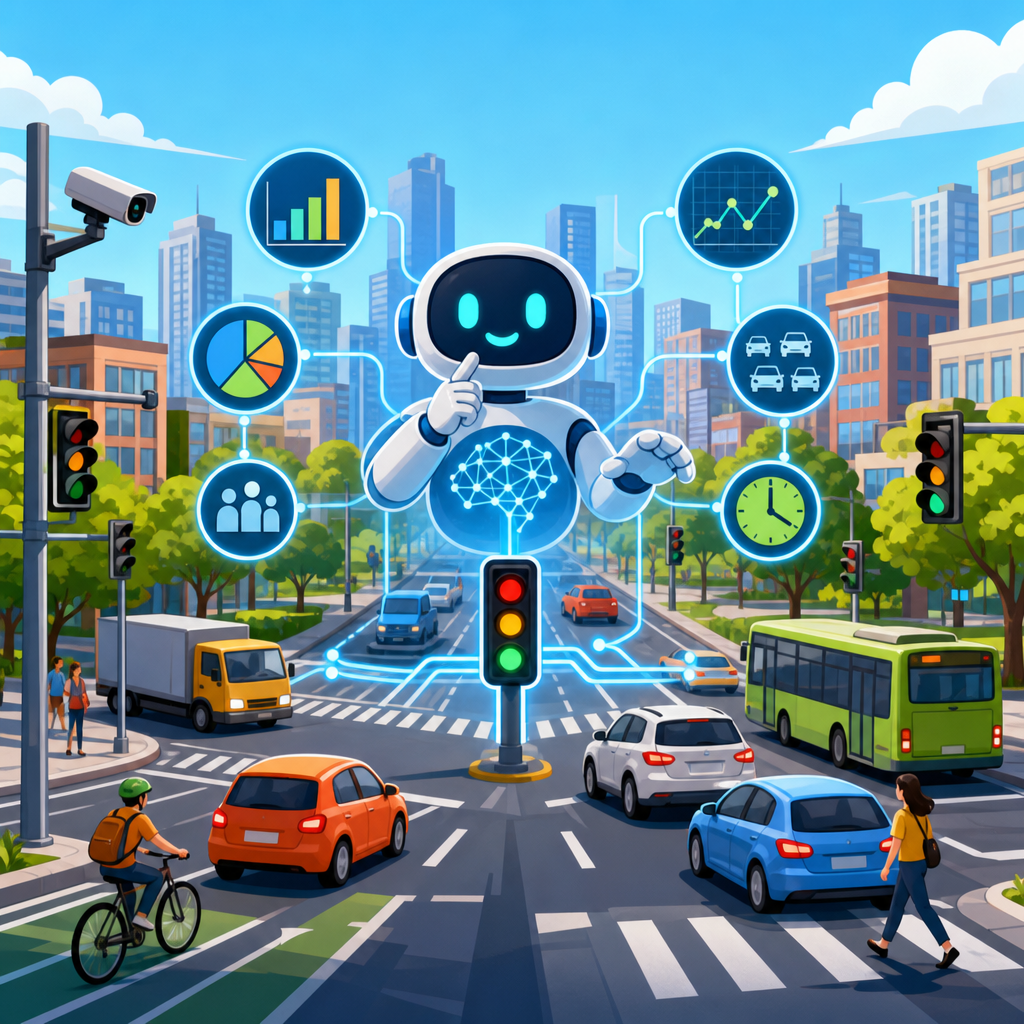
AI in traffic signal timing is moving from pilot projects to citywide programs, but scaling it responsibly depends less on software marketing and more on disciplined measurement. In plain terms, traffic signal timing is the process of setting cycle lengths, green splits, offsets, and phase sequences so intersections move people and goods efficiently. Adding AI usually means adaptive control, predictive models, or reinforcement learning systems that change timings using live detector, camera, probe vehicle, and transit data. I have worked with agencies that expected immediate congestion relief from these tools, only to discover that weak baselines, poor detector health, and unclear goals made results impossible to trust. Before a city expands any AI signal timing deployment, it should define what success means, how it will be measured, and which tradeoffs it is willing to accept. That matters because signals influence travel time, safety exposure, bus reliability, emissions, emergency response, and even pedestrian comfort at the curb.
Cities also need precise definitions because the term AI covers very different products. Some systems are rule based adaptive platforms that optimize splits and offsets every few minutes. Others use machine learning to forecast demand by movement, classify queues from video, or coordinate corridors using cloud computing. A few newer platforms claim network level self learning behavior across hundreds of intersections. Those approaches are not interchangeable. The detector coverage, communications latency, staff skills, cybersecurity posture, and procurement structure required for each can differ sharply. Measurement provides the common language that lets public works directors, traffic engineers, transit planners, elected officials, and residents compare options fairly. If an agency cannot explain current performance by time of day, season, weather condition, and user type, it is not ready to attribute improvements to AI. A strong measurement plan turns a pilot from a demo into evidence, and evidence is what justifies scaling.
Start with outcomes, not algorithms
The first thing a city should measure before scaling AI in traffic signal timing is whether the stated problem is delay, unreliability, safety risk, poor bus performance, freight friction, excess fuel use, or something else. These goals lead to different timing strategies. If the core issue is recurring commuter congestion on an arterial, metrics such as corridor travel time, intersection control delay, progression quality, and arrivals on green are central. If the issue is pedestrian safety near schools or commercial districts, agencies should emphasize crossing compliance, turning conflict exposure, leading pedestrian interval performance, and red light running patterns. When bus service is the pain point, the right measures include bus travel time, schedule adherence, stop to stop variability, and transit signal priority effectiveness. I have seen agencies claim success because average vehicle delay fell by 8 percent while bus travel times worsened and pedestrian wait times increased. That is not success; it is goal confusion documented by the wrong metric set.
Baseline development is equally important. A city should capture at least several months of predeployment conditions, segmented by weekday, weekend, peak period, school schedule, weather, and special events. Using a single before week and after week often creates false confidence because traffic volumes fluctuate for reasons unrelated to signal timing. The Highway Capacity Manual offers a consistent framework for defining control delay, level of service, and queue behavior, while the Traffic Signal Timing Manual from FHWA remains a practical reference for operational diagnosis. Those standards do not replace local judgment, but they help agencies avoid improvised definitions that break comparisons over time. Baselines should also include asset health: detector uptime, cabinet failures, communications loss, and maintenance response time. If an AI platform improves timing only when every camera is calibrated and every stop bar detector works perfectly, scaling costs may exceed the operational benefit.
Measure mobility with corridor and network discipline
Mobility measurement should go beyond a simple average speed number. For signal timing, the most useful indicators usually include median travel time, travel time reliability, 95th percentile travel time, average stopped delay per vehicle, queue length distribution, intersection throughput, and progression quality by direction. Median values are more stable than means when incidents distort traffic. Reliability matters because travelers experience uncertainty as a cost. A corridor that takes 12 minutes one day and 22 minutes the next often feels worse than one that consistently takes 15 minutes. Probe vehicle datasets from INRIX, HERE, TomTom, or StreetLight can support corridor analysis, while high resolution controller event data can reveal split failures, force offs, pedestrian recalls, and max outs at the intersection level. When I review AI timing pilots, I look for both levels. Corridor probes show what users feel; controller events show why they felt it.
Cities should also compare performance across time periods instead of only reporting a systemwide average. AI tools frequently improve peak direction progression while creating minor losses in the reverse direction, at midday, or on side streets. Those tradeoffs can be reasonable, but they must be visible. A downtown grid may need balanced person throughput rather than directional green waves. A freight corridor serving a port may prioritize off peak truck platoons and gate queues. A suburban arterial with closely spaced schools may need special school arrival timing plans. The point is that network context determines what mobility success looks like. Cities should therefore measure person based outcomes where possible, not just vehicle counts. If a corridor carries heavy bus ridership, pedestrian volumes, and cyclists, a small increase in car delay may be justified by larger gains in total people moved safely and predictably.
Safety metrics must be leading, not only lagging
Crash reduction is the ultimate public outcome, but crashes are too rare and too delayed to be the only safety measure in an AI scaling decision. Cities should measure leading indicators such as red light running frequency, dilemma zone occupancy, hard braking near stop bars, speed on approach, encroachment time between turning vehicles and pedestrians, blocked crosswalk events, and queue spillback into adjacent intersections. Video analytics platforms and connected vehicle data can estimate many of these surrogate safety measures with useful precision when cameras are properly placed and privacy rules are clear. The Surrogate Safety Assessment Model and FHWA conflict methods provide recognized ways to think about exposure before a crash occurs. In practice, I have found that a system claiming to reduce delay but increasing yellow onset entries or permissive left turn conflicts is a scaling risk, not a breakthrough.
Equally important, safety measurement must reflect all users. Pedestrians and cyclists are often the first to absorb the hidden costs of aggressive optimization. Shorter cycle lengths can lower delay for side streets yet reduce crossing comfort if walk and clearance intervals are squeezed to the legal minimum. Long coordinated greens can improve arterial flow while encouraging higher approach speeds. Transit priority can reduce bus delay but should not trap pedestrians on islands or create surprise phases for drivers without clear displays. A city should audit signal timing against the Manual on Uniform Traffic Control Devices, ADA requirements, and local Vision Zero policies before expanding AI control. Measuring compliance, not just performance, protects the agency from adopting an optimization regime that conflicts with accepted safety practice. The best scaling decisions combine crash history, conflict indicators, speed management, and accessibility checks into one governance process.
Data quality, equity, and operations readiness decide scale
Many AI traffic signal timing programs fail because the city measures outputs but ignores data quality. Every model is constrained by the condition of the field devices feeding it. Before scaling, agencies should quantify detector coverage by lane and movement, false call rates, missed detections, video occlusion patterns, communications latency, packet loss, and time synchronization accuracy across cabinets. If clocks drift or detector channels are mislabeled, event data becomes misleading and corridor coordination suffers. The city should also track maintenance capacity: average time to repair a failed detector, camera cleaning cycles, firmware version control, spare parts availability, and vendor support responsiveness. These are not back office details. They determine whether AI remains adaptive during rain, glare, construction, and seasonal traffic changes. In one deployment I observed, performance degraded every autumn because low sun angles blinded cameras on westbound approaches; the algorithm was blamed for a sensor problem.
Equity should be measured with the same rigor as mobility. Cities should map who benefits and who bears the tradeoffs by neighborhood, income proxy, disability access need, transit dependence, and exposure to traffic harms. That does not mean every corridor must perform identically. It means agencies should know whether optimization consistently shifts delay to residents on local streets, lengthens pedestrian wait times near senior housing, or weakens bus reliability in lower income districts. Pairing signal performance data with land use, demographic, and transit service layers can reveal these patterns. Staffing readiness is another scaling metric that deserves executive attention.
| Measurement area | What to track before scaling | Why it matters |
|---|---|---|
| Mobility | Median corridor travel time, 95th percentile travel time, split failures, queue lengths | Shows user experience and intersection causes |
| Safety | Red light running, hard braking, speed on approach, blocked crosswalks | Reveals risk before crash data matures |
| Transit and freight | Bus travel time variability, TSP success rate, truck delay at key gates | Protects person throughput and economic activity |
| Data quality | Detector uptime, false calls, camera occlusion, latency, clock drift | Determines whether AI recommendations are trustworthy |
| Operations | Repair time, staff training, override procedures, cybersecurity incidents | Indicates whether the city can sustain performance at scale |
| Equity and access | Pedestrian wait time, ADA compliance, neighborhood benefit distribution | Prevents optimization from shifting burdens unfairly |
Finally, cities should measure governance readiness. That includes whether they have clear override rules for incidents and special events, audit logs for algorithm changes, procurement terms for data ownership, and cybersecurity controls aligned with frameworks such as the NIST Cybersecurity Framework. AI timing is not a one time installation; it is an operating model. Staff need dashboards they can interpret, not black box scores they cannot challenge. Contracts should specify access to raw and processed data, model retraining practices, fallback modes, and performance guarantees. Without those controls, scaling can create vendor dependence and public accountability problems. A city that can explain how decisions are made, what data supports them, and how failures are corrected is far more likely to achieve durable benefits from AI signal timing than a city buying automation on faith.
How to decide whether a pilot is ready for expansion
A pilot is ready to scale when the city can demonstrate repeatable gains, explain the mechanism behind those gains, and show that benefits persist under normal operational stress. Repeatable gains means improvements appear across multiple months, not a single curated demo period. Explainable mechanism means engineers can point to actual changes in green allocation, coordination quality, queue management, or priority treatment that produced the result. Persistence under stress means rain, incidents, detector failures, construction detours, school openings, and seasonal demand shifts do not collapse performance. I advise agencies to require a written scale decision memo that compares before and after performance, lists tradeoffs openly, documents sensor health, and states which corridors are suitable next and why. That memo should be understandable to both technical staff and executive leadership. If a vendor cannot support that level of transparency, the city should pause expansion.
The strongest programs treat AI as a tool inside a broader signal management discipline. They maintain timing plan libraries, retiming schedules, detector maintenance, performance dashboards, and public communication. They measure corridor mobility, multimodal safety, equity effects, and operational resilience together rather than in separate silos. They also remain realistic. AI cannot fix missing turn lanes, poor land use access patterns, unsafe street geometry, or underfunded maintenance. It can, however, help a well prepared city respond faster to demand shifts, improve reliability, and make timing decisions with more evidence than periodic manual retiming alone. For cities considering scale, the practical next step is simple: build a measurement framework first, run a pilot against it, and expand only when the data shows durable public value.
Frequently Asked Questions
What should cities measure first before expanding AI-based traffic signal timing beyond a pilot?
Before scaling, cities should establish a clear baseline that shows how the corridor or intersection performs today without AI intervention. That means measuring more than average vehicle delay. A reliable pre-deployment baseline should include travel time, travel time reliability, queue length, intersection throughput, stop frequency, split failures, pedestrian delay, transit performance, freight movement impacts, and safety-related indicators such as red-light running trends, near-miss data where available, and conflict patterns. Cities should also document time-of-day variation, seasonal changes, weather effects, special event disruption, school zone behavior, and emergency preemption activity so they understand normal volatility before attributing improvements to AI.
Just as important, agencies should define what “success” means for the specific network. A downtown grid may prioritize person throughput, bus reliability, and pedestrian crossing quality, while an industrial corridor may care more about truck travel time consistency and queue spillback prevention. If cities skip this step, they risk scaling a system that improves a vendor dashboard but does not meaningfully advance policy goals. The strongest programs align every metric to a public objective such as safety, equity, reliability, emissions reduction, or transit priority, then set thresholds for acceptable performance before rollout expands.
Why is data quality so important when evaluating AI traffic signal timing systems?
AI signal control systems are only as good as the data feeding them. If detectors are misaligned, loop sensors are failing, cameras are obstructed, timestamps are inconsistent, or intersection controller logs are incomplete, the AI may optimize against bad inputs and create unstable or misleading timing decisions. In practice, poor data quality can make a system appear responsive while actually increasing delay for side streets, misreading pedestrian demand, or failing to detect recurring queue spillback. That is why cities should audit sensor uptime, false detection rates, missing data frequency, latency, calibration consistency, and coverage gaps before declaring a pilot successful or committing to citywide deployment.
Data quality also matters for accountability. If a city cannot trust its own measurements, it cannot fairly compare AI performance against traditional coordinated timing plans or adaptive systems already in place. Strong evaluation requires clean before-and-after data, common reporting intervals, and independent verification methods such as floating car runs, third-party travel time data, controller event logs, and field observation. Cities should also assess whether the data architecture can support long-term scaling, including storage, integration, cybersecurity, privacy controls, and maintenance workflows. In short, cities are not just buying smarter timing logic; they are taking on an operational data system that must be reliable every day, not only during the pilot demonstration.
How can cities tell whether AI signal timing is improving mobility without harming safety or equity?
Cities should evaluate AI signal timing using a balanced scorecard rather than a single mobility metric. Faster travel times alone are not enough if they come at the expense of pedestrians, cyclists, transit riders, or neighborhoods with less political visibility. A strong assessment looks at movement across modes and user groups: vehicle delay, bus schedule adherence, pedestrian wait times, bicycle crossing comfort, freight reliability, and person-throughput by corridor. It should also include safety proxies and direct indicators such as speed profile changes, yellow and all-red compliance, hard braking events where available, conflicts between turning vehicles and pedestrians, and changes in red-light running or queue spillback into adjacent crossings.
Equity measurement is equally important before scaling. Cities should compare outcomes across neighborhoods, not just across high-profile corridors. If AI improves commute times in business districts but increases crossing delays near schools, clinics, senior housing, or bus-dependent communities, the deployment may conflict with the city’s broader transportation goals. Agencies should segment results by geography, time period, mode, and vulnerable road user exposure, then determine whether benefits and burdens are distributed fairly. The best practice is to publish evaluation criteria in advance and make tradeoffs explicit, so the public can see whether the system is truly supporting safer, more reliable, and more equitable street operations.
What operational and technical risks should cities evaluate before scaling AI traffic signal timing citywide?
Scaling from a pilot to a citywide program introduces risks that are often invisible in a limited test. One major issue is interoperability. Cities should confirm that the AI platform works with existing signal controllers, central management software, communications networks, emergency vehicle preemption systems, transit signal priority tools, and maintenance workflows. They should test how the system behaves during detector failure, communications outages, construction detours, unusual weather, and special events. If the AI performs well only under ideal conditions, it may not be ready for broad deployment. Agencies also need clear fallback plans so intersections can revert safely to known timing patterns if the system degrades.
Governance and vendor dependency are also critical. Cities should ask who owns the data, whether signal timing logic is explainable enough for staff review, how model updates are validated, how cybersecurity responsibilities are assigned, and whether procurement terms prevent lock-in. Another practical concern is staffing: citywide AI timing still requires engineers and technicians who can audit performance, interpret anomalies, retime corridors when land use changes, and maintain field devices. A scalable system is not just one that works technically; it is one the city can operate, inspect, troubleshoot, and govern with confidence over many years.
How long should cities evaluate AI traffic signal timing before deciding to scale?
Cities should avoid making a scaling decision based on a short, highly managed pilot window. A meaningful evaluation period should be long enough to capture weekday peaks, off-peak conditions, weekends, school schedules, weather variation, incident disruption, and seasonal demand changes. In many cases, that means several months of observation at minimum, with enough lead time to establish a credible baseline before activation and enough follow-up time to assess whether early gains persist. Short pilots can overstate benefits because vendors and agencies are watching closely, field devices are temporarily well maintained, and corridor conditions may not reflect normal year-round variation.
Beyond duration, cities should use phased evaluation gates. For example, they might begin with a small corridor, then expand to a district only if predefined performance targets are met for reliability, safety, data integrity, and maintainability. This stage-gate approach helps prevent premature scaling based on anecdotal success. It also gives city staff time to determine whether improvements are consistent, replicable, and robust under real-world operating conditions. The right question is not simply whether the AI worked during a pilot, but whether the city has enough evidence to trust it across different locations, conditions, and policy priorities over time.