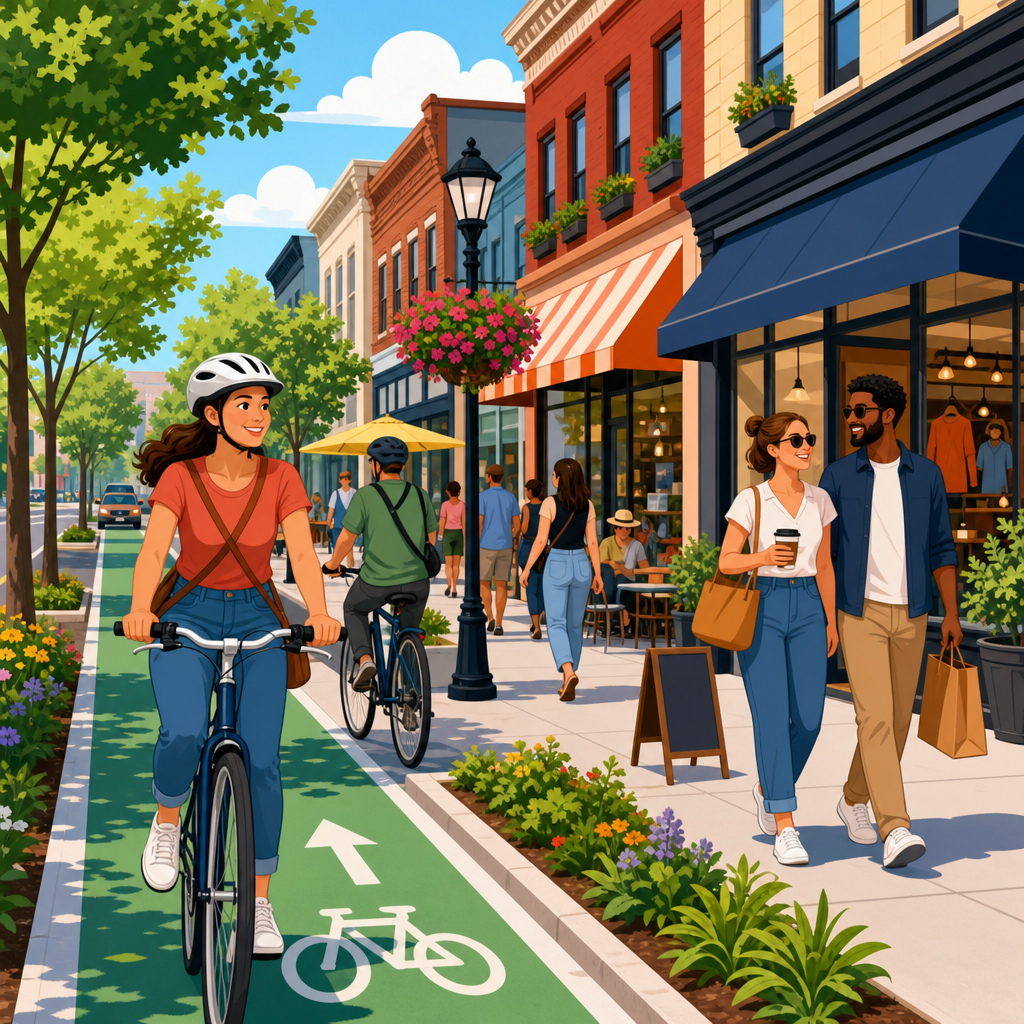
Bike networks shape how people move through commercial districts, and that movement directly affects Main Street retail foot traffic. A bike network is the connected system of protected lanes, neighborhood greenways, intersections, bike parking, and wayfinding that allows people to reach shops safely and predictably without a car. Main Street retail foot traffic refers to the number of people walking past storefronts, stopping, browsing, and entering businesses along traditional urban shopping corridors. When city leaders and merchants ask whether bike lanes help or hurt business, they are really asking how street design changes access, visibility, dwell time, and the mix of customers arriving each day.
I have worked with downtown associations, corridor plans, and curb management studies where this question comes up immediately after any proposed street redesign. The debate often starts with parking counts, but retail performance depends on much more than curb spaces. A successful business district needs a steady flow of customers, frequent short visits, safe crossings, and an environment where people feel comfortable lingering. Bike networks matter because they can increase the number of people a street serves per hour, reduce the stress of arriving, and connect nearby residents to stores in a way that encourages repeat visits. They also influence who uses the corridor, at what time of day, and how far they are willing to travel.
The relationship is not automatic. A painted lane that disappears at busy intersections will not produce the same retail effect as a protected route linked to secure bike parking and calm crossings. Weather, land use, transit service, local demographics, and tenant mix all affect outcomes. Still, evidence from cities such as New York, Toronto, London, and Portland consistently shows that well-designed bike access can support or improve sales, vacancy reduction, and pedestrian activity, especially on neighborhood-serving streets. Understanding how this happens helps business owners, planners, and community groups make better decisions about street investment.
Why bike access changes retail behavior
Bike networks affect retail foot traffic by changing the practical economics of short urban trips. A customer on a bicycle usually travels slower than a driver, has a wider field of attention, and can stop with much less friction. That matters on Main Street, where impulse visits and visual discovery drive spending. On corridors I have studied, merchants often notice that riders are more likely than drivers to make unplanned stops because parking a bike takes seconds instead of a multi-minute search for a legal car space. That lower arrival friction turns exposure into visits.
Safety is the first condition. People do not shop by bike in meaningful numbers if they feel threatened by traffic. Protected lanes, reduced crossing distances, daylighted intersections, and lower vehicle speeds make the entire corridor more permeable. Once riders feel safe, the network increases the corridor catchment area beyond immediate walking distance. A resident who might only walk five or ten minutes to shop may comfortably bike fifteen minutes, expanding the pool of frequent customers for cafes, pharmacies, grocers, bookstores, and personal services.
Bike access also interacts with pedestrian activity. Riders become walkers the moment they dismount, and corridors with better cycling conditions often gain more people on the sidewalk because total person throughput rises. Streets that prioritize active travel usually include wider sidewalks, trees, benches, and better crossings, all of which improve the retail environment for everyone, including drivers who park once and continue on foot. This is why business effects should be assessed at the corridor level rather than by counting only the parking spaces removed in front of one storefront.
What the evidence shows in real business districts
The strongest findings from retail studies are not that every bike lane boosts every store, but that fears of severe business loss are usually overstated and that many corridors see measurable gains. New York City Department of Transportation analyses found that after protected bike lanes and pedestrian upgrades were added on parts of Ninth Avenue and elsewhere, local retail sales often outperformed borough-wide trends. On Manhattan’s Ninth Avenue, protected lanes were paired with refuge islands and calmer traffic, creating a street that felt safer to cross and easier to browse.
Toronto’s Bloor Street pilot produced another widely cited example. Merchant concerns focused on parking removal, yet detailed surveys later showed that customers arriving by car were a smaller share than many business owners estimated. Walking, transit, and cycling already accounted for most visits, and bike improvements did not trigger the collapse opponents predicted. Similar patterns have appeared in London high streets, where Transport for London and borough studies have shown that people arriving on foot, by transit, or by bike often spend more over time because they visit more frequently, even if individual purchase amounts can be smaller than a car trip.
Portland, Oregon, adds a useful neighborhood-scale example. On commercial streets connected to greenways and bike lanes, merchants benefit from a customer base that makes repeat discretionary trips. A rider might stop for coffee, then return later in the week for groceries or a repair service. This visit frequency matters more than a single large basket for many independent retailers. The consistent takeaway across cities is that mode share and spending should be measured over weeks and months, not judged by anecdote from a few days of construction or adjustment.
How street design translates into more foot traffic
Retail gains come from design details, not from the word bike lane alone. The most effective bike networks are continuous, intuitive, and comfortable for less confident riders. Continuity matters because gaps at intersections or bridge approaches suppress usage. If a parent, older adult, or casual rider cannot complete the final half mile safely, they often will not start the trip. For Main Street retail, that means fewer potential customers reaching the corridor in the first place.
Visibility is the second mechanism. Protected lanes place people closer to storefront windows than travel lanes full of fast-moving cars. Riders see signs, outdoor displays, and food counters at a speed that allows recognition and reaction. Frequent curb extensions and shorter crossings then help those riders become pedestrians. Good bike parking finishes the process. I have seen corridors install racks at every corner and immediately solve the clutter problem that occurs when people lock bikes to trees, signs, or railings. Convenient parking signals that riders are expected customers, not afterthoughts.
Loading and curb management are equally important. Retail streets still need freight access, pickup zones, and accessible parking. The best redesigns preserve these functions while reallocating excess space from general traffic lanes or underpriced long-stay curb parking. When delivery windows, loading bays, and short-term pickup areas are mapped clearly, merchants can support bike improvements because operational needs remain protected. The design challenge is not bike access versus business access. It is matching limited curb space to its highest-value uses throughout the day.
Metrics cities and merchants should track
To understand whether a bike network helps Main Street retail foot traffic, cities need a better measurement framework than simple before-and-after parking counts. The most useful indicators combine mobility, retail performance, and public realm data. In corridor studies, I usually recommend starting with a baseline at least one season before installation and continuing for a year after implementation to control for weather and construction effects.
| Metric | What it reveals | How to measure it |
|---|---|---|
| Pedestrian counts | Sidewalk activity and storefront exposure | Manual counts, computer vision, or infrared sensors at peak and off-peak times |
| Bicycle counts | Network usage and arrival volume | Tube counters, video analysis, or permanent inductive counters |
| Retail sales trends | Business performance relative to citywide conditions | Sales tax data, merchant surveys, card spending panels |
| Vacancy rate | Corridor resilience and leasing confidence | Quarterly storefront inventory and broker records |
| Dwell time | Likelihood of browsing and multiple stops | Anonymized mobile data, intercept surveys, observational studies |
| Curb turnover | Whether access is improving or constraining trade | License plate surveys and loading observations |
These metrics help separate perception from outcome. A merchant may feel that fewer drivers are present, yet total customer volume may rise because walking and cycling visits increase. Measuring turnover is especially important. One curb space that serves eight short visits can produce more retail activity than one space occupied all day by an employee vehicle. Good analysis compares corridor performance against nearby control streets and against wider economic conditions, including inflation, e-commerce pressure, and seasonal tourism.
Which businesses benefit most, and where tradeoffs appear
Not every retailer experiences bike network effects in the same way. Food and beverage businesses, convenience retail, pharmacies, florists, bakeries, salons, and small-format specialty shops usually benefit the most because they depend on frequent local visits and impulse spending. These businesses thrive when a corridor becomes easier to reach without planning a car trip. Service businesses also gain from improved visibility and repeat patronage from nearby residents.
Bulky-goods retailers, regional destination stores, and businesses with a high share of customers traveling long distances by car may see fewer direct gains, especially if the street redesign removes convenient loading or pickup space. That does not mean bike infrastructure is a poor fit. It means the curb plan must reflect actual business operations. A furniture store may need designated loading, while a cafe may need outdoor seating and bike racks. Mixed-use corridors can accommodate both when planners use block-by-block curb allocation instead of one generic template.
There are also short-term tradeoffs. Construction can disrupt access, obscure storefronts, and depress sales for weeks or months. The most successful cities mitigate this with phased work, merchant communication, temporary signage, and delivery coordination. Another tradeoff is network incompleteness. A single improved block may not shift customer behavior if surrounding streets remain stressful. Retail benefits usually emerge when the corridor is part of a larger connected system that links homes, schools, transit stops, and nearby employment centers.
What makes a bike network retail-ready
A retail-supportive bike network has five nonnegotiable features. First, it is connected. Customers need direct links from neighborhoods and transit hubs to the shopping street. Second, it is protected where traffic volumes or speeds are high. Third, intersections are legible, with clear priority, signal timing, and safe turning treatments. Fourth, there is abundant short-stay bike parking near storefronts. Fifth, the corridor remains functional for deliveries, accessibility needs, and emergency access.
Wayfinding is often underrated. Simple signs showing ride times to adjacent neighborhoods, schools, stations, and parks help people see a Main Street as close and easy to reach. Secure bike parking matters too. Standard inverted-U racks work for short stays, but districts with restaurants, evening uses, or e-bikes increasingly need covered parking, lockers, or monitored corrals. E-bike growth is significant because it extends the realistic customer shed, especially in hilly cities and for older adults. That means more households can choose local trips without using a car.
Finally, governance matters. Corridor maintenance, enforcement of loading rules, snow clearance, and merchant engagement determine whether the network performs well after ribbon cutting. I have seen excellent designs fail temporarily because delivery vehicles blocked the lane every morning, or because racks were installed too far from entrances. Fine-grained operational fixes often produce bigger retail gains than expensive capital changes once the basic network is in place.
How merchants and city leaders can act now
The practical lesson is clear: bike networks can increase Main Street retail foot traffic when they are safe, connected, and integrated with the everyday needs of commerce. They work by reducing trip friction, expanding the local customer base, supporting repeat visits, and creating a street where more people move slowly enough to notice and enter stores. The best results come from complete corridor design, not isolated striping. Protected lanes, quality crossings, bike parking, loading management, and public realm upgrades operate as one system.
Decision-makers should also be honest about limits. A bike lane cannot compensate for weak tenant mix, poor storefront presentation, high vacancy, or a corridor cut off by hostile arterials. Construction impacts need mitigation, and some businesses require tailored curb access. But the broad evidence is stronger than the skepticism. In most urban and town-center settings, the question is no longer whether bike access belongs in a retail strategy. The question is how to design it so merchants, customers, and deliveries all function better together.
For city staff, the next step is to measure current travel patterns before making assumptions about who shops on Main Street. For business associations, it is to participate in design discussions with clear operating data on deliveries, peak hours, and customer needs. For merchants, it is to welcome arriving riders with visible racks, easy pickup, and storefront cues that reward spontaneous stops. Treat the bike network as customer infrastructure, and Main Street becomes easier to reach, safer to explore, and more resilient over time.
Frequently Asked Questions
How do bike networks increase Main Street retail foot traffic?
Bike networks increase Main Street retail foot traffic by making it easier for more people to reach shopping districts safely, comfortably, and consistently. When protected bike lanes, neighborhood greenways, safer intersections, visible crossings, and convenient bike parking are connected into a reliable system, people are more likely to choose a bike for short local trips. That matters for retailers because many Main Street visits are not destination-only trips. They are quick errands, casual browsing trips, coffee stops, meal outings, and repeat neighborhood visits. A strong bike network supports all of those patterns.
Unlike high-speed car corridors that can move people past storefronts without encouraging them to stop, bike-friendly streets tend to create a slower and more interactive street environment. People on bikes notice window displays, signs, sidewalk activity, and storefront changes in ways that are much closer to the pedestrian experience than the driving experience. They can stop more easily, lock up nearby, and add an unplanned purchase to an existing trip. That translates into more pass-by visibility and more opportunities for impulse visits.
Bike networks also expand a business district’s effective customer catchment area. A comfortable five- to fifteen-minute bike ride can connect neighborhoods to Main Street corridors that may feel too far to walk but too inconvenient to drive and park for small purchases. In practical terms, that means more people can access local businesses regularly without needing a parking space. For retailers, the result is often a steadier flow of potential customers throughout the day rather than traffic concentrated only around peak driving times.
Do people who arrive by bike actually spend money at Main Street businesses?
Yes, and this is one of the most important points for business owners to understand. Customers who arrive by bike may sometimes spend less per individual visit than customers arriving by car, but they often visit more frequently. For many Main Street businesses, especially cafes, bakeries, grocery stores, restaurants, pharmacies, bookstores, salons, and specialty shops, repeat visits are a major driver of revenue. A customer who bikes past a store several times a week has many more opportunities to stop in than a customer who drives only occasionally.
The value of bike access is tied to retail patterns, not just single-transaction size. Main Street commerce thrives on regular neighborhood activity: morning coffee, after-work pickups, lunch, convenience shopping, browsing, and social trips. Bike networks support those high-frequency trips because they reduce the friction of travel. People do not have to find parking, circle the block, or decide whether a short trip is worth the hassle. They can simply arrive, lock up close to the storefront, and walk in.
It is also important to remember that street space is limited. A small amount of curb space used for bike parking can serve multiple customers in the same footprint as one car parking space. That means the productivity of the street edge can improve when a corridor is designed to welcome many access modes, including biking and walking. In retail terms, the real question is not whether every cyclist spends more than every driver, but whether a better bike network increases the total number of convenient visits, storefront exposures, and buying opportunities. In many Main Street settings, it does.
What parts of a bike network matter most for retail success on Main Street?
The most important factor is connectivity. A painted bike lane that begins and ends abruptly is far less useful than a complete network that allows people to travel from their neighborhood to a commercial corridor without stressful gaps. Retail benefits grow when the trip feels safe from start to finish. That includes protected lanes on busy streets, low-stress neighborhood greenways on calmer streets, clear transitions between facilities, and intersections designed to reduce conflicts with turning vehicles.
Intersections are especially important because they are often where people feel the least safe. If shoppers can ride along a corridor but feel exposed when crossing major streets or entering the business district, many will avoid the trip entirely. Well-designed crossings, visible markings, signal timing, curb extensions, refuge islands, and predictable turning movements make a significant difference. These details may seem technical, but they directly affect whether a potential customer chooses to visit.
End-of-trip amenities matter too. Secure and visible bike parking near storefronts is essential. If customers have to hunt for a place to lock up, or if they feel their bike is vulnerable to theft, some portion of demand disappears. Good wayfinding also helps by showing riders where the district is, how to enter it, and where key destinations are located. The strongest retail results usually come from a combination of safe routes, comfortable intersections, convenient parking, slower vehicle speeds, and a street design that makes browsing and stopping feel natural.
Can bike network improvements hurt Main Street businesses by removing parking or changing traffic patterns?
This concern is common, but the answer depends on how the project is designed and what kind of business district is being discussed. In many traditional urban shopping areas, retailers overestimate how many customers arrive by car and underestimate how many come on foot, by bike, by transit, or through linked trips. Main Streets typically perform best when access is balanced across modes rather than optimized only for fast vehicle movement. If a corridor becomes safer, more comfortable, and more inviting, it can attract more people overall even if some curb space or travel capacity changes.
That said, implementation matters. A successful bike network project should consider loading needs, short-term pickups, ADA access, delivery activity, side-street parking management, and the visibility of businesses during construction. Retailers are right to care about disruption, and cities should address those concerns directly. Good planning does not treat bike access and business access as competing goals. It integrates them by preserving essential operations while improving the customer experience on the street.
Over the longer term, calmer traffic and a more pleasant public realm often support stronger retail performance than auto-oriented designs that move cars quickly but discourage lingering. Main Street businesses benefit when people feel comfortable crossing the street, walking between stores, sitting outdoors, and making spontaneous stops. If a bike network improvement contributes to that environment, it can strengthen the district’s economic resilience. The key is not simply adding a bike lane, but redesigning the corridor so it works better as a place as well as a route.
How can cities and business districts measure whether bike networks are improving retail foot traffic?
The best approach is to use multiple measures rather than relying on one headline number. Pedestrian counts are a core metric because Main Street retail success is closely tied to the number of people walking past storefronts and entering shops. Cities and business improvement districts can compare foot traffic before and after bike network upgrades, while also tracking bike volumes, storefront vacancy rates, sales tax data where available, and business turnover. This creates a fuller picture of whether mobility changes are translating into commercial gains.
Intercept surveys and customer travel surveys are also valuable. They help answer practical questions such as how people arrived, how often they visit, whether they combined multiple stops into one trip, and whether safer bike access changed their behavior. For example, a district may discover that bike network improvements increased visit frequency rather than dramatically increasing one-time spending. That is still a meaningful retail outcome, especially for businesses built on repeat local demand.
Qualitative indicators should not be ignored. Longer dwell times, busier sidewalks, more active curb zones, higher use of bike parking, and stronger outdoor dining performance can all signal a healthier street economy. Seasonality, weather, nearby construction, and broader economic trends should also be accounted for so results are interpreted fairly. In short, measuring the retail effects of bike networks requires looking at how people move, how often they return, and how the street functions as a commercial place. When those indicators improve together, it is a strong sign that the bike network is supporting Main Street foot traffic.