Freight, loading, and last-mile logistics shape whether mixed-use districts function smoothly or descend into curbside conflict. In neighborhoods where housing, offices, retail, entertainment, hotels, and civic uses share tight street networks, goods movement becomes a daily test of urban design and operations. Freight refers to the transport of goods by truck, van, cargo bike, rail, or consolidated service. Loading describes the curb, alley, dock, and staging activities needed to move goods into and out of buildings. Last-mile logistics covers the final leg from a distribution point to the business, resident, or customer receiving the shipment. Together, these systems determine delivery reliability, traffic flow, noise, emissions, and public safety.
I have worked on district plans where a well-designed plaza failed because delivery vehicles blocked emergency access each morning, and on downtown corridors where simple loading reforms reduced double parking within weeks. Mixed-use districts intensify these issues because peaks overlap. Restaurants need early produce deliveries, offices receive parcel volumes all day, apartments generate e-commerce returns at night, and hotels depend on linen, food, and waste collection schedules. The same curb may be expected to serve bus stops, ride-hailing pickups, accessible parking, bike lanes, café seating, and freight operations. When cities and developers ignore freight, the result is predictable: congestion, unsafe crossings, tenant frustration, and higher operating costs for everyone.
This hub article explains how freight, loading, and last-mile logistics should be planned in mixed-use districts, why they matter for sustainable urban development, and which strategies consistently work in practice. It covers curb management, building design, off-street loading, microhubs, delivery timing, data systems, and governance. It also connects freight planning to broader goals such as mode shift, public realm quality, climate targets, and economic resilience. The core principle is straightforward: goods movement is not a back-of-house afterthought. In a successful mixed-use district, logistics is treated as essential infrastructure, designed at the same level of seriousness as transit, utilities, drainage, and pedestrian circulation.
Why freight planning matters in mixed-use districts
Mixed-use districts compress diverse trip types into a limited footprint, which increases the value of every minute and every meter at the curb. A single block may host residential towers, small-format grocery, medical offices, restaurants, coworking space, and schools. Each use has different receiving needs, shipment sizes, labor patterns, and service windows. Without a freight plan, trucks circle for space, vans stop in travel lanes, and workers hand-carry goods across sidewalks. That adds delay, fuel burn, injury risk, and noise. It also weakens the district’s commercial performance. Retailers lose delivery certainty, restaurants shorten menus when perishables arrive late, and property managers absorb avoidable staffing and security costs.
Good freight planning supports sustainability more directly than many project teams realize. Efficient loading reduces vehicle idling and failed deliveries. Consolidation lowers trip counts. Cargo bike deployment can replace van trips for parcel and food deliveries under the right density and distance conditions. Designated loading space protects bus lanes and bike facilities, which helps maintain mode share gains for passenger travel. The World Bank, OECD, and city freight programs in London, New York, and Paris have all shown that urban freight efficiency is integral to emissions reduction, economic productivity, and street safety. In practical terms, cleaner freight depends on operations and geometry, not just better vehicle technology.
Curb management: the district’s most contested asset
The curb is the operating system of a mixed-use district. If everything is allowed everywhere, conflict becomes constant. Effective curb management begins with inventory: block face lengths, lane widths, hydrants, driveways, transit stops, ADA access, bike lane interfaces, and current regulations by time of day. The next step is demand mapping. Cities and property owners need to know who uses the curb, when they arrive, how long they dwell, and whether they require liftgates, hand-trucks, refrigeration, or secure handoff. In my experience, the best curb plans are built from field observation at 15-minute intervals, not assumptions in a spreadsheet.
Time-based allocation is usually the fastest improvement. Morning hours can prioritize commercial loading; midday can shift space toward passenger loading or short-stay parking; evening periods can support restaurant pickup and nightlife demand. Digital curb tools, license-plate-based enforcement, and geofenced permits make these rules easier to manage than static signs alone. Clear curb policy also improves fairness. Small businesses often lose out when unregulated couriers occupy frontage all day. By assigning delivery zones by vehicle type and dwell time, districts can reserve scarce space for legitimate turnover rather than long-duration storage.
| Logistics challenge | Common cause | Practical district response |
|---|---|---|
| Double parking by vans | Insufficient short-term loading near entrances | Create time-window loading bays with strict turnover enforcement |
| Blocked sidewalks during deliveries | No internal staging space in buildings | Require package rooms and service corridors at ground level |
| Freight conflicts with bike lanes | Loading placed across protected cycling routes | Use side streets, floating loading bays, or rear access alleys |
| High delivery emissions | Fragmented trips from multiple carriers | Support consolidation centers and cargo bike transfer points |
| Noise complaints from residents | Unmanaged overnight servicing | Set quiet-delivery standards and equipment requirements |
Building design and off-street loading requirements
The most expensive freight problems are usually designed in long before the first tenant opens. Mixed-use projects need receiving strategies sized to actual tenant mix, not generic zoning minimums. Dock height, turning radii, ramp grades, column spacing, door widths, vertical clearance, compactor access, and elevator dimensions all affect operational success. A grocery anchor may require frequent medium truck deliveries with pallet jacks and refrigerated holding; a hotel needs secure back-of-house routes for food, laundry, and waste; apartment towers need parcel rooms, move-in zones, and reverse-logistics space for returns. If these functions are omitted, the curb becomes the default warehouse.
Modern zoning codes increasingly move from minimum parking toward performance-based loading standards, and that shift is overdue. The right requirement is not simply a count of berths per square foot. It is a fit between building operations and street context. Dense districts with alleys may rely on smaller docks plus shared district staging. Superblocks without service streets may need internal maneuvering areas to prevent backing into public lanes. Design review should test actual vehicles using swept-path analysis in tools such as AutoTURN, while also checking whether handoff routes are secure, weather-protected, and separated from public lobbies where necessary. Good logistics design improves tenant leasing, maintenance efficiency, and life-safety compliance.
Last-mile delivery models and when they work
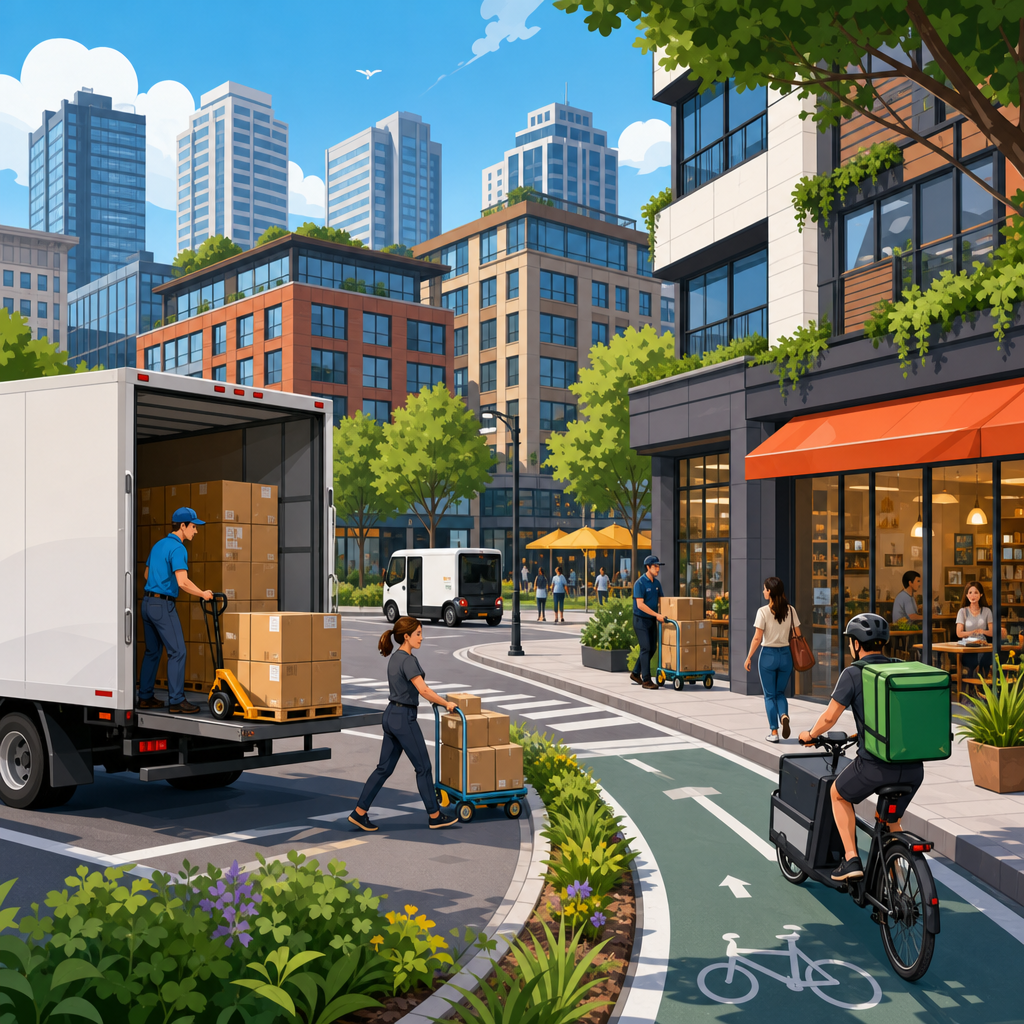
There is no single best last-mile model for every mixed-use district. Direct-to-door van delivery remains common because it is flexible and relatively simple, but it performs poorly where curb access is scarce and stop density is high. Consolidation centers on the edge of a district can reduce repeated carrier trips by combining loads and transferring them to smaller vehicles. Microhubs, often located in garages, vacant retail bays, or modular containers, support cargo bikes and on-foot couriers for parcel-heavy areas. Locker networks reduce failed residential deliveries, especially in buildings with limited staffing. Retailers also use dark-store and ship-from-store models, which can speed service but increase local loading pressure if not managed carefully.
Choosing among these options depends on density, land values, shipment mix, labor costs, and service expectations. Cargo bikes work best for small parcels, meal delivery, pharmacy items, and urgent documents in areas with short trip distances and protected cycling infrastructure. They are less suitable for bulky furniture, large grocery orders, or routes requiring steep grades without e-assist capacity. Urban consolidation centers can cut redundant trips, but they require governance, carrier participation, and enough throughput to justify rent and handling. In practice, the most resilient districts use a portfolio approach: off-street docks for large deliveries, managed curb zones for service vehicles, lockers for residents, and microhubs for high-frequency parcel activity.
Operations, scheduling, and tenant coordination
Even excellent physical design fails without operating rules. Mixed-use districts need delivery management plans that specify service windows, approved vehicle sizes, route guidance, waste collection timing, and contact protocols for exceptions. Property managers should coordinate major tenants rather than allowing each one to negotiate deliveries independently. I have seen office, hotel, and retail teams in the same podium unknowingly schedule simultaneous peak receiving, overwhelming a shared dock by 8:30 a.m. A dock booking system, even a basic cloud calendar at first, can smooth arrivals and cut queueing immediately. Larger projects often use transportation management software that records dwell time, missed appointments, and carrier performance.
Tenant manuals should include practical logistics standards: acceptable pallet dimensions, packaging rules for recycling streams, after-hours noise limits, and procedures for oversized items and move-ins. These details matter. If parcels overflow into residential lobbies, staffing costs rise and security weakens. If restaurant grease pickup overlaps with school arrival, public health and traffic risks increase. If reverse logistics for returns and damaged goods are ignored, back rooms fill with unsorted material that should have been planned as part of normal goods flow. District governance works best when logistics KPIs are reviewed like any other operational metric, including dock utilization, curb turnover, double-parking incidents, and resident complaints.
Data, technology, and enforcement
Urban freight planning improves quickly when cities and district managers replace anecdote with measurement. Useful data sources include curb occupancy sensors, computer vision counts, GPS traces from fleets, dock booking records, building access logs, and merchant surveys. The point is not surveillance for its own sake. The point is to understand demand patterns well enough to allocate space and staff effectively. For example, sensor data may show that a loading zone signed for two-hour use is actually serving six-minute parcel stops, suggesting it should be split into shorter spaces with different rules. Conversely, a hotel service entrance may need a larger reservation window for linen trucks using liftgates.
Technology only works when paired with enforcement and clear policy. Dynamic signs that no one obeys are decorative. Districts need visible rules, violation consequences, and feedback loops to refine regulations over time. Some cities now use camera-assisted freight lane enforcement and digital permits linked to specific curb zones. Others publish loading availability in navigation apps so carriers can route more realistically. Building owners can help by sharing anonymized booking data with municipalities, creating a better picture of district demand. The strongest programs use data to support decisions, then communicate the logic publicly so carriers, residents, and merchants understand why a curb change was made and how success will be measured.
Sustainability, equity, and resilience
Freight policy in mixed-use districts should advance environmental and social goals without pretending tradeoffs do not exist. Electrifying vans and trucks reduces tailpipe emissions, but charging access, vehicle cost, and payload limits still affect fleet adoption. Cargo bikes can cut noise and congestion, yet riders need safe infrastructure, secure storage, and fair labor conditions. Off-peak delivery programs reduce daytime congestion, but nearby residents may object if unloading is loud. The best plans use quiet-delivery standards, such as low-noise roll cages, rubber dock plates, driver training, and sealed containers, rather than banning night operations outright. Sustainability comes from system design, not symbolism.
Equity also matters. Small businesses often cannot command favorable delivery slots from major carriers, and older buildings without docks are common in neighborhood commercial corridors. Cities can support these areas through shared loading zones, merchant outreach, standardized signage, and grants for lockers, hand-truck ramps, or microconsolidation pilots. Resilience planning should consider disruptions such as severe weather, road closures, utility works, and emergency response. Districts with multiple delivery modes, backup staging space, and clear communication channels recover faster. In every case, the lesson is the same: a mixed-use district that plans goods movement explicitly will be safer, cleaner, and economically stronger than one that leaves freight to chance.
Freight, loading, and last-mile logistics are foundational to mixed-use district performance because every land use depends on reliable goods movement. The essential tasks are clear: map curb demand, match building design to tenant operations, manage service windows, use data to refine rules, and build a layered delivery system that includes docks, curb zones, lockers, and smaller low-emission vehicles where they fit. When these elements are coordinated, districts reduce congestion, protect sidewalks and bike lanes, lower emissions, and improve the daily experience for residents, workers, visitors, and businesses. When they are ignored, the same district pays in delays, complaints, safety incidents, and avoidable operating costs.
For sustainable urban development, the main benefit is not simply faster delivery. It is a district that can support growth without sacrificing street quality or climate goals. Goods movement becomes more predictable, public space works better, and commercial tenants operate with less friction. Use this hub as the starting point for freight strategy across planning, design, and operations. Audit your curb, review your loading assumptions, and align logistics decisions with the mixed-use reality on the ground.
Frequently Asked Questions
1. Why are freight, loading, and last-mile logistics so important in mixed-use districts?
Freight, loading, and last-mile logistics are essential because they determine whether a mixed-use district operates efficiently for everyone who uses it. In these environments, residential buildings, offices, restaurants, shops, hotels, entertainment venues, and public services all depend on frequent deliveries, waste collection, maintenance access, and service vehicles. Unlike single-use areas, mixed-use districts compress many different demand patterns into the same streets and curb zones. Morning parcel deliveries, midday food service, retail restocking, hotel operations, evening entertainment traffic, and residential move-ins may all compete for the same limited space within a single day.
When these logistics needs are not planned for, the result is predictable: double parking, blocked bike lanes, buses delayed by delivery vehicles, sidewalk obstruction, noise complaints, and safety conflicts between trucks, pedestrians, and cyclists. On the other hand, when freight and loading are integrated into district design and management, the neighborhood becomes more reliable, safer, and easier to navigate. Businesses receive goods on time, residents experience less disruption, and public space functions as intended. In practical terms, logistics is not a back-of-house issue in mixed-use districts; it is a core urban systems issue that directly affects mobility, economic performance, public realm quality, and day-to-day livability.
2. What are the most common curbside and loading problems in mixed-use neighborhoods?
The most common problems stem from one basic reality: demand for curb access usually exceeds supply. Mixed-use districts often have narrow streets, older buildings with limited loading infrastructure, and a curb line expected to serve passenger pick-up and drop-off, parking, outdoor dining, transit stops, bike facilities, ride-hailing, construction activity, and commercial deliveries at the same time. Without clear prioritization, freight vehicles frequently end up stopping wherever space is available, even if that means occupying travel lanes, crosswalk approaches, or no-parking areas.
Another major issue is mismatch between building operations and street design. A restaurant may require multiple refrigerated deliveries per week, a residential tower may generate high parcel volumes, and a hotel may need regular linen, food, and waste service, yet the building may have little or no off-street dock capacity. In those cases, the curb becomes the default loading zone, whether or not it was designed for that purpose. Delivery timing also matters. If all operators aim for the same peak periods, conflicts intensify. E-commerce has added another layer by increasing the frequency of smaller deliveries, often by vans that require short but recurring curb access throughout the day.
Enforcement and management gaps make these problems worse. Poorly signed loading spaces, outdated time windows, inconsistent rules, and lack of data about actual curb use can create a system that frustrates both carriers and the public. The result is not just inconvenience; it affects emergency access, transit reliability, pedestrian comfort, and the economic efficiency of local businesses. Effective mixed-use logistics planning starts by recognizing that curbside conflict is usually a policy and design problem, not simply a driver behavior problem.
3. How can cities and developers design mixed-use districts to handle deliveries more effectively?
Successful design begins by treating freight and loading as basic infrastructure rather than an afterthought. At the building scale, that means evaluating expected delivery, service, move-in, waste, and maintenance volumes early in the planning process. Developers should consider off-street loading docks, shared service bays, internal staging rooms, package management areas, and alley access where feasible. Building operations should align with tenant mix. A district with food and beverage uses, hospitality, and high-density residential will need a different loading strategy than one dominated by offices and small-format retail.
At the street level, curb management is critical. Cities can designate commercial loading zones in the right locations, size them for real vehicle types, and set time limits or delivery windows based on observed demand. Dynamic curb allocation can be especially useful in mixed-use settings, allowing space to serve freight functions at some times of day and passenger or parking functions at others. Clear signage, digital curb management tools, and predictable enforcement help carriers comply because they reduce uncertainty. Where street widths are constrained, planners may need to prioritize essential functions explicitly rather than trying to accommodate every use equally at every hour.
District-scale strategies can deliver even greater benefits. Shared loading facilities, microhubs, consolidated delivery points, and coordinated service management can reduce redundant vehicle trips and improve curb efficiency. In some locations, cargo bikes or smaller electric vehicles can handle the final leg of delivery from a nearby hub, reducing the need for larger trucks on local streets. The most effective systems combine physical design, operating rules, tenant coordination, and ongoing monitoring. In short, logistics works best when the district is planned as an integrated ecosystem rather than a collection of isolated buildings competing for curb space.
4. What role does last-mile delivery play in mixed-use district performance?
Last-mile delivery is the final movement of goods from a distribution point to the end user, and in mixed-use districts it has an outsized impact because it happens directly in the public realm. Residents expect parcel delivery, restaurants depend on food and beverage shipments, retailers need regular replenishment, and offices require everything from supplies to equipment. These deliveries may be small individually, but their cumulative footprint is significant. A district can have hundreds or thousands of last-mile stops per day, creating constant pressure on curbs, building entries, elevators, and shared access areas.
Its influence goes beyond convenience. Last-mile logistics affects traffic flow, emissions, noise, labor efficiency, and customer experience. If drivers cannot find legal, proximate loading space, they spend more time circling or stopping in unsafe locations, which increases congestion and operating costs. Repeated failed deliveries, especially in residential or office settings without staffed receiving areas, add more trips to the network. Conversely, well-managed last-mile systems can streamline operations through consolidated delivery schedules, secure package rooms, locker systems, building concierges, and designated transfer points that reduce repeated door-to-door friction.
Mixed-use districts also create opportunities for innovation in the last mile. Because destinations are clustered, they can support shared logistics infrastructure more effectively than dispersed suburban environments. Urban consolidation centers, neighborhood micro-distribution facilities, and low-emission delivery modes can be more viable where stop density is high. However, these approaches only succeed if land use planning, curb policy, and property management are aligned. The main point is that last-mile delivery is no longer a minor support function; it is a central determinant of how mixed-use districts perform economically, operationally, and environmentally.
5. What are the best practices for reducing freight conflict while keeping businesses and residents well served?
Best practices start with balancing efficiency, safety, and livability rather than optimizing only one objective. A strong first step is demand analysis: understanding who is receiving goods, what vehicle types are arriving, when deliveries occur, how long loading takes, and where conflicts are most common. With that information, cities and property owners can tailor solutions instead of relying on generic loading rules. Freight needs should be matched to actual district conditions, including land use mix, street geometry, pedestrian volumes, and transit activity.
From there, a layered strategy usually works best. Dedicated and well-enforced loading zones reduce illegal stopping. Delivery time management can spread demand away from peak curb periods. Shared loading docks and centralized receiving systems can limit duplicate trips to individual storefronts or buildings. Tenant coordination matters as well; if major users can align procurement and delivery practices, districts often see measurable reductions in curb pressure. For dense urban settings, low-emission vehicles, cargo bikes, and neighborhood consolidation models can improve service while reducing noise and traffic impacts. Technology can support these efforts through curb reservation systems, loading analytics, and real-time communication between carriers and building operators.
Equally important is governance. Mixed-use districts function best when municipalities, developers, building managers, tenants, carriers, and residents all understand the operating framework. Clear rules, transparent enforcement, and periodic performance review help the system adapt as uses change. A district that was designed around office deliveries may need a different logistics model once residential occupancy, restaurant activity, or e-commerce volume grows. The most resilient approach is therefore not a one-time loading plan, but an ongoing logistics management program that treats freight access as a fundamental component of urban operations.