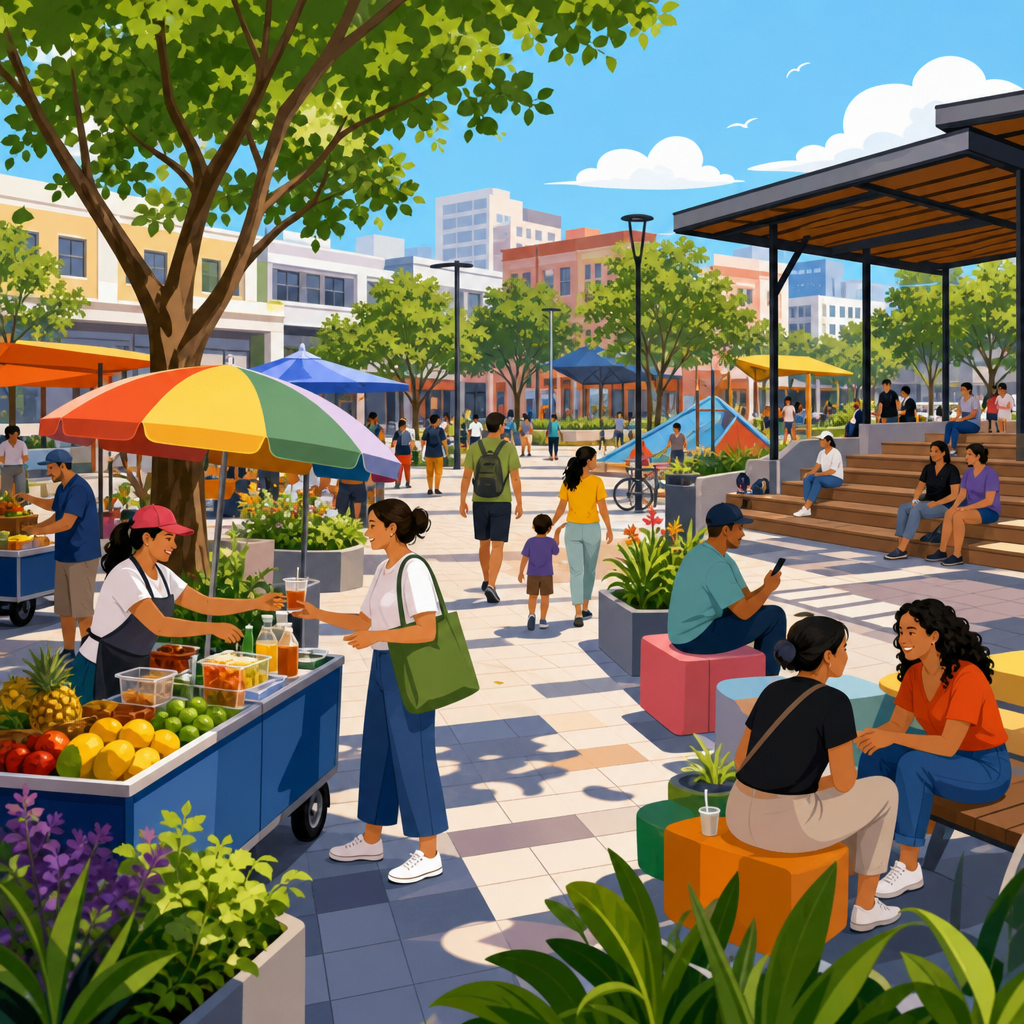
Designing public spaces that support informal vendors and everyday use is one of the clearest tests of whether a city is built for real life or only for formal plans. Public space includes streets, sidewalks, plazas, markets, transit edges, parks, and other shared environments where daily movement, trade, rest, and social contact happen. Informal vendors are people who sell food, household goods, clothing, services, or seasonal items outside conventional shop leases, often from carts, tables, mats, bicycles, kiosks, or temporary stalls. Everyday use refers to the repeated, ordinary activities that make a place valuable: walking to work, waiting for a bus, buying breakfast, meeting neighbors, taking children to school, or sitting in shade during midday heat.
This topic matters because informal trade is not marginal in most cities; it is central to how urban economies work. The International Labour Organization has repeatedly shown that informal employment represents a large share of total employment in many low and middle income countries, and street vending is one of its most visible forms. Even in wealthier cities, pop-up selling, mobile food trading, and curbside micro-retail fill gaps that formal retail leaves behind. When public spaces are designed only for traffic flow, image management, or occasional events, vendors are pushed into conflict with pedestrians, police, sanitation crews, and nearby businesses. When those spaces are designed with access, services, and rules that match actual behavior, cities gain safer sidewalks, stronger local economies, better passive surveillance, and more inclusive public life.
I have worked on streetscape and market-area projects where the biggest design mistake was treating vendors as an afterthought. Plans would show generous paving, new benches, and decorative planting, but ignore where the tea seller stores water, how a fruit cart receives deliveries at dawn, or where customers stand without blocking a crossing. Those omissions become operational failures within days of opening. Good design starts by recognizing that vendors are not temporary clutter. They are users, employers, service providers, and place-makers. A hub article on this subject therefore needs to connect spatial design, regulation, sanitation, mobility, climate comfort, and management, because none of those systems works in isolation.
At its core, designing for informal vendors means creating a flexible public realm that accommodates commerce without sacrificing safety, accessibility, or civic quality. That requires clear pedestrian through-zones, designated selling areas, access to water and waste collection, storage strategies, fair licensing, and governance that can adapt to peak hours and seasonal demand. It also requires understanding tradeoffs. Too much control can sterilize a place and exclude low-income sellers. Too little structure can create congestion, litter, unsafe cooking conditions, and avoidable conflict. The goal is not to freeze a street into a perfect diagram. The goal is to support a living system where vending and everyday urban use can coexist productively.
Start with how people actually use the street
The first principle is simple: design from observed behavior, not assumptions. Before setting dimensions or vendor locations, cities should map pedestrian desire lines, bus stop queues, school release patterns, delivery times, religious gathering peaks, and the times when vendors cluster naturally. Short observational studies often reveal more than expensive concept imagery. On one corridor I reviewed, the official concern was sidewalk crowding at lunchtime. Counts showed the real bottleneck happened at 7:30 a.m., when commuters, schoolchildren, and breakfast vendors converged beside an informal motorcycle drop-off point. Relocating stalls would not have solved it. Reorganizing curb use and widening the waiting area did.
Everyday public space succeeds when it supports overlapping rhythms. A plaza may host office workers at noon, produce sellers in the early morning, and families in the evening. A transit edge may need fast-moving pedestrian lanes during peak commute hours and flexible vending bays at off-peak periods. Designing for one “ideal” use typically fails because most successful urban places are mixed-use by time as well as by function. Tools such as pedestrian counts, heat mapping, curbside occupancy studies, and simple behavior mapping with time stamps help planners identify where vending supports convenience and where it undermines circulation. The answer is usually not blanket permission or blanket prohibition, but calibrated allocation.
Accessibility must anchor this analysis. Sidewalks should retain a continuous, obstacle-free through-route that meets local accessibility standards and supports wheelchair users, parents with strollers, older adults, and people with low vision. Vendors can coexist with accessibility when placement is planned around minimum clear widths, corner visibility, tactile paving, and crossing approaches. In practice, that means defining where selling can occur and where it cannot, especially near curb ramps, station exits, hospital entrances, and fire egress routes. A public space that works only for agile pedestrians is poorly designed, no matter how lively it looks in photographs.
Build a spatial framework that gives vendors room without causing conflict
Once use patterns are understood, the next task is spatial structure. Informal vending functions best in public space when cities create legible zones: a pedestrian through-zone, a frontage or activity zone, service points, loading access, and places to sit or queue. This is not abstract theory. It translates directly into pavement markings, stall footprints, corner setbacks, drainage lines, utility access points, and enforcement rules. On narrow sidewalks, vending may need to shift into recessed bays, edge pockets, parallel curbside strips, or adjacent mini-plazas. On wider avenues, modular pitches can create order while preserving movement.
Stall dimensions should reflect what is actually sold. A fruit table, a garment rail, and a cooked-food cart have very different footprints and operating needs. Cooked-food vendors need greater separation from building entrances, safe fuel storage or electric supply, handwashing access, and waste handling. Sellers of lightweight goods may only need a small marked pitch and lockable storage nearby. Flexible design beats one-size-fits-all layouts. I have seen projects fail because every vendor was assigned the same tiny rectangle, which forced some to spill outward while others paid for unusable space. Matching space type to vending type reduces conflict immediately.
The table below shows a practical framework cities can use when aligning street design with vendor operations and public access.
| Design issue | Recommended approach | Why it works |
|---|---|---|
| Pedestrian flow | Maintain a continuous clear through-zone with marked stall setbacks | Reduces pinch points and preserves accessible movement |
| Food vending | Cluster near water, drainage, seating, and waste collection points | Supports hygiene and simplifies servicing |
| Peak-hour congestion | Use time-based vending permissions by location | Allows trade when demand is high without blocking commute flows |
| Deliveries and restocking | Provide off-peak loading windows and nearby hand-cart access | Prevents random curb stopping and sidewalk obstruction |
| Weather exposure | Add shade trees, canopies, and rain-protected edges | Improves comfort for vendors and customers, increasing dwell time |
| Enforcement | Link pitch numbers to simple licensing and visible rules | Makes compliance easier and enforcement more consistent |
Edges matter as much as centers. Many successful vendor spaces are not grand squares but the leftover spaces beside stations, under flyovers, along market streets, and near schools or clinics. These places can become highly functional if designed carefully, with lighting, drainage, waste storage, and clear sightlines. Crime prevention through environmental design is relevant here: active edges, visibility, and predictable layouts improve safety more effectively than displacement alone. Vendors often provide passive surveillance by extending hours of occupation and increasing “eyes on the street,” a principle associated with Jane Jacobs and repeatedly validated in lively urban districts.
Provide the basic services that turn tolerated vending into successful urban management
The difference between a chaotic vending area and a well-run one is often not architecture but services. Water, sanitation, drainage, electricity, waste collection, grease management, storage, and cleaning schedules determine whether a place remains healthy and politically supportable. Food vending especially requires public health infrastructure. Handwashing points, potable water access, wastewater disposal, and designated refuse collection are not luxuries; they are prerequisites for safe operation. Cities that ignore these basics often blame vendors for conditions created by public underinvestment.
Sanitation design should be specific. Waste bins need to match the actual waste stream, including organic waste from fruit and vegetables, packaging waste, and cooking-related refuse. Collection times should align with trading hours, not standard office schedules. Drainage must handle wash water and rainfall together, especially in tropical climates where intense storms can flood low points quickly. In one market-edge redesign, simply correcting crossfall and adding trapped gullies reduced standing water dramatically, which cut odor complaints and improved customer footfall. Small engineering decisions have large social effects.
Energy access is another overlooked factor. Many vendors rely on unsafe extension cords, generators, charcoal, or liquefied petroleum gas because legal connections are absent. A managed system of metered outlets or shared utility points can improve safety, reduce noise, and lower emissions. Where cooking is involved, ventilation, fire safety distances, and fuel handling rules need to be realistic and enforceable. Banning all heat-based preparation in a district may appear simple, but it usually pushes cooking into riskier back spaces. It is better to define approved equipment and locations than to pretend cooking will disappear.
Storage can transform street order. Vendors who must carry all stock daily tend to spread goods across every available surface and guard them aggressively. Lockers, shared back-of-house rooms, overnight cart parking, or modular kiosks with secure shutters reduce clutter and setup time. These facilities do not need to be expensive. Even a basic managed storage compound near a transit station can improve sidewalk conditions significantly. When cities ask why vendors cannot just “pack up,” they often ignore the physical burden and theft risk built into that instruction.
Create governance rules that are fair, legible, and adaptable
Design alone cannot solve public-space conflict. Governance determines whether spatial plans remain credible. The most effective systems combine simple licensing, transparent allocation, vendor representation, and proportionate enforcement. A pitch map with numbered locations, permitted operating times, and clear responsibilities for cleaning and maintenance gives everyone a reference point. Without that clarity, enforcement becomes selective, corruption risks increase, and compliant vendors are punished alongside noncompliant ones.
Licensing should be light enough for low-income sellers to enter legally yet structured enough to support accountability. Digital systems can help, but paper-based options remain essential where smartphone access or digital literacy is uneven. Fees should reflect service levels and location value, and they should be reinvested visibly into cleaning, lighting, toilets, and maintenance. When vendors see no service return from fees, compliance declines. Representative committees or market associations can help negotiate issues such as seasonal overflow, festival demand, and redesign phases, but they work only if they include women, migrant sellers, and smaller operators rather than just established stall leaders.
Time-based management is especially useful. Many conflicts are temporal rather than permanent. A school frontage may need strict clearance during drop-off and pickup but can host snack vendors later. A commuter corridor may allow mobile carts after peak hours. Night markets can animate districts that are underused after dark, provided noise, waste, and transport connections are addressed. Cities such as Bangkok, Bogotá, and parts of Mexico City have all experimented, with varying success, in balancing vending rights and movement needs through timed access rather than total exclusion. The lesson is consistent: flexible rules outperform rigid bans when public-space demand changes by hour.
Enforcement must distinguish between harmful behavior and mere informality. Blocking emergency access, dumping waste, or using unsafe fuel deserves intervention. Selling from a defined pitch without causing obstruction should not trigger repeated confiscation raids. Heavy-handed crackdowns often destroy livelihoods without fixing the underlying design failure. Better practice pairs warnings, education, and incremental compliance support with targeted penalties for repeated high-risk violations. Public legitimacy depends on that proportionality.
Design for climate comfort, inclusion, and long-term resilience
Public spaces that support everyday use must also support human comfort. Shade, seating, drinking water, shelter from rain, and heat-conscious materials are essential for both vendors and customers. In hot climates, surface temperatures on dark paving can become dangerous, while unshaded plazas empty out during peak sun. Street trees, tensile canopies, arcades, and orientation strategies can lower thermal stress and increase dwell time. The same features that help a vendor sell through the afternoon also help an older pedestrian rest safely and make a square usable beyond ceremonial moments.
Inclusion requires attention to who vendors are. Women often dominate certain sectors, especially prepared food and small household goods, yet may face greater exposure to harassment, insecure sanitation, and caregiving constraints. Design responses include visible lighting, nearby toilets, stroller-friendly circulation, and spaces where children can wait safely. Migrant and disabled vendors may need multilingual signage, simplified permit processes, and equipment standards adapted to different mobility needs. If a city claims inclusion but only designs for the strongest and best-connected traders, it has missed the point.
Resilience also matters. Informal vending frequently expands during economic downturns, migration shocks, and periods of formal job loss. Public spaces that can absorb this pressure without collapsing into conflict are more resilient urban systems. Modular layouts, temporary permits, demountable stalls, and event-based overflow plans allow cities to scale capacity up or down. This is especially important near transport nodes and wholesale markets, where sudden surges in demand are common. The strongest designs are not the most fixed. They are the ones with enough structure to guide use and enough flexibility to adapt when the city changes.
Designing public spaces that support informal vendors and everyday use is ultimately a practical discipline grounded in observation, public health, accessibility, and fair governance. The most successful places do not eliminate friction entirely; they manage it with clear spatial rules, basic services, and responsive regulation. When cities understand how vending actually works, they can create streets and plazas that are cleaner, safer, more inclusive, and economically stronger. Vendors gain stability, pedestrians gain comfort and access, and neighborhoods gain the daily vitality that formal planning alone rarely produces.
For sustainable urban development, this is not a side issue. It is a core test of whether public space serves the full urban population. If you are shaping a street, station area, market edge, or neighborhood square, start by mapping daily patterns, protecting accessible movement, and providing the services vendors need to operate responsibly. Then build rules that people can understand and follow. That is how public space begins to work for everyday life.
Frequently Asked Questions
Why should public spaces be designed to accommodate informal vendors instead of treating them as temporary or unwanted activity?
Informal vending is not a side issue in urban life. In many cities, it is one of the main ways people access affordable food, everyday goods, quick services, and low-barrier economic opportunity. Designing public space to accommodate vendors recognizes how streets, sidewalks, plazas, transit edges, and market areas already function in real life. Vendors often serve commuters, workers, students, caregivers, and residents who rely on convenience, low prices, and flexible hours. They also help activate public space by increasing foot traffic, creating a sense of presence, and extending the hours during which an area feels watched, useful, and socially active.
When cities ignore or push out vending, the result is often not a cleaner or better-functioning public realm. More often, it produces conflict, inconsistent enforcement, and spaces that are technically orderly but less useful to the people who depend on them. A design approach that includes informal commerce can improve circulation, reduce friction, and create clearer expectations for everyone. Instead of treating vendors as an obstacle, it treats them as one of several legitimate users of shared space, alongside pedestrians, transit riders, nearby businesses, children, older adults, and people stopping to rest or meet others.
Well-designed accommodation also supports broader policy goals. It can strengthen local livelihoods, improve access to necessities, increase perceptions of safety through regular activity, and make public space more inclusive across income levels. The key is not simply allowing vending everywhere without structure. It is creating spatial rules, service access, and management systems that make vending compatible with everyday use. That means designating appropriate locations, preserving clear walking routes, supporting sanitation and waste handling, and planning for peak and off-peak conditions. In practical terms, cities that design for informal vendors are usually cities that design more honestly for how public space is actually used.
What design features help public spaces work well for both vendors and pedestrians?
The most important principle is to protect pedestrian movement first while still making room for exchange, waiting, and short stays. This usually starts with adequate sidewalk width or expanded pedestrian zones so that walking paths remain continuous and unobstructed even when vendors are present. A clear through-zone should be easy to understand, accessible for wheelchair users and people pushing strollers, and free from sudden bottlenecks near corners, crosswalks, bus stops, and building entrances. Vendor space should be positioned so that browsing and queuing happen outside that primary movement path.
Beyond width, the layout matters. Vendors tend to do best in places with natural foot traffic, but those are also the places where unmanaged placement can create conflict. Public spaces can address this with marked vending bays, flexible pitch zones, curbside market strips, widened corners, edge conditions near plazas, and designated areas adjacent to transit without blocking boarding or alighting. Good design also considers queue spillover, delivery access, shade, drainage, seating, lighting, and visibility. If people stop to buy food or goods, they need somewhere to stand without forcing others into the street.
Basic infrastructure makes a major difference. Durable pavement, weather protection, waste bins, nearby water access where appropriate, electricity for approved uses, storage options, and routine cleaning support both public health and day-to-day usability. Seating and rest areas can complement vending when placed thoughtfully, encouraging people to spend time in the space without creating clutter. Signage should clarify where vending is allowed, where pedestrian access must remain open, and what rules apply during special events or peak commuting hours.
Design should also be adaptable. Public space changes over the day and across seasons. A location that works well for morning coffee carts may need different arrangements at lunchtime, during school dismissal, or during weekend markets. Flexible design elements such as removable bollards, modular stalls, timed access rules, and temporary market infrastructure can help spaces respond to changing demand. The best results usually come from testing layouts in real conditions and adjusting them based on observation, not just relying on fixed plans drawn in the abstract.
How can cities support informal vendors without creating disorder, congestion, or unfair conditions for other public space users?
Support and order are not opposites. In fact, disorder often grows from the absence of clear, realistic systems. Cities can reduce congestion and conflict by establishing transparent rules about where vending can occur, what types of setups are permitted, how much space may be occupied, and what safety and sanitation standards apply. These rules work best when they match actual urban conditions. If regulations are too restrictive, too expensive, or disconnected from demand, they are likely to be ignored or enforced unevenly. A workable framework balances flexibility with predictability.
Fairness begins with clear spatial management. Cities should map high-demand areas, identify pinch points, and distinguish between places suitable for daily vending, places appropriate only at certain times, and places where vending would create unacceptable obstruction. This should include attention to schools, hospitals, transit stations, emergency access routes, and accessibility needs. Rather than relying solely on prohibition, cities can use time-based permissions, rotating pitches, seasonal allocations, and graduated licensing or registration systems that recognize different scales of operation, from mobile carts to semi-fixed stalls.
Equally important is consistent governance. Vendors, pedestrians, nearby residents, formal businesses, and maintenance teams all need to understand the rules and trust that they will be applied fairly. That means simple permitting processes, reasonable fees, multilingual communication where needed, and enforcement focused on safety and access rather than arbitrary removal. Design and management should work together: marked pitches, posted standards, waste collection schedules, and designated storage or servicing areas make compliance easier and more visible.
Cities should also avoid framing every tension as a conflict between formal and informal commerce. Many public spaces can support both when circulation, loading, cleanliness, and frontage access are planned carefully. In some cases, vendors complement nearby shops by increasing footfall and extending the variety of goods available. The goal is not to erase all friction, because active urban spaces always involve negotiation. The goal is to create a public realm where everyday trade can happen without undermining safety, accessibility, or the shared character of the space.
What role do safety, sanitation, and accessibility play in designing spaces for informal vending?
Safety, sanitation, and accessibility are foundational, not secondary. If a city wants public space to support vending as part of everyday life, it must provide the conditions that make those spaces safe and usable for everyone. Safety begins with visibility, lighting, and layout. Vendors often contribute to natural surveillance because they create regular presence and activity, but that benefit depends on clear sightlines, well-lit paths, and enough space to prevent crowding around crossings, transit stops, or emergency routes. Street design should reduce vehicle conflicts through curb management, traffic calming, protected pedestrian areas, and careful placement of vending away from dangerous turning movements.
Sanitation is equally important because poorly serviced spaces can quickly become contested and politically vulnerable. Public space that supports food sales or high pedestrian use needs regular waste collection, sufficient bins, cleaning schedules, drainage, and access to water where appropriate. Cities should plan for grease, packaging, food waste, and wastewater instead of assuming vendors will somehow manage without infrastructure. Durable surfaces that are easy to clean and maintain can prevent longer-term deterioration. When sanitation systems are built into the design, public health outcomes improve and complaints tend to decrease.
Accessibility must be protected at every stage. That includes continuous step-free movement, sufficient clear width, tactile guidance where needed, curb ramps, unobstructed crossings, and layouts that do not force wheelchair users, older adults, or visually impaired pedestrians into traffic or confusing detours. Queues, signs, tables, stools, and stored materials should never compromise the accessible path of travel. This is one reason marked vending zones and enforcement of clear passage matter so much. Accessibility is not just a legal requirement; it is a direct measure of whether a public space truly serves everyday users.
Good design brings these priorities together rather than treating them as constraints that limit vending. A safer, cleaner, more accessible environment benefits vendors too. It attracts customers, reduces conflict with authorities and neighbors, and makes day-to-day operations more predictable. The most successful public spaces are usually the ones where essential services are planned openly and where the rights of movement, trade, rest, and gathering are balanced through design rather than left to constant improvisation.
How can planners and designers create public spaces that remain flexible for everyday use while still supporting informal economies over time?
Long-term success depends on designing for change. Public spaces are rarely used in only one way, and informal economies are especially responsive to daily rhythms, seasonal demand, cultural events, and shifting neighborhood conditions. A space that supports commuters in the morning may become a lunch destination at midday, a social area in the evening, and a market on weekends. Planners and designers should therefore think in terms of layered use rather than fixed single-purpose arrangements. Flexibility can be built through modular stalls, movable furniture, temporary service connections, retractable shade, adaptable curb space, and layouts that allow portions of a space to expand or contract according to demand.
Management models are just as important as physical design. Public space works better over time when there is a system for allocation, maintenance, conflict resolution, and periodic adjustment. That may involve local market managers, vendor associations, community-based stewardship, or partnerships between municipal departments. Ongoing observation is essential