Designing affordable housing without the institutional feel is one of the clearest tests of whether cities can deliver dignity at scale. Affordable housing refers to homes priced so households do not spend more than roughly 30 percent of income on shelter and basic utilities, while institutional feel describes environments that seem impersonal, rigid, and managed primarily for efficiency rather than comfort. In practice, that feeling comes from repetitive corridors, blank facades, harsh lighting, poor acoustics, and materials chosen only for lowest first cost. I have worked on multifamily and supportive housing projects where residents noticed these details immediately. They could forgive compact unit sizes more easily than they could forgive feeling anonymous in their own building.
This issue matters because design quality affects far more than appearance. It shapes resident mental health, social trust, maintenance costs, leasing stability, and neighborhood acceptance. Research from environmental psychology and public health consistently shows that access to daylight, control over privacy, views of nature, reduced noise, and well-scaled common areas improve well-being. In affordable housing, those benefits are not luxuries. They directly support outcomes that owners, cities, and residents all care about, including lower turnover, fewer complaints, reduced vandalism, and stronger community stewardship. A building that feels institutional often signals scarcity and stigma. A building that feels residential communicates permanence, respect, and belonging.
The good news is that avoiding an institutional character does not require expensive finishes or boutique architecture. It requires disciplined decisions about massing, entry sequence, circulation, materials, furniture, and operations from the earliest concept phase. Standards such as the International Building Code, Fair Housing Act accessibility requirements, energy codes, Passive House principles, and Crime Prevention Through Environmental Design all can coexist with warmth and personality when used intelligently. The most successful projects treat budget as a design parameter, not an excuse. They simplify structure, stack plumbing efficiently, and invest in the places residents touch every day: the front door, mail area, stair, courtyard, laundry, and unit interiors.
As a hub article within sustainable urban development, this guide brings together the core decisions that shape humane, affordable homes. It explains how architects, developers, housing authorities, nonprofit sponsors, and community groups can create buildings that are durable, efficient, and unmistakably residential. The central idea is simple: residents should feel they live in a home, not a facility.
Start with dignity, not damage control
The strongest affordable housing projects begin by defining resident experience before drawing a floor plan. That means asking what a person sees when approaching the site, how they enter, where they wait, whether they can greet neighbors without being forced into social contact, and how quickly they reach daylight once inside. Too many projects reverse that sequence. They begin with parking counts, unit yield, and standardized double-loaded corridors, then try to soften the result with paint and art. By then, the institutional feel is embedded in the plan.
A dignity-first approach uses ordinary residential cues. Entrances are visible, protected from rain, and scaled for people rather than vehicles. Address numbers, planters, benches, and lighting create a recognizable threshold. Internal circulation has natural light wherever possible. Community rooms can be found easily but do not dominate the lobby like a waiting room. Staff space is necessary in many affordable and supportive housing models, yet it should not define the whole building. Residents should not feel they are passing through a checkpoint every time they come home.
One useful test in design review is to ask whether a feature would feel acceptable in market-rate housing. If the answer is no, it deserves another look. Fixed plastic seating in common rooms, glaring troffer lighting, cinder block painted one color, exposed service doors beside the entry, and endless beige corridors all send the message that the building was designed around management convenience. Durable alternatives exist at modest cost: wood-look resilient flooring in lounges, acoustic wall panels, warm LED lighting at 2700K to 3000K, recessed niches at unit entries, and framed views to courtyards or streets.
Site planning and building form that feel residential
The site plan often determines whether affordable housing blends into neighborhood life or reads as an isolated institution. Buildings that present one oversized mass with a single dominating facade tend to appear monolithic. Breaking the form into smaller volumes, stepping upper floors, varying setbacks, and using distinct entry bays can make a large project feel like a collection of homes. This does not require fake historic styling. It is about scale, shadow, and rhythm. Even a simple three- or four-story wood-frame building over a concrete podium can feel humane when the facade has depth, operable windows, balconies or Juliet rails where feasible, and clear transitions between public and private zones.
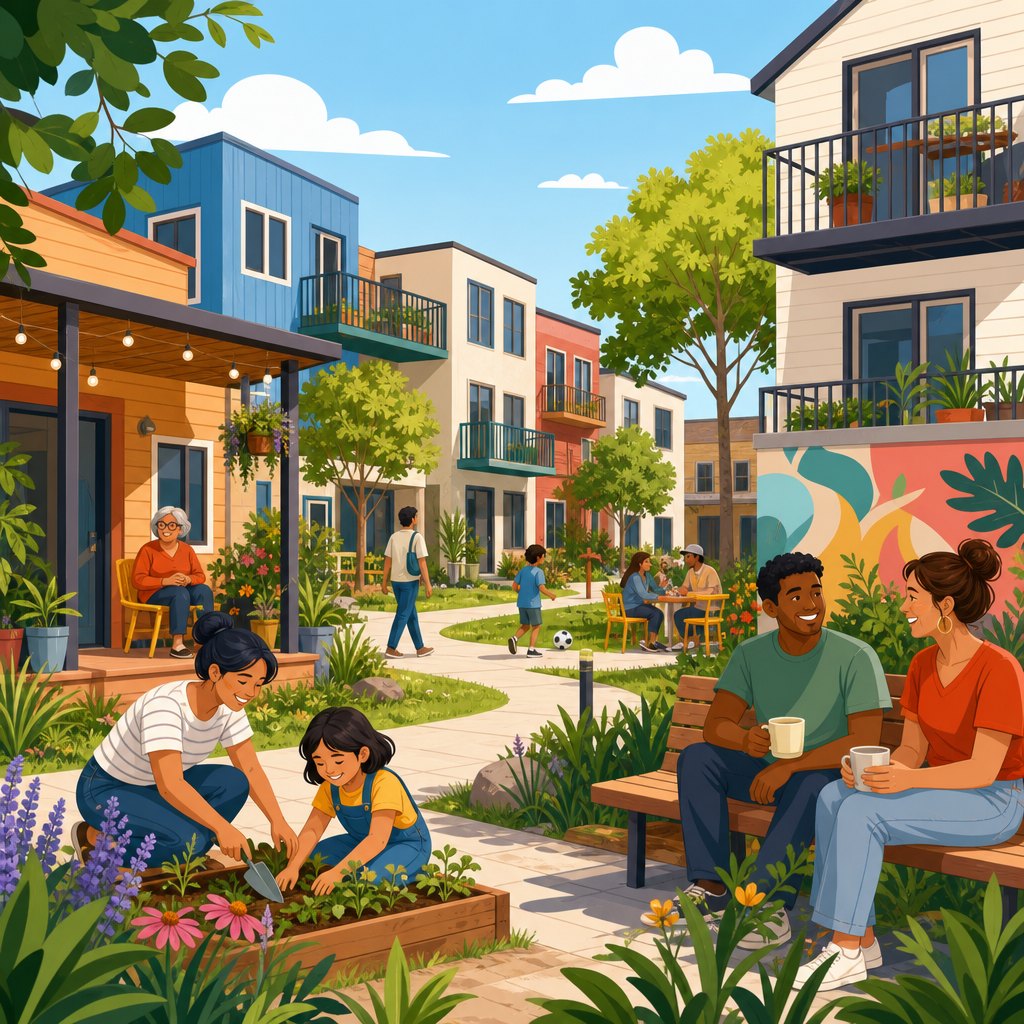
Ground floors matter most. Blank walls, oversized ventilation grilles, and utility rooms facing the street create dead edges associated with institutional and industrial buildings. Better projects put active uses along the sidewalk: stoops for ground-floor units, community rooms with transparent glazing, laundry rooms with windows, and management offices placed discreetly rather than as a defensive front desk. Outdoor spaces should be visible and usable. A small courtyard with movable furniture and shade often works better than a large leftover lawn. Families use spaces that feel safe, legible, and close to home.
Neighborhood fit is also essential for political support. In my experience, opposition drops when a project looks like housing people already recognize. Materials common to the area, such as brick, fiber cement lap siding, or textured stucco in restrained colors, can help without imitation. Street trees, bike parking, and front doors that engage the public realm further reduce the sense of separation. The objective is not disguise. It is to design honestly for belonging.
Interiors that reduce stress and support daily life
Residents experience a building primarily from the inside, so interior design choices carry disproportionate weight. The first priority is sensory comfort. Noise transfer between units and from corridors is one of the quickest ways to make housing feel institutional. Solid core doors at amenity spaces, acoustic insulation at demising walls, resilient underlayment, and careful placement of mechanical equipment are worth the investment. When budgets are tight, I advise teams to protect acoustic measures before decorative upgrades. People remember sleepless nights more than they remember a premium countertop.
Lighting should mimic residential patterns rather than office standards. Corridors need enough illumination for safety, but they do not need to feel like a clinic. Layered lighting with wall sconces, decorative pendants in lounges, and warm color temperatures can transform perception. Daylight in stairs and hall ends is especially valuable because it helps orientation and encourages stair use. Interior finishes should be durable, cleanable, and tactile. Luxury vinyl tile, high-pressure laminate, and impact-resistant gypsum board all have their place, but texture and color variation prevent the flat sameness that residents read as institutional.
Unit planning also matters. Small apartments can still feel generous when kitchens have real prep space, windows are placed for both light and privacy, and storage is designed intentionally. Open shelving near the entry, medicine cabinets, wardrobe niches, and laundry hookups where possible support routine living. In family housing, sightlines from kitchen to living area help caregivers. In senior housing, resting spots along hallways and clear wayfinding reduce fatigue. In supportive housing, trauma-informed design principles such as predictable layouts, visual privacy, and options for retreat can reduce stress without adding major cost.
Cost-smart design moves with high impact
Affordable housing budgets are constrained by land prices, financing complexity, and operating realities, so every recommendation must survive value engineering. The best strategy is to spend where residents feel the difference most and standardize what they do not. Repetition in structure and wet walls lowers cost. Compact building forms improve energy performance. Prefabricated bathroom pods, panelized walls, or modular components can reduce schedule risk in some markets, though transportation and union conditions matter. Savings from these efficiencies should be redirected toward visible quality at entries, common rooms, landscaping, and acoustic performance.
| Design move | Why it avoids an institutional feel | Budget implication |
|---|---|---|
| Daylit corridor ends | Improves orientation and reduces the closed tunnel effect | Low to moderate, depending on facade design |
| Durable warm lighting | Creates residential ambiance instead of clinic brightness | Low lifecycle cost with LEDs |
| Material changes at entries | Gives each unit threshold identity and pride of place | Low if limited to key touchpoints |
| Visible stair design | Encourages movement and makes circulation feel active | Low when planned early |
| Small shared outdoor rooms | Supports community without requiring large amenity budgets | Moderate, often offset by reduced hardscape elsewhere |
Maintenance teams should be included early because operational durability is inseparable from resident experience. For example, specifying replaceable carpet tiles in lounge areas may outperform broadloom because damaged sections can be swapped without closing the space. Matte finishes hide wear better than glossy ones. Door hardware should be commercial grade, but levers and pulls can still look residential. Likewise, landscape design should favor hardy species, drip irrigation, and shaded seating instead of decorative planting that fails after one hot season. Long-term beauty comes from realistic maintenance planning, not from fragile features.
Energy efficiency also supports comfort. Better envelopes, continuous insulation, balanced ventilation, and high-performance windows reduce drafts and overheating, which residents interpret as quality. Passive House and other low-energy approaches have proven effective in affordable housing because lower utility bills protect household budgets and stabilize operations. The key is commissioning. A sophisticated system that is difficult to maintain can undermine trust. Simple controls, resident education, and clear owner manuals matter as much as the specification itself.
Operations, management, and community identity
Even well-designed buildings can become institutional through policy and management. Signage is a common example. A lobby covered in warnings, office hours, and punitive notices instantly changes the atmosphere. Consolidated, well-designed signage with plain language and multilingual information is more respectful and more effective. Mail and package areas should be convenient, not hidden behind staff counters. Security measures should be integrated subtly through access control, sightlines, and good lighting rather than heavy barriers. CPTED principles work best when residents feel both safe and trusted.
Programming and resident participation reinforce a sense of home. Bulletin boards for community events, display space for resident artwork, gardening plots, and flexible rooms for after-school programs or tenant meetings all build identity. In several projects I have seen, a modest investment in movable furniture and shared kitchen equipment had more social value than expensive fixed amenities. Spaces stayed active because residents could shape them. Management practices should support that flexibility with clear reservation rules, quick maintenance response, and staff trained in de-escalation and trauma-informed interaction where appropriate.
Finally, post-occupancy evaluation is essential. Teams should return six months and one year after opening to ask residents what works, what feels stressful, and what spaces remain underused. Walk the building at night, during school pickup, and on hot afternoons. Measure acoustics, temperatures, and maintenance calls. The best affordable housing operators treat feedback as design data, not as public relations. That loop is how future projects improve and how trust grows between residents, developers, and cities.
Affordable housing without the institutional feel is not a stylistic trick. It is the result of many practical choices aligned around dignity, comfort, and long-term performance. When site planning creates a recognizable address, when facades are scaled to people, when interiors are quiet and daylit, and when management practices reinforce respect, residents feel at home. Those outcomes are compatible with strict budgets, code requirements, and sustainability targets. In fact, they often strengthen each other. Better envelopes improve comfort. Better acoustics reduce complaints. Better common spaces support social resilience.
For city leaders and project teams, the main lesson is to focus on the everyday experience of living in the building rather than on isolated finish upgrades. Start with the approach, the entry, the corridor, the stair, the courtyard, and the unit threshold. Protect a few high-impact details through value engineering. Coordinate design with operations from the start. Then verify performance after occupancy and use what you learn. Affordable housing succeeds when it provides more than shelter; it provides stability, pride, and belonging. Use these principles as the foundation for every future project in sustainable urban development.
Frequently Asked Questions
What makes affordable housing feel institutional in the first place?
Affordable housing tends to feel institutional when design decisions prioritize standardization, surveillance, and cost control to such a degree that everyday comfort disappears. Residents notice this in long identical hallways, flat and repetitive facades, low-quality finishes, harsh overhead lighting, limited places to sit or gather, and circulation spaces that feel like they were designed only to move people efficiently rather than support daily life. When entry sequences are confusing, common areas are undersized, and windows, materials, and colors feel overly utilitarian, a building can begin to resemble a dormitory, clinic, or administrative facility instead of a home.
That feeling is not created by one feature alone. It usually comes from the cumulative effect of many small decisions: blank walls instead of active frontages, identical unit doors lined up under fluorescent lights, poor acoustics, little privacy at thresholds, and outdoor areas that look left over rather than intentionally shaped. In many cases, maintenance concerns and budget constraints push teams toward durable but visually cold solutions. Durability matters, but when every choice is made only through the lens of efficiency, the result can feel impersonal.
The good news is that avoiding an institutional feel does not require luxury. It requires designing for dignity, orientation, privacy, and belonging. Simple moves such as breaking down building massing, using warmer and more tactile materials, introducing natural light into circulation spaces, creating clear and welcoming entries, and designing shared spaces people actually want to use can dramatically change how a property feels. The key is to remember that affordable housing is still housing first. Residents should experience it as a stable, comfortable place to live, not as a system they are being processed through.
How can architects design affordable housing that feels like home without driving up costs?
The most effective strategy is to focus on high-impact, cost-conscious design decisions rather than expensive gestures. A building can feel warm, legible, and residential through proportion, layout, light, color, and detail. For example, placing windows at corridor ends, giving entries a clear sense of arrival, varying facade rhythms, and using a restrained but thoughtful material palette can create a much more domestic atmosphere without major cost increases. Good design at the planning stage often does more to improve experience than costly upgrades added later.
Unit layouts matter just as much as public-facing design. Homes feel more personal when they have natural light in living spaces, adequate storage, clear separation between private and social areas, and room for everyday routines such as cooking, studying, or caring for children. Even modest units can feel generous when circulation is efficient and furniture placement has been considered. Small features like window sills, durable but warm-toned flooring, operable windows, and kitchen layouts that support real use can make residents feel respected. These are not luxury additions; they are signs that the design team considered how people actually live.
At the building scale, cost discipline can coexist with human-centered design by standardizing what should be standardized and customizing what most affects experience. Repetition in structure or unit modules can help control costs, while strategic variation at entrances, common spaces, facades, and landscape edges can keep the environment from feeling monotonous. Thoughtful lighting, durable finishes with texture, and community rooms that open to outdoor areas can all be done within tight budgets when they are treated as priorities from the start. In affordable housing, design value often comes from care, not extravagance.
What role do shared spaces and circulation areas play in reducing the institutional feel?
Shared spaces and circulation areas are often where institutional character becomes most obvious, because they are the parts of a building residents experience repeatedly every day. If these spaces are narrow, dark, acoustically harsh, and visually repetitive, the whole property can feel impersonal no matter how well designed the units are. By contrast, when hallways have daylight, views, niches, artwork, seating, or variation in scale, they stop feeling like back-of-house service zones and begin to feel like part of the residential experience. People form impressions of a building in the moments between their front door and the street.
Well-designed shared areas also support community without forcing it. A successful common room, laundry area, lobby, courtyard, or play space should feel visible, safe, and easy to access, but not overly programmed or controlled. Residents are more likely to use spaces that feel comfortable and flexible, with good lighting, durable furnishings, acoustic control, and visual connection to outdoor areas. Family-friendly design, stroller storage, mail areas that do not create bottlenecks, and places for informal conversation all help a building feel lived in rather than managed from a distance.
Circulation can also be designed to improve pride and orientation. Breaking down long corridors, creating smaller clusters of units, using stairwells that are daylit and inviting, and differentiating floors through color or graphics can reduce monotony. These moves make the building easier to navigate and psychologically more personal. In affordable housing, common areas should not be treated as leftovers after the units are resolved. They are essential spaces where identity, safety, and neighborly interaction are shaped, and they can go a long way toward eliminating an institutional atmosphere.
How important are exterior design, landscaping, and neighborhood connection in making affordable housing feel dignified?
They are extremely important because the sense of dignity begins before a resident even enters the building. Exterior design communicates whether the development was conceived as a real part of the neighborhood or as an isolated project built to meet a numerical target. Blank walls, oversized setbacks, exposed service areas, and facades with little depth or variation can signal neglect or defensiveness. In contrast, buildings with clear entries, well-proportioned windows, layered materials, and street-facing elements such as porches, stoops, community rooms, or planted edges feel more welcoming and connected to local urban life.
Landscaping is especially powerful because it softens the environment and gives residents visible signs of care. Trees, planting beds, shaded seating, play areas, and defined pathways can make even a modest site feel more humane. Good landscape design also helps with practical concerns such as stormwater, heat mitigation, privacy, and buffering from traffic. Importantly, it should not look ornamental in a token way. Residents should be able to use it, move through it, and benefit from it every day. A well-designed outdoor area can become an extension of home, particularly in dense developments where private indoor space is limited.
Neighborhood connection matters just as much. Affordable housing should engage sidewalks, transit, schools, parks, and nearby services in a way that supports daily routines and reduces stigma. When developments are integrated into the surrounding fabric rather than visually segregated from it, they are more likely to be accepted as part of the community and more likely to support residents’ long-term stability. Dignified housing is not only about what happens inside the walls. It is also about whether residents feel that their building belongs, and that they belong with it.
Can durable, easy-to-maintain materials still feel warm and residential?
Yes, absolutely. One of the biggest misconceptions in affordable housing is that durability and warmth are opposing goals. In reality, the best projects combine long-lasting materials with thoughtful color, texture, and detailing so that spaces hold up well without feeling cold. For example, resilient flooring can be selected in wood-look or muted natural tones, wall protection can be integrated discreetly rather than appearing purely institutional, and robust fixtures can still have clean, residential proportions. The issue is rarely durability itself; it is whether materials are chosen only for resistance to wear or also for how they shape daily experience.
Warmth often comes from composition more than from expensive products. A simple palette can feel inviting when it uses contrast intelligently, avoids excessive glare, and introduces tactile variation. Matte finishes, softer light temperatures, acoustically absorbent surfaces, and hardware that feels solid and comfortable in the hand all contribute to a more residential atmosphere. In common areas, combining durable painted surfaces with wood accents, well-placed signage, and furniture-scaled lighting can transform the emotional tone of a space. These choices do not need to be extravagant to be effective.
The long-term perspective is important here. Materials that age gracefully help preserve dignity over time, which is essential in affordable housing where replacement budgets may be limited. A warm environment should not depend on fragile finishes that quickly deteriorate. Instead, design teams should prioritize materials that can withstand heavy use, are easy to clean, and still retain a sense of character after years of occupancy. When durability is paired with thoughtful design, residents do not have to choose between practicality and comfort. They can have homes that are resilient, respectful, and genuinely pleasant to live in.