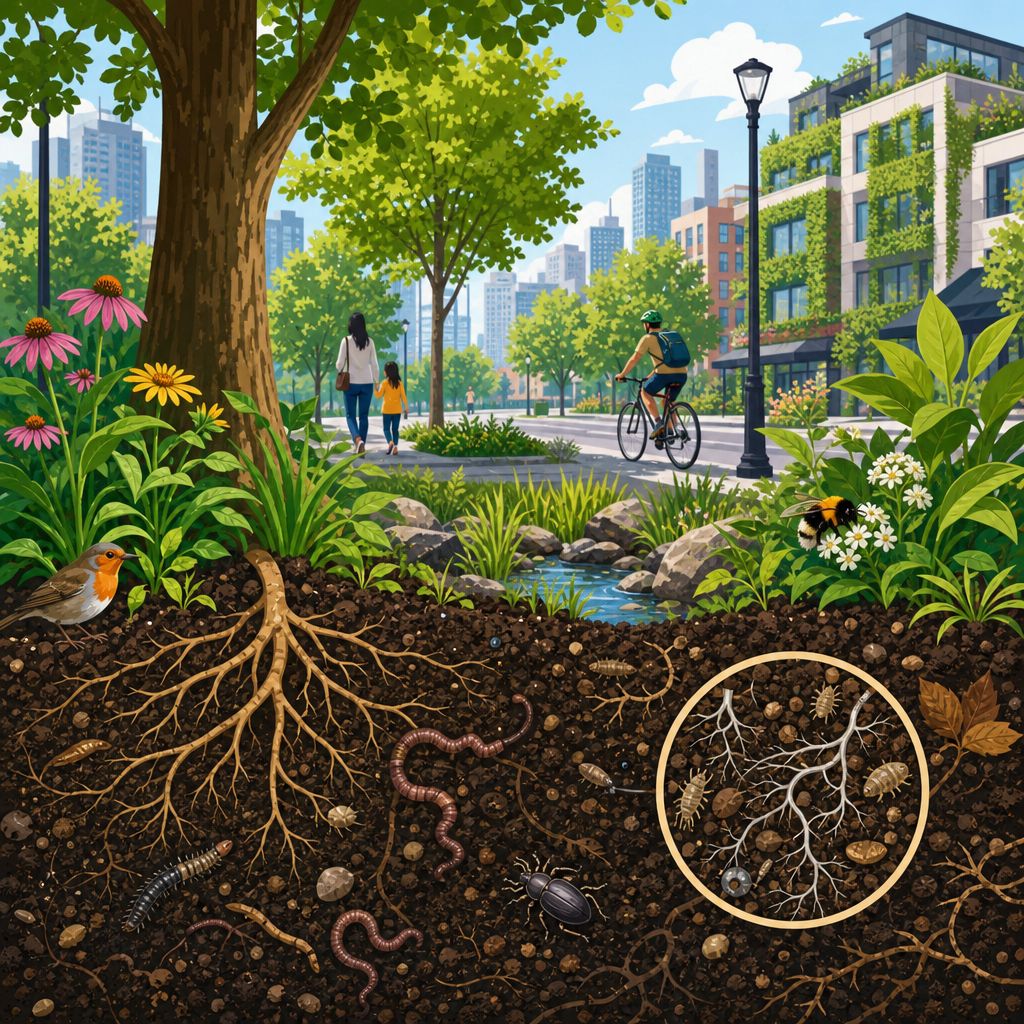
Healthy soils in urban landscapes are the missing piece of green infrastructure because they determine whether trees survive, rain gardens infiltrate stormwater, parks stay usable, and cities become measurably cooler, safer, and more resilient. In planning conversations, green infrastructure usually means visible assets such as street trees, bioswales, green roofs, wetlands, and permeable pavements. Soil is often treated as background material, yet it is the living system that supports water storage, nutrient cycling, root growth, carbon retention, and pollutant breakdown. Urban soil, in practical terms, includes native ground, disturbed fill, engineered planting media, and compacted subgrades left after construction. When any of those layers are shallow, sealed, contaminated, or oxygen-poor, landscape performance declines quickly. I have seen expensive plantings fail within two summers because the design team specified attractive species but ignored compaction, drainage, and soil volume. Conversely, ordinary plant palettes often perform remarkably well when soil structure, organic matter, and rooting space are protected from the start.
This topic matters because cities face overlapping stresses: heavier rainfall, hotter summers, aging drainage networks, denser development, and rising expectations for public realm quality. Healthy urban soils address several of these problems at once. They increase infiltration, reducing runoff peaks that overwhelm combined sewer systems. They hold plant-available water, helping vegetation endure drought and lowering irrigation demand. They support microbial activity that transforms nutrients and some contaminants. They also improve the durability of public landscapes by reducing bare ground, ponding, and repeated replacement costs. For a sustainable urban development strategy, soil is not a minor horticultural detail. It is a foundational infrastructure asset that should be assessed, protected, constructed, monitored, and funded with the same seriousness applied to pipes, pavement sections, and structural systems.
What Healthy Urban Soil Actually Means
Healthy soil is not simply dark, loose dirt. In urban landscapes, a healthy soil profile has enough pore space for air and water movement, enough stable aggregates to resist crusting, enough biological activity to cycle nutrients, and enough rooting depth and volume to support long-term plant growth. Texture matters, but structure usually matters more. A clay loam with stable aggregation can outperform a sandy fill that drains fast but stores little water and nutrients. Typical indicators include bulk density, infiltration rate, organic matter, pH, electrical conductivity, cation exchange capacity, respiration, and visible rooting depth. For trees, uncompacted rooting volume is often the decisive factor. Research and municipal standards increasingly point to soil volume targets tied to mature canopy size rather than minimum pit dimensions. That shift reflects a hard-learned lesson from streetscape work: a tree opening can look generous at the surface while roots below encounter dense rubble, utility conflicts, and anoxic conditions.
Healthy urban soil also means fit for purpose. A sports field soil needs different drainage behavior than a rain garden bioretention mix or a woodland restoration soil. Engineered media can be appropriate, but only when it matches the intended function. Bioretention soil, for example, balances infiltration with water-holding capacity and plant support; it is not interchangeable with general topsoil. The same is true for structural soil systems under pavements, suspended pavement cells, and rooftop growing media. In each case, performance depends on specified particle sizes, organic content, hydraulic conductivity, and installation quality. The mistake I encounter most often is treating soil as a commodity purchased by volume, not a designed material with measurable performance criteria.
Why Urban Soils Degrade So Easily
Urban soils degrade primarily through compaction, stripping, sealing, contamination, and chronic disturbance. Construction is the biggest driver. Repeated equipment passes collapse pore space, raising bulk density and reducing infiltration by orders of magnitude. Topsoil is often stockpiled poorly, mixed with subsoil, or removed entirely. Fine grading can create a neat finished surface that masks severe subsurface problems. Once pavements and buildings are installed, opportunities for remediation become expensive and disruptive. This is why preconstruction soil protection zones are as important as tree protection fencing. If soil is treated as a staging area, it ceases to function as infrastructure.
Contamination adds another layer of complexity. Many urban sites contain elevated lead, petroleum residues, polycyclic aromatic hydrocarbons, salts, or demolition debris. Risk depends on concentration, exposure pathway, and site use. A playground, community garden, and street median do not carry the same human exposure profile. Established guidance from the United States Environmental Protection Agency and local brownfield programs emphasizes testing before disturbance and selecting remedies proportionate to risk. Sometimes capping with clean soil and mulch is sufficient. In other cases, excavation, immobilization, or land-use restrictions are necessary. Healthy soil management is therefore not just about fertility. It is about public health, regulatory compliance, and realistic long-term maintenance.
How Soil Supports Stormwater, Cooling, and Biodiversity
Soil is the operating medium behind several green infrastructure benefits that cities try to purchase through capital projects. Stormwater management is the clearest example. A well-structured soil profile absorbs rainfall, slows runoff, and feeds water back to plants. In rain gardens and bioswales, soil controls both infiltration and pollutant treatment. Water moves through pores, sediments settle, organic matter adsorbs some metals and hydrocarbons, and microbial communities transform nitrogen compounds. If the media clogs, compacts, or lacks underdrain balance, the system fails functionally even when the planting still looks acceptable from the sidewalk.
Urban heat mitigation also depends heavily on soil. Trees cool streets through shade and evapotranspiration, but both mechanisms weaken when roots are confined or drought stressed. I have reviewed blocks where identical tree species showed dramatically different canopy density because one side had continuous soil trenches and the other had isolated pits surrounded by compacted fill. The side with better soil volume produced more shade, lower surface temperatures, and fewer replacements. Soil health also influences biodiversity. Pollinators, decomposers, fungi, and soil invertebrates all depend on suitable moisture, organic matter, and reduced chemical stress. Even small urban parks can support richer food webs when leaf litter is managed thoughtfully, mulch is used correctly, and soil disturbance is minimized.
Planning, Design, and Construction Practices That Work
Successful urban soil programs start before schematic design. The first step is site assessment: review historic land use, map utilities, test contamination, examine drainage patterns, and sample soil horizons rather than relying on a single composite topsoil test. The second step is preservation. If existing soil functions well, protect it from compaction and grade changes. If it does not, decide whether rehabilitation or replacement is more cost-effective. Deep tillage with compost incorporation can restore infiltration on some open sites, but it is ineffective where subsoil is heavily compacted, contaminated, or constrained by buried infrastructure. On streetscapes and plazas, suspended pavement systems often outperform conventional tree pits because they provide usable rooting volume beneath hardscape while supporting pedestrian loads.
Specifications are where good intentions become durable outcomes. Soil specs should define texture ranges, organic matter percentages, coarse fragment limits, pH, soluble salts, compaction limits, installation moisture conditions, and testing protocols. They should also state depths by landscape type and identify subgrade preparation requirements. Vague notes such as provide good quality topsoil invite substitution and failure. Post-installation testing matters just as much. I prefer infiltration testing, bulk density checks, and proof that imported soils match submitted lab data. Maintenance plans should include mulch depth, irrigation establishment periods, aeration triggers, and clear rules against routine soil disturbance around roots.
| Urban landscape element | Primary soil need | Common failure point | Proven response |
|---|---|---|---|
| Street trees | Large connected rooting volume | Small pits and compaction | Suspended pavement or shared trenches |
| Rain gardens | Engineered infiltration media | Clogging and poor pretreatment | Specified bioretention mix and sediment control |
| Parks and lawns | Balanced drainage and wear tolerance | Surface sealing from traffic | Aeration, compost amendment, access management |
| Community gardens | Clean, fertile rooting zone | Lead contamination | Testing, raised beds, clean imported soil |
Policy, Maintenance, and Measurement for Long-Term Results
Municipal policy often determines whether soil is protected or sacrificed. Stronger approaches include minimum soil volume standards for trees, decompaction requirements after construction, soil restoration credits in stormwater ordinances, and clear acceptance testing before project closeout. Several cities now tie canopy goals to underground soil capacity rather than planting counts alone, which is a major improvement. A hundred newly planted trees are not a success metric if half will decline because the rooting environment was never built to support maturity. Procurement language should also align budgets with lifecycle value. Soil rehabilitation may look expensive in a line item, but it usually costs less than repeated plant replacement, drainage complaints, and emergency pavement repairs caused by stressed roots seeking oxygen and water.
Maintenance is where many projects either mature well or unravel. Mulch volcanoes, chronic overirrigation, herbicide misuse, and trenching for later utilities can erase early gains. Healthy soil management requires practical routines: keep mulch off trunks, maintain two to three inches of coarse organic mulch where appropriate, avoid working wet soils, and monitor infiltration in stormwater features after major sediment events. Measurement should be simple enough for field staff to use consistently. Core indicators include canopy condition, infiltration rates, soil compaction, organic matter trends, and replacement frequency. These metrics connect soil decisions to outcomes that finance directors and public works teams understand. For sustainable urban development, the lesson is straightforward: if cities want green infrastructure that performs for decades, they must treat soil as living infrastructure, write better standards, protect it during construction, and maintain it deliberately. Audit existing projects, revise specifications, and make healthy urban soils the baseline for every landscape investment.
Frequently Asked Questions
Why are healthy soils considered the missing piece of green infrastructure in cities?
Healthy soils are often overlooked because they are not as visible as street trees, rain gardens, green roofs, or permeable pavements, but they are the foundation that makes all of those systems work. In urban landscapes, soil is far more than dirt or construction fill. It is a living, structured system made up of minerals, organic matter, air, water, roots, fungi, bacteria, and soil fauna that together regulate infiltration, drainage, nutrient cycling, and plant health. When soils are compacted, stripped of topsoil, low in organic matter, or cut off from biological activity, green infrastructure cannot perform as intended. Trees struggle to establish roots, stormwater features hold water instead of infiltrating it, turf areas become muddy or hard and unusable, and landscapes require more irrigation and maintenance to stay functional.
That is why healthy soils deserve to be treated as core infrastructure rather than leftover material at the end of a construction project. A biologically active, well-structured soil can absorb and store rainfall, support vigorous vegetation, buffer temperature extremes, and help landscapes recover from heat, drought, and heavy storm events. In practical terms, this means urban investments perform better and last longer. Cities that focus only on visible surface elements may miss the root cause of failure, while cities that improve soil conditions create a stronger base for resilience, cooling, biodiversity, and public space performance.
How do healthy urban soils improve stormwater management and flooding resilience?
Healthy urban soils improve stormwater performance by increasing the ground’s ability to accept, hold, and slowly release water. In a functioning soil, stable aggregates create pore spaces of different sizes. Some pores allow rainfall to infiltrate quickly, while others retain moisture for later plant use. Organic matter acts like a sponge, roots create channels for water movement, and soil biology helps maintain structure over time. Together, these characteristics reduce runoff, improve infiltration, and support the hydrologic goals of green infrastructure systems such as bioswales, rain gardens, tree trenches, and vegetated medians.
By contrast, many urban soils are heavily compacted during grading and construction. Compaction crushes pore space, lowers infiltration rates, and causes rainfall to pond or run off across the surface. Even well-designed stormwater features can underperform if the underlying soil cannot absorb water. This is one reason two sites with similar rain garden designs may behave very differently in practice. The visible design may be the same, but the soil condition below determines whether the feature drains within hours or remains saturated for days.
From a resilience perspective, healthier soils help cities manage both extremes: too much water and too little. During intense rain events, they reduce peak runoff and lessen pressure on storm drains and combined sewer systems. During dry periods, they store moisture that supports plants and reduces irrigation demand. For planners, landscape architects, and public works teams, soil quality is therefore not a secondary issue. It directly affects flood reduction, maintenance costs, vegetation survival, and the long-term success of stormwater infrastructure.
What happens to trees, parks, and public landscapes when urban soils are compacted or degraded?
When urban soils are compacted or degraded, the effects show up across the landscape. Trees often exhibit the most visible symptoms. Their roots have difficulty penetrating dense soil, oxygen levels decline, water may either run off too quickly or sit in place, and nutrient cycling slows. As a result, trees become stunted, more vulnerable to drought and pests, and less likely to reach maturity. This matters because urban tree canopy goals depend not just on planting more trees, but on keeping them alive long enough to deliver shade, cooling, air quality benefits, and carbon storage.
Parks and public open spaces are also heavily affected. Turf areas on poor soils can become hard, dusty, and heat-prone in dry weather, then muddy and unusable after rain. Sports fields wear out faster, foot traffic causes further compaction, and maintenance demands increase. In community spaces, this directly affects usability, safety, and public satisfaction. Landscapes that look good right after installation may steadily decline if the soil below was never restored, amended, or protected.
Degraded soil also creates a chain reaction in maintenance and cost. Irrigation needs rise because water does not infiltrate or remain available to roots. Fertility inputs often increase because nutrient cycling is weak. Plants fail more often, requiring replacement. Surface drainage complaints become more common. In short, poor soil undermines the performance of the entire landscape system. Healthy soil, by comparison, supports stronger roots, more durable vegetation, better drainage, and public spaces that remain functional under real urban use.
What are the key signs of healthy soil in an urban landscape?
Healthy soil in an urban setting usually shows a combination of physical, biological, and functional indicators. Physically, it should have a crumbly or aggregated structure rather than being hard, dense, or powdery. Water should infiltrate reasonably well without prolonged ponding, and roots should be able to penetrate through the profile instead of circling in shallow layers. Good soil also contains meaningful organic matter, which improves moisture retention, nutrient availability, and structure. A healthy soil is not necessarily identical everywhere, but it should be fit for the intended landscape use and support reliable plant performance.
Biological activity is another major sign. Living soils contain fungi, bacteria, insects, worms, and other organisms that help break down organic material, cycle nutrients, and maintain aggregation. In urban projects, this living dimension is often missing because soils have been scraped, stockpiled, compacted, or mixed with poor-quality fill. Reintroducing compost, protecting root zones, reducing unnecessary disturbance, and selecting appropriate mulches and plantings can help rebuild that biological function over time.
Function may be the most useful indicator of all. Does the soil support healthy root growth? Does rain soak in instead of rushing away? Do plants show resilience during heat and dry periods? Does the site remain usable after storms? If the answer is yes, the soil is likely doing its job as infrastructure. For municipalities and designers, soil testing can provide more precise data on texture, compaction, pH, organic matter, contamination, and infiltration. Those measurements are valuable because they connect soil condition directly to performance outcomes, helping teams design landscapes that work in the field, not just on paper.
How can cities and property owners improve soil health as part of green infrastructure planning?
Improving soil health starts with changing how soil is valued in planning, design, construction, and maintenance. Too often, soil is considered a disposable substrate rather than a performance-critical asset. A better approach is to set soil quality goals early in a project, just as teams would set goals for drainage, plant survival, or pavement durability. That can include protecting existing topsoil where possible, limiting construction compaction, requiring minimum soil volumes for trees, using engineered or restored soils where appropriate, and specifying post-construction testing to confirm that infiltration and rooting conditions meet project objectives.
At the site level, practical soil improvement strategies include decompaction, addition of stable organic matter, use of compost where appropriate, expansion of rooting space, mulching to protect the surface, and planting strategies that keep living roots in the soil. Soil should also be matched to function. A rain garden soil blend, for example, may differ from soil intended for a lawn, a street tree trench, or a heavily used park area. The goal is not one universal soil recipe, but a soil system designed to support hydrology, vegetation, and public use together.
For cities, the biggest gains often come from policy and standards. Municipal soil specifications, tree protection ordinances, stormwater credit systems that recognize soil restoration, and maintenance practices that avoid repeated compaction can all improve outcomes at scale. Property owners can contribute by reducing unnecessary pavement, adding organic matter, avoiding over-tilling, using mulch instead of leaving bare ground, and preserving mature trees and their root zones. Over time, these actions make landscapes cooler, more absorbent, more durable, and less expensive to maintain. In that sense, investing in soil health is one of the most practical and cost-effective ways to strengthen urban green infrastructure from the ground up.