Water reuse in cities is moving from a niche conservation tactic to core urban infrastructure, because growing populations, climate volatility, and aging utilities are putting freshwater supplies under sustained pressure. In practical terms, water reuse means capturing wastewater, stormwater, or lightly used household water, treating it to a standard matched to its next use, and circulating it back into buildings, landscapes, industry, or even drinking water systems. Greywater usually refers to water from showers, bathroom sinks, and laundry, while blackwater includes toilet waste and kitchen discharge that carries higher pathogen and organic loads. District-scale systems sit between single-building reuse and citywide treatment networks: they collect, treat, and redistribute water across campuses, neighborhoods, mixed-use developments, or industrial parks. I have worked on urban water planning discussions where the central lesson was always the same: cities that treat wastewater as a resource gain flexibility, not just sustainability. That matters because reuse can reduce potable demand, defer expensive supply projects, cut nutrient discharges, support heat-resilient landscapes, and improve drought preparedness. It also matters because water reuse in cities is no longer one technology or one policy. It is a coordinated set of decisions involving plumbing codes, treatment standards, public health oversight, utility pricing, energy use, and public trust. Understanding the spectrum from greywater systems to district-scale water reuse helps city leaders, developers, and residents choose solutions that fit local risk, cost, and infrastructure realities.
What urban water reuse includes and where it fits
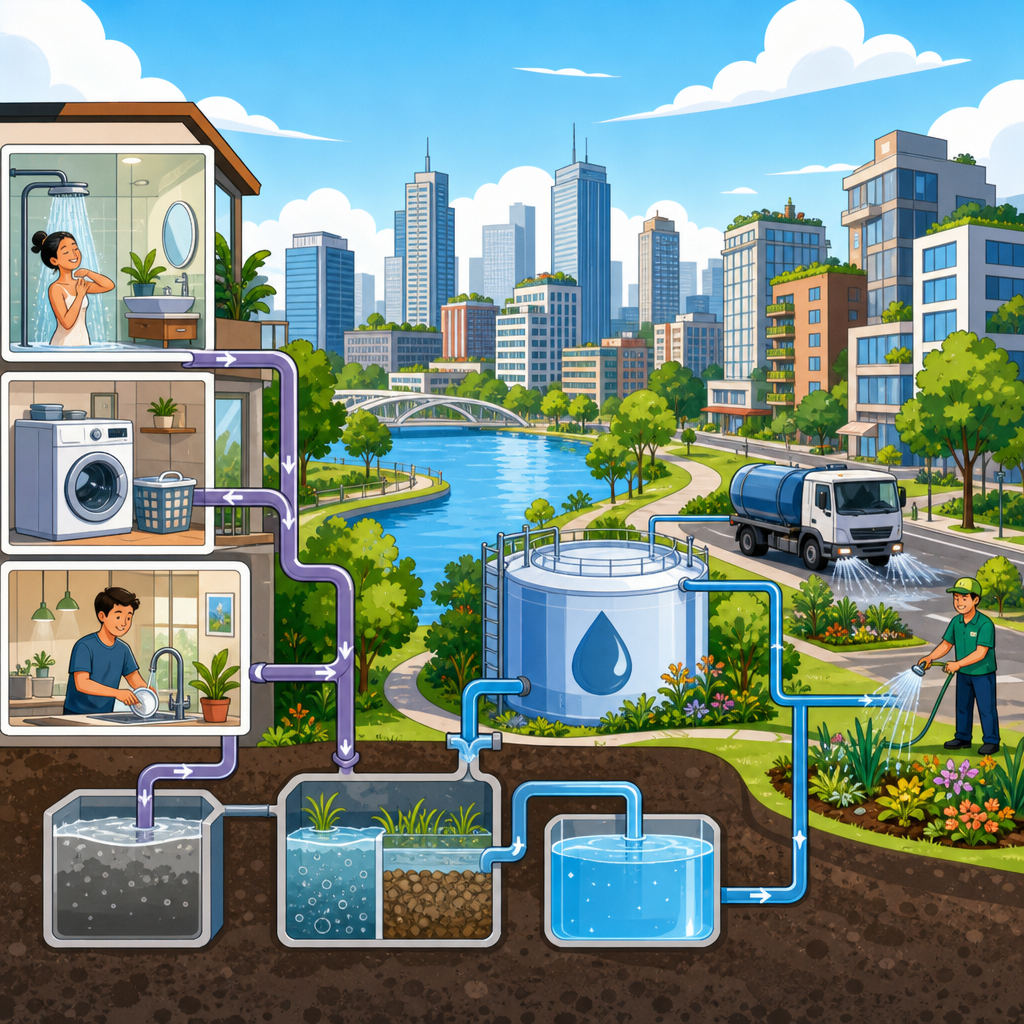
Urban water reuse covers several distinct pathways, and the differences matter. The simplest is onsite greywater reuse, where water from showers or laundry is filtered and reused for toilet flushing or subsurface irrigation. A step up is whole-building water recycling, which may capture greywater, condensate from cooling systems, foundation drainage, and sometimes blackwater for nonpotable reuse after advanced treatment. District-scale systems expand that model by aggregating flows from multiple buildings, improving treatment efficiency through larger volumes and more stable loads. At the city level, utilities may implement recycled water networks for parks, cooling towers, factories, and street cleaning, often marked by purple pipes to distinguish nonpotable supply. Some cities also use indirect potable reuse, where highly treated wastewater is introduced into aquifers or reservoirs before drinking water treatment, and direct potable reuse, where advanced purified water is blended into potable systems under strict regulatory control. The best choice depends on density, land availability, end-use demand, local regulation, and whether dual plumbing is feasible. In dense mixed-use districts, district systems often outperform isolated building systems because operations, staffing, and monitoring are centralized.
How greywater systems work in buildings
Greywater systems are attractive because they target a reliable source and a predictable nonpotable demand. In multifamily housing, hotels, dormitories, and gyms, showers generate daily volumes that align well with toilet flushing. A typical system includes source separation piping, coarse screening, equalization storage, filtration, disinfection, controls, and a separate distribution line to approved fixtures. The treatment level must match the end use and local code, with common technologies including cartridge filters, membrane bioreactors, ultraviolet disinfection, and chlorination. The key operational challenge is variability. Laundry water may contain surfactants and lint; shower water may turn septic if stored too long; low occupancy can destabilize biological treatment. For that reason, successful systems keep retention times short, automate flushing, and include potable bypasses. San Francisco’s Non-potable Water Program accelerated this market by setting clear engineering and monitoring expectations for large buildings. In my experience, the most common design mistake is underestimating maintenance. Filters foul, tanks need cleaning, and sensors drift. Greywater is not a set-and-forget device. When maintenance contracts, alarms, and operator responsibilities are built into project budgets from day one, performance is far more reliable and public confidence is easier to sustain.
District-scale systems and why they are gaining ground
District-scale reuse systems are gaining ground because they can solve problems that building-by-building approaches cannot. A district plant can balance variable inflows across residential, office, retail, and hospitality uses, creating steadier treatment conditions and more continuous nonpotable demand. It can also justify advanced treatment trains and dedicated operators that would be too expensive for a single property. Common district applications include toilet flushing, cooling tower makeup, irrigation, decorative water features, and process water for commercial uses. These systems are especially effective in new master-planned developments, university campuses, airports, and redevelopment zones where dual piping can be installed before streets and buildings are finished. Examples often cited by practitioners include precinct-scale recycling in Sydney Olympic Park, campus reuse networks in U.S. universities, and high-rise districts in San Francisco that connect onsite treatment with neighborhood planning. District-scale systems also create governance questions. Someone must own the pipes, hold the permit, set water quality protocols, recover costs, and respond during failures. In practice, the strongest models pair utility oversight with private or quasi-public operations under enforceable service standards. That institutional design is as important as membranes, pumps, and tanks.
Treatment technologies, standards, and risk management
Water reuse succeeds when treatment is matched to risk. The framework used by regulators and engineers is straightforward: identify source water quality, define end uses, set pathogen and chemical targets, and build multiple barriers so a single failure does not create exposure. For nonpotable urban reuse, common barriers include source separation, biological treatment, membrane filtration, ultraviolet disinfection, chlorination residuals, backflow prevention, cross-connection testing, and continuous monitoring. For higher-risk applications, advanced treatment may add microfiltration, reverse osmosis, and advanced oxidation with ultraviolet light and hydrogen peroxide. International and national guidance provides the baseline. The World Health Organization has long promoted health-based targets and risk management through water safety planning. In the United States, many projects align with state recycled water criteria, NSF/ANSI standards for onsite treatment components, and local plumbing codes informed by the International Association of Plumbing and Mechanical Officials. The technology itself is mature; the challenge is operational discipline. Alarms must trigger real responses, validation testing must be documented, and emergency shutdowns must fail safe to potable backup or disposal. The public health record of well-run reuse systems is strong precisely because serious projects are engineered around redundancy, verification, and conservative operating rules.
| Reuse scale | Typical sources | Common end uses | Main advantage | Main limitation |
|---|---|---|---|---|
| Single home or building | Greywater, condensate | Toilet flushing, subsurface irrigation | Direct reduction in potable demand onsite | Higher maintenance burden per unit of water saved |
| Campus or district | Greywater, blackwater, stormwater, cooling blowdown | Flushing, cooling towers, irrigation, process uses | Operational efficiency and stable demand matching | Needs governance, permits, and dual-network planning |
| Citywide recycled water | Municipal wastewater | Parks, industry, street cleaning, large cooling loads | Large volume savings and centralized control | Distribution infrastructure can be capital intensive |
| Potable reuse | Advanced treated municipal wastewater | Drinking water supply augmentation | Drought-resilient local supply | Highest regulatory, monitoring, and communication demands |
Economics, energy, and the real tradeoffs cities face
The economics of urban water reuse are highly context dependent, which is why blanket claims are usually misleading. Reuse can be cost effective where imported water is expensive, sewer discharge fees are high, drought restrictions are frequent, or developers already face stormwater retention requirements. It can be less attractive where potable water is underpriced, energy costs are high, and retrofits require invasive plumbing work. Capital costs typically include treatment equipment, storage, pumps, controls, dual piping, and permitting. Operating costs include labor, electricity, chemicals, membrane replacement, laboratory testing, and maintenance. District-scale systems often lower unit costs by spreading staffing and monitoring across larger water volumes. However, energy use must be considered honestly. Pumping and advanced treatment consume power, and poorly designed systems can save water while increasing carbon intensity. The best projects evaluate both water and energy through lifecycle analysis. Cooling tower reuse can produce strong returns because towers are large, continuous users of nonpotable water. Irrigation-only systems are often weaker economically unless paired with stormwater compliance benefits. Pricing policy also matters. If reuse water is billed too close to potable rates, customers resist. If it is priced too low, systems may struggle to cover robust operations. Sound rate design should reflect reliability, avoided costs, and public health safeguards.
Planning, policy, and public acceptance in urban reuse programs
Planning successful reuse programs requires more than technology selection. Cities need enabling codes, clear health authority roles, inspection capacity, asset management plans, and communication that explains what water is being reused, how it is treated, and where it can safely go. Public acceptance is often framed as a psychological hurdle, but I have found that resistance usually comes from uncertainty, not ignorance. People want to know who is accountable, what standards apply, and what happens if a system fails. Transparent answers build trust. Good programs label nonpotable fixtures, require annual cross-connection testing, publish water quality summaries, and train facility staff. Policy design should also avoid locking in poor fits. In low-density suburbs with cheap water, mandatory district reuse may produce stranded assets. In dense redevelopment areas with major cooling loads and sewer constraints, the same policy can be transformative. Cities such as Singapore, Los Angeles, and Brisbane demonstrate that reuse works best when it is integrated with broader water portfolios that include efficiency, stormwater capture, leak reduction, groundwater management, and demand forecasting. Reuse is not a silver bullet, but it is one of the few urban water strategies that simultaneously addresses supply reliability, wastewater discharge, and local resilience when matched carefully to place.
Where urban water reuse is heading next
The next phase of water reuse in cities will be defined by integration and scale. More projects will combine recycled water, stormwater harvesting, green infrastructure, and building analytics rather than treating each as a separate silo. Digital controls are improving fast: online turbidity, chlorine residual, total organic carbon, and remote alarm platforms now allow operators to detect issues earlier and document compliance more effectively. Membrane bioreactors continue to dominate compact urban installations because they deliver high-quality effluent in small footprints, but hybrid systems using anaerobic treatment, heat recovery, and nutrient capture are gaining interest where utilities want broader resource recovery. Data centers, logistics hubs, and advanced manufacturing are also changing the demand side by creating concentrated nonpotable loads that can anchor district systems. At the policy level, potable reuse rules are becoming clearer in more jurisdictions, which will expand options for water-stressed regions. The practical takeaway is simple: cities should map local water flows, identify clusters of demand, compare onsite and district opportunities, and build governance early. Water reuse in cities works best when planners start with end uses, public health protection, and long-term operations instead of chasing technology for its own sake. For any city shaping a sustainable urban development strategy, now is the time to evaluate reuse pathways and turn wastewater from a disposal problem into a managed asset.
Frequently Asked Questions
What is water reuse, and how is it different from simple water conservation?
Water reuse is the practice of collecting water that has already been used once—such as wastewater, stormwater, or lightly used household water—and treating it so it can safely serve another purpose. Unlike basic conservation, which focuses on using less water in the first place, reuse is about extending the value of every gallon already brought into a city. That makes it especially important in urban areas where freshwater supplies are under pressure from population growth, drought, climate variability, and aging infrastructure.
In city systems, reuse can happen at several scales. A single building might capture greywater from showers and bathroom sinks for toilet flushing or irrigation. A neighborhood or district might run a shared non-potable network that supplies treated reclaimed water for cooling towers, landscaping, and industrial processes. At the largest scale, utilities can purify wastewater to very high standards and return it to reservoirs, aquifers, or even directly into potable water systems. The core principle is always the same: treat water to a level that matches its intended end use rather than relying on drinking-quality water for every task.
This distinction matters because many urban water demands do not require potable water. Irrigating parks, supplying decorative fountains, flushing toilets, and supporting industrial operations can often be done with non-potable reclaimed water if the treatment and distribution systems are properly designed. By matching water quality to actual need, cities can reduce stress on rivers, lakes, and groundwater while improving long-term water security.
What counts as greywater, and how is it typically used in cities and buildings?
Greywater generally refers to lightly used water from sources such as showers, bathtubs, bathroom sinks, and clothes washers. It does not usually include water from toilets, kitchen sinks, or dishwashers, because those streams contain higher levels of pathogens, grease, food waste, and organic material and are therefore treated more like blackwater or sewage. Greywater sits in an important middle ground: it is not clean enough to reuse without treatment, but it is often much easier to treat than full municipal wastewater.
In practice, greywater systems are commonly used for non-potable applications inside buildings and on surrounding landscapes. The most common uses are toilet and urinal flushing, subsurface irrigation, and in some cases cooling or other mechanical building functions. In dense urban developments, greywater can be captured on-site, treated through filtration and disinfection, and recirculated within the same property. This reduces potable water demand and can also lower wastewater discharge volumes to city sewers.
However, greywater reuse is not as simple as redirecting pipes. Water quality can change quickly, especially if it is stored too long, and treatment needs vary by local code and intended use. Designers have to consider plumbing separation, odor control, microbial risks, maintenance requirements, and user behavior, including what soaps, cleaners, and personal care products go down the drain. For that reason, successful greywater programs depend not just on technology, but also on clear regulations, building design standards, and ongoing operations management.
How do district-scale water reuse systems work?
District-scale systems collect and treat water from multiple buildings or an entire neighborhood rather than handling reuse building by building. These systems are becoming more attractive in urban planning because they can capture economies of scale while still serving local needs. Instead of each property installing its own compact treatment unit, a district may have a centralized facility that accepts wastewater, stormwater, or a combination of local sources and then distributes treated reclaimed water through a separate non-potable pipe network.
The strength of this model is flexibility. District-scale reclaimed water can be used across mixed-use developments for toilet flushing, irrigation, cooling towers, street cleaning, industrial processes, and public space maintenance. Because demand is spread across many users, the system can be designed for more consistent utilization than a single-building setup. This can improve financial viability, simplify maintenance, and make it easier to monitor treatment performance with dedicated professional operators.
District systems also fit well into broader urban resilience strategies. They can reduce reliance on centralized potable water supplies, lower loads on wastewater treatment plants, and create more redundancy during drought or emergency conditions. In some cities, district systems are paired with green infrastructure, stormwater capture, and energy recovery to create integrated resource networks. That said, they require significant coordination around land use, utility governance, public health regulation, capital investment, and long-term ownership. The technical model is proven, but successful implementation depends on institutions being able to plan and operate across property lines and over many decades.
Is reused water safe, and what treatment is needed before it can be used again?
Yes, reused water can be very safe when it is treated, monitored, and managed according to its intended purpose. Safety in water reuse is based on a “fit-for-purpose” approach, meaning the treatment level is matched to how the water will be used. Water for irrigating a median strip does not need the same treatment standard as water intended for industrial boilers, and neither is treated exactly the same as water destined for potable reuse. The key is that reuse systems are designed around risk management rather than assumption.
Treatment can include several stages, depending on the source water and end use. Common steps include screening to remove solids, biological treatment to reduce organic material, filtration to capture smaller particles, and disinfection using chlorine, ultraviolet light, ozone, or other methods to control pathogens. For advanced reuse applications—especially indirect or direct potable reuse—systems may also include membrane filtration, reverse osmosis, activated carbon, and advanced oxidation. These barriers are combined with continuous monitoring, operational controls, and regulatory oversight to ensure reliability.
Public concern often centers on health risks, and understandably so. But modern reuse systems are built around multiple safeguards, often called a multiple-barrier approach. If one treatment process underperforms, others still provide protection. Utilities and facility operators also use testing, alarms, automatic shutdown protocols, and cross-connection control to prevent reclaimed water from entering the wrong pipes. In other words, safety depends less on whether water was previously used and more on whether the treatment system, monitoring framework, and operational discipline are strong. In well-regulated programs, reused water is managed with the same seriousness as any other critical public utility.
Why are cities investing in water reuse now, and what are the biggest challenges to wider adoption?
Cities are investing in water reuse because it addresses several major urban pressures at once. It can stretch constrained water supplies, reduce dependence on imported water, improve drought resilience, lower wastewater discharges, and support growth without requiring the same level of new freshwater extraction. As climate patterns become more volatile, reuse offers something many traditional sources do not: a relatively stable local supply generated by the city itself. Wastewater continues to be produced even during dry periods, which makes it a valuable resource in long-term planning.
Reuse also aligns with the broader shift toward circular urban infrastructure. Instead of treating wastewater solely as a disposal problem, cities are increasingly viewing it as a recoverable asset that can provide water, energy, nutrients, and system flexibility. In fast-growing districts, campuses, industrial zones, and redeveloping waterfronts, reuse can be built into projects from the start. This makes it easier to create dual plumbing systems, local treatment capacity, and reliable non-potable demand. In many places, water reuse is no longer seen as a niche sustainability feature but as a strategic infrastructure investment.
The challenges, however, are real. Upfront costs can be high, especially when separate distribution pipes, storage, advanced treatment, and monitoring systems are required. Regulations may be fragmented or outdated, making approvals slow and inconsistent. Public acceptance can also be a hurdle, particularly for potable reuse, even when the science and treatment standards are strong. On top of that, utilities and developers must solve practical issues such as who owns the system, who maintains it, how rates are structured, and how demand will be balanced over time. Wider adoption depends not only on technology, but on policy reform, financing tools, public communication, and careful integration with urban planning and utility operations.