Edge computing in smart cities explained starts with a simple idea: process data near where it is created instead of sending everything to a distant cloud. In a city, that data comes from traffic cameras, air-quality sensors, water meters, parking systems, transit platforms, streetlights, public safety networks, and connected buildings. A smart city uses digital infrastructure to improve public services, reduce waste, and respond faster to changing conditions. Edge computing is the local computing layer that makes those systems practical at city scale.
The key terms are straightforward. The cloud is centralized computing in remote data centers. The edge is computing placed close to devices and users, such as inside an intersection cabinet, a transit depot, a utility substation, or a neighborhood micro data center. Latency is the delay between an event and a system response. Bandwidth is network capacity. Resilience means a service keeps working even when connectivity fails. In urban operations, these terms are not abstract. They determine whether an adaptive traffic signal changes in milliseconds, whether a leak detection system flags a burst main before severe damage, and whether emergency video analytics continue during a backhaul outage.
I have worked on connected infrastructure projects where teams originally tried to push every sensor feed to a central platform. The result was predictable: unnecessary transmission costs, delayed decisions, and security concerns from moving too much raw data across networks. When we shifted decision logic closer to the field, performance improved immediately. That is why edge computing matters in smart cities. It reduces latency, lowers bandwidth use, supports privacy by filtering or anonymizing data locally, and creates a more fault-tolerant operating model. As cities deploy more Internet of Things devices and residents expect reliable, real-time services, edge computing becomes less of an optional architecture choice and more of a core operating requirement.
It also matters economically. City budgets are constrained, and infrastructure assets last decades. A useful smart city design cannot depend on constant high-capacity connectivity or unlimited cloud processing. It must work with existing fiber, cellular, Wi-Fi, and operational technology networks while supporting phased upgrades. Edge architectures help by processing only the data that needs immediate action locally and sending summaries, events, or archival records upstream. This article explains how edge computing works in smart cities, where it delivers the most value, what technologies are involved, and what city leaders should consider before deployment.
How Edge Computing Works in Urban Infrastructure
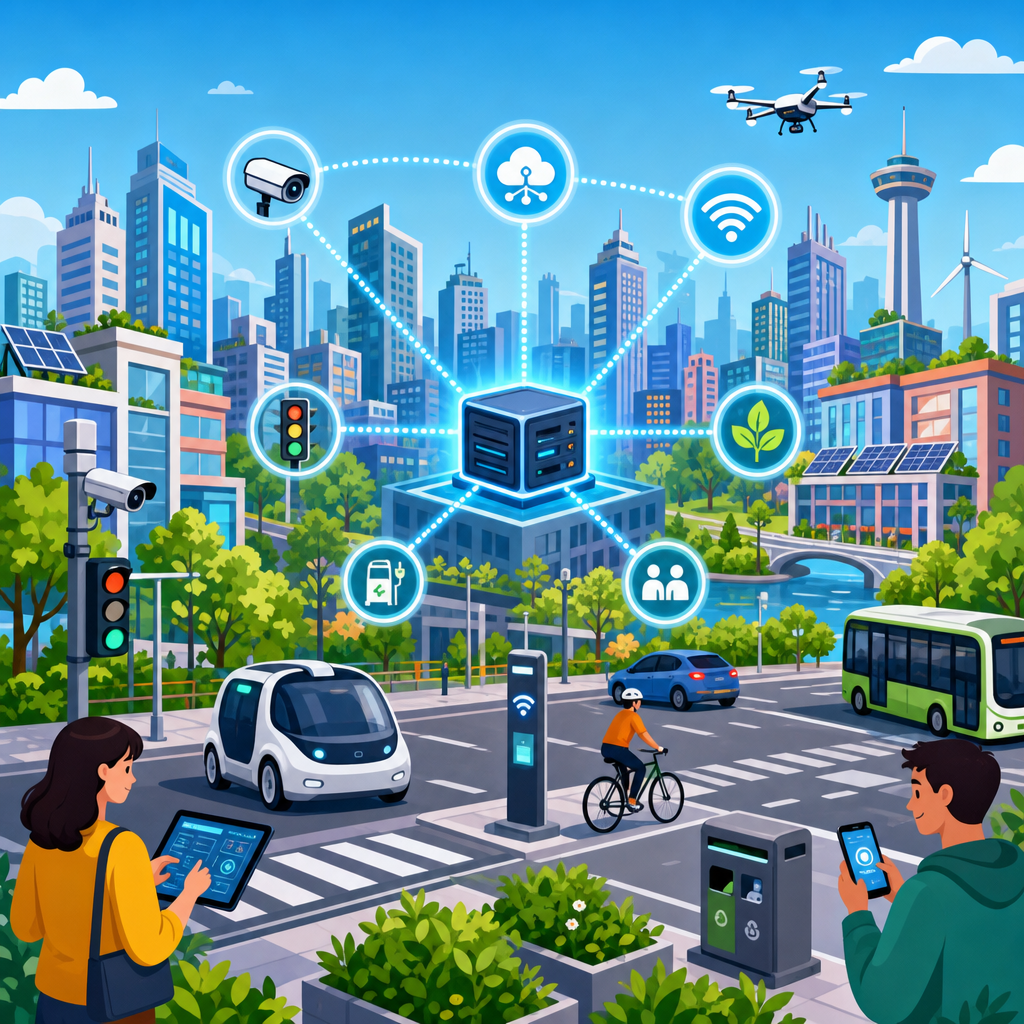
In a smart city architecture, devices collect data, edge nodes process it, and central platforms coordinate policy, long-term analytics, and storage. A device might be a camera, lidar unit, environmental sensor, smart meter, parking sensor, elevator controller, or building management system endpoint. The edge node could be an industrial PC, gateway, ruggedized server, or specialized appliance running containerized workloads. The central layer may be a cloud platform, a municipal data center, or a hybrid environment. The practical rule is simple: if a decision must happen fast, reliably, or privately, compute it near the source.
A traffic intersection is a clear example. Cameras and loop detectors detect vehicle queues, pedestrians, and signal phase timing. An edge processor running computer vision can adjust signal timing locally within seconds, even if the connection to the central traffic management platform is degraded. The city still sends metadata and performance logs upstream for planning, but it does not need to transmit every frame continuously. This pattern appears across urban systems: local inference, central oversight, and selective data synchronization.
Connectivity options vary by use case. Cities commonly use fiber for high-capacity backbone links, 5G for mobile and distributed deployments, LPWAN technologies such as LoRaWAN for low-power sensor networks, and Ethernet or fieldbus protocols inside facilities. At the edge, software often runs in containers managed with Kubernetes distributions designed for constrained environments, while message brokers such as MQTT move events efficiently. For industrial and utility contexts, standards and protocols like OPC UA, Modbus, BACnet, and DNP3 matter because edge systems must integrate with legacy operational technology rather than replace it wholesale.
Security has to be designed in from the start. In practice, that means secure boot, hardware root of trust, certificate-based identity, encrypted data in transit, role-based access control, and reliable remote patching. Zero trust principles are especially relevant because city assets are geographically dispersed and physically exposed. An unsecured roadside cabinet or building controller can become an entry point into wider municipal systems. Edge computing strengthens operations only when governance, asset inventory, and lifecycle management are taken as seriously as analytics and automation.
Where Smart Cities Use Edge Computing
Transportation is usually the first major use case because timing is critical and benefits are visible. Edge systems support adaptive traffic signals, bus priority, incident detection, curb management, parking guidance, and pedestrian safety alerts. Cities such as Pittsburgh have shown that adaptive signal control can reduce travel time and idling by dynamically adjusting phases based on live conditions. Those gains depend on local processing because road conditions change faster than a distant system can always evaluate economically at scale.
Utilities are another strong fit. Water networks use edge analytics to monitor pressure changes, acoustic patterns, and flow anomalies that indicate leaks. Electric utilities use edge devices in substations and feeders to support fault detection, voltage optimization, and distributed energy resource coordination. As rooftop solar, battery storage, and electric vehicle charging grow, grid decisions become more decentralized. Processing data only in a central control room is too slow and too bandwidth-intensive for many distribution-level events.
Public safety also benefits, but it requires careful controls. Edge video analytics can detect crowding, wrong-way vehicle movement, smoke signatures, or perimeter breaches without sending all raw footage to a central repository. That reduces backhaul load and can improve privacy when only alerts or redacted clips leave the local node. The tradeoff is governance. Cities need clear retention policies, bias testing for machine vision models, independent oversight, and procurement standards that prohibit vague claims from vendors. Good edge design supports accountability; it does not remove the need for it.
Buildings and public facilities often provide the fastest return. Schools, libraries, housing complexes, and municipal offices already have mechanical and electrical systems generating data. Edge controls can optimize HVAC scheduling, detect occupancy patterns, manage indoor air quality, and coordinate backup power. In one municipal building retrofit I observed, local analytics identified simultaneous heating and cooling across multiple zones, a common but expensive control problem. Correcting it cut energy waste without a full building system replacement.
| City Function | Typical Edge Task | Main Benefit | Example Outcome |
|---|---|---|---|
| Traffic management | Local video inference and signal control | Lower latency | Faster congestion response at intersections |
| Water networks | Pressure and acoustic anomaly detection | Reduced losses | Earlier leak identification |
| Public transit | Vehicle telemetry processing | Operational reliability | More accurate arrival predictions |
| Public safety | On-site event detection | Bandwidth and privacy gains | Alerts without constant raw video upload |
| Municipal buildings | HVAC and occupancy optimization | Energy savings | Lower utility costs and improved comfort |
Benefits, Tradeoffs, and Performance Metrics
The main benefit of edge computing in smart cities is responsiveness. Systems can act in milliseconds or seconds rather than waiting for round trips to a central platform. That matters for traffic control, safety alerts, equipment shutdowns, and microgrid balancing. The second benefit is efficiency. High-volume sensor streams, especially video, are expensive to move and store. Filtering, compressing, or summarizing data at the edge sharply reduces network and cloud costs. The third benefit is resilience. Local services can continue during intermittent connectivity, which is important during storms, construction damage, or carrier outages.
Privacy and data sovereignty are also major advantages. Cities frequently handle sensitive information, from identifiable video to occupancy patterns in public housing. Edge architectures can keep raw data within a facility or district and export only derived metrics. That design aligns well with privacy-by-design principles and with regulations that limit unnecessary data collection. It is not a complete privacy solution, but it is a materially better starting point than centralizing every feed.
There are real tradeoffs. Distributed systems are harder to manage than a single centralized platform. You may have hundreds or thousands of edge nodes across harsh environments, each needing monitoring, patching, hardware replacement, and model updates. Physical security is harder. Procurement can be fragmented if each department buys incompatible gateways. AI models can drift over time as seasons, lighting, traffic patterns, or equipment behavior change. Without disciplined MLOps and device management, an edge deployment can degrade quietly.
The best way to evaluate value is through explicit metrics. For transportation, measure queue length reduction, average travel time, incident clearance time, and signal uptime. For utilities, measure non-revenue water reduction, outage duration, transformer loading, and truck rolls avoided. For buildings, track energy use intensity, peak demand, occupant comfort complaints, and maintenance response times. For the platform itself, monitor latency, packet loss, uptime, patch compliance, and mean time to detect and recover from failures. Cities that define these metrics before procurement avoid the common mistake of buying technology without a service outcome framework.
Technology Stack, Standards, and Deployment Strategy
A practical smart city edge stack has five layers. First, sensing and control devices generate data and execute commands. Second, connectivity links devices to gateways through wired or wireless networks. Third, edge compute nodes run local applications, rules engines, databases, and AI inference. Fourth, an orchestration layer manages software deployment, observability, identity, and updates. Fifth, central platforms support dashboards, historical analysis, digital twins, and cross-department reporting. This layered model prevents lock-in because components can evolve without rewriting the entire system.
Hardware selection should match environmental and operational requirements. Roadside systems need ruggedized enclosures, wide temperature tolerance, surge protection, and redundant power options. In utility environments, compliance with sector requirements and electromagnetic resilience matters. In buildings, fanless mini servers or gateways may be enough. For AI workloads, accelerators such as NVIDIA Jetson modules, Intel processors with OpenVINO support, or Google Coral TPUs can improve inference efficiency. The right choice depends on model complexity, power budget, maintenance capacity, and expected service life.
Software choices should favor interoperability. Containers simplify updates and rollback. APIs should be documented and standards-based. Time-series databases, event streaming, and observability tools are essential because city operations generate continuous telemetry rather than occasional transactions. Digital twin platforms can add value when they are tied to operational decisions, not used as a presentation layer alone. In transportation and facilities, I have seen teams get better results from a modest edge analytics deployment with strong alerting than from an expensive visualization platform with weak integration.
Deployment strategy should begin with one outcome-focused pilot, but not a dead-end pilot. Pick a problem with measurable value, such as leak detection in a district metered area or adaptive control on a congested corridor. Establish baseline performance, define data governance, and involve operations staff from the beginning. Then design for scale: common device identity, remote management, spare parts strategy, cybersecurity controls, and procurement templates. The most successful programs create a repeatable reference architecture so each department does not reinvent connectivity, security, and data models.
What City Leaders Should Ask Before Investing
City leaders should start with service delivery questions, not vendor demos. What decision needs to happen locally, and how fast? What data must remain on-site for privacy or legal reasons? What happens when connectivity fails? Which existing systems must the new platform integrate with? Who owns lifecycle management after installation? These questions expose whether edge computing is necessary, where it should be placed, and how much operational change the city is really funding.
They should also examine governance and procurement. Contracts must specify interoperability, security patch timelines, logging access, data ownership, and model performance monitoring. Avoid architectures that require one proprietary cloud for every management task. Require support for open protocols where possible and insist on exportable data. If AI is involved, ask how models were trained, how bias was tested, how false positives will be handled, and how field performance will be recalibrated. A smart city program succeeds when operations teams trust it enough to use it daily.
Funding and staffing deserve equal attention. Capital budgets may cover devices and installation, but ongoing costs include connectivity, software subscriptions, replacement cycles, cyber insurance implications, and workforce training. In many municipalities, the limiting factor is not technology but operational capacity. A smaller deployment with strong maintenance discipline beats an ambitious rollout that cannot be supported after ribbon cutting.
Edge computing gives smart cities a practical way to turn sensor data into fast, reliable action. By processing information close to streets, buildings, vehicles, and utility assets, cities reduce latency, control bandwidth costs, improve resilience, and protect sensitive data more effectively. The strongest use cases are the ones tied to clear service outcomes: safer intersections, fewer leaks, better transit reliability, lower building energy waste, and more dependable public services during network disruptions.
The core lesson is that edge computing is not a single product. It is an architectural approach that combines local processing, secure connectivity, interoperable software, and disciplined operations. When cities define outcomes first, choose standards-based tools, and plan for lifecycle management, edge investments scale well across departments. When they chase dashboards without governance, they create fragmented systems that are expensive to maintain and hard to trust.
For city managers, planners, utilities, and infrastructure teams, the next step is simple: identify one operational problem where faster local decisions would materially improve service, then build a pilot with measurable metrics, security controls, and a path to scale. That is how edge computing in smart cities moves from concept to lasting public value.
Frequently Asked Questions
What is edge computing in a smart city, and how is it different from traditional cloud computing?
Edge computing in a smart city means processing data close to the place where it is created rather than sending all of it to a centralized cloud or data center first. In practice, that means computing can happen inside traffic cabinets, transit stations, utility substations, streetlight controllers, public safety hubs, or on local gateways connected to sensors and cameras. The goal is simple: make decisions faster, reduce unnecessary data movement, and keep essential city services running efficiently.
Traditional cloud computing is still valuable, but it usually depends on sending large amounts of data over networks to distant servers for analysis and storage. That approach works well for long-term reporting, large-scale trend analysis, and cross-department planning. However, smart city systems often need immediate action. A traffic intersection may need to adjust signal timing in seconds. A flood sensor may need to trigger an alert immediately. A public transit platform may need to detect crowding in real time. In those situations, edge computing helps because it reduces latency, lowers bandwidth demands, and allows local systems to act quickly even if connectivity to the cloud is limited or interrupted.
In most real smart city deployments, edge and cloud are not competing models. They work together. Edge devices handle urgent, location-specific processing, while the cloud supports citywide dashboards, historical analytics, machine learning model training, and longer-term storage. That hybrid model gives cities both speed and scale, which is why edge computing has become such an important part of modern urban technology strategies.
Why is edge computing important for smart city services like traffic management, utilities, and public safety?
Edge computing matters because many city operations depend on rapid, local decisions. Urban systems generate enormous amounts of data every second, and not all of that data needs to travel across wide-area networks before something useful happens. By processing information near the source, cities can respond to real-world conditions faster and more reliably. That translates into better public services, lower operating costs, and a stronger ability to manage disruptions.
In traffic management, edge systems can analyze camera feeds and sensor inputs locally to detect congestion, adjust signal timing, identify near-miss incidents, or give priority to buses and emergency vehicles. In utility systems, edge computing can help water networks detect pressure changes that suggest leaks, allow electric grids to balance loads more effectively, or support smart meters that provide near-real-time usage insights. In public safety, it can support faster incident detection, local video analytics, situational awareness, and resilient communications during emergencies.
Another major benefit is efficiency. If every camera stream, meter reading, and environmental sensor update had to be sent continuously to the cloud, network costs and storage needs would rise quickly. Edge computing filters, summarizes, and prioritizes data so that only the most important information is forwarded upstream. That reduces bandwidth use and helps city teams focus on actionable insights instead of raw data overload. Just as important, edge computing can improve service continuity. If a network link fails, local systems may still keep operating, which is essential for critical infrastructure.
What kinds of smart city applications benefit most from edge computing?
The best candidates for edge computing are applications that need low latency, local autonomy, high reliability, or efficient handling of large data volumes. Traffic control is one of the clearest examples. Intersections, adaptive signal systems, parking guidance platforms, and connected road infrastructure all benefit when data is analyzed in real time near the roadway. Waiting for centralized processing can introduce delays that reduce effectiveness.
Video-heavy applications also benefit significantly. Cameras used for traffic flow analysis, curb management, transit monitoring, or public space operations generate massive streams of data. Edge systems can run analytics locally to detect specific events, count objects, estimate occupancy, or identify anomalies, then send only metadata or alerts to central platforms. That approach is far more practical than transmitting every frame for constant remote analysis.
Environmental and infrastructure monitoring are also strong use cases. Air-quality sensors, flood detectors, smart streetlights, waste systems, water meters, and building automation systems often need immediate local logic. For example, a flood monitoring node may issue a local warning the moment conditions cross a threshold. A smart building may adjust HVAC operations based on occupancy and air conditions without waiting on a central server. Public transit can use edge computing for passenger information displays, fare systems, vehicle telemetry, and platform crowd management. In general, if a smart city application must react quickly, operate reliably, or process data at scale close to where it originates, edge computing is usually a strong fit.
How does edge computing help with data privacy, security, and resilience in smart cities?
Edge computing can strengthen privacy and security when it is designed properly because it allows cities to keep sensitive data closer to its source and reduce unnecessary transmission of raw information. For example, instead of sending continuous full-resolution video to a remote platform, an edge system may analyze the feed locally and transmit only event data, counts, or alerts. That reduces exposure and supports more privacy-conscious data handling practices. It can also help cities align technical operations with local regulations, procurement standards, and public expectations around responsible technology use.
From a security standpoint, edge computing can limit the amount of data moving across networks and make it easier to segment systems by function or location. That said, edge deployments also expand the number of devices in the field, so cities must manage them carefully. Strong identity controls, encryption, secure boot, patch management, device authentication, logging, and zero-trust architecture all matter. A well-designed edge environment is not automatically secure just because it is local; it becomes secure through disciplined governance, continuous monitoring, and clear operational standards.
Resilience is another major advantage. Smart cities cannot afford to have critical operations stop simply because a cloud service is unreachable or a backhaul connection is degraded. Edge systems can continue to make local decisions during network interruptions, which is especially important for transportation systems, utility controls, emergency response workflows, and building operations. In other words, edge computing gives cities a way to maintain essential functionality under imperfect real-world conditions. That combination of local processing, reduced exposure, and continued operation makes edge computing highly valuable for urban infrastructure.
What challenges do cities face when implementing edge computing, and what makes a deployment successful?
Implementing edge computing in a smart city is not just a technology purchase; it is a long-term operational program. One common challenge is integration. Cities often have a mix of legacy infrastructure, vendor-specific systems, and separate departmental platforms that were not originally designed to share data or support distributed computing. Bringing transportation, utilities, public safety, facilities, and IT systems into a coordinated architecture takes planning, interoperability standards, and strong procurement discipline.
Another challenge is lifecycle management. Edge devices may be deployed across hundreds or thousands of locations, from street cabinets to rooftops to underground utility sites. Each device needs power, connectivity, physical protection, software updates, performance monitoring, and security oversight. Cities also need clear policies for data retention, model updates, incident response, and maintenance responsibilities. Without a governance framework, edge infrastructure can become fragmented and difficult to scale.
Successful deployments usually share a few traits. First, they begin with a specific operational problem, such as reducing traffic congestion, improving leak detection, or optimizing energy use in public buildings. Second, they use a hybrid architecture that places time-sensitive processing at the edge while keeping cloud and central platforms for coordination, analytics, and historical insight. Third, they prioritize cybersecurity, privacy, and open standards from the beginning rather than treating them as afterthoughts. Finally, successful cities build cross-functional collaboration among IT teams, public works, transportation departments, utilities, and policy leaders. Edge computing delivers the most value when it is tied directly to measurable public outcomes: faster response times, lower waste, improved reliability, and better service for residents.