
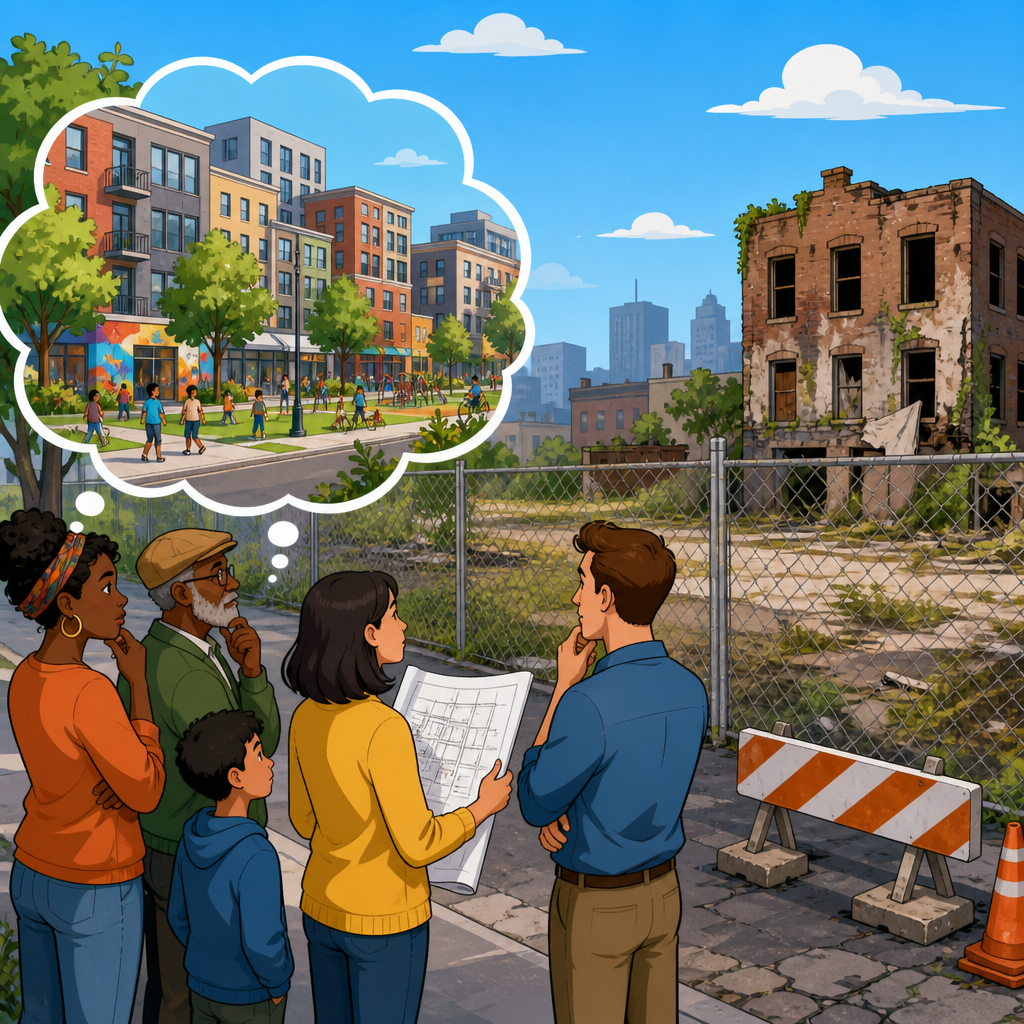
Neighborhood revitalization promises safer streets, stronger local business districts, better housing, and renewed public confidence, yet many plans remain half-finished for years. A neighborhood revitalization plan is a public or public-private strategy to improve physical infrastructure, housing conditions, economic activity, public space, and social outcomes within a defined area. In practice, it usually combines zoning changes, capital projects, incentives for development, code enforcement, environmental cleanup, and resident engagement. When people ask why some neighborhood revitalization plans stall for a decade, they are usually seeing a visible mismatch between adopted plans and delivered results.
This matters because delay changes everything. Construction costs rise, elected leadership turns over, community trust erodes, and the original market assumptions behind a redevelopment area may no longer hold. I have worked on long-range planning efforts where a corridor vision looked feasible at adoption, then became far harder after interest rates increased, federal grants shifted, or one key parcel failed to assemble. Revitalization is not a single project with one permit and one contractor. It is a chain of interdependent actions involving land control, infrastructure timing, public finance, private lenders, legal approvals, and resident buy-in. If one link fails, momentum weakens across the entire district.
Stalled plans also affect equity. Neighborhoods targeted for improvement are often places that have experienced disinvestment, environmental burdens, or weak access to jobs and services. When a city announces a plan, residents reasonably expect visible progress. If demolition occurs without replacement housing, if streetscape work starts but storefront vacancies remain, or if tax incentives benefit outsiders before existing residents see gains, skepticism hardens. That skepticism is not simply political noise; it becomes a practical obstacle to future implementation because every subsequent meeting, bond request, or rezoning starts from a lower level of trust.
Understanding why revitalization plans slow down requires looking beyond the easy explanation of “lack of funding.” Money matters, but so do sequencing, governance, land economics, procurement rules, environmental review, and market timing. The most useful way to analyze delay is to ask a direct question: what must happen, in what order, by whom, under what legal and financial constraints, for the neighborhood plan to move from concept to completed outcomes? Once that chain is clear, the causes of decade-long delay become easier to diagnose and, in some cases, prevent.
Fragmented ownership and site control problems
Many neighborhood revitalization plans assume that strategic sites can be assembled for housing, mixed-use projects, parks, or civic facilities. In reality, land assembly is often the first major bottleneck. A target corridor may include absentee owners, tax-delinquent parcels, inherited properties with title defects, contaminated former industrial lots, and active businesses that do not want to move. One missing parcel can block a needed street connection, stormwater facility, parking strategy, or development footprint. I have seen projects lose three years simply because a corner parcel remained tied up in probate while engineering relied on that exact frontage.
Site control problems are especially severe where parcels are small and ownership is fragmented. Even when a city has redevelopment authority, acquisition requires appraisal, negotiation, legal process, and funding. Eminent domain is politically sensitive and often avoided unless a project serves a clear public purpose and has strong legal footing. Meanwhile, private developers usually will not finalize financing until they know a site is fully controlled, environmentally understood, and buildable under current zoning. That creates a circular delay: land cannot be assembled without money, and money does not arrive without assembled land.
Brownfield conditions add another layer. Former dry cleaners, gas stations, machine shops, and rail-adjacent properties can trigger Phase I and Phase II environmental assessments, remediation planning, and state agency oversight. Programs from the Environmental Protection Agency and state voluntary cleanup systems can help, but they require time, technical reports, and liability management. If contamination is worse than expected, costs escalate, lenders tighten terms, and projected returns shrink. Plans that look simple on a land-use map can become highly complex once ownership and environmental reality are examined parcel by parcel.
Funding gaps, weak capital stacks, and rising costs
Most delayed revitalization efforts suffer from incomplete capital stacks rather than a total absence of money. Capital stack means the layered mix of sources needed to make a project feasible: local funds, state grants, federal grants, tax credits, bonds, philanthropy, developer equity, and senior debt. Each source has its own timing, eligibility rules, match requirements, labor standards, environmental obligations, and reporting burdens. A downtown streetscape grant may fund sidewalks but not utility relocation. A housing subsidy may require affordability covenants that reduce project revenue. Tax increment financing may be authorized, yet the increment may not be strong enough in early years to support debt.
Construction inflation has been one of the clearest reasons plans stall. Material prices, labor shortages, insurance costs, and interest rates can push a once-feasible project into a financing gap. A multifamily deal underwritten at one set of assumptions may become impossible when debt service coverage ratios tighten and appraisal values lag behind actual development cost. The same is true for public infrastructure. Water, sewer, streets, and retaining walls often cost far more than early concept estimates suggest because concept plans rarely include full geotechnical, drainage, utility conflict, or traffic control analysis.
These gaps are visible across many cities. A community development corporation may secure Low-Income Housing Tax Credits for one phase of housing but still lack gap financing for structured parking, ground-floor commercial buildout, or off-site utility upgrades. A city may win a federal RAISE or CDBG allocation for part of a corridor but not enough to address all intersections, drainage issues, and accessibility improvements. The result is partial execution: a trail gets built, but adjacent redevelopment does not follow because enabling infrastructure remained unfunded. Revitalization is delayed not because no one cares, but because the pieces do not finance at the same time.
Governance, approvals, and administrative drag
Neighborhood plans often cross multiple departments and levels of government, and that creates administrative drag. Planning, engineering, housing, economic development, public works, parks, transit agencies, school districts, utilities, state transportation departments, and regional authorities may all have a role. Each organization has its own calendar, procurement process, legal review, and performance metrics. If no single implementation manager has authority to coordinate decisions, routine actions become slow. One agency waits for design, another for right-of-way certification, another for a funding agreement, and another for council approval.
Approvals can take years even when everyone supports the plan in principle. Rezoning may require planning commission review and governing body adoption. Subdivision or plat changes may depend on utility easements. Historic districts may trigger design review. Federal funding can trigger National Environmental Policy Act review, Uniform Relocation Act obligations, Davis-Bacon wage compliance, and disadvantaged business participation goals. None of these requirements are unnecessary; they exist for legal, ethical, and public-interest reasons. But they extend timelines, especially for under-resourced municipalities that do not have experienced in-house staff managing complex implementation pipelines.
Leadership turnover compounds the problem. A mayor, city manager, redevelopment director, or council majority may change within the ten-year life of a plan. New leaders may prefer different corridors, different incentives, or different messaging. Even if the plan remains formally adopted, implementation can slow as priorities are reconsidered. I have watched well-designed small area plans lose momentum simply because the original champion left office and no one inherited the same urgency. Plans endure on paper; progress requires sustained institutional ownership.
Market mismatch and unrealistic assumptions
Some neighborhood revitalization plans stall because they were based on optimistic market assumptions. A plan may call for mixed-use buildings with ground-floor retail, but the local retail market may be too thin to support that amount of space. It may identify workforce housing demand, but rents may still be insufficient to support new construction without subsidy. It may envision a grocery store as an anchor, while operators see too little purchasing power, difficult truck access, or nearby competition. Good urban design does not automatically create a viable pro forma.
Market mismatch appears when plans import solutions from stronger districts without adapting to local demand. A successful transit-oriented development pattern in one city cannot simply be copied into a lower-density neighborhood with infrequent transit and limited job concentration. Likewise, storefront revitalization programs can improve facades without generating durable tenant demand if parking, safety perceptions, and local spending patterns are not addressed. Real estate absorption takes time, and lenders want evidence. If a district has a long history of vacancies, developers may phase cautiously, which makes transformation feel slower than residents expected.
| Common cause of delay | How it stalls the plan | Typical real-world example |
|---|---|---|
| Fragmented parcels | Prevents site assembly and coordinated design | One holdout owner blocks a mixed-use block redevelopment |
| Financing gap | Stops projects after design or predevelopment | Affordable housing wins tax credits but lacks utility funding |
| Permitting complexity | Extends review and raises soft costs | Historic review and environmental clearance delay bidding |
| Weak market demand | Developers phase slowly or walk away | Ground-floor retail remains vacant despite new apartments |
| Community distrust | Creates opposition to rezonings and land acquisition | Residents resist after earlier promises produced displacement |
Unrealistic timelines are another symptom of market mismatch. Public plans often present five-year renderings for work that realistically needs ten to fifteen years. Early wins are possible, but full buildout depends on private investment cycles, household growth, lease-up performance, and repeated public approvals. When a plan overpromises speed, every normal delay feels like failure. More careful plans distinguish between catalytic projects, enabling infrastructure, and long-term redevelopment areas, which gives decision-makers a more honest basis for measuring progress.
Community trust, displacement fears, and political conflict
Revitalization can stall when residents do not trust the process or fear displacement. In many neighborhoods, those concerns are rational. Past urban renewal programs demolished homes, split communities with highways, or transferred value away from long-term residents. If a new plan promises investment without clear anti-displacement measures, residents may oppose rezonings, land banking, tax incentives, or public-private partnerships. Opposition can be strong even among people who want better housing and safer streets, because they have seen improvement bypass existing households before.
Meaningful engagement is more than a public meeting and a concept board. Residents want to know who benefits, when benefits arrive, what protections exist for renters and homeowners, and how decisions will be enforced. Effective plans answer direct questions: Will property taxes rise? Will relocation assistance be available? How many affordable units are guaranteed, at what income bands, and for how long? Will local businesses receive technical assistance? Without clear commitments, a revitalization plan can become politically fragile. Every subsequent step then faces challenge, delay, or litigation risk.
Political conflict also emerges among stakeholders who all support revitalization in theory but disagree on method. Preservation advocates may resist demolition. Business owners may oppose construction disruption. Housing advocates may push for deeper affordability than a project can finance. Traffic engineers may prioritize vehicle throughput while planners want walkability. These conflicts are normal, but if they are not resolved early, they reappear at every approval stage. The plan stalls because no stable coalition exists to carry implementation through inevitable tradeoffs.
What keeps plans moving instead of stalling
The plans that keep moving for a decade do three things well: they sequence projects realistically, assign accountability clearly, and match ambition to delivery capacity. Sequencing means identifying near-term actions that unlock later phases, such as title cleanup, utility mapping, environmental assessments, updated zoning, and predevelopment funding. Accountability means naming a lead entity, implementation manager, and dashboard of deadlines, not just adopting a vision document. Delivery capacity means having staff, legal support, procurement competence, and experienced development partners who can execute under public constraints.
Strong implementation programs also create visible early wins. That may include facade grants, park improvements, code enforcement, traffic calming, vacant lot activation, or small-business support while larger housing or infrastructure deals are still in predevelopment. Early wins matter because they prove the plan is not just another report. At the same time, serious revitalization requires disciplined financial strategy: layered subsidies, realistic operating assumptions, contingency planning, and periodic market updates. The best plans are treated as living implementation programs, not static illustrations.
Data helps maintain momentum. Cities that track parcel status, infrastructure cost updates, grant deadlines, housing production, affordability outcomes, and tenant retention can adjust faster when assumptions change. They can also communicate honestly with residents: this block is delayed because easements are unresolved; this housing phase moved because tax credits were awarded; this commercial component was resized because leasing demand was weaker than forecast. Transparent reporting does not eliminate delay, but it reduces rumor and preserves credibility.
Neighborhood revitalization plans stall for a decade when the work is harder, more fragmented, and more conditional than the public narrative suggests. Land assembly can fail. Environmental conditions can surprise. Capital stacks can collapse under inflation or higher interest rates. Approvals can drag across agencies and election cycles. Market demand can fall short of the design vision. Residents can withhold trust when protections against displacement are vague or unenforced. None of these barriers is abstract; each has delayed real projects in cities of every size.
The central lesson is straightforward: successful revitalization depends less on the brilliance of the plan and more on the discipline of implementation. Good plans start with parcel reality, infrastructure cost truth, market evidence, and governance clarity. They separate near-term wins from long-term redevelopment, identify who is responsible for every action, and explain tradeoffs openly. They also respect community memory by pairing investment goals with concrete protections for existing residents and businesses. That combination is what turns a plan from a hopeful document into a durable program.
If you are evaluating an urban planning and policy strategy, ask tougher implementation questions early. Who controls the land? What funding is committed, not just discussed? What approvals are required? What anti-displacement tools are enforceable? What gets built first, and why? Those questions reveal whether a neighborhood revitalization plan is likely to move steadily or stall for years. Use them to read plans critically, set realistic expectations, and build redevelopment efforts that actually deliver.
Frequently Asked Questions
Why do some neighborhood revitalization plans take ten years or more to produce visible results?
Most neighborhood revitalization plans stall not because the vision is wrong, but because the work is far more complicated than the public often realizes. A typical plan is not a single project. It is a bundle of zoning updates, infrastructure upgrades, housing interventions, code enforcement, business incentives, land assembly, public safety strategies, and community engagement efforts that all need to move in some degree of coordination. If even one major piece lags, the rest can lose momentum. For example, a city may approve a new land-use framework, but if utility upgrades, street redesign, or environmental cleanup are delayed, private developers and lenders may hesitate to invest.
Funding is another major reason timelines stretch. Revitalization usually depends on multiple layers of capital, including municipal budgets, grants, tax credits, bonds, philanthropic support, and private financing. Those sources operate on different schedules and come with different rules. A plan can appear “approved” on paper while key pieces remain unfunded for years. Political turnover also matters. A new mayor, council, agency director, or state administration may change priorities, re-evaluate spending, or slow implementation while reviewing inherited commitments.
In addition, revitalization often takes place in neighborhoods that have experienced decades of disinvestment, fragmented ownership, aging infrastructure, and public mistrust. Those conditions cannot be reversed quickly. Acquiring problem properties, resolving title issues, relocating utilities, negotiating with stakeholders, and complying with environmental and procurement regulations can consume years before residents see obvious physical change. In many cases, the plan is not truly stalled in a technical sense; it is moving through a slow, uneven implementation process where visible outcomes arrive much later than the initial announcement suggested.
What are the most common obstacles that cause revitalization plans to lose momentum?
The most common obstacles are weak implementation capacity, inconsistent funding, fragmented leadership, and unrealistic expectations. Many plans begin with strong public support and polished renderings, but the real challenge starts after adoption. A plan needs a clear implementation structure: who is responsible for each action, what resources are committed, what deadlines are realistic, and how progress will be measured. When those details are vague, agencies and partners may assume someone else is in charge. That creates drift, duplication, and missed opportunities.
Land and real estate conditions also create major friction. Revitalization often depends on assembling parcels, dealing with absentee owners, addressing tax delinquency, clearing liens, or remediating contamination. These are slow, legally sensitive processes. On top of that, market conditions may not support the pace planners envisioned. A neighborhood may need investment, but developers may still see the area as too risky, especially if construction costs are high, interest rates rise, or comparable property values do not justify the project. In that environment, even generous incentives may not be enough to trigger development right away.
Community conflict can be another source of delay. Residents may support revitalization in principle but disagree about density, affordability, parking, business recruitment, demolition, historic preservation, or fears of displacement. Those concerns are not signs of failure; they are normal and important. But if engagement is handled poorly, mistrust can deepen and approvals can slow significantly. Finally, external shocks such as recessions, supply-chain disruptions, labor shortages, lawsuits, or public health emergencies can knock a plan off course. The most resilient revitalization efforts are the ones designed to absorb delays without losing the core strategy.
How do politics and government turnover affect long-term neighborhood revitalization efforts?
Politics plays a central role because revitalization is usually dependent on public decisions about land use, capital spending, incentives, enforcement, and interagency coordination. Even a well-designed plan can lose speed when elected officials or department leaders change. New administrations often want to put their own stamp on development policy, revisit prior commitments, or shift resources toward citywide priorities they consider more urgent. As a result, projects that seemed secure under one leadership team can be delayed, scaled back, or restructured under the next.
Government turnover also affects institutional memory. Revitalization plans are often implemented over many years, but staff departures can disrupt relationships, technical knowledge, and the continuity needed to manage complex projects. A neighborhood may have spent years building trust with one planning director, redevelopment authority, or community liaison, only to have those people leave. The replacement team may need time to get oriented, rebuild local relationships, and reassess assumptions. That transition period alone can slow progress considerably.
There is also the practical issue of budget competition. Long-term revitalization must compete with immediate public demands such as policing, schools, sanitation, emergency repairs, and citywide infrastructure. In tough fiscal periods, neighborhood plans that do not have locked-in funding can be pushed back. This is why durable revitalization plans often rely on more than political enthusiasm. They need formal adoption, dedicated funding streams, measurable milestones, and broad support from residents, institutions, businesses, and multiple layers of government. The more a plan is embedded in systems rather than personalities, the better its chances of surviving political change.
Can community opposition or mistrust cause a revitalization plan to stall?
Yes, and in many neighborhoods, mistrust is one of the most underestimated reasons plans slow down. Residents who have lived through broken promises, displacement pressures, selective code enforcement, or years of neglect may not automatically welcome a new revitalization agenda. They may question who the plan is really for, who will benefit first, whether affordable housing will remain, and whether existing small businesses and long-term residents will be pushed out once values rise. If those concerns are dismissed as resistance to progress, the process usually gets harder, not easier.
Community opposition tends to become strongest when engagement feels symbolic rather than meaningful. If the public sees decisions being made before meetings occur, or if officials rely on generic outreach without responding to neighborhood-specific concerns, trust erodes quickly. People may then object to rezonings, development agreements, public land transfers, or infrastructure changes not because they reject improvement, but because they do not believe the process is accountable. That can lead to appeals, organizing campaigns, political pressure, and prolonged delays.
At the same time, strong community engagement can actually prevent long-term stalling when it is done early and seriously. Plans move more effectively when residents help define priorities, identify problem properties, shape anti-displacement protections, and influence how public benefits are delivered. Trust does not eliminate disagreement, but it creates a more stable environment for implementation. In practical terms, a plan is much less likely to unravel when the neighborhood understands the tradeoffs, sees transparent reporting, and believes its concerns are changing the final decisions rather than merely being recorded.
What makes a neighborhood revitalization plan more likely to succeed instead of stalling for years?
The most successful plans translate broad goals into specific, funded, sequenced actions. That means identifying which projects can happen quickly, which ones require long-term capital, which agency or partner is responsible for each task, and what milestones the public should expect along the way. Plans that remain too conceptual often struggle because they do not create accountability. By contrast, a strong implementation framework includes timelines, cost estimates, performance measures, and contingency strategies if a major funding source falls through.
Early wins are especially important. Residents need to see evidence that the plan is real, whether that means cleaning vacant lots, improving lighting, addressing unsafe buildings, repairing sidewalks, supporting local merchants, or opening a visible public space improvement. These smaller actions do not replace larger structural investments, but they help maintain confidence while more complicated projects move through design, financing, and approvals. Without early wins, even a good plan can start to feel like another study that never turns into action.
Successful revitalization also depends on balancing physical redevelopment with affordability, resident stability, and local economic inclusion. If a plan focuses only on attracting outside investment without protecting existing households and businesses, it may face backlash or produce uneven results. Tools such as affordable housing requirements, property tax relief for vulnerable homeowners, tenant protections, small business assistance, and community benefit agreements can help keep revitalization from becoming displacement by another name. In the end, plans are less likely to stall when they are realistic about market conditions, honest about tradeoffs, backed by operational capacity, and built around long-term trust instead of short-term political momentum.


