
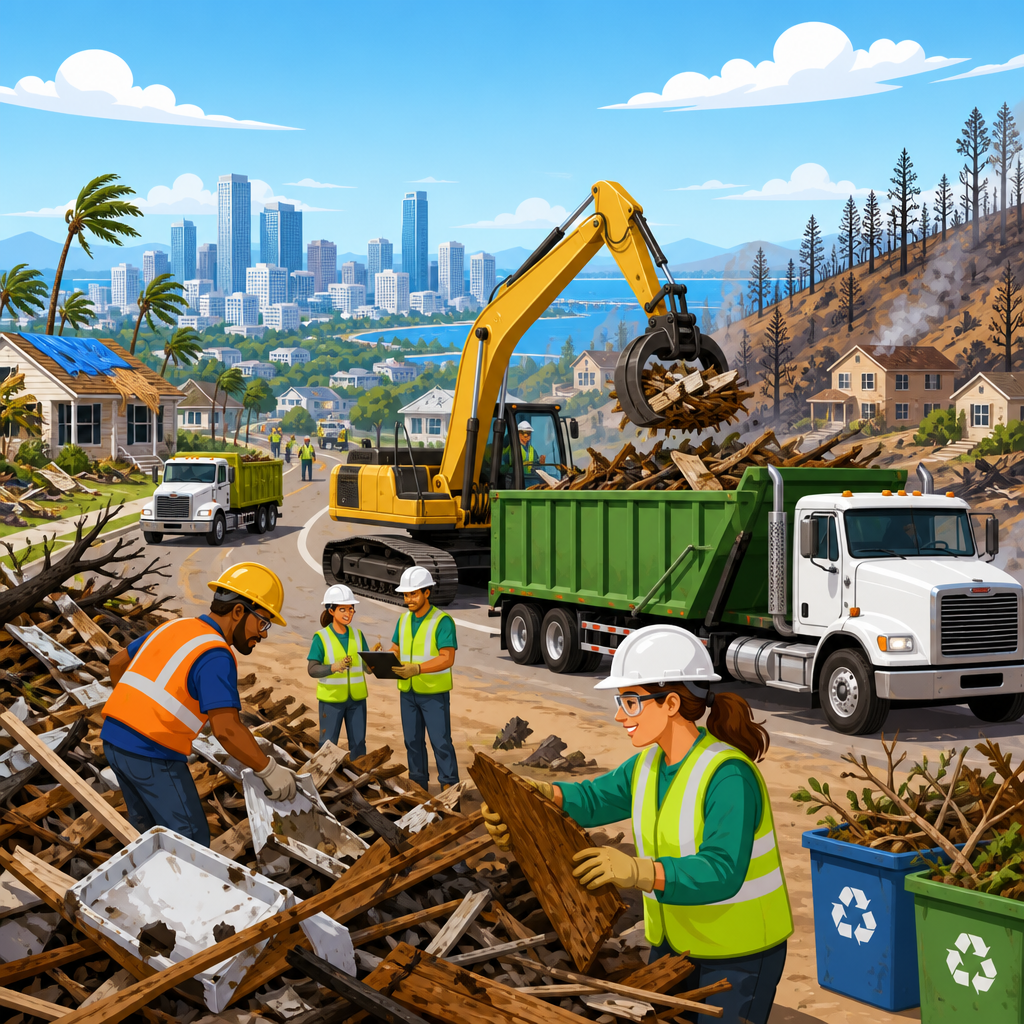
After a hurricane tears roofs from homes or a wildfire turns whole blocks into ash, the first visible sign of recovery is often debris management. Disaster debris is the mix of fallen trees, ruined furniture, shingles, drywall, vehicles, household goods, ash, concrete, and hazardous waste left behind after storms and wildfires. Cities manage disaster debris through coordinated collection, temporary storage, sorting, hazard control, recycling, contracting, and final disposal. This work matters because debris blocks roads, delays utility repair, threatens public health, raises flood risk, and can overwhelm local landfills within days. In my work reviewing municipal recovery plans, I have seen debris operations determine whether a community regains basic function in a week or struggles for months. Good systems are built before disaster strikes, but they are tested in the chaotic first seventy-two hours after impact. Residents usually notice the piles at the curb, yet the real challenge is the policy and logistics behind those piles. Local governments must classify materials correctly, document costs for reimbursement, protect workers, and communicate clear instructions to households. When they do this well, debris removal becomes more than cleanup. It becomes the backbone of emergency response, infrastructure restoration, environmental protection, and neighborhood recovery.
What counts as disaster debris and why classification comes first
Disaster debris is not one stream. Cities begin by classifying material because each category follows different handling rules, equipment needs, and disposal pathways. Vegetative debris includes trees, limbs, stumps, brush, and sometimes spoiled crops. Construction and demolition debris includes lumber, drywall, bricks, roofing, insulation, carpet, windows, and metal framing. White goods include refrigerators, air conditioners, washers, and stoves, which often require removal of refrigerants under federal clean air rules. Electronic waste includes televisions, computers, and batteries. Household hazardous waste can include paint, solvents, propane cylinders, pesticides, pool chemicals, and fuel containers. Wildfire debris adds a dangerous layer because ash may contain asbestos, lead, arsenic, and other combustion byproducts from burned structures, vehicles, and treated wood. Mixed debris is the most expensive category because it slows loading, sorting, and disposal. A city that fails to separate streams early usually pays more later in labor, landfill tipping fees, and environmental risk. Classification also drives public messaging. Residents need simple, specific directions on where to place tree limbs, appliances, and bagged ash. Without those instructions, curbside piles become contaminated, equipment cycles slow down, and contractors miss deadlines.
How cities organize the first response after a storm or wildfire
The first objective is life safety, not perfect cleanup. Public works crews, transportation departments, utilities, police, fire agencies, and contractors focus on emergency route clearance so ambulances, line crews, and supply trucks can move. Cities typically work from a debris management plan tied to the incident command system, with defined roles for operations, planning, finance, and public information. In the first operational period, crews identify priority corridors, critical facilities, and neighborhoods cut off by fallen trees or structural debris. After hurricanes, chainsaw teams and heavy equipment often clear one lane first, then return for full width access. After wildfires, structural engineers and hazardous materials specialists may inspect burned areas before widespread removal begins. Documentation starts immediately. Load tickets, truck certifications, photographs, GPS logs, and timesheets are not administrative extras; they are essential for cost control and for reimbursement through programs such as FEMA Public Assistance in the United States. I have watched cities lose eligible funding because debris quantities could not be tied to documented routes or properly monitored trucks. Early organization also includes selecting temporary debris management sites, arranging traffic control, and activating mutual aid. The jurisdictions that recover fastest are usually the ones that already prequalified contractors, mapped disposal options, and drafted public instructions before disaster season began.
Collection, temporary sites, and the logistics chain that residents rarely see
Once access routes are open, cities shift from emergency clearance to systematic collection. This phase looks simple from the curb but depends on a tight logistics chain. Debris is usually moved from neighborhoods to temporary debris management sites, sometimes called staging or reduction sites, before final disposal or recycling. These sites need enough area for truck circulation, fire breaks, environmental controls, equipment pads, stormwater protection, and separate zones for vegetative, mixed, metal, white goods, and hazardous materials. Site selection is a planning decision with real consequences. A poor location can create traffic conflicts, runoff problems, noise complaints, or community opposition. A good site reduces haul distance, supports safe sorting, and allows volume reduction through grinding or burning where permitted. Storm debris may be compacted, chipped, or mulched. Wildfire debris often requires more controlled handling, including dust suppression and sealed transport for ash and contaminated soils. Collection routes are usually scheduled by zone, with repeated passes because residents continue bringing debris to the curb for weeks. Communication is critical here. Cities need to tell residents pickup dates, separation rules, and what crews will not take, such as debris on private lots beyond the right of way unless special authority exists. When that communication is vague, illegal dumping rises and collection costs climb fast.
Storm debris and wildfire debris require different operational strategies
Storms and wildfires both generate enormous debris volumes, but the materials and risks are different enough that cities plan separately. After hurricanes and tornadoes, vegetative debris often dominates by volume. Tree crews, grapple trucks, tub grinders, and haul tractors become the backbone of operations. Flooded storms add contaminated household contents, sediment, and mold-damaged drywall. Wildfires produce less bulky vegetation in urban areas than many residents expect, but more hazardous fine material from burned structures. Ash from a single destroyed home can contain toxins from insulation, plastics, electronics, paints, and vehicle components. That changes worker protection, air monitoring, dust control, and disposal requirements. Municipalities in California, for example, often coordinate with state environmental agencies and the U.S. Army Corps of Engineers on phased wildfire cleanup, including household hazardous waste removal before ash and structural debris are cleared. Timing also differs. Storm debris removal may begin across wide areas almost immediately. Wildfire debris removal can be delayed by active fire conditions, utility hazards, unstable walls, and forensic investigations into fire origin. The best city plans recognize these distinctions in advance rather than forcing one generic debris contract to fit every hazard.
| Debris type | Typical examples | Main city priority | Common handling method |
|---|---|---|---|
| Vegetative | Tree limbs, stumps, brush | Clear roads and reduce fire or flood risk | Separate, chip, grind, mulch, or landfill |
| Construction and demolition | Drywall, lumber, shingles, brick | Restore property access and manage volume | Load, sort, recycle metals and concrete, landfill residue |
| White goods and electronics | Refrigerators, washers, televisions | Prevent refrigerant release and battery hazards | Special collection, component removal, recycling |
| Hazardous and wildfire ash | Paint, propane, asbestos-containing debris, ash | Protect health and meet disposal rules | Containerize, suppress dust, transport to approved facilities |
Public health, environmental compliance, and worker safety
Debris operations succeed only when safety and compliance are built into every step. Sharp metal, unstable piles, downed power lines, spoiled food, sewage contamination, and airborne particulates are routine hazards after storms. Wildfire cleanup adds carcinogenic dust, battery fires, and exposure to asbestos and lead from older buildings. Cities address these risks through exclusion zones, traffic control, respirator policies, personal protective equipment standards, and trained spotters at loading points and temporary sites. Dust suppression with water is common, but it must be balanced against runoff control, especially near waterways. Environmental compliance also shapes disposal decisions. Refrigerants must be recovered from appliances. Tires need separate handling. Household hazardous waste cannot simply be mixed into municipal solid waste. If asbestos is suspected, sampling and abatement rules apply before demolition or transport. Open burning of vegetative debris may be allowed in some jurisdictions but prohibited in others because of air quality standards. Monitoring contractors is therefore not optional. Municipal debris monitors check truck capacities, verify load types, inspect routes, and document reductions at temporary sites. In well-run programs, safety briefings happen daily and site conditions are logged continuously. These practices protect residents, reduce legal exposure, and preserve eligibility for state or federal aid.
Funding, contracts, and the reimbursement rules that shape city decisions
Money drives more debris policy than most residents realize. Large disasters can generate debris volumes measured in millions of cubic yards, and the bill can exceed annual public works budgets. Cities usually rely on a mix of local funds, emergency reserves, insurance, state aid, and federal disaster assistance. In the United States, FEMA Public Assistance can reimburse eligible debris removal costs, but only when procurement, monitoring, and documentation meet required standards. That means contract language matters before the disaster, not after it. Many cities maintain standby contracts for debris removal, debris monitoring, hazardous waste handling, and temporary site management. Unit-price contracts are common because they tie payment to measurable quantities such as cubic yards hauled or tons disposed. Time-and-materials contracts may be used briefly in the immediate emergency phase, but they require tighter justification and oversight. Competitive procurement, clear scopes of work, truck certification, and independent monitoring are basic controls against overbilling. I have seen strong finance teams save millions by reconciling load tickets daily and flagging impossible haul cycles. Cities also weigh recycling value, landfill availability, and haul distance because disposal choices affect both cost and schedule. Sound debris finance is not glamorous, but it is one of the clearest predictors of a credible recovery program.
Communication with residents can accelerate or derail cleanup
Even the best debris plan fails if residents do not know what to do. Cities need repeated, plain-language instructions across websites, text alerts, social media, local radio, multilingual flyers, and community groups. The most useful messages answer practical questions directly: where to place debris, how far from mailboxes and hydrants, whether bagging is required, what happens to spoiled food, how appliances should be prepared, whether ash should be wetted or sealed, and when crews will make first and final passes. Visual examples help, but precision matters more. If a city says separate debris, it should specify categories and whether mixed piles will be skipped. If private property removal is limited, that boundary should be explained early to avoid frustration. Trust also depends on realistic timelines. Overpromising a two-week cleanup when utility restoration will take a month damages credibility and increases political pressure on crews. In neighborhoods with older residents, renters, or limited internet access, cities often work through schools, faith organizations, and door-to-door outreach. Communication is part of operations, not an accessory to operations. It reduces contamination, improves route efficiency, and helps officials identify unmet needs, illegal dumping, and safety issues before they spread.
What resilient cities do before disaster season arrives
The strongest debris programs are built long before the first warning siren or red flag alert. Cities prepare by writing and updating debris management plans, mapping temporary sites, estimating debris volumes using hazard scenarios, and identifying critical routes and vulnerable facilities. They prequalify contractors, negotiate mutual aid, and review landfill and recycling capacity within realistic haul distances. Training exercises are especially valuable because they expose gaps that documents hide. A tabletop exercise can reveal whether finance staff understand load ticket controls, whether legal teams have reviewed emergency procurement authority, and whether public information officers can issue clear debris separation guidance under pressure. Communities in fire-prone areas also benefit from mitigation work that reduces later debris burdens, such as defensible space enforcement, vegetation management, ignition-resistant building standards, and utility hardening. Coastal and flood-prone cities can lower cleanup costs through tree maintenance, stormwater upgrades, and stricter construction standards in hazard zones. Recovery always starts with removal, but the quality of removal is set by preparedness. City leaders who treat debris planning as a routine administrative task usually discover, too late, that it is really a test of governance, logistics, environmental stewardship, and public trust.
Cities manage disaster debris effectively when they treat it as a full recovery system rather than a hauling problem. The essential steps are clear: classify debris correctly, open emergency routes fast, use temporary sites wisely, apply different strategies for storms and wildfires, protect workers and residents, document every load, and communicate simple instructions repeatedly. The reason this matters is equally clear. Debris removal restores access, speeds utility repair, reduces health risks, limits environmental damage, and gives neighborhoods their first tangible sign that recovery has begun. The hardest part is not buying more trucks after a disaster. It is building the policies, contracts, site plans, and documentation habits that let those trucks operate safely and efficiently under pressure. In every city I have studied, the best outcomes came from preparation done months or years before the event, then executed with discipline in the first days after impact. If your community is updating its urban planning and policy priorities, put debris management near the top of the list. Review the local plan, identify gaps, and make sure the next storm or wildfire does not turn cleanup into a second disaster.
Frequently Asked Questions
What counts as disaster debris after storms and wildfires?
Disaster debris includes far more than just broken branches or damaged household items left at the curb. After storms and wildfires, cities may have to deal with a wide range of materials such as fallen trees, stumps, roofing, shingles, drywall, siding, insulation, fencing, concrete, brick, ruined furniture, appliances, electronics, mattresses, vehicles, and contaminated soil. In wildfire zones, the debris stream can also include ash, partially burned building materials, melted metals, and toxic residues created when homes, garages, and businesses burn. Household hazardous waste is another major category and may include paint, propane tanks, pesticides, cleaning chemicals, batteries, automotive fluids, and damaged fuel containers.
What makes disaster debris difficult to manage is that it is rarely clean or uniform. Materials are often mixed together, soaked, burned, mold-damaged, or contaminated by sewage, floodwater, or hazardous substances. That means cities cannot simply treat everything as ordinary trash. They must identify what can be safely collected at the curb, what must be separated for special handling, what can be recycled or reduced, and what requires secure disposal. Properly defining the debris stream is the first step in protecting public health, reopening roads, restoring utilities, and helping neighborhoods begin recovery.
How do cities actually collect and remove debris after a major disaster?
Cities usually follow a phased debris management process rather than picking up everything all at once. The first priority is emergency clearance, which focuses on opening roads for ambulances, fire crews, utility workers, and search-and-rescue teams. During this stage, public works crews or emergency contractors remove debris that blocks critical routes, intersections, bridges, hospitals, shelters, and utility access points. Once life-safety access has been restored, communities move into broader debris removal operations aimed at neighborhoods, commercial corridors, and public spaces.
To manage this work at scale, local governments often establish collection zones, publish curbside placement rules, and bring in debris monitoring teams and specialized contractors. Residents may be instructed to separate vegetative debris, construction and demolition debris, appliances, electronics, and hazardous waste into different piles so materials can be handled correctly. Trucks then haul debris to temporary debris management sites, where it may be reduced, sorted, documented, and prepared for recycling or disposal. Throughout the process, cities track volumes, routes, load tickets, and contractor performance carefully because these records are important for both operational control and possible state or federal reimbursement. In large disasters, debris removal can continue for weeks or months, depending on damage levels, weather, staffing, and available disposal capacity.
Why do cities sort disaster debris instead of sending everything straight to the landfill?
Sorting disaster debris is one of the most important parts of the recovery process because different materials carry different risks, costs, and disposal requirements. If everything is dumped together, recyclable materials are lost, hazardous items can contaminate entire loads, and landfill space is used up much faster. By separating debris into categories such as vegetative waste, construction and demolition material, metals, white goods, electronics, vehicles, and hazardous waste, cities can move each stream to the right destination safely and efficiently.
Sorting also reduces environmental harm and can lower recovery costs. Vegetative debris may be chipped, ground, composted, or used as biomass feedstock when allowed. Metals can often be recycled. Appliances can be processed after refrigerants are removed. Concrete and masonry may sometimes be crushed and reused as fill or aggregate. Hazardous materials, however, must go through controlled handling and disposal channels to avoid exposing workers, residents, and waterways to toxic substances. In wildfire recovery especially, ash and debris can contain asbestos, lead, heavy metals, and chemical residues from burned household products and building materials. Careful sorting helps prevent these contaminants from spreading while preserving disposal capacity for the materials that truly have no other option.
How do cities handle hazardous waste and ash after a wildfire or severe storm?
Hazardous waste requires special procedures because it poses direct risks to sanitation workers, contractors, residents, pets, soil, air, and water. After severe storms, cities may encounter leaking fuel containers, household chemicals, propane tanks, batteries, pesticides, and damaged industrial materials. After wildfires, the danger often increases because burned structures can leave behind ash and debris contaminated with asbestos, lead-based paint residue, treated wood byproducts, solvents, melted electronics, and other toxic compounds. Cities typically do not want residents placing these materials into standard debris piles because that can create safety problems during loading, transport, and disposal.
Instead, local governments usually coordinate with environmental agencies, hazardous materials teams, and licensed disposal firms to identify, isolate, package, transport, and document these wastes. They may establish drop-off points, special collection days, or dedicated cleanup programs for affected neighborhoods. In heavily burned areas, crews may use dust-control measures, protective equipment, and strict handling protocols to reduce airborne exposure. Residents are often advised not to sift through ash unnecessarily and to follow official guidance before disturbing burned properties. The goal is to prevent toxic materials from entering storm drains, waterways, or ordinary landfills and to make sure debris removal does not create a second public health emergency during recovery.
Who pays for disaster debris removal, and why does the process sometimes take so long?
Disaster debris removal is expensive because it involves labor, heavy equipment, fuel, monitoring, hauling, site management, environmental compliance, and disposal or recycling fees. In many cases, local governments pay upfront using municipal funds, emergency reserves, or contracted services, then seek reimbursement from state or federal disaster programs when those programs are activated. Eligibility often depends on strict rules about what debris qualifies, where it was collected, how it was documented, and whether procurement and monitoring procedures were followed correctly. That is why cities spend so much effort on contracts, load tracking, inspection, and recordkeeping during cleanup operations.
As for timing, debris removal can take longer than residents expect because the work is highly regulated and logistically complex. Cities must assess damage, prioritize life-safety routes, secure contractors, communicate sorting instructions, set up temporary staging sites, coordinate with utilities, manage traffic, protect waterways, and ensure hazardous materials are handled properly. Disposal sites and landfills may also have limited capacity, especially if several communities are hit at once. Weather, legal restrictions, environmental testing, and insurance questions can add even more delays. While the pace can feel frustrating, a careful debris management process helps cities protect public health, control costs, reduce environmental damage, and support a safer, more organized recovery.


